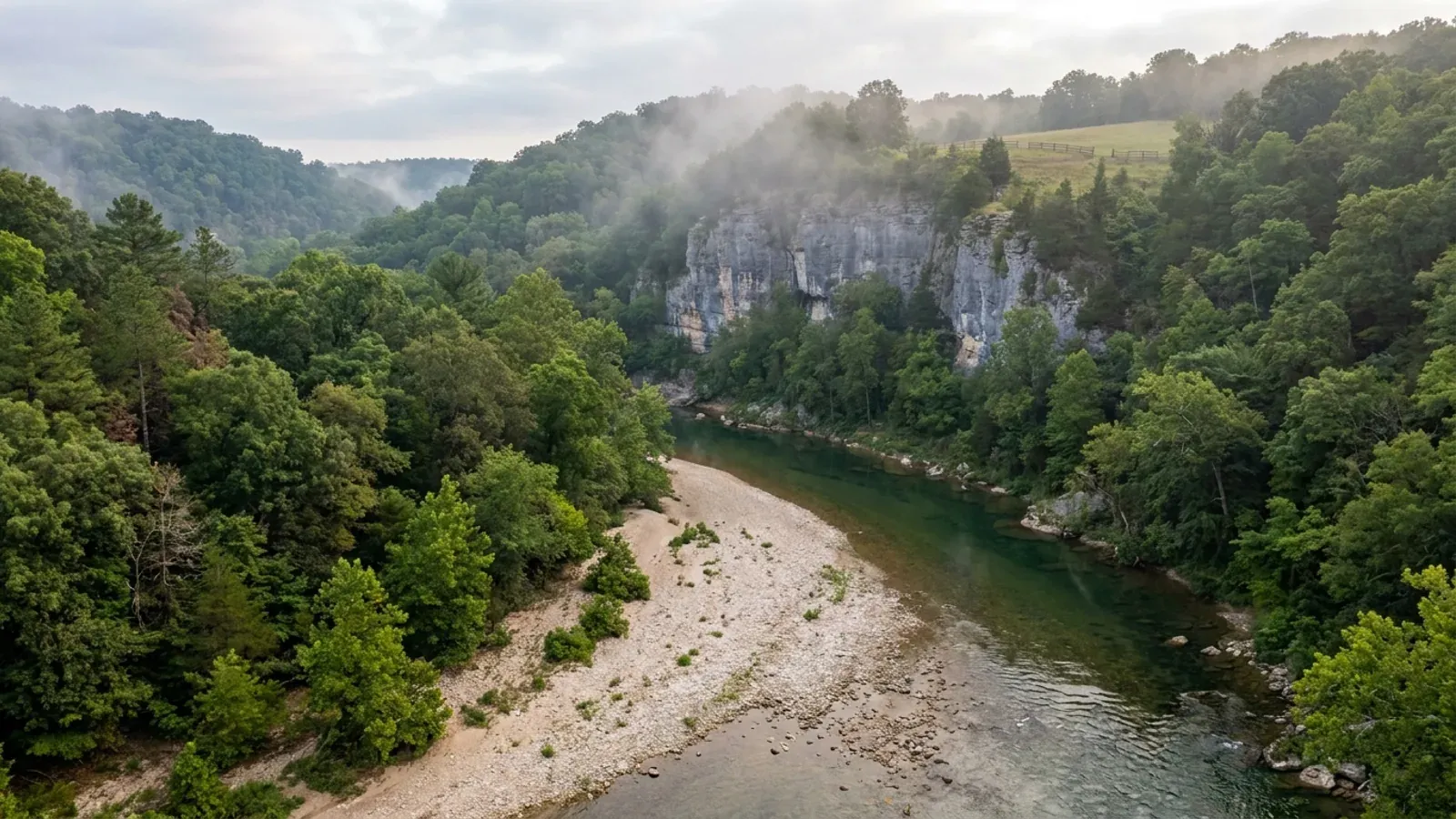
Barndominium Builders in Texas County, MO
Texas County is the largest county in Missouri by land area — 1,177.267 square miles, about 173 square miles more than second-place Shannon — and it carries 407,913 acres in farms across 1,309 farms at a 312-acre average, on a resident population of 25,715. It is a third-classification county, and that one word settles the question most buyers ask first: RSMo 64.170 empowers only counties of the first and second classification to adopt a building code, and RSMo 64.205 says in a single sentence that those provisions apply to first- and second-class counties. So there is no county building code here, and the county has no legal authority to create one — that is a different and much more permanent answer than a county that could adopt a code and simply has not. What the county does have is a septic gate with real teeth. The Department of Health and Senior Services records Texas County as a Local Authority via Ordinance, so the Texas County Health Department permits on-site wastewater under the county's own ordinance rather than under the state programme, and the department's own published answer to how a system gets sized begins with a soil morphology report rather than a percolation test. Seventeen elected township boards, not a county highway department, maintain the gravel outside the city limits, and 17,460 of the county's 25,715 residents live in that unincorporated balance.
Texas County at a glance
- County
- Texas County
- Population
- 25,715
- ZIP codes
- 65444, 65464, 65468, 65483, 65484, 65542, 65552, 65555, 65557, 65564, 65570, 65571, 65589, 65689
- Site visits
- First site visits anywhere in the county's 1,177 square miles, usually within the week
Building conditions in Texas County
Missouri sets no residential building code and no statewide way of adopting one, so the first question on any parcel is not what the code says — it is whether there is one. Only counties of the first and second classification may adopt a building code at all, and classification is set by assessed valuation rather than population, so a small county can hold the power while a much larger one does not. Zoning is a separate power with its own answer, granted only after a vote of the people and repealable by another. What changes from one jurisdiction to the next is whether the work is inspected, who issues the permit, what that office charges, how the parcel is zoned, and the design figures your drawings have to satisfy.
RSMo 64.170 (effective 28 Aug 2008) and RSMo 64.205 (effective 28 Aug 1963), rendered from revisor.mo.gov/main/OneSection.aspx 6 Sep 2026 — a deliberately bogus section on that host returns a 302 redirect rather than a statute page; Missouri Association of Counties, "Missouri Counties by Classification", published May 2025, mocounties.com/s/Missouri-Counties-by-Classification-2025.pdf, downloaded and text-extracted 6 Sep 2026; RSMo 48.020 (effective 28 Aug 2026); Missouri Department of Economic Development, "County Building Codes for Missouri", data.mo.gov dataset iq7s-izvt, FIPS 215 row queried 6 Sep 2026 (dataset last updated 11 Aug 2021)
RSMo 64.170 and 64.205 (no county building-code authority); RSMo 701.046 and 701.031 (on-site sewage, rendered 6 Sep 2026); FEMA Community Status Book Report for Missouri, fema.gov/cis/MO.html, report dated 09/06/2026 and downloaded that day; MoDOT Engineering Policy Guide Category 941 "Permits and Access Requests", epg.modot.org, fetched 6 Sep 2026 — a bogus category on that host returns a genuine 404; Texas County, Missouri, Townships page (township road and bridge responsibility), Internet Archive capture 7 Dec 2025
Missouri Department of Health and Senior Services, OWTS Construction Permit Process, county selector set to this county, health.mo.gov/business-professionals/onsite-wastewater-treatment/owts-construction-permit-process, rendered in a browser 6 Sep 2026 — a bogus value on the same county parameter returns zero rows; Texas County Health Department, Sewage Disposal FAQ, texascountyhealth.org/sewage-disposal, fetched 6 Sep 2026 (bogus path on that host returns a genuine 404); RSMo 701.031 (effective 28 Aug 2005) and RSMo 701.047, rendered from revisor.mo.gov 6 Sep 2026
U.S. Census Bureau, 2024 Gazetteer Files, counties record, ALAND_SQMI for GEOID 29215 (and 29203 for the comparison), downloaded from www2.census.gov 6 Sep 2026 — a bogus filename on that host returns "U.S. Census Bureau: Page not found"; USDA NASS, 2022 Census of Agriculture County Profile, Texas County, Missouri, cp29215.pdf, downloaded and text-extracted 6 Sep 2026 (a bogus county number on the same path returns HTTP 404)
Texas County, Missouri, Townships page, texascountymissouri.gov/government/townships/, read from the Internet Archive capture of 7 Dec 2025 (the live host serves a bot-detection interstitial and is therefore not cited directly; a bogus URL returns no archived snapshot); U.S. Census Bureau, Vintage 2024 Subcounty Population Estimates, sub-est2024.csv, "Balance of Texas County" and county total, downloaded 6 Sep 2026
City of Houston, Missouri, "Building Permit and Certificate of Occupancy" form, houstonmo.org/wp-content/uploads/BUILDING-PERMIT.pdf, downloaded and text-extracted 6 Sep 2026 (a bogus path on that host returns a genuine 404); RSMo 89.020 as summarised in research/statewide/code-regime.md §4f from the section rendered 5 Sep 2026; U.S. Census Bureau, Vintage 2024 Subcounty Population Estimates, county-part records for county 215
Also worth knowing before you build in Texas County
- Zoning is a separate power from a building code, and it has its own answer here
- A third-classification county cannot have a building code, but it CAN have zoning: RSMo 64.510 lets the commission of any second- or third-class county provide for a county plan "after approval by vote of the people of the county", and RSMo 64.530 puts the question on the ballot as "Shall county zoning (or planning) be adopted?". Texas County's own board directory lists a Texas County Planning Commission built exactly as RSMo 64.520 prescribes — one resident from the unincorporated part of each township, plus the presiding commissioner — so county planning was approved here at some point. What the directory does NOT list is a county board of zoning adjustment, which RSMo 64.660 says any county that has appointed a planning or zoning commission and adopted a zoning plan shall appoint. The county publishes no zoning ordinance, no zoning map and no zoning administrator among its departments. Note also that whichever way this stands today, RSMo 64.695 lets voters terminate the programme on a petition of five percent of the county's last gubernatorial vote — and on termination every rule made under it becomes "void and of no effect".
- The agricultural exemption is a zoning exemption, and it stops at the front door
- RSMo 64.620(2) — the exemption that applies to second- and third-class counties — does not exempt farm buildings in general. It exempts "the raising of crops, livestock, orchards, or forestry" and "the erection, maintenance, repair, alteration or extension of farm buildings or farm structures used for such purposes in an area not within the area shown on the flood hazard area map." The exemption follows the USE, and living in a building is not the raising of crops. The same section, at subsection 1, lists "residence" as one of the uses a county may regulate — agriculture and residence sit on opposite sides of the line in one sentence. Two further limits travel with it. It is an exemption from ZONING only, reaching no septic permit, no floodplain permit and no city code. And inside a mapped flood hazard area it does not apply at all — which is worth knowing here, because in FEMA's Community Status Book the only communities in this county enrolled in the National Flood Insurance Program are Cabool, Houston, Missouri and Licking; the unincorporated county appears on neither the participating nor the not-participating list, while 44 Missouri counties do participate at county level. Missouri's own tax statute draws the same line as the zoning statute: RSMo 137.017 adds the value of buildings customarily associated with farming to agricultural land value "excluding residential dwellings and related land".
- No authority publishes a design figure here, so the ground sets them instead
- There is no adopted residential code in unincorporated Texas County, so there is no Table R301.2 for anyone to fill in — no ground snow load, no design wind speed, no frost line depth, no seismic design category and no climate zone published by any authority with jurisdiction over rural land in this county. Three published figures sit near the question and none of them binds anyone here: the Missouri Public Service Commission's 2016 frost depth map, drawn for MANUFACTURED-HOME INSTALLERS, puts everything south of Interstate 44 — which is all of this county — in a 12-inch band while printing its own note that local jurisdictions may require deeper footings; the USGS seismic design service returns Ss 0.321 g, S1 0.150 g and category D at the county seat on ASCE 7-16 at Site Class D; and EPA's Map of Radon Zones places the county in Zone 2, a predicted average indoor screening level between 2 and 4 pCi/L. What actually decides a foundation here is the rock. Missouri's Department of Natural Resources publishes a statewide sinkhole layer of 16,001 points, and 484 of them fall inside this county's boundary. Map units in which Moko is a major component cover 51,199 acres of the soil survey, and the USDA series description gives Moko's depth to bedrock as 4 to 20 inches over "level bedded dolostone, fractured in the upper part", with soil-filled cracks up to 10 inches deep. Rock outcrop is a major component of map units covering another 77,681 acres, and the county's most extensive soil, Poynor, carries 25 to 60 percent chert gravel through its profile. That geology is also why the septic answer is a soil morphology report rather than a percolation test: the state on-site sewage rule treats a fast percolation rate, a drainfield within 100 feet of a sinkhole's topographic drainage, or cherty soils over shallow bedrock as reasons to require soil evaluation or a registered geologist.
- One electric cooperative, and it inspects the meter base, not the house
- Intercounty Electric Cooperative Association, based at 102 Maple Avenue in Licking, serves this county — its own service-territory page names ten counties, Texas County alongside Dent, Phelps, Crawford, Gasconade, Laclede, Maries, Pulaski, Shannon and Wright, with more than 24,000 members over 30,000 meters. Its published route to a new service is a membership application, identification, the pole numbers for the location, a deposit and a service charge, with new line construction routed to its engineering department and a staking engineer assigned by area. There is no building permit in that list, no inspection of the house and no requirement to produce a 911 address. That matters because in a county with no building department there is a widespread assumption that the utility is the backstop. In Missouri it is not: cooperative documents statewide condition any meter-base inspection on a city or county requiring one, and enforce only their own service-entrance specification. Interior wiring in unincorporated Texas County is inspected by no one.
- There is no instrument out here that could tell you what to clad a house in
- Ask whether Texas County restricts exterior materials on a dwelling and the honest answer is that the question has nowhere to land. A material rule has to sit inside something — a building code, a zoning ordinance, a subdivision regulation or a design overlay — and in the unincorporated county there is none of those. RSMo 64.170.1 empowers only "the county commission in all counties of the first and second classification", and RSMo 64.205 states the same boundary from the other side, so there is no county building code and no lawful route to one. The county's own website says the rest. Its Government menu lists Assessor, Circuit Judge, Circuit Clerk, Collector/Treasurer, Coroner, County Clerk, Commission, Emergency Management Director, Prosecuting Attorney, Public Administrator, Recorder, Sheriff and Surveyor, with no building department, no building official, no planning and zoning office and no code enforcement among them; its "Apply For" menu runs conceal carry weapons permit, county auctioneer's licence, liquor licence, marriage licence and merchant licence, with no building permit in the list. An exemption is a carve-out from a rule, and out here there is no rule to carve. Cross a city line and an authority appears, though still not a material rule. Section 5-1 of the code of the City of Houston, Missouri makes it unlawful to "build, structurally alter or construct any building, dwelling, or permanent structure, including, but not limited to a residence, commercial building, detached garage, carport, shed, barn, outbuilding, gazebo and pergola" without a permit, which the city administrator issues on a finding that the plan complies with the city's code of ordinances — and Articles III through V of that building chapter are reserved, so there is no adopted model building code standing behind the review. What the review runs against is Chapter 25, the zoning code, which covers use zones, agricultural, residential, commercial and industrial districts, bulk regulations, accessory buildings, lot coverage, landscaping, off-street parking, grading, home occupations, signs, non-conforming structures, conditional uses and fencing across twenty-four articles — and contains no design or architectural standards article at all. Its one materials clause governs fences.
RSMo 64.510 (effective 28 Aug 1963), 64.520 (28 Aug 2004), 64.530 (28 Aug 1978), 64.660 (28 Aug 1990) and 64.695 (28 Aug 1978), all rendered from revisor.mo.gov/main/OneSection.aspx 6 Sep 2026; Texas County, Missouri, Texas County Board Directory, texascountymissouri.gov/government/texas-county-board-directory/, read from the Internet Archive capture of 23 Feb 2025
RSMo 64.620 (effective 4 Mar 1991), rendered from revisor.mo.gov/main/OneSection.aspx 6 Sep 2026; RSMo 137.016 and 137.017 (effective 28 Aug 2018) as rendered and quoted in research/statewide/code-regime.md §5d, 5 Sep 2026; FEMA Community Status Book Report, Missouri, fema.gov/cis/MO.html, report dated 09/06/2026, downloaded and parsed that day — a bogus state code on the same path returns HTTP 404, and the county-level counts were derived by parsing both tables in that report
Missouri Public Service Commission, "2016 State of Missouri Frost Depth Map", psc.mo.gov/CMSInternetData/ManufacturedHousing/Installer/, band text extracted 5 Sep 2026 and recorded in research/statewide/code-regime.md §6c; USGS Seismic Design Web Service, earthquake.usgs.gov/ws/designmaps/asce7-16.json, queried 6 Sep 2026 for 37.3242 / -91.9560, Risk Category II, Site Class D (an out-of-region coordinate returns an explicit error); EPA Map of Radon Zones county spreadsheet, EPA 402/A-16/001, radon_zones-spreadsheet.xls, downloaded and parsed 6 Sep 2026, county row = Zone 2; Missouri DNR / Missouri Geological Survey sinkhole layer, gis.dnr.mo.gov/host/rest/services/geology/sinkholes/MapServer/1 — statewide count 16,001 and a point-in-polygon count of 484 against the U.S. Census TIGERweb boundary for GEOID 29215, both queried 6 Sep 2026 (a bogus object id returns a count of 0); USDA-NRCS Soil Data Access, survey area MO215, major-component acreage by map unit, queried 6 Sep 2026 (a bogus area symbol returns an empty result); USDA-NRCS Official Series Descriptions MOKO and POYNOR, soilseries.sc.egov.usda.gov, fetched 6 Sep 2026 (a bogus series returns HTTP 404); 19 CSR 20-3.060 as summarised in research/statewide/site-conditions.md §8a
Intercounty Electric Cooperative Association, Service Territory and Establish Service pages, ieca.coop/service-territory and ieca.coop/establish-service, fetched 6 Sep 2026 (a bogus path on that host returns HTTP 404); the statewide finding on cooperative meter-base inspection is documented from Cuivre River Electric Cooperative Form #UG40-7 (28 Apr 2026), Platte-Clay Electric Cooperative Engineering Rules and Regulations (Jan 2024) and Ameren Missouri's residential overhead service specification in research/statewide/code-regime.md §7c
Texas County, Missouri, Government and "How Do I? — Apply For" navigation menus, texascountymissouri.gov, read from the Internet Archive capture of 3 January 2026, the county's live host answering a real path and a deliberately bogus control path identically so that neither can be told from the other; RSMo 64.170 (effective 28 August 2008) and 64.205 (28 August 1963), rendered from revisor.mo.gov/main/OneSection.aspx on 9 September 2026, where a deliberately bogus section returns the not-found interstitial with no "Effective" line while both real sections carry one; City of Houston, Missouri Code of Ordinances Section 5-1 and Chapter 25 Zoning in full, Supplement 20, codified through Ordinance No. 2026-104 adopted 16 March 2026 with online content updated 22 May 2026, read 9 September 2026 through the Municode content service for jobId 485012 and productId 11008, the jurisdiction confirmed from the payload's own heading "CODE OF ORDINANCES OF THE CITY OF HOUSTON, MISSOURI" rather than from the URL, and a bogus node id on the same endpoint returning an honest 404
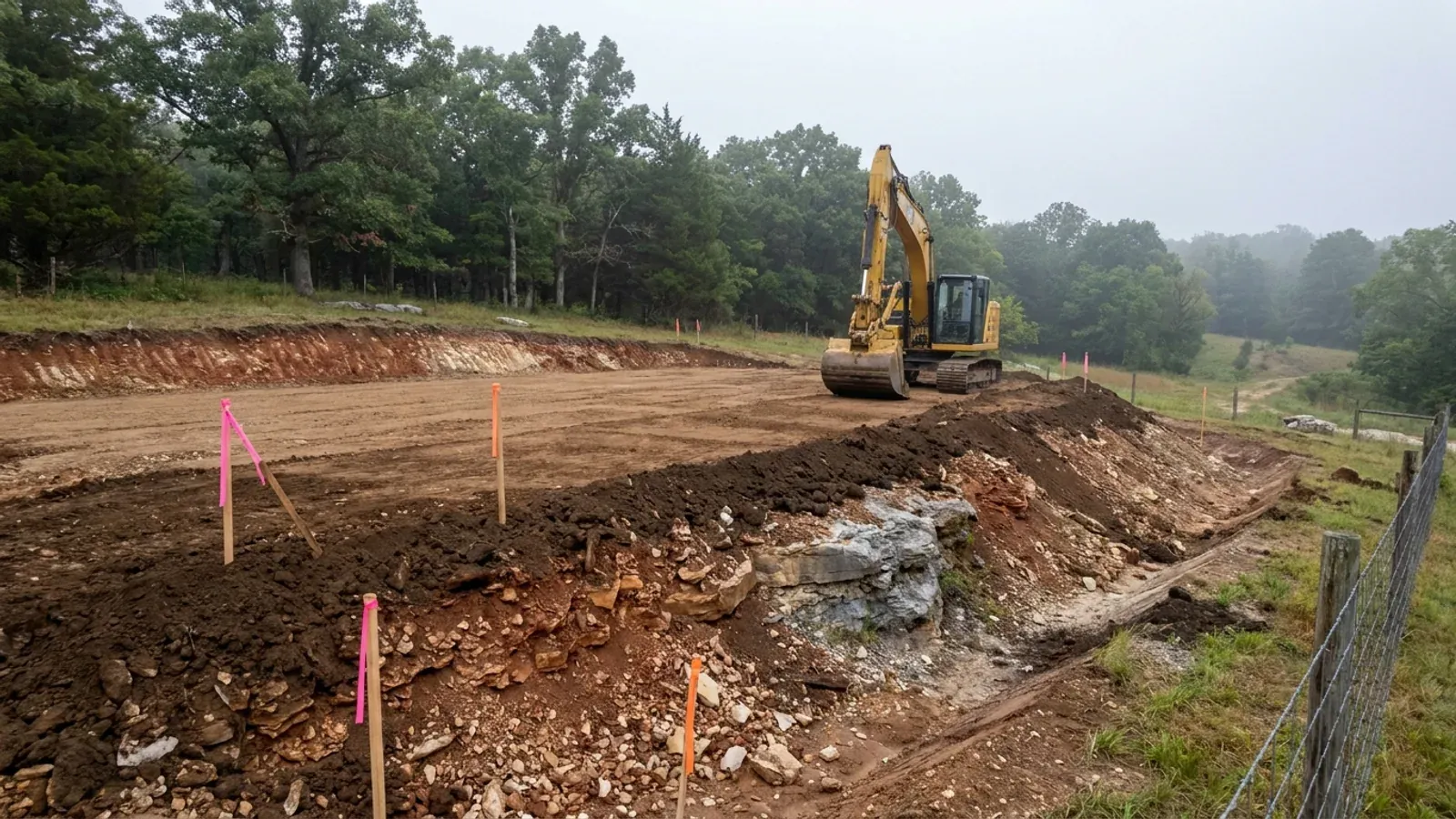
The expensive surprises are in the ground, not the building
What moves a Missouri budget is usually below grade, and which problem you have depends on where in the state you are. Across the Ozarks it is karst: the Department of Natural Resources maps more than sixteen thousand sinkhole points, and what matters there is what is under the slab rather than what the slab sits in. Across the north and centre it is claypan — dense, slow-draining subsoil that perches water above it for months of the year. In the Bootheel it is deep alluvium carrying the highest seismic demand in the state, where the same soils modelled for liquefaction attack post embedment and slab bearing rather than the frame above them. The same ground then decides the septic system, and Missouri does not run that on a percolation test alone: the rule allows a perc test or a soil morphology examination in a profile pit, and the authority reviewing your parcel picks which. Where a drainfield sits near a sinkhole's drainage, perc testing on its own is not permitted at all. Whether that authority is the state or your own county is itself a local question, and it changes what you have to file. So the site work, the foundation and the drainfield get resolved together rather than one at a time. We price the dirt before we price the building.
What we build in Texas County
All nine services are available in Texas County. What a build costs depends far more on the parcel than on square footage, so we price against your land rather than publishing a rate card.
Custom Plans
Barndominium floor plans drawn to your parcel and your soil, and to whichever Missouri authority — a county, a city, or none at all — will review them.
Barndominium Kits
Barndominium shell packages delivered to your Missouri land, drawn to the criteria your own county or city publishes — because the state publishes none.
Turnkey Builds
Start to finish barndominium construction in Missouri: the permits that genuinely apply, site work, shell and interior finish, under one contract.
What a build looks like
Three stages every Texas County project passes through, from a raw parcel to a finished home. Site work first, because that is where the budget is decided.
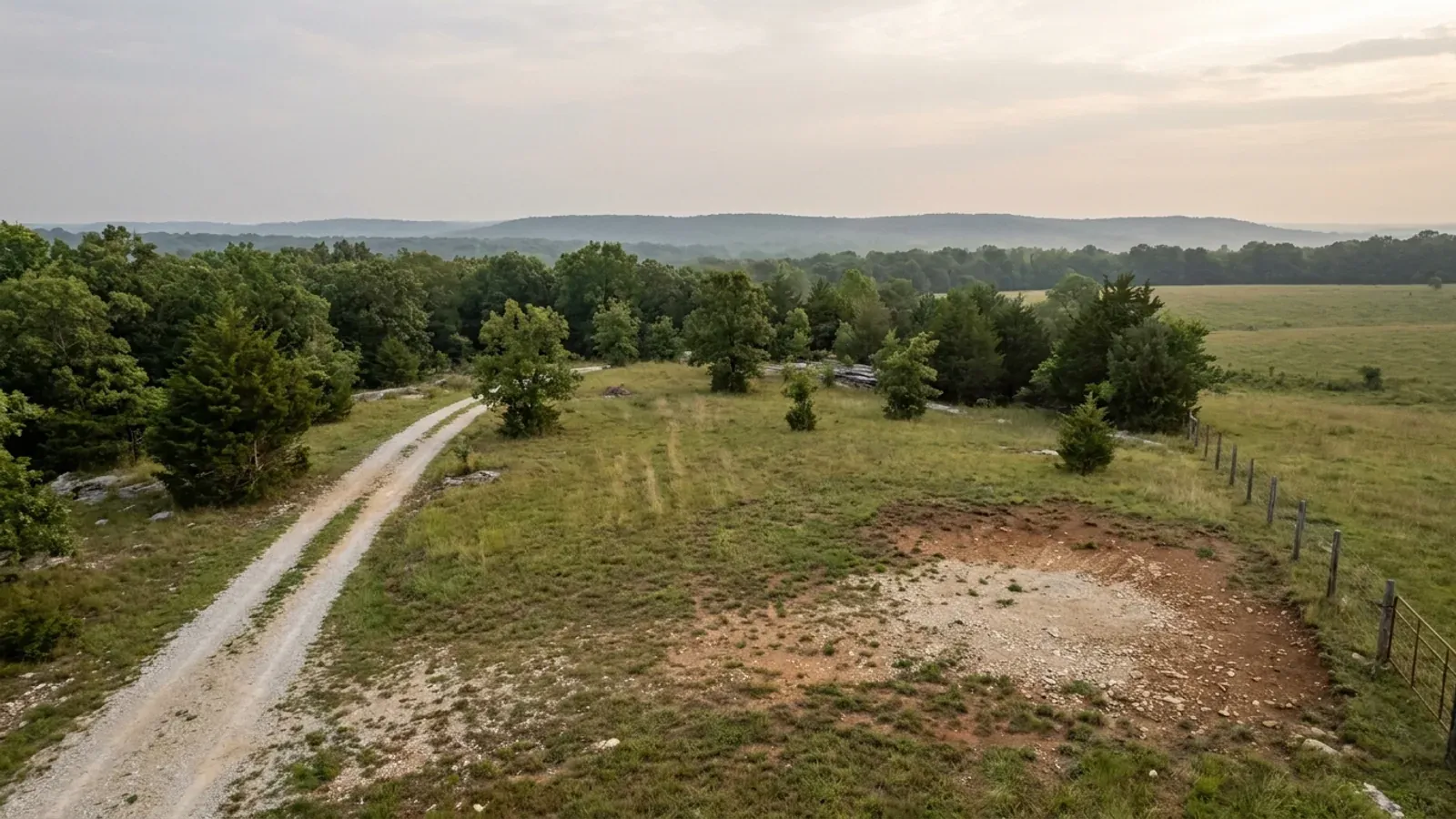
The parcel
Zoning, setbacks, flood zone and utility access get checked before anything is drawn.
Pad and permit
Clearing, grading and a compacted pad, while the submittal works through whichever office issues the permit where you are building.
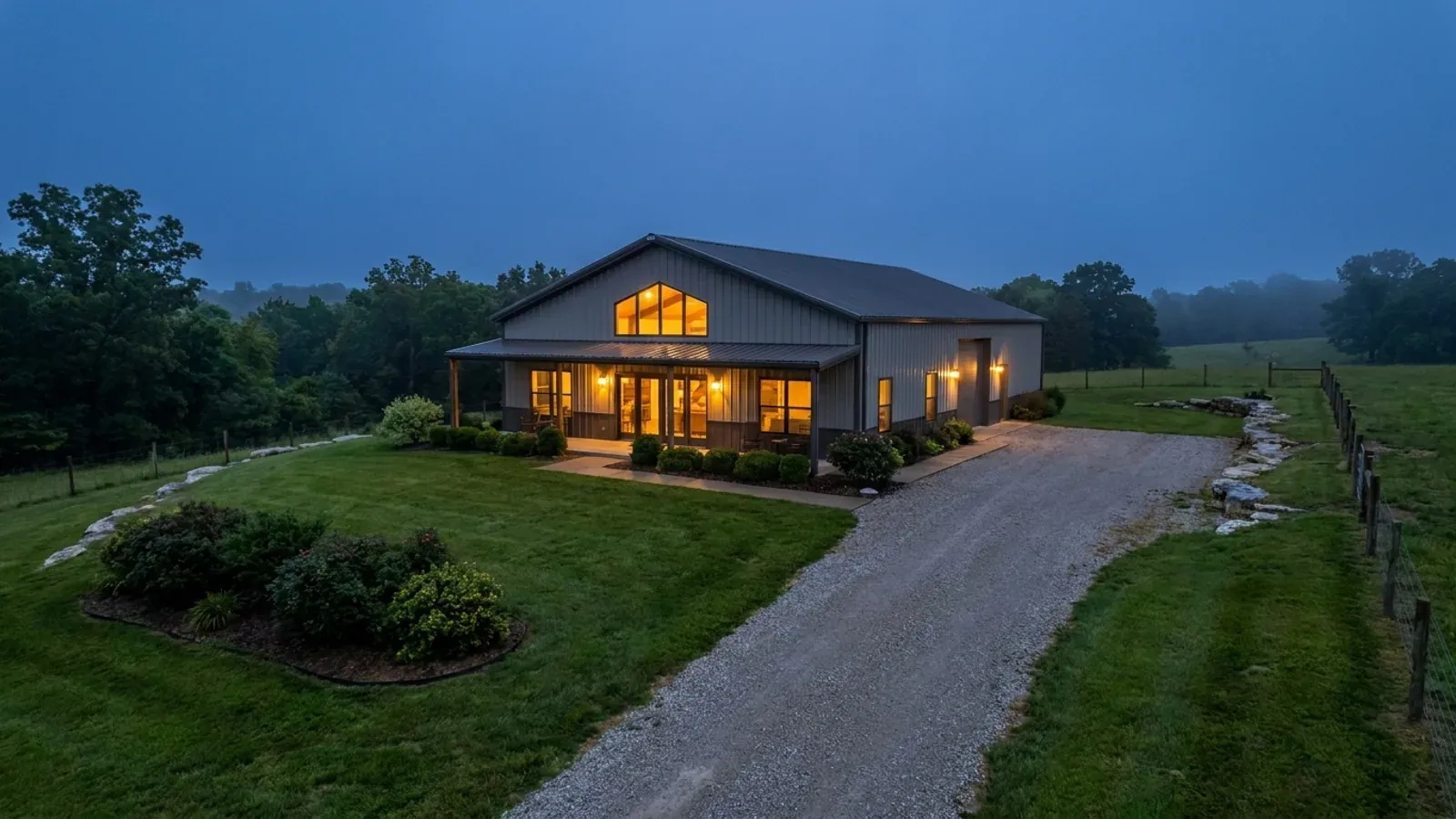
Frame to finish
Shell erected and dried in, then systems, insulation and interior finish through to CO.
Those are the rules where you are building in Texas County. Tell us what you want to build and we will draw it to them.
Where we build around Texas County
Texas County and the rural land around it. The buildable acreage for a project this size usually sits outside the city limits, which is frequently what changes who issues your permit.
Keep reading
The questions that usually come next once you know what Texas County allows.
Barndominium Cost Guide
Sourced per-square-foot ranges by tier and by size, with a calculator built on the same figures.
Read itIs It Legal in Missouri?
Classification, zoning, the HOA gate, and why "nonresidential farm building" does not cover a home.
Read itHow Long Does It Take?
Census build-duration data, and what actually sets the permit clock where you are building.
Read itNearby areas we build in
Others we cover nearby, and they are not interchangeable. One may be a county with an adopted building code, another a county with no legal authority to have one, another a city that permits inside its own limits whichever county the land sits in. So the office that issues the permit, whether anyone inspects the work at all, the fees, the zoning and the design figures can differ from one card to the next — sometimes across a single property line.
Building in Texas County: common questions
8 questions we get asked most often about building in Texas County. If yours is not on the list, ask it directly.
Does Texas County have a building code, and could it adopt one?
Then who inspects my barndominium while it is being built?
My lot is more than three acres. Doesn't that exempt me from the septic permit?
Is there county zoning, and could it appear or disappear later?
The building is agricultural. Doesn't that exempt it?
What changes if my land is inside Houston, Missouri, Licking, Cabool or Summersville?
If nobody publishes wind, snow, frost or seismic figures, what do I build to?
Who maintains the road my land is on?
Building in Texas County?
Start with the plan. Tell us what you want to build and we will draw it, then confirm which office issues the permit for your parcel, what it will let you put there, and what wind load it has to meet. That conversation costs nothing.