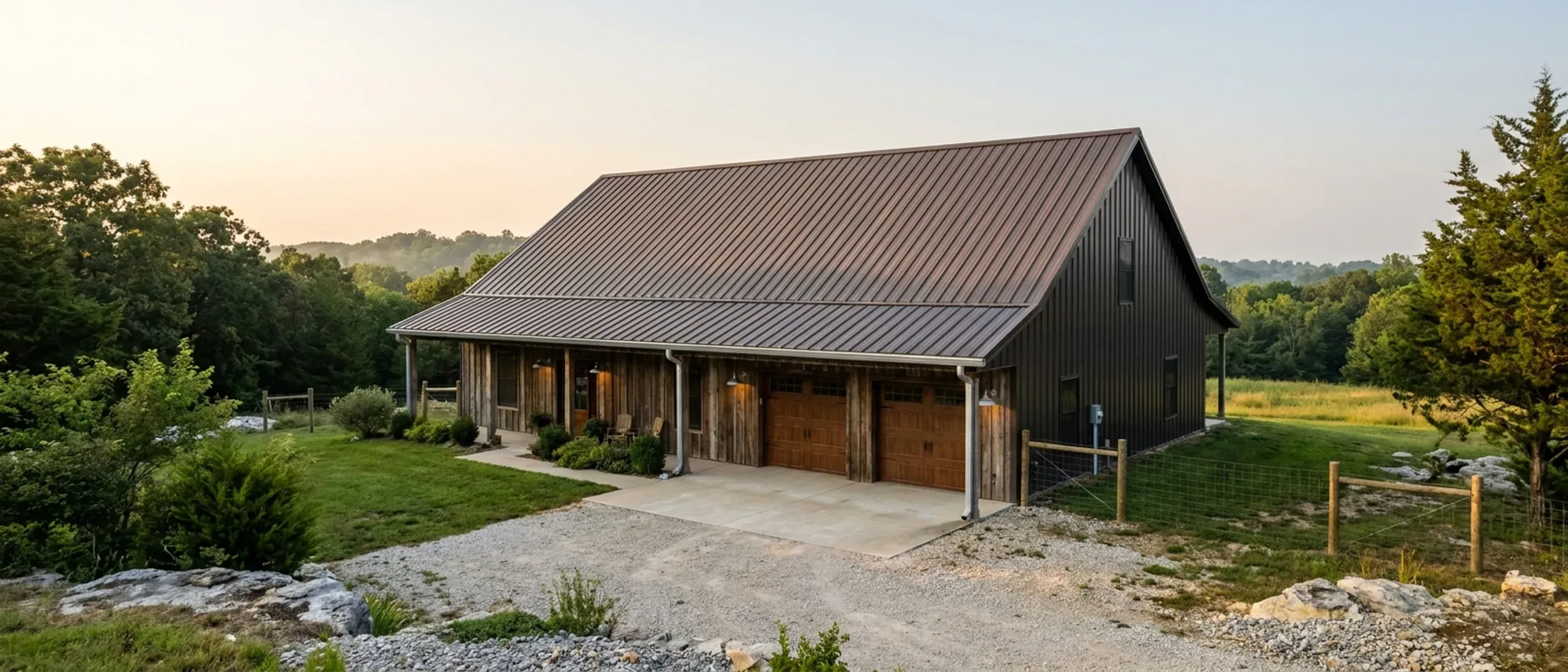
Barndominium Laws, Codes and Permits in Missouri
Every other state this company has built in hands you a single answer and then lists the exceptions. Missouri does not. There is no statewide residential building code here, no state building code council, no state building code administrator, and no statutory mechanism by which one could be adopted — Title XLI of the Revised Statutes of Missouri is literally headed "Codes and Standards" and contains exactly two chapters, on manufactured homes and on a short list of state standards covering glazing, elevators, lead, water closets and anemometer towers. Nothing about framing, foundations, wind, snow or occupancy for a dwelling. When the General Assembly legislated on fire and life safety in 2026, it wrote into the new section that nothing in it "shall be construed as creating a statewide building or fire code applicable to any occupancy not already subject to inspection by the division." A legislature only writes that sentence in a state that does not have one. So the honest shape of this page is not a list of rules. It is a decision procedure: who is legally allowed to regulate your parcel, how to find out which of them actually does, and what each of them will and will not look at. In Missouri the answer genuinely differs from one parcel to the next, and Camden County alone contains five different answers inside a single county line. What this page will never tell you is that nobody inspects. On this build that has turned out to be false three separate times, and the reason is a route almost nobody knows about.
Figures on this page are cited third-party or government data, not a quote from Missouri Barndominium Builders.
Start here: six questions that decide your build
Work through these in order. Each one is answerable in an afternoon, and together they tell you exactly who can require what. Skipping to question four because someone told you the county has no code is how people get surprised.
1. Is the land inside a city, town or village?
If it is, stop here and read that city's ordinances — the county's answer is irrelevant to you. Municipal power in Missouri is general and unconditional: RSMo 89.020(1) empowers "the legislative body of all cities, towns, and villages" to zone, with no class test and no referendum, and cities adopt building codes under their own charters and general municipal powers. This is the sharpest structural contrast inside the state. Cities may regulate as of right; counties must be the right class and win a vote. A county building code adopted under RSMo 64.180 "shall be applicable to the unincorporated territory of the county" and does not reach inside a municipality.
2. If it is unincorporated — what classification is the county, and as of when?
RSMo 64.170(1) empowers "the county commission in all counties of the first and second classification" to control construction and issue building permits, and RSMo 64.205 closes the door from the other side: sections 64.170 to 64.200 "shall apply to all counties of the first and second class." Fourth-classification counties operate under second-class law and fall inside the grant. Third-classification counties do not, and cannot. On the Missouri Association of Counties' classification list published May 2025, thirteen counties are first class, three are second, four are fourth and eighty-nine are third, out of a stated total of 114, with the remaining five operating under home rule charters. So twenty-five counties in all — the five charter counties plus the twenty in the first, second and fourth classifications — may lawfully hold a county building code. Eighty-nine may not.
3. Is it one of the five charter counties? Then classification is beside the point
Clay, Jackson, Jefferson, St. Charles and St. Louis operate under home rule charters. Mo. Const. Art. VI, § 18(a) provides that counties adopting a charter "shall be a separate class of counties outside of the classification system," and § 18(c) lets the charter vest legislative power over any municipal or political-subdivision function "in the part of the county outside incorporated cities." So their building-code authority does not come from RSMo 64.170 and citing that section at them is simply wrong. Jackson County is the clean example: Article II section 16(3) of its Constitutional Home Rule Charter gives the County Legislature power to legislate on "building construction" in the part of the county outside incorporated cities, and the county enforces the 2018 International Residential Code under Jackson County Code chapter 54 § 5400.
4. Which fire protection district covers the address?
This is the question almost nobody asks and the one that has overturned the obvious answer three times on this build. RSMo 321.220(12) lets a fire protection district board adopt fire ordinances whose standards may be "industrial codes adopted by nationally organized and recognized trade bodies," with violation a misdemeanor prosecuted by the county prosecutor, and the Revisor's own annotation cites Wellston Fire Protection Dist. v. State Bank & Trust Co., 282 S.W.2d 171 (1955), for the proposition that such a district may regulate and inspect the erection of buildings. That is Chapter 321, not Chapter 64. County classification has nothing to do with it. Ask the district by name, in writing, whether it has adopted a building or residential code — and take a clear negative as a real and useful answer.
5. Who permits your septic, and under what authority type?
This is the one construction permit that exists everywhere, and it decides whether the much-repeated three-acre exemption applies to you at all. The Missouri Department of Health and Senior Services runs a county selector on its OWTS construction permit page that resolves every county to one of three authority types: DHSS Onsite Program, Local Authority (contract), or Local Authority via Ordinance. Under DHSS or contract, the state rules and the state exclusions apply. Under an ordinance, the county's own thresholds apply and they are frequently much tougher than the state's. Run your county through the selector before you assume anything about acreage.
6. Is any part of the parcel in a mapped flood hazard area?
Flood status does not add a step so much as remove your exemptions. Missouri's farm-building zoning exemption is written to apply only "in an area not within the area shown on the flood hazard area map," so inside the mapped area it switches off entirely. The Missouri floodplain management quick guide published by the State Emergency Management Agency and FEMA lists construction of agricultural buildings among the activities requiring a local permit inside a special flood hazard area, says non-elevated agricultural structures may be permitted only by variance, and states in four words that farm houses are not agricultural structures. Pull the flood zone from the FEMA Flood Map Service Center, then check separately whether the county participates in the National Flood Insurance Program at all — seventeen counties and 146 municipalities did not, as of October 2017.
The four routes by which someone can regulate you
Missouri does not have one system with exceptions. It has four independent grants of authority, running in parallel, from three different chapters of the statutes and from the state constitution. A parcel can sit under none of them, or under three at once.
Route one — a county code under RSMo 64.170, with two locks on it
The classification test is the first lock. The second is the referendum. RSMo 64.170(2): "Any county which has not adopted a building code prior to August 28, 2001 … shall not have the authority to adopt a building code pursuant to such sections unless the authority is approved by voters," on a ballot reading "Shall ______ (insert name of county) have authority to create, adopt and impose a county building code?" Subsection 3 puts the question only to voters in the affected area, so incorporated residents do not vote on it. Christian County's chain is the fully documented example: a ballot item captioned "CHRISTIAN CO BLDG CODE" appears in the County Clerk's statement of votes cast for the special election of 7 August 2007, and the county's own Building Regulations page states that building codes were adopted in March 2008.
And a county code does not have to be current
RSMo 64.196(1) requires only that a county adopting or amending a code after 28 August 2001 adopt "a current, calendar year 1999 or later edition, nationally recognized building code, as amended." Read that precisely. It does not name the International Code Council, it sets no review cycle, it requires no state approval, and it does not require the newest edition. A Missouri county lawfully running a 2000-edition code in 2026 is in compliance. The proof is on the ground: Cass County enforces the 2006 International Residential Code alongside the 2005 National Electrical Code and its own Post Frame Building Standards under Ord. No. 08-06, while Clay County runs the 2012 International Residential Code under § 150.16 and Franklin County runs the 2021 edition. Never assume the edition. Ask for the adopting order by number.
Route two — a charter county's own charter
Covered at question three above, and worth repeating because it changes what you cite. The five charter counties draw their authority from Mo. Const. Art. VI, § 18(b) and (c) and from their own charters, and the Revisor's annotation to § 18(a) records Leiser v. City of Wildwood, 59 S.W.3d 597 (Mo. App. E.D. 2001), holding that no county can both be first classification and have a charter form of government. The practical answer for a reader is the same — these counties have building departments — but the instrument is different and so are the amendments. St. Charles County, for instance, does not adopt the IRC as such; it adopts the 2021 St. Charles County Residential Code for One- and Two-Family Dwellings under OSCCMo § 500.150.
Route three — the city, which needs no permission from anyone
Cities are where most of the state's actual code enforcement lives, and they are unconstrained by the classification system. Sikeston is in a third-classification county and enforces the 2018 International Residential Code as amended, under Sikeston Municipal Code Title V Chapter 500 Article II. Springfield adopts the 2018 IRC through Land Development Code article XIII by General Ordinance 6736, adopted 8 August 2022 and effective 1 January 2023. Osage Beach and Camdenton both moved to the 2024 IRC in 2026, by Ord. No. 26.35 of 16 April 2026 and Ord. No. 3115-26 of 7 July 2026 respectively, while Lake Ozark twelve miles away still runs the 2012 edition. City limits are a hard boundary for the county's rules and for the county's absence of rules alike.
Route four — a fire protection district, and the statute that bounds it
RSMo 321.228, effective 28 August 2012, is the limit on route four and it is worth reading closely. Where a city, town, village or county "adopts or has adopted, implements, and enforces a residential construction regulatory system," any fire protection district wholly or partly inside it is "without power, authority, or privilege to enforce or implement a residential construction regulatory system" there, and anything of that kind the district adopts "shall be treated as advisory only." Districts keep three things regardless: final regulatory authority over the location and specifications of fire hydrants, hydrant flow rates and fire lanes; the ability to inspect the alteration, enlargement, replacement or repair of a detached one- or two-family dwelling, which is not new construction; and, under subsection 3(3), no fee for either. So the district route is live only where the city or county does not itself regulate residential construction.
A district adopting the fire code is a different thing entirely
This distinction matters and it is easy to get backwards. A fire protection district adopting the International Fire Code or a fire prevention code is doing something RSMo 321.228 does not reach at all. That is ordinary, lawful and common everywhere, and it does not make the district a building department. Christian County is exactly that case: the Nixa Fire Protection District states that the 2018 International Fire Code is its adopted code and that "If you live in Christian County inside the Nixa Fire Protection District than you fall under the fire code," while the Ozark Fire Protection District has adopted Ordinance No. 2020-001, the Fire Prevention Code, and explains on its own site that "State statutes assign fire protection responsibility to Fire Protection Districts." A parcel there can sit under the county's building code and a district's fire code at the same time, with two permits and two inspectors, and neither is the other.
One county line, five answers — Camden County worked through
Camden County is first classification on 44,135 residents, because Lake of the Ozarks valuation puts it over the statutory threshold. It has never adopted a building code. If you stopped there you would conclude that nobody inspects anything in unincorporated Camden County, and you would be wrong four times over.
Inside Camdenton or Osage Beach: a city building department
Both cities permit inside their own limits under their own adopted codes and their own contractor licences. Camdenton adopted the 2024 International Building, Residential, Property Maintenance, Existing Building, Mechanical, Plumbing, Fuel Gas and Fire Codes with the 2023 National Electrical Code under Municipal Code § 500.020 and § 500.030 by Ord. No. 3115-26 of 7 July 2026. Osage Beach adopted the 2024 International Residential Code under § 500.035 and § 500.037 by Ord. No. 26.35 of 16 April 2026, and publishes a 115 mph design wind speed against Camdenton's 107 mph — both on the same edition, adopted three months apart, twelve miles apart. That is a genuine difference in adopted numbers, not a conversion artefact.
Inside Lake Ozark: the same idea, three code generations back
Lake Ozark runs the 2012 International Residential Code under Municipal Code § 500.020, by Ord. No. 2009-21 and Ord. No. 2013-37, and publishes 90 mph where Osage Beach publishes 115. Here the difference is a convention artefact and not a weather one: editions before 2012 used nominal wind speeds and later editions use ultimate speeds, and snow, seismic category and frost line are identical at 20 psf, category B and 24 inches across both towns. Anyone who presents 90 against 115 as one town being calmer than the other has misread the table. Lake Ozark also prohibits "the use of flat or corrugated sheet metal for the exterior walls or roof covering" at § 405.100.E, with standing seam excepted, alongside a 4:12 minimum roof pitch, a 12-inch eave and a 22-by-40-foot minimum dwelling.
Inside Mid-County Fire Protection District: a full plan-review programme
Mid-County Fire Protection District covers 227 square miles of central Camden County and states that it currently enforces the 2024 International Residential Code, the 2024 International Building Code, the 2024 International Fire Code and the 2023 National Electrical Code, under its own ordinances MCFPD 2025-02 through 2025-05. Its published residential requirements are a real programme: two plan sets, truss certification, a review of up to two weeks, inspections at concrete, rough-in framing, electrical and plumbing before insulation, and a final before occupancy. The district's schedule charges 18 cents per square foot of the entire enclosed structure with a $100 minimum, and $100 per day for occupying without approval. This is inside a county with no building code.
Inside Sunrise Beach Fire Protection District: the fire marshal is the building code official
Sunrise Beach Fire Protection District adopted a new Fire Prevention Code by its Ordinance #2026-01 on 16 March 2026, taking in the 2024 International Fire Code and, alongside it, the 2024 International Residential, Building, Existing Building, Mechanical, Plumbing, Fuel Gas, Property Maintenance, Swimming Pool and Spa and Energy Conservation Codes with the 2020 National Electrical Code. The ordinance provides that wherever those codes say "code official" or "building code official" it "shall be understood to mean that the Fire Marshal." Osage Beach Fire Protection District, checked on the same pass, publishes no adopted building code — a cleared district is a real finding too, and worth recording when you make the calls.
Outside all of them: a zoning permit, and only in a band around the lake
Camden County's zoning does not come from the sections most Missouri counties use. Section 101 of its Unified Land-Use Code adopts it under RSMo 64.005, a lake statute for counties bordering a lake with at least 110 miles of shoreline, approved by the county's voters in 1997. The Code defines the zoning district as a band running from not more than three-quarters of a mile to not more than three and a half miles from the 645-foot mark of the lake. Buy far enough back and there is no zoning district, no use table and no setback. The county's Planning and Zoning office issues zoning, land disturbance, special-use and conditional-use permits, not building permits, and Section 502 says a zoning permit exists to ensure compliance with setbacks, height, parking, access and utility provision. Its own construction permit sign-off sheet requires signatures from the wastewater department, road and bridge, and the fire protection district.
And a second exemption most counties do not have
RSMo 64.005.2 exempts from zoning adopted under it "any incorporated city, town or village which has adopted city planning and zoning or any agricultural or horticultural property as defined in section 137.016," and Camden's Code repeats that at Section 903(1). Section 137.016 is the property-tax definition. It is one of the very few places in Missouri law where the tax classification and the zoning exemption are wired to the same words — which is exactly the confusion the next section deals with, because the tax statute does not do what buyers hope it does.
The agricultural exemption, and the four places it stops
This is the most useful content on the site and the easiest thing in Missouri to get wrong. The exemption is real, it is worded almost identically in three places, and it does not do what a barndominium buyer wants it to do.
What the exemption actually says
RSMo 64.620(2), for second and third classification counties, provides that the section does not apply "to the raising of crops, livestock, orchards, or forestry," nor "to the erection, maintenance, repair, alteration or extension of farm buildings or farm structures used for such purposes in an area not within the area shown on the flood hazard area map." RSMo 64.890(2), for the alternative programme, repeats it word for word. RSMo 64.090(2), for first-classification charter counties, repeats it with "farm structures" alone. Note the operative words: used for such purposes. The exemption is a function of what the building is used for, not of its shape, its cladding, its span, or whether a post-frame supplier called it a barn.
Stop one — a dwelling is not the raising of crops, livestock, orchards or forestry
A barndominium is a dwelling. That is the whole product. The same statute that carries the exemption, RSMo 64.620(1), empowers the county to regulate "the location and use of buildings, structures and land for trade, industry, residence or other purposes, including areas for agriculture, forestry, and recreation." Agriculture and residence are named separately, on opposite sides of the line. The shop half of a shop-house may be a different matter, but that is a building-by-building, county-by-county question about use and it has no generic answer. Neither "farm building" nor "farm structure" is defined anywhere in RSMo Chapter 64, and no Missouri appellate decision construing the term under 64.620 was located, so treat this as what the statute says rather than as a prediction about how your county will rule.
Stop two — it switches off inside the mapped flood hazard area
The exemption applies only "in an area not within the area shown on the flood hazard area map." Inside the mapped area it does not apply at all. This makes floodplain status load-bearing for precisely the rural river-bottom acreage a Missouri barndominium buyer is most likely to be shown, and it is independently corroborated on the flood side: the state's own floodplain guidance requires local permits for agricultural buildings inside a special flood hazard area and says farm houses are not agricultural structures.
Stop three — it is an exemption from zoning, and from nothing else
These are sections of the county planning and zoning enabling acts. They say nothing about septic permits, floodplain development permits, utility requirements, well construction — or a county building code, which is adopted under the separate authority of RSMo 64.170. That distinction is worth stating twice. The building-commission group of sections, RSMo 64.170 through 64.207, contains no farm-building exemption at all, and 64.170(1) empowers regulation of "any building or structure" without qualification. The only nearby farm exemption, RSMo 64.003 effective 28 August 2025, is expressly limited to a county's "fire protection or fire prevention ordinance" and does not reach a building code. An individual county may of course write its own farm exemption into its code, and some do — Clay County allows farm buildings on five acres under Land Development Code § 151-6.3B but expressly does not allow "showers, sinks, bathrooms or human occupancy" in them. Ask; do not assume.
Stop four — even the tax statute separates the house from the farm
Buyers reason from their tax bill rather than from the zoning act, and the tax definition is the one that misleads them. RSMo 137.016(1.2) defines agricultural and horticultural property to include "buildings and structures customarily associated with farming, agricultural, and horticultural uses" — that is the clause people hear. RSMo 137.017(1) then closes it: the value of those buildings is added to the use value of the agricultural land "excluding residential dwellings and related land." And 137.016(1.1) classifies as residential property "all real property improved by a structure which is used or intended to be used for residential living by human occupants." Missouri's most farmer-friendly definition of agricultural carves out the dwelling and its site. A zoning administrator is not going to be more generous than the assessor.
And the right to farm does not override any of it
Expect this argument, because it has a real source. Mo. Const. Art. I, § 35, adopted 5 August 2014, guarantees the right of farmers and ranchers to engage in farming and ranching practices — and then says in its own text that the guarantee is "subject to duly authorized powers, if any, conferred by article VI of the Constitution of Missouri." Article VI is the local-government article: it contains the charter-county powers and the county classification system. The right to farm is expressly subordinate to county and municipal power, not superior to it. The Revisor's annotation cites Vimont v. Christian County Health Dept., 502 S.W.3d 718 (Mo. App. S.D. 2016), holding that the right-to-farm provision does not invalidate a county ordinance duly authorized under Article VI powers. And in any case it protects farming practices. Building a house is not a farming practice.
What is required where the building code is not
In a county with no building code and no zoning, a build is not ungated. It is gated by things that are not building departments, and none of them looks at your framing. Here they are in order of how much bite each one has.
Septic is the primary gate, and it is statewide
This is the single most important correction to the "nothing is required in rural Missouri" idea. RSMo 701.046, as amended effective 28 August 2026, provides that no person may construct or make a major modification or major repair to an on-site sewage disposal system "without first notifying the city, county or department" and obtaining a construction permit. The words "or department" are load-bearing: where a county runs no programme of its own, the Department of Health and Senior Services is itself the permitting authority, so there is no gap anywhere in the state. RSMo 701.050 requires notice before 9:00 a.m. on the day preceding completion, holds the system open for inspection until 3:00 p.m. on the day of completion, and requires written results within three working days. That is a real inspection, in counties that have no building department at all.
The three-acre exclusion, and the three limits on it
RSMo 701.031 excludes the owner of a single-family residence lot of three acres or more — and, on different conditions, a residential lot of ten acres or more — from sections 701.025 to 701.059 and the rules under them, provided every point of the system is more than ten feet from any adjoining property line and no effluent enters adjoining property, contaminates surface water or groundwater, or creates a nuisance. Three limits travel with it. It excludes you from the state provisions only, and RSMo 701.047 lets a county ordinance reach the same parcel and be more restrictive. The duty in the same section's opening sentence — that owners of all buildings where people live, work or assemble "shall provide for the sanitary disposal of all domestic sewage" — does not go away. And the statute carves the carve-out: "except lots adjacent to lakes operated by the Corps of Engineers or by a public utility."
So the acreage number is a floor, not an answer
Where a county has its own ordinance, the state exclusion is typically displaced, and the counties are using that hard. The Greene County programme reaches every parcel with no acreage exclusion at all, and Cass County's § 700.040 likewise applies to any unincorporated property, on a schedule charging $300. Lincoln County's ordinance, adopted 1995 and revised 1999, reaches any parcel under forty acres and charges $100 — which matters because virtually every barndominium tract falls between three and forty. Where the authority type is Contract, by contrast, the county administers the state standards, so off a lakeshore the three-acre exclusion does operate; Taney County is that case. And on any lakefront parcel the argument fails before it starts: the Camden County Wastewater Department requires a permit for residential lots adjoining Lake of the Ozarks regardless of size.
Expect a soil morphology evaluation, not a perc test
Missouri's on-site sewage rule recognises two acceptable site evaluations and the permitting authority chooses which is used. Percolation testing alone may be used only for siting and sizing standard systems in areas not classified as having significant groundwater contamination potential, and only rates between ten and sixty minutes per inch are acceptable. Soil morphology evaluation, conducted in a profile pit by a registered evaluator, is directed at sites with significant contamination potential, severe geological limitations or restrictive layers. A disposal field within one hundred feet of the topographic drainage of a sinkhole falls in the first category, which is most of the karst Ozarks; northern Missouri claypan falls in the last. Missouri registers percolation testers and on-site soil evaluators as separate professional categories. The right phrase in this state is soil morphology evaluation, or a percolation test if the local authority allows one.
The driveway, the address and the well
A new entrance onto a state route needs a MoDOT permit, requested through its electronic permitting system and governed by the MoDOT Engineering Policy Guide Category 941, which covers sight distance, traffic impact and entrance design; a residential driveway is a Type I entrance in MoDOT's taxonomy. County roads are county by county — Johnson County's Road and Bridge Department triages it usefully by sign colour, sending green numbered signs to the county for a permit and brown numbered signs to the private owners. E-911 addressing varies: Phelps County states in writing that new addressable construction needs an address assigned at the courthouse, while Adair County runs it the other way and requires the driveway and structure location to be marked before assigning one. A private domestic well needs no landowner permit at all — the permit is occupational and held by the driller, who files the well report with the Department of Natural Resources within sixty days.
And the electric utility will not backfill the inspection
The comforting idea that the utility's pre-energisation check is the de facto inspection does not hold here, and the utilities say so themselves. Cuivre River Electric Cooperative's rural residential service installation guide makes meter-base inspection conditional — "After the meter base has been inspected, if required by the city or county" — and its own jurisdiction table lists a phone number for St. Charles and Warren County planning and zoning and, against Lincoln County, the words "Not required." Platte-Clay Electric Cooperative's engineering rules state that "The Cooperative does not inspect the members' wiring for compliance with requirements of electrical codes." Missouri's own statewide electrical contractors office states that the state "will not be issuing permits nor will the state be inspecting the work performed." In a no-code county the only electrical gate is the utility's meter-base specification. Interior wiring is checked by nobody unless you arrange it.
Choosing a builder in a state with no builder licence
Missouri has no state general-contractor, residential-builder or home-improvement licence, and no board that could issue one. That makes the usual shortcut — look up the licence number — unavailable, and it makes two other things worth understanding.
What Missouri does and does not license
There is a statewide electrical contractor licence under RSMo 324.900 to 324.945, and it is optional rather than mandatory: RSMo 324.920(4) provides that a person operating in a political subdivision that does not require a local licence, or that requires one the person holds, "shall not be required to possess a statewide license." It is a reciprocity convenience. Plumbing is not statewide at all — RSMo Chapter 341's own internal divisions are headed "Cities Over 15,000" and "Counties of the First Classification," and there is no state plumbing board. There is no statewide mechanical or HVAC licence. So where a licence exists it is almost always municipal, and the thresholds are local: Kansas City requires a residential building contractor licence for a one- or two-family dwelling and for detached accessory buildings over 400 square feet, while Greene County states that its only licensing requirement in the unincorporated area is for wastewater installers.
Business licences are not competency licences, and the difference matters
Several Missouri cities require something before you may advertise or work, and it is a tax registration rather than an examination. Springfield requires a business licence of any person or company providing services or selling goods in the city, and separately tests and certifies electricians, plumbers, gas fitters and mechanical craftsmen — but has no general contractor competency licence. Columbia's equivalent is an occupation licence assessed on gross receipts, with city trade licences alongside it. The City of St. Louis runs a Construction Industry Contractor graduated business licence under Chapter 8.12A, which is a business-licence tax with no dollar or scope threshold. Independence has the fullest scheme found — Class A General, Class B Building and Class C Residential, with trades licensed separately. Asking "are you licensed here" is only a useful question once you know which of these the jurisdiction actually issues.
Three words Missouri protects, and the statute reaches advertising
RSMo 327.076.1 makes it a class A misdemeanor to practise architecture, engineering, land surveying or landscape architecture, "or [to hold] himself or herself out as able to practice such profession," without a current Missouri licence. Subsection 2 lets the board proceed against an unlicensed person who "offers to render" those services, or who "uses or advertises any title, word, figure, sign, card, advertisement, or other symbol or description tending to convey the impression that the person is licensed." So the statute expressly reaches advertisements, not just drawings. If a builder's website uses the words architect, engineer or surveyor about itself, that is a question worth asking rather than a reassurance.
But a house is exempt, and that exemption is generous
Missouri does not require a licensed professional to design an ordinary dwelling. RSMo 327.101.2(5)(a) exempts that work when it is rendered for "a dwelling house," and RSMo 327.191.2(5) mirrors the exemption on the engineering side — provided the person states on any drawings, specifications, estimates or reports that they are not licensed as such, and does not use the protected words. There is a separate exemption at 327.101.2(8) and 327.191.2(8) for buildings "used exclusively for agriculture purposes," and that is not the door a barndominium goes through: a building occupied as a dwelling is not used exclusively for agriculture. These are two different exemptions and merging them is a real error. Where a seal is genuinely required — Christian County states that all metal structures require structural and foundation engineering stamped by a Missouri engineer, and Platte County's permit packet requires sealed drawings for several permit types — that work is done by a Missouri-licensed professional engineer whom you engage for the purpose.
The one consumer protection the statutes do give you
RSMo 429.012 makes a written notice to the owner a condition of the mechanic's lien itself. Every original contractor who performs work or furnishes material for a building or improvement must give the person they contracted with — or the owner where there is no contract — a written notice carrying the prescribed "Notice to Owner" wording in ten-point bold type, before receiving payment of any kind, and at the latest with the first invoice. Subsection 2 makes compliance "a condition precedent to the creation, existence or validity" of that contractor's lien. Subsection 4 carves out new residences where the buyer has been given mechanics' and suppliers' lien protection through a Missouri-registered title insurance company. It attaches regardless of licensure, jurisdiction or contract size, and in a state with no licensing board it is one of the few statutory hooks a homeowner actually has.
And one rule that applies to every builder in the state
RSMo 67.281 requires a builder of one- or two-family dwellings or townhouses to offer the purchaser, at the purchaser's cost, the option to install fire sprinklers, on or before entering the purchase contract — and provides that no purchaser may be denied the right to choose or decline them "by any code, ordinance, rule, regulation, order, or resolution by any county or other political subdivision." No Missouri city or county may make residential sprinklers mandatory in a new one- or two-family dwelling. It is one of the very few things the state genuinely says about every house in Missouri.
Reading this because you are weighing a build? The next step is a plan drawn for your program.
What's different about Missouri
No statewide code, and no way to adopt one
This is not an oversight anyone is fixing. RSMo Title XLI, "Codes and Standards", is two chapters — Chapter 700 on manufactured homes and modular units, and Chapter 701 on state standards. Chapter 701's headings run glazing materials, on-site disposal systems, lead abatement, elevator safety, water closets, Energy Star appliances and anemometer towers. There is no chapter creating a state residential code, no council to write one, and no adoption by reference of a model code for site-built houses. A further confirmation from the state's own structure: the Missouri Division of Professional Registration's list of licensing boards contains an Electrical Contractors board and a board for architects, engineers, surveyors and landscape architects, and no board at all for general contractors, residential builders, plumbers, mechanical contractors or roofers. A state that inspected houses would have somebody to inspect them.
So there is no Missouri wind speed, snow load or frost depth either
The design criteria table in the International Residential Code is a blank the adopting jurisdiction fills in, so in Missouri it has as many answers as there are jurisdictions. Frost line depth, the single most consequential number for a post-frame foundation because it sets the depth of every post hole and pier, runs from 36 inches in the Kansas City Residential Code 2018 through 30 inches in Boone County's addendum to the 2012 International Codes, in St. Charles County's 2021 Residential Code and in Jefferson County, to 24 inches in the City of Springfield's 2018 IRC adoptive ordinance, 18 inches in Nixa and the city of Ozark, and 15 inches in Sikeston. Springfield and Nixa are twelve miles apart and publish 24 and 18. Ask the jurisdiction for its filled-in Table R301.2(1) in writing. It is one page, it settles snow, wind, frost, seismic and termite at once, and no builder's recollection of a single figure for the whole state is a substitute for it.
County class is a tax figure, and it moves
RSMo 48.020, in the version effective 28 August 2026, classifies every county by assessed valuation and by nothing else: first classification is a valuation of nine hundred million dollars and over, held for the period in RSMo 48.030; second classification runs from six hundred million up to the first-class threshold; third classification is everything below. Subsection 2 indexes those thresholds annually to the Consumer Price Index for All Urban Consumers, with the State Tax Commission publishing the amount. That is why Camden County, with 44,135 residents, holds the same statutory class as Boone County at 192,154. Class is not a proxy for size and cannot be read off a map. It is also not permanent: RSMo 48.030(3) lets a qualifying county's governing body elect first classification at any time, and the 2026 amendment to 48.020 anticipates fourth-classification movements from 1 January 2027. Every class claim needs a date on it, including the ones on this page.
The New Madrid seismic zone, and a state mandate that exempts your house
Missouri has a statutory seismic mandate with no analogue in the five states this company built in before. RSMo 319.200 to 319.207 requires a city, town, village or county notified by the state geologist and the U.S. Geological Survey as likely to experience shaking of Modified Mercalli VII or above from a New Madrid event to adopt an ordinance imposing seismic provisions, with state aid withheld from any jurisdiction that does not. The State Emergency Management Agency's 2023–2028 Missouri State Hazard Mitigation Plan puts 47 counties inside that statute. Then RSMo 319.203(2) exempts any private structure under ten thousand square feet, and any single-family or duplex residence, and subsection 3 adds that nothing in the sections requires a political subdivision to run an inspection programme. The state mandate does not reach your barndominium. Whatever local code applies does, through its own seismic provisions — and the numbers are not small. The USGS seismic design service returns a short-period value above 3 g at New Madrid, roughly thirty-three times the value at St. Joseph.
The one statewide construction standard applies only to factory-sealed units
There is exactly one way to get a uniform, statewide, locally unamendable construction standard for a Missouri dwelling, and it is not a site-built barndominium. RSMo 700.035(1) provides that where a manufactured home or modular unit carries the Public Service Commission's seal, "no agency of this state, nor any municipality or other local governmental body shall require such manufactured home or modular unit to comply with any other building, plumbing, heating or electrical code." The Commission's own Modular Manufacturer Registration Packet records that from 30 November 2024, new modular unit models must be built to the 2021 International Building, Plumbing, Mechanical, Fuel Gas, Residential and Energy Codes and the 2020 National Electrical Code. Those editions belong to sealed factory units and to nothing else. A panelised or site-erected barndominium is not a modular unit, carries no seal, and takes whatever the local jurisdiction requires — including nothing.
The ground, not the code, is often the real constraint
Missouri Department of Natural Resources has mapped approximately 16,000 sinkholes and about 7,500 caves, and says of karst development that "aside from structurally impacting foundations of homes and other buildings, sinkholes often serve as direct conduits for rapid surface water infiltration into the underlying groundwater aquifer." Greene County regulates it directly: its Design Standards Section 107, adopted 5 April 1999, requires a sinkhole evaluation report for any development site a sinkhole touches, sets a residential setback of at least 20 feet from the sinkhole flooding area with the lowest floor above a defined elevation, and requires a statement from a qualified engineer that foundation conditions are suitable. In northeast Missouri the problem is the opposite: the USDA-NRCS official series description for the Mexico soil series records a perched water table with an upper limit of half a foot to a foot and a half below the surface from December to May, and very slow permeability. Pull the parcel on the Department's GeoSTRAT tool and on Web Soil Survey before you sign anything.
Pros and cons, honestly
Pros
- In most of rural Missouri you can build a large, unconventional house without asking anyone's permission about how it is built. Eighty-nine counties have no authority to hold a building code, and there is no state code standing behind them.
- Where no code applies, the design is not constrained to what a plans examiner is comfortable approving — clear spans, shop-scale doors, unusual room proportions and a shell-first build sequence are all just decisions.
- The statutes are short, public and readable. RSMo 64.170, 48.020, 701.031 and 321.228 are four pages between them and they settle most of what a landowner needs to know.
- The state has no general-contractor licence to buy, so a builder cannot hide behind a number. What you can check instead is specific and verifiable: the adopting ordinance, the district's own inspection list, the septic authority type, the sealed drawings.
- Missouri forbids any city or county from mandating residential fire sprinklers under RSMo 67.281, which removes one of the more expensive local variations found in other states.
- A factory-sealed modular unit under RSMo 700.035(1) is genuinely exempt from every local building, plumbing, heating and electrical code, which is a real route for a buyer who wants one uniform standard.
Cons
- No inspection also means no independent check on your builder. In a no-code county the only electrical gate is the utility's meter-base specification, and the interior wiring is checked by nobody unless you pay someone to check it.
- The answer changes parcel by parcel and there is no register to look it up in. Camden County alone has five answers inside one county line, and two of them are fire protection districts that a reasonable person would never think to call.
- "My county has no building code" is one of the most common wrong beliefs on this build. A fire protection district can be the building department under RSMo 321.220(12), classification is irrelevant to that route, and it has turned out to be the live answer three separate times here.
- The agricultural exemption almost never covers the building people think it covers. It is a zoning exemption, it turns on use rather than shape, it switches off inside the mapped flood hazard area, and it does not touch a county building code at all.
- County codes can be very old. RSMo 64.196 requires only a nationally recognised code of 1999 or later, so a 2006-edition county is fully compliant, and reconciling an old adopted edition with a modern engineered package is work somebody has to do.
- Zoning can be voted out and floodplain participation can be voted down. Under RSMo 64.695 a petition of five percent of the county's gubernatorial vote puts termination on the ballot, and every regulation adopted under the programme becomes void — so a neighbour's approval history is not a guarantee about yours.
- Some jurisdictions prohibit the exterior this building type is made of. Lake Ozark § 405.100.E bans flat or corrugated sheet metal on exterior walls and roof coverings, Osage Beach carries the same ban outside its agricultural district, and Clay County's Land Development Code § 151-10.6 excludes smooth, ribbed or corrugated metal panels as house siding along with corrugated, galvanized and zinc roofs.
- Getting it wrong is not a paperwork problem. A violation of a county building code is a misdemeanor under RSMo 64.200, and a violation of a fire protection district's ordinance is prosecuted by the county prosecutor under RSMo 321.220(12).
Is there a single residential code that applies across Missouri?
Why can my county not have a building code when the next county over does?
My county has no building code. Does that mean nobody will inspect my barndominium?
Will calling my barndominium an agricultural building exempt it?
What design wind speed, snow load and frost depth should my builder use?
I have five acres. Am I exempt from the septic permit?
Do I need a licensed architect or engineer to design a barndominium in Missouri?
Is a permit the same thing as an inspection in Missouri?
Can my county's zoning or floodplain rules simply disappear?
Questions answered? Tell us what you want to build and we will put real numbers against it.
Keep reading
The pages that answer the next question this one raises.
Permitting help
The service page version of this guide: identifying the authority for a specific parcel, and assembling the submittal it actually wants.
Read itBarndominium pros and cons
The structural comparison against a conventional house — what a post-frame or steel shell genuinely does better, and what it genuinely does worse.
Read itAre barndominiums worth it?
The decision page: resale, appraisal, financing friction and who this building type is not right for.
Read itCamden County
The county worked through above — first classification on 44,135 people, no county building code, and four fire districts doing the inspections.
Read itMiller County
Third classification, no Chapter 64 authority at all — and a fire protection district issuing building permits inside it anyway.
Read itBoone County
The other end of the same statute: a first-classification county running its own adopted code, its own addendums and its own inspections division.
Read itWant a real number instead of a range?
Start your plans and we will come back with a budget for what you actually want to build, not a national average. Send the parcel ID or an address when you have one and we will price it against your land. That conversation costs nothing.