Barndominium Builders in Rolla, MO
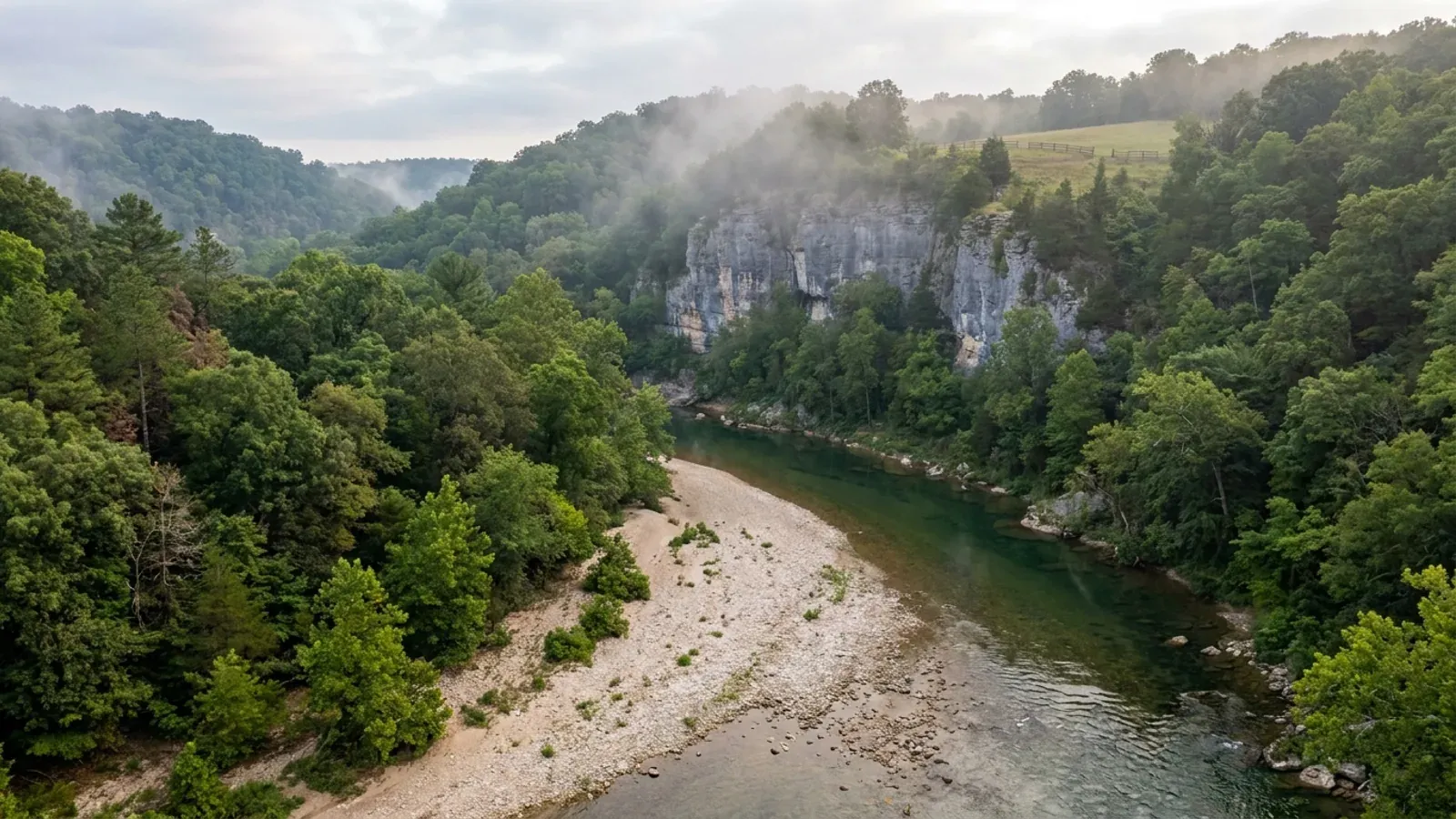
Rolla sits on the I-44 corridor at the northern edge of the Salem Plateau, a city of 20,660 inside a county of 45,672 where nearly everything outside the limits is farm, pasture and Ozark woodland. The line that matters to anyone buying land here runs along the city limit, and it separates two completely different rulebooks. Inside Rolla the city permits and inspects: on 20 April 2026 the City Council replaced its entire building chapter by Ord. No. 4908, adopting the 2024 International Residential Code with local amendments and its own filled-in Table R301.2, effective 1 August 2026. Outside Rolla, Phelps County is a third-classification county, and RSMo 64.170 empowers only counties of the first and second classification to adopt a building code, issue building permits or appoint a building commission. The county holds no such power, publishes no building department, and says in its own words that it does not issue certificates of occupancy. That is not the same as nothing standing between a landowner and a finished house. The gates that do exist on unincorporated ground are a floodplain development permit administered through the Meramec Regional Planning Commission, an on-site wastewater construction permit that moved from the county health department to the state Department of Health and Senior Services on 1 October 2024, a rural 911 address assigned at the courthouse to a published sign specification, and a county plat and road-dedication procedure that has been in force since 1 June 2007. The ground is the other half of the story. Phelps County is karst — 246 mapped sinkholes and 216 sink-area features — but it is far from the state's densest, and the soil survey says something more useful than the word Ozarks: bedrock lies within 20 inches on only about three per cent of the county, and within 40 inches on roughly thirty-eight. The largest single soil component in the county puts dolomite at about 23 inches, which is one inch above the frost depth Rolla's own code requires a footing to reach.
Rolla at a glance
- County
- Phelps County
- Population
- 20,660
- ZIP codes
- 65401, 65409, 65436, 65449, 65459, 65461, 65462, 65529, 65550, 65559
- Site visits
- Same-week site visits across Rolla and the Phelps County ring around it — Newburg and Doolittle west along I-44, St. James and the Meramec headwaters east, Edgar Springs and the Little Piney country south, and the Gasconade breaks north toward the Maries County line
Building conditions in Rolla
Missouri sets no residential building code and no statewide way of adopting one, so the first question on any parcel is not what the code says — it is whether there is one. Only counties of the first and second classification may adopt a building code at all, and classification is set by assessed valuation rather than population, so a small county can hold the power while a much larger one does not. Zoning is a separate power with its own answer, granted only after a vote of the people and repealable by another. What changes from one jurisdiction to the next is whether the work is inspected, who issues the permit, what that office charges, how the parcel is zoned, and the design figures your drawings have to satisfy.
RSMo 64.170(1), effective 28 August 2008 (RSMo 1939 § 14942; A.L. 1999 S.B. 160 & 82; A.L. 2001 S.B. 86; A.L. 2008 S.B. 1181 et al.), read on revisor.mo.gov 8 September 2026; RSMo 48.020; Missouri Association of Counties, Missouri Counties by Classification, published May 2025, downloaded from mocounties.com 8 September 2026, listing PHELPS under CLASS 3 (TOTAL 89) and stating TOTAL COUNTIES 114; Missouri Department of Natural Resources ArcGIS County Boundaries layer, gis.dnr.mo.gov, Phelps record CO_CLASS 3, queried 8 September 2026; Phelps County official website, Directory and Frequently Asked Questions pages, phelpscounty.org, read 8 September 2026
City of Rolla Municipal Code Ch. 6 Art. I Sections 6-1, 6-3, 6-4; Art. III Section 6-25; Art. IV Sections 6-30 and 6-31; Art. V Section 6-35; Art. VI Section 6-40; and Ch. 14 Art. I Section 14-1, all bearing [Ord. No. 4908, 4-20-2026], read on eCode360 custId RO6735 on 8 September 2026 with the document title verified as ending 'City of Rolla, MO' in the same read; the codified text was current to Ord. No. 4912 with fifteen later ordinances through Ord. No. 4933 of 24 August 2026 listed as adopted but not yet codified, none of which affects Chapter 6
City of Rolla Municipal Code Section 6-4(n), amended Table R301.2 (Ord. No. 4908, 20 April 2026, effective 1 August 2026), read on eCode360 8 September 2026 and re-read independently the same day from a second node with the title verified as 'City of Rolla, MO' in both reads; City of St. James Municipal Code Section 500.050.B.2, Table R301.2(1) insertions (Ord. No. 1147, 12 August 2019), read on eCode360 8 September 2026 with the title verified as 'Chapter 500: Building Regulations - City of St. James, MO'
City of Rolla Municipal Code Ch. 42 Art. III Div. 6, Sections 42-350 and 42-351; Ch. 42 Art. IV Div. 5, Section 42-451; Ch. 42 Art. II Div. 1, Section 42-203 definition of RESIDENTIAL-DESIGN MANUFACTURED HOME; and Ch. 42 Art. II Div. 2, Section 42-211 (R-1 Suburban Residential District), all [Ord. No. 4762, 10-2-2023], with Section 42-211 also carrying [Ord. No. 4836, 12-16-2024]; read on eCode360 8 September 2026, titles verified in the same reads, and Div. 6 re-read from a second node the same day. Currency checked against the chapter's editor's note (former Ch. 42 repealed 10-2-2023 by Ord. No. 4762) and against the single uncodified instrument affecting the chapter, Ord. No. 4924 of 3 August 2026, whose text was downloaded and read and which amends only the C-C district, parking, bicycle parking, marijuana uses and the zoning use table
Phelps/Maries County Health Department press release dated 1 October 2024, reciting the Phelps County Commission vote of 10 September 2024 to repeal the ordinance adopted 29 January 1998, and its Safe Environment page, both on phelpscountyhealth.com, downloaded and read 8 September 2026; Missouri Department of Health and Senior Services on-site wastewater construction permit process page, health.mo.gov, ?county=Phelps returning Agency DHSS and Authority Type DHSS, run 8 September 2026 after a ?county=Camden control returned Camden County Wastewater Dept., Ordinance; RSMo 701.031, effective 28 August 2005 (L. 1986 H.B. 1101 § 4, A.L. 1994 S.B. 446, A.L. 1999 H.B. 216, A.L. 2004 H.B. 1433, A.L. 2005 H.B. 617), and RSMo 701.029 and 701.308, read on revisor.mo.gov 8 September 2026
FEMA OpenFEMA NfipCommunityStatusBook API, state MO, county PHELPS COUNTY, six communities returned, data last refreshed 25 August 2025 per the API's own lastRefresh field, queried 8 September 2026 against a control filter that returned count 0; Meramec Regional Planning Commission news release, 'Phelps County — Thinking about a construction or renovation project in Phelps County? You may need a floodplain development permit', dated 20 April 2018, meramecregion.org, read 8 September 2026, quoting then-presiding commissioner Randy Verkamp and MRPC assistant director Tammy Snodgrass; Phelps County Assessor's office, Phelps County Rural 911 Addresses page, phelps.missouriassessors.com/rural911Address.php, read 8 September 2026, reciting the county ordinance on posting of numbers; Phelps County official Frequently Asked Questions page, phelpscounty.org, read 8 September 2026
Also worth knowing before you build in Rolla
- Every fire district covering the county was checked, and none of them is a building department
- A fire protection district can be a building-code authority in Missouri, and it is a real possibility on unincorporated ground precisely where the county has no code. RSMo 321.220(12) lets a district board adopt fire protection and fire prevention ordinances whose administrative standards may be industrial codes adopted by nationally organized and recognized trade bodies, with violations prosecuted as misdemeanors by the county prosecutor. That route was checked for Phelps County and nothing was found. The Rolla Rural Fire Protection District covers roughly 210 square miles outside the Rolla city limits across Phelps, Maries and Dent counties, running north to the Maries County line, east to the St. James city limits, west to the Doolittle city limits and south to the Yancy Mills area, and its published site carries no adopted building or residential code, no permit programme and no plan review. Inside Rolla the question is settled by statute rather than by inquiry: RSMo 321.228.2 provides that where a city adopts, implements and enforces a residential construction regulatory system, every fire protection district wholly or partly within it is without power, authority or privilege to enforce or implement one, and any such district system is advisory only. Rolla plainly does adopt and enforce one. What districts keep everywhere is narrow and specific — final regulatory authority over the location and specification of fire hydrants, hydrant flow rates and fire lanes, and permission to inspect the alteration, enlargement, replacement or repair of a one- or two-family dwelling, with no fee for either. Note also the carve-out inside RSMo 321.220(12) itself: a district's fire ordinances may not impose regulations or require permits on the erection, maintenance, repair, alteration or extension of farm buildings or farm structures. And the City of Rolla's own 2024 International Fire Code adoption is a fire code, not a residential construction regulatory system operated by a district, so it sits outside the preemption question entirely.
- The county's largest soil puts rock at about 23 inches, one inch above the required footing depth
- The word Ozarks is not evidence, so the ground under Phelps County was measured rather than assumed. The Phelps County soil survey area covers 431,347 acres in 66 map units. Lithic or paralithic bedrock lies within 20 inches on 13,604 component-weighted acres, about 3.2 per cent of the county — shallower-rock-free than most people expect. But the curve turns hard just below that. Within 24 inches, Rolla's own published frost line, the figure is 108,933 acres or 25.3 per cent; within 30 inches, the figure St. James publishes, it is 163,000 acres or 37.8 per cent; and within 40 inches it is 165,273 acres or 38.3 per cent. The reason is the county's dominant soil. Bender is the largest single component in the survey area at 78,654 component-weighted acres, roughly 18 per cent of Phelps County, and it carries lithic bedrock at 58 centimetres — about 23 inches. A footing trench dug to the city's 24-inch requirement in Bender soil arrives at dolomite almost exactly at grade. Bendavis, third largest, sits at 64 centimetres and Gatewood at 71. The second constraint is a fragipan, a dense root-restricting layer mapped on 96,294 acres, 22.3 per cent of the county, at depths from 41 to 97 centimetres — Union, the second-largest component, carries it at 76 centimetres and Tonti at 58. And 203,088 acres, 47 per cent of the survey area, sit in map units whose names carry gravelly, cherty, stony, rocky or rock outcrop. None of that makes a barndominium harder to build than a stick house; it makes the foundation design a site-specific question that a soil borehole answers and a regional generalisation does not.
- 246 mapped sinkholes — real karst, but a sixth of the density of the Springfield plateau
- Phelps County sits on the Salem Plateau near the Meramec headwaters and it is genuinely karst country: the Missouri Department of Natural Resources sinkhole inventory holds 246 known and probable sinkhole points inside the county boundary, plus 216 mapped sink-area features. What that number needs is a scale. Greene County, almost exactly the same size at 677 square miles against Phelps's 674, carries 1,471 sinkholes in the same dataset — six times the density. Neighbouring Dent County has 493 and Texas County 483, while Crawford has 92, Pulaski 138 and Maries just 16. So the honest description of Phelps is a moderately karsted county on a heavily karsted plateau, not the worst of it and nowhere near the least. The practical consequences are two. A sinkhole or a losing stream near a proposed drainfield changes the wastewater design, because the state rules bar a percolation test alone where there is significant groundwater contamination potential and define that to include a drainfield within 100 feet of a sinkhole's drainage. And a closed depression on a building pad is a foundation question, not a landscaping one. Both are answered by looking at the specific tract, and the state's mapped inventory is the place to start looking.
- The county's plat and road-dedication procedure has been in force since 1 June 2007
- There is one piece of county paperwork a rural build can run into that has nothing to do with a building code. The Phelps County Commission adopted an ordinance, effective 1 June 2007, establishing the procedure for accepting and approving a subdivision plat within the county, establishing subdivision public road dedication, and accepting a road into the county road system for maintenance. Its own text says these regulations supersede all previous regulations, policy and direction on the subject. A plat is presented to the County Commission for acceptance, must meet the Missouri Minimum Standards for Property Boundary Surveys, and must carry proper dedication language for any roadway intended to become public. Accepting the plat does not accept the roads: county maintenance begins only after a plat showing all utility systems is provided, a stormwater drainage plan under the Phelps County Road Specifications is reviewed and approved, a registered professional engineer certifies to the County Highway Engineer that the roadway structures, drainage structures and utility systems were built to county regulations and specifications, and county highway maintenance recommends acceptance to the Commission. For a single house on an existing tract on an existing county road none of this applies. For anyone splitting land or building a new access road to serve more than one dwelling, it is the procedure that governs, and it is worth reading before the survey is ordered rather than after.
- The city permits a shed at 200 square feet; St. James stops at 49
- Inside Rolla, permit exemptions follow the 2024 International Residential Code as amended, and zoning Section 42-451 adds that an accessory structure under 200 square feet may not require a building permit though it must still meet setbacks — and if it is not attached to a foundation and weighs under 200 pounds empty, it may sit inside a utility easement. Rolla also rewrote the model exemption for finish work, replacing item 6 with roof covering, siding, painting, papering, tiling, carpeting, cabinets, countertops and similar finish work — so re-siding or re-roofing an existing building inside the city does not need a permit. St. James, in the same county, sets the same exemption at 49 square feet under its 2015 International Residential Code and at 36 square feet, six feet by six, under its 2015 International Building Code, and expressly exempts replacement of siding, doors, windows and like-for-like roof coverings. Outside both cities, on unincorporated ground, there is no building-permit threshold of any kind, because there is no county building permit. Three different answers to the same question inside one county, and the boundary you are standing on decides which one you get.
- 748 farms averaging 233 acres, and nearly a third of the farmland is woods
- Phelps County had 748 farms in the 2022 Census of Agriculture, working 174,422 acres at an average of 233 acres a farm. What those acres are matters more than the total for anyone shopping for a building site. Pastureland accounts for 80,677 acres, woodland for 53,723, cropland for 32,734 and other uses for 7,288 — so roughly 31 per cent of the land in farms here is timber, which is the Salem Plateau showing up in the land-use table. Only 77 acres in the whole county are irrigated. The size distribution is equally telling: 46 farms of 1 to 9 acres, 183 of 10 to 49, 282 of 50 to 179, 156 of 180 to 499, and 52 of 1,000 acres or more. Two thirds of the county's farms are under 180 acres, which is the size range most house-and-shop buyers are actually shopping in, and it means the tracts exist rather than having to be carved out of large holdings.
- Rolla is 12 square miles inside a county of 674
- The scale of the two jurisdictions explains why the code question is the whole question here. The City of Rolla covers 12.123 square miles of land and holds an estimated 20,660 people as of 1 July 2024. Phelps County covers 673.64 square miles and holds 45,672. St. James, the county's second city, holds 3,932 in 4.245 square miles. So the city with the building department accounts for under two per cent of the county's land area, and something like 45 per cent of its population. Almost every buildable acre in Phelps County is outside every set of city limits, on ground where no building permit is issued by anyone. Rolla's own zoning district list has no agricultural district in it — R-1 Suburban Residential is the largest-lot residential district the city offers, and even there the minimum lot to subdivide is three acres only where public water and sewer do not reach.
- Rolla's energy code is advisory, and the city wrote its own R-values instead
- Section 6-20(b) of the Rolla City Code adopts the 2024 International Energy Conservation Code as an advisory energy conservation code only, and says in terms that it is not mandatory. The requirements that do bind sit in Section 6-21 and are much shorter than a model energy code: residential wall assemblies at R-13 or better, floor assemblies at R-19 including garage ceilings with living space above, roof assemblies at R-19, ceilings at R-30 at the time of installation, and duct insulation at R-5 where the ducts are inside the building but outside conditioned space and R-8 where they are outside the building, with at least R-8 between the duct and the outer part of any assembly the duct is buried in. Doors, windows and approved penetrations are outside the wall requirement, unfinished basement concrete walls are exempt, and concrete floors in contact with the earth need not be insulated. Non-residential wall assemblies drop to R-11, with the building official empowered to approve less for storage, warehouse or manufacturing space not normally occupied by employees. On a metal-skinned building the envelope is where the money and the comfort both live, so knowing that the operative number is a flat R-13 wall rather than a full IECC compliance path changes how the shell is specified from the first sketch.
- Rolla's subdivision rules stop at the city limit — and so does everything else the city does
- Some Missouri cities reach beyond their boundaries for plat approval. Rolla does not. Section 42-500 of the city code says the subdivision regulations apply to any subdivision or re-subdivision of land within the City jurisdiction, that no plat of a subdivision of land lying within the municipality may be filed or recorded until the city has reviewed and approved it, and that property sold in breach of them is ineligible for building permits until the breach is cured. There is no extraterritorial clause and no one-mile ring. That is worth knowing because it means the boundary is clean: cross the city limit and the City of Rolla has no say in the plat, no say in the design, and no permit to issue. What replaces it on unincorporated ground is the county's own 2007 plat and road-dedication procedure, the floodplain permit where the parcel is mapped, the state wastewater permit or the three-acre exclusion, and a 911 address from the courthouse. Anyone whose site sits near the line should confirm which side of it they are on before they design to either rulebook.
RSMo 321.228, effective 28 August 2012 (L. 2012 H.B. 1647 merged with S.B. 769), and RSMo 321.220(12), effective 28 August 2025, both read verbatim on revisor.mo.gov 8 September 2026; Rolla Rural Fire Protection District, About page, rollaruralfire.com, read 8 September 2026 (site sections: Home, About, Join, Gallery — no codes, permits or inspections page); City of Rolla Municipal Code Section 14-1 (Ord. No. 4908, 20 April 2026), adopting the 2024 International Fire Code, read on eCode360 8 September 2026
USDA-NRCS Soil Data Access, sdmdataaccess.sc.egov.usda.gov, SSURGO survey area MO161 Phelps County, Missouri, 431,347 acres; component-weighted acreages computed as map unit acres times component percentage from the legend, mapunit, component and corestrictions tables; queried 8 September 2026 after a bogus-table control returned an OGC ServiceExceptionReport reading Invalid object name
Missouri Department of Natural Resources ArcGIS map service geology/sinkholes (known and probable sinkhole locations) and geology/sink_areas, gis.dnr.mo.gov, counted by spatial intersection against the DNR boundary/county County Boundaries polygon for each county, queried 8 September 2026; a control polygon placed in the Atlantic returned count 0. County land areas from the same DNR county layer (Phelps 673.64 sq mi, Greene 677.3 sq mi). Percolation and sinkhole rule from 19 CSR 20-3.060(2)(D)
Phelps County Commission, 'Ordinance Establishing the Procedure for Accepting and Approving a Subdivision Plat Within the County, Establishing Subdivision Public Road Dedication and Accepting a Road Into the County Road System for Maintenance', Effective Date of Regulation June 1, 2007, published on the Phelps County Road Department page at phelpscounty.org, downloaded and read 8 September 2026
City of Rolla Municipal Code Section 6-4(c) (amending IRC R105.2 item 6) and Ch. 42 Section 42-451(10) and (8), read on eCode360 8 September 2026; City of St. James Municipal Code Section 500.050.B.6 (IRC R105.2 as amended, 49 square feet) and Section 500.020.B.3.e (IBC 105.2 as amended, 36 square feet), Ord. No. 1147 of 12 August 2019, read on eCode360 8 September 2026
USDA National Agricultural Statistics Service, 2022 Census of Agriculture, Phelps County, Missouri county profile (cp29161.pdf), nass.usda.gov, downloaded and read 8 September 2026 after a bogus county-code control returned a 196-byte HTTP 404
US Census Bureau 2024 Gazetteer Files, place file for Missouri (2024_gaz_place_29.txt), GEOID 2962912 Rolla city, land area 31,399,414 sq m (12.123 sq mi), internal point 37.94594 / -91.761202, and GEOID 2964424 St. James city, 4.245 sq mi, www2.census.gov, downloaded 8 September 2026; US Census Bureau Vintage 2024 Population Estimates, sub-est2024_29.csv (Rolla 20,660; St. James 3,932) and co-est2024-alldata.csv (Phelps County 45,672), www2.census.gov, downloaded 8 September 2026; county land area from the Missouri Department of Natural Resources County Boundaries layer, 673.64 sq mi; City of Rolla Municipal Code Sections 42-201 and 42-211
City of Rolla Municipal Code Ch. 6 Art. II, Sections 6-20 and 6-21 (Ord. No. 4908, 20 April 2026, effective 1 August 2026), read on eCode360 8 September 2026 with the title verified as 'Article II: Energy Conservation - City of Rolla, MO' in the same read
City of Rolla Municipal Code Ch. 42 Art. V, Section 42-500 (Ord. No. 4762, 2 October 2023), read on eCode360 8 September 2026 with the title verified as 'Article V: Subdivision Regulations - City of Rolla, MO' in the same read
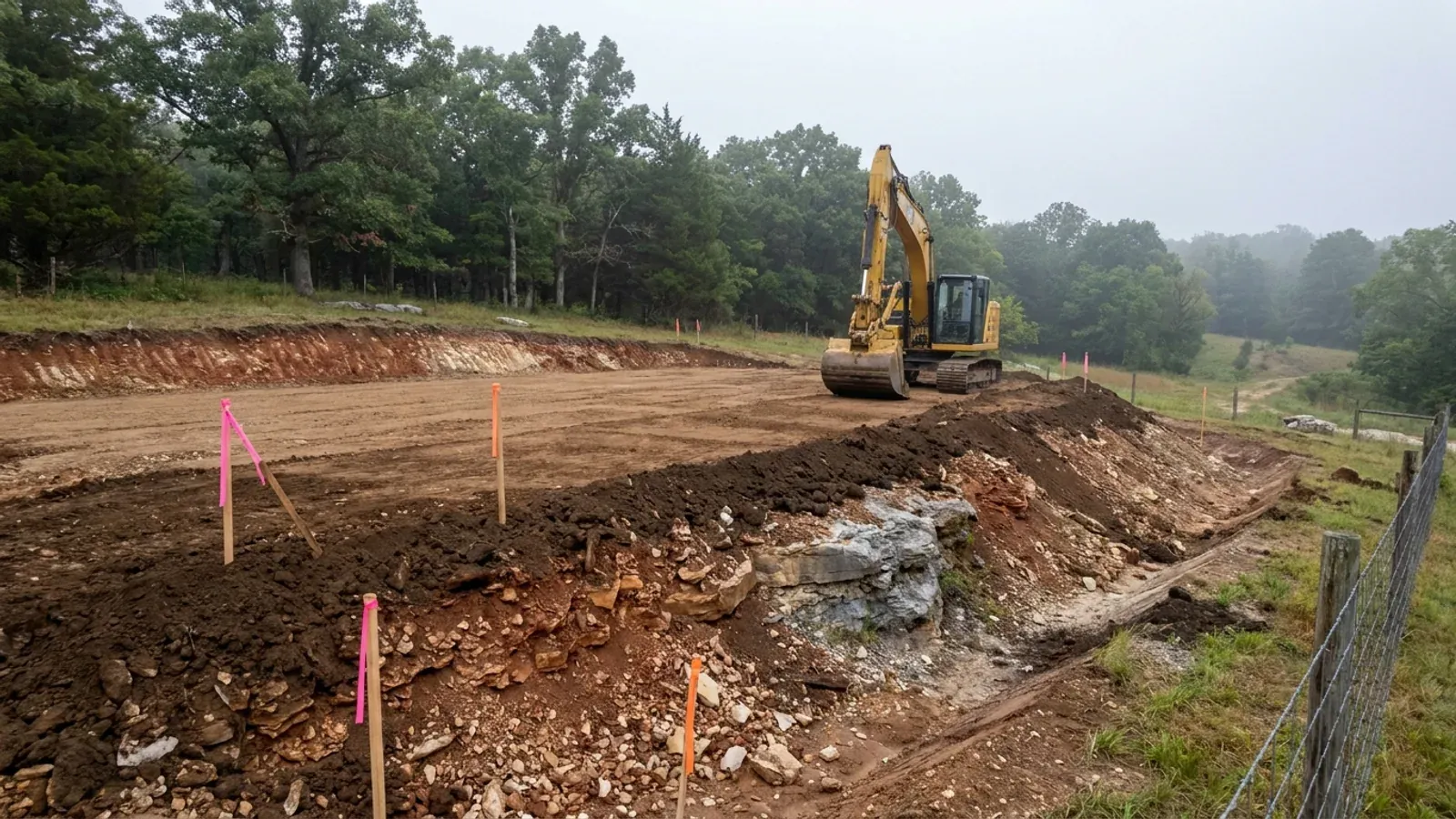
The expensive surprises are in the ground, not the building
What moves a Missouri budget is usually below grade, and which problem you have depends on where in the state you are. Across the Ozarks it is karst: the Department of Natural Resources maps more than sixteen thousand sinkhole points, and what matters there is what is under the slab rather than what the slab sits in. Across the north and centre it is claypan — dense, slow-draining subsoil that perches water above it for months of the year. In the Bootheel it is deep alluvium carrying the highest seismic demand in the state, where the same soils modelled for liquefaction attack post embedment and slab bearing rather than the frame above them. The same ground then decides the septic system, and Missouri does not run that on a percolation test alone: the rule allows a perc test or a soil morphology examination in a profile pit, and the authority reviewing your parcel picks which. Where a drainfield sits near a sinkhole's drainage, perc testing on its own is not permitted at all. Whether that authority is the state or your own county is itself a local question, and it changes what you have to file. So the site work, the foundation and the drainfield get resolved together rather than one at a time. We price the dirt before we price the building.
What we build in Rolla
All nine services are available in Rolla. What a build costs depends far more on the parcel than on square footage, so we price against your land rather than publishing a rate card.
Custom Plans
Barndominium floor plans drawn to your parcel and your soil, and to whichever Missouri authority — a county, a city, or none at all — will review them.
Barndominium Kits
Barndominium shell packages delivered to your Missouri land, drawn to the criteria your own county or city publishes — because the state publishes none.
Turnkey Builds
Start to finish barndominium construction in Missouri: the permits that genuinely apply, site work, shell and interior finish, under one contract.
What a build looks like
Three stages every Rolla project passes through, from a raw parcel to a finished home. Site work first, because that is where the budget is decided.
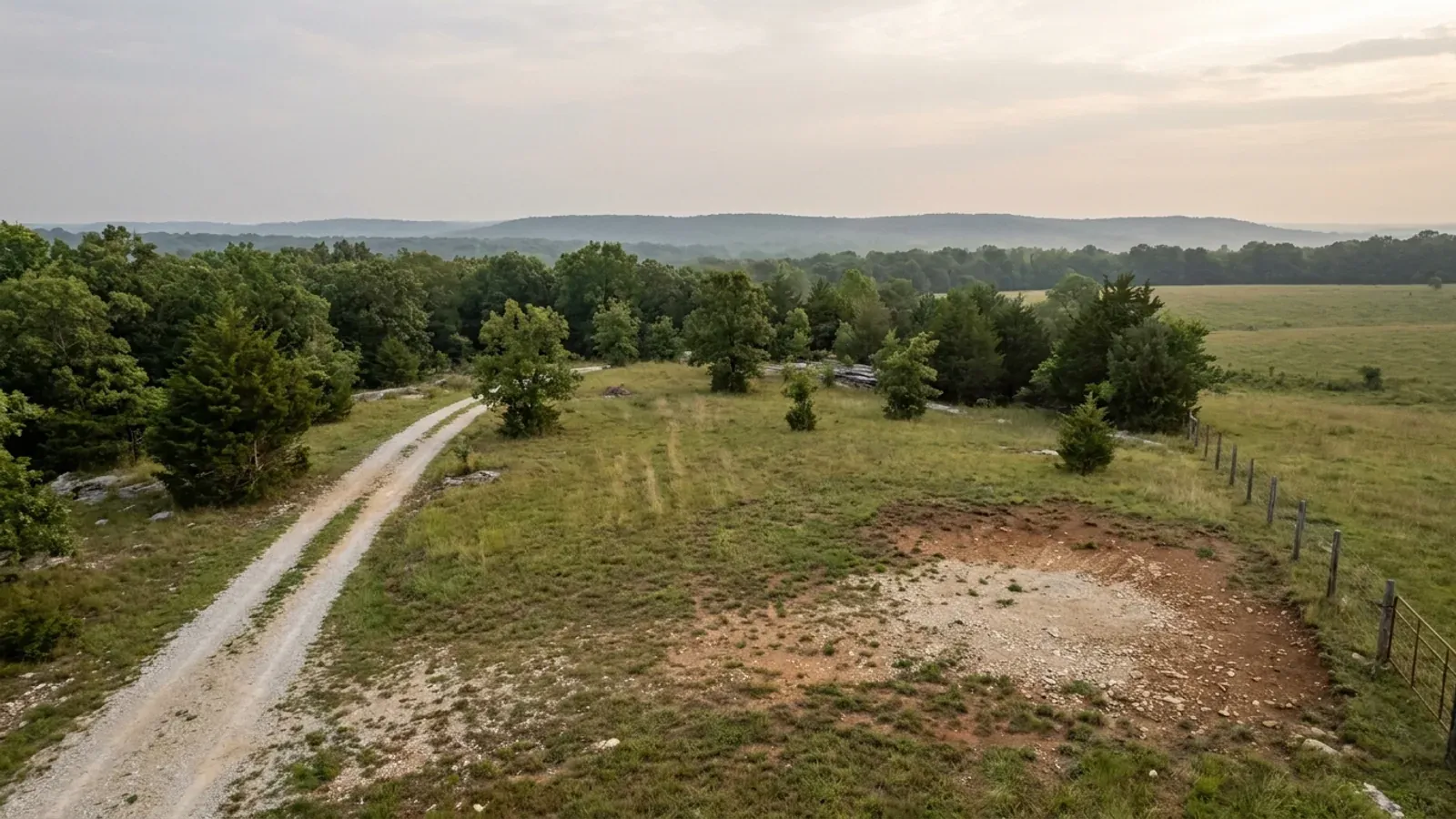
The parcel
Zoning, setbacks, flood zone and utility access get checked before anything is drawn.
Pad and permit
Clearing, grading and a compacted pad, while the submittal works through whichever office issues the permit where you are building.
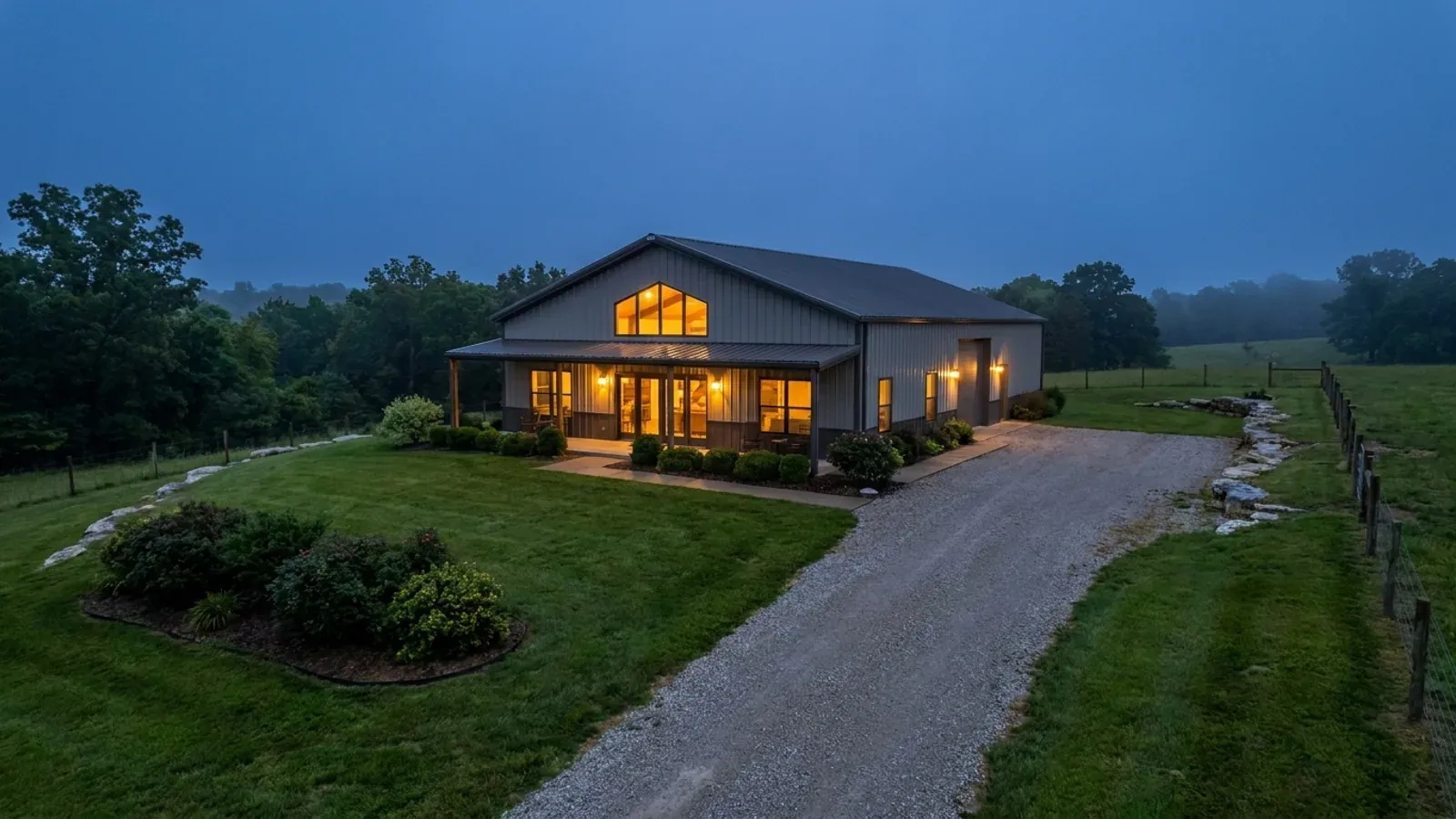
Frame to finish
Shell erected and dried in, then systems, insulation and interior finish through to CO.
Those are the rules where you are building in Rolla. Tell us what you want to build and we will draw it to them.
Where we build around Rolla
Phelps County and the rural land around it. The buildable acreage for a project this size usually sits outside the city limits, which is frequently what changes who issues your permit.
Keep reading
The questions that usually come next once you know what Rolla allows.
Barndominium Cost Guide
Sourced per-square-foot ranges by tier and by size, with a calculator built on the same figures.
Read itIs It Legal in Missouri?
Classification, zoning, the HOA gate, and why "nonresidential farm building" does not cover a home.
Read itHow Long Does It Take?
Census build-duration data, and what actually sets the permit clock where you are building.
Read itNearby areas we build in
Others we cover nearby, and they are not interchangeable. One may be a county with an adopted building code, another a county with no legal authority to have one, another a city that permits inside its own limits whichever county the land sits in. So the office that issues the permit, whether anyone inspects the work at all, the fees, the zoning and the design figures can differ from one card to the next — sometimes across a single property line.
Building in Rolla: common questions
9 questions we get asked most often about building in Rolla. If yours is not on the list, ask it directly.
Do I need a building permit to build a barndominium in Phelps County?
If nobody inspects the building, what actually stops me?
How deep do the footings have to go?
Can I put up metal siding and a metal roof, or does the city restrict that?
How big a shop can I build, and can I build it before the house?
My land is over three acres. Do I still need a septic permit?
The county has sinkholes. Should that worry me?
What does a permit cost inside Rolla?
Which building code applies where in Phelps County?
Building in Rolla?
Start with the plan. Tell us what you want to build and we will draw it, then confirm which office issues the permit for your parcel, what it will let you put there, and what wind load it has to meet. That conversation costs nothing.