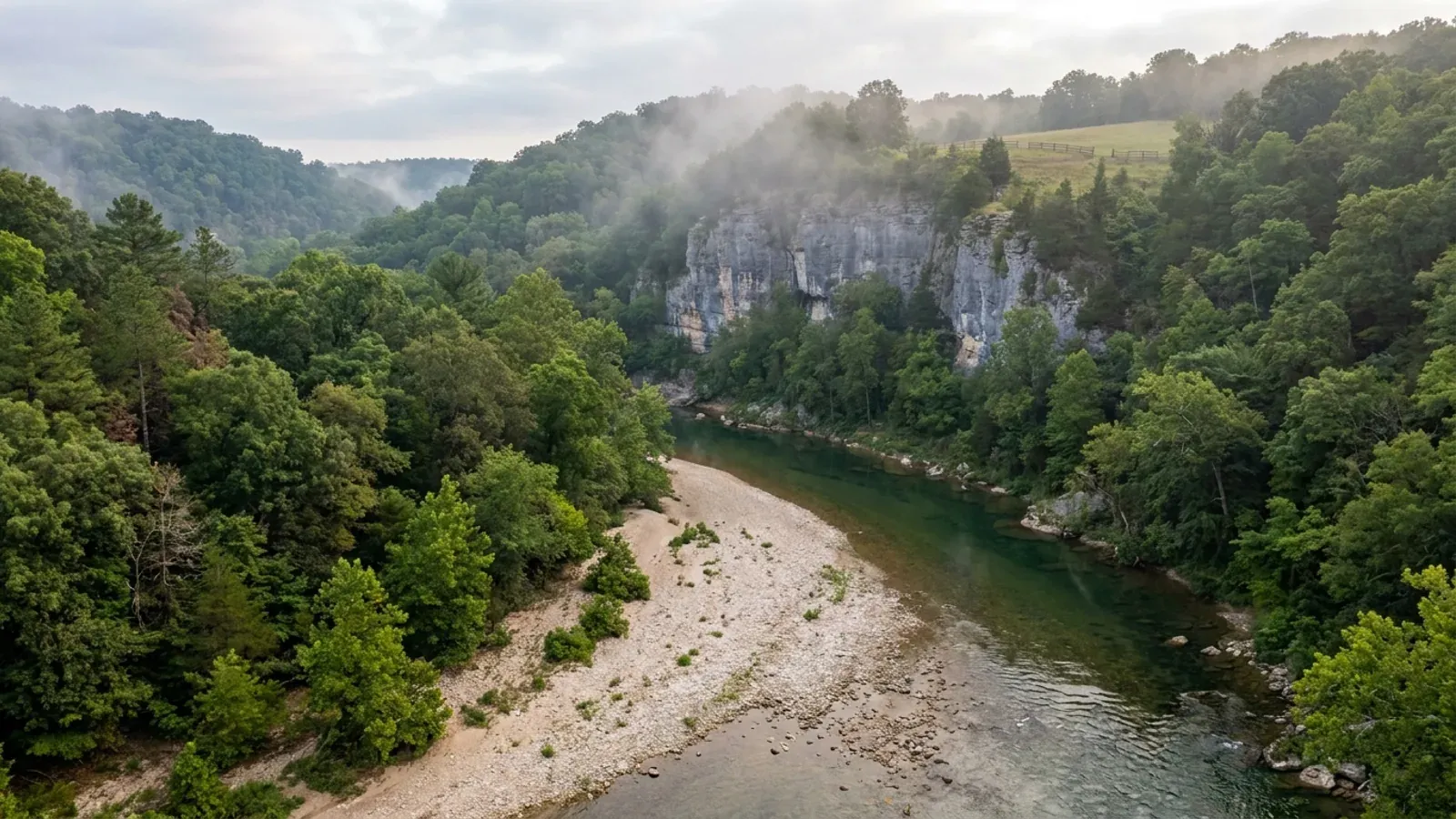
Barndominium Builders in West Plains, MO
West Plains is the only place in Howell County where a building permit is issued at all. Inside the city limits the Building and Development department runs a full permit and inspection programme — eleven called inspections from temporary power to the final walk-through, and no occupancy without a certificate — on the 2021 International Building Code and the 2020 National Electrical Code. Step outside the city and the picture inverts completely. Howell County is a county of the third classification, which under RSMo 64.170 and RSMo 64.205 means it has no power to adopt a building code at all, and its own official directory bears that out: twenty-odd offices and not one of them a building department, a building inspector, a code enforcement office or a planning and zoning office. There is no county building permit, no county zoning and no county floodplain ordinance. What is left is a short, real chain — a septic permit under the health department, a 911 address, an electric account, and access to the road — and on a three-acre-or-larger single-family lot even the septic permit falls away by statute. That is the whole argument for buying acreage here, and it is also why the ground itself deserves more attention than the paperwork: Howell County carries 1,390 mapped sinkholes, the third-highest count recorded on this site, on soils that are almost never shallow to rock.
West Plains at a glance
- County
- Howell County
- Cities & counties covered
- West Plains 12,704 · Howell County 40,762 · Balance of Howell County (outside any incorporated place) 23,043 · Mountain View 2,668 · Willow Springs 2,219 · Brandsville 128
- Site visits
- Same-week site visits across Howell County — West Plains and the US 63 corridor, Pomona and Willow Springs north, Mountain View west along US 60, Brandsville and Moody south toward the Arkansas line, and the Eleven Point and North Fork river country east and west of town
Building conditions in West Plains
Missouri sets no residential building code and no statewide way of adopting one, so the first question on any parcel is not what the code says — it is whether there is one. Only counties of the first and second classification may adopt a building code at all, and classification is set by assessed valuation rather than population, so a small county can hold the power while a much larger one does not. Zoning is a separate power with its own answer, granted only after a vote of the people and repealable by another. What changes from one jurisdiction to the next is whether the work is inspected, who issues the permit, what that office charges, how the parcel is zoned, and the design figures your drawings have to satisfy.
Missouri Association of Counties, 'Missouri Counties by Classification', published May 2025, downloaded 8 September 2026 from mocounties.com/s/Missouri-Counties-by-Classification-2025.pdf (73,901 bytes, application/pdf; the document prints TOTAL COUNTIES 114, CLASS 3 (TOTAL 89) and lists HOWELL in the class 3 block); RSMo 64.170 as rendered at revisor.mo.gov, Title VI, Chapter 64, Effective 28 Aug 2008; RSMo 64.205, Effective 28 Aug 1963; RSMo 48.020, Effective 28 Aug 2026; populations from the U.S. Census Bureau Vintage 2024 subcounty population estimates, sub-est2024.csv, POPESTIMATE2024
West Plains Code of Ordinances ch. 10 arts. II, III and IX (§§ 10-73, 10-74, 10-83, 10-529), read 8 September 2026 from the Municode codification, Supplement 5, online content updated 5 August 2026, codified through Ord. No. 4817 enacted 17 February 2026, with the adopting history reading Ord. No. 4761, §§ 1A and 1F, 18 December 2023; editions and the inspection sequence from the City of West Plains Building and Development page, westplains.gov/departments/planning/building-and-planning/, read 8 September 2026. Every one of the 132 pages in the city's own sitemap was fetched and searched for 'frost depth', 'frost line', 'wind speed', 'ground snow', 'snow load', 'seismic design category' and 'International Residential Code'; only the Building and Development page returned a hit, and that hit was the code names
Missouri DHSS OWTS construction permit process county selector, health.mo.gov/business-professionals/onsite-wastewater-treatment/owts-construction-permit-process?county=Howell, queried 8 September 2026, returning Agency: Howell County Health Department, Authority Type: Contract, 108 Kentucky, West Plains, MO 65775, (417) 256-7078; the same selector was run first against ?county=Camden as a known-good control (returning Camden County Wastewater Dept., Authority Type: Ordinance) and against a bogus county, which returns 'The submitted value ... in the county element is not allowed' and 'No results found.'; quoted permitting text from the Howell County Health Department, Environmental Public Health page, howellcountyhealth.com/environmental-public-health/, read 8 September 2026; RSMo 701.031, revisor.mo.gov, Title XLI, Chapter 701, Effective 28 Aug 2005
FEMA OpenFEMA dataset NfipCommunityStatusBook (v1), queried 8 September 2026 for state MO and county HOWELL COUNTY, returning five communities; fields participatingInNFIP, sanction, sanctionDate, initialFloodInsuranceRateMap, initialFloodHazardBoundaryMap, regularEmergencyProgramDate and currentlyEffectiveMapDate as recorded above, dataset lastRefresh 25 August 2026. A bogus county name returns zero rows as the control
USDA-NRCS Soil Data Access, sdmdataaccess.sc.egov.usda.gov/Tabular/post.rest, queried 8 September 2026 against survey area MO091 (Howell County, Missouri), which returns 94 map units totalling 593,754 acres. Bedrock share computed as SUM(mapunit.muacres × component.comppct_r ÷ 100) over components having a corestrictions row with reskind in ('Lithic bedrock','Paralithic bedrock') and resdept_r ≤ 51 (and separately ≤ 102); resdept_r is recorded in CENTIMETRES, so 51 cm ≈ 20 inches and 102 cm ≈ 40 inches. Acres are COMPONENT-WEIGHTED, not map-unit acres, and the restriction test is an EXISTS subquery so a component carrying two restrictions is counted once — de-duplication checked. Only 'Lithic bedrock' occurs in this survey; no paralithic rows are present. Fragipan share computed identically on reskind = 'Fragipan'. Controls: survey area MO999 returns an empty result and a bogus table name returns an OGC ServiceExceptionReport reading 'Invalid query: Invalid object name'. Sinkhole count from the Missouri DNR ArcGIS SINKHOLES layer, gis.dnr.mo.gov/host/rest/services/geology/sinkholes/MapServer/1, intersected with the Census TIGERweb polygon for county 29091 at outSR 26915, returnCountOnly, queried 8 September 2026; the unfiltered statewide count returns 16,001, matching the department's published figure of approximately 16,000, and the same method returns 484 for Texas County, matching the figure already on record
West Plains Code of Ordinances ch. 50, art. I (§§ 50-3 definitions, 50-6 general regulations) and art. III (§§ 50-110 to 50-117 general district regulations, §§ 50-144 to 50-148 A-1, §§ 50-180 to 50-184 R-1, and §§ 50-429 to 50-433 Quality Development Corridor), read 8 September 2026 from the Municode codification, Supplement 5, content updated 5 August 2026, codified through Ord. No. 4817 enacted 17 February 2026; § 50-114 derives from Code 2002 § 102-130, Ord. No. 4080 § 1, 21 July 2008 and Ord. No. 4537 Exh. A(50-114), 20 December 2017, and §§ 50-430 to 50-432 from Ord. No. 4537 Exh. A, 20 December 2017. Section 50-114 and §§ 50-430/50-432 were each re-read on a second, independent navigation and matched
Also worth knowing before you build in West Plains
- Three fire protection districts exist in the county, and the statute that decides what they may do
- A Missouri fire protection district organised under RSMo Chapter 321 is not bound by county classification, so a county that may not have a building code can still contain ground that sits under district rules. The Missouri Division of Fire Safety's Fire Departments by County report lists thirteen registered fire services in Howell County. Three of them are Chapter 321 districts by name — the Brandsville Fire Protection District, the Pomona Fire Protection District and the Pumpkin Center Fire Protection District. The rest are the City of West Plains Fire and Rescue, a municipal department, together with volunteer and membership departments at Caulfield, Moody, Mountain View, Peace Valley, Pottersville, Willow Springs and Eleven Point, plus Howell County Rural Fire Department #1 and the Willow Springs Rural Fire Protection Association, neither of which is a district. RSMo 321.220(12) lets a district board adopt fire protection and fire prevention ordinances whose standards may be 'industrial codes adopted by nationally organized and recognized trade bodies', prosecuted as a misdemeanor by the county prosecutor — but it also says those ordinances 'shall not be exercised so as to impose regulations or to require permits with respect to the erection, maintenance, repair, alteration, or extension of farm buildings or farm structures'. RSMo 321.228 then draws the harder line: where a city, town, village or county 'adopts or has adopted, implements, and enforces a residential construction regulatory system', every fire district wholly or partly inside it is 'without power, authority, or privilege to enforce or implement' one there. Inside West Plains, the city plainly runs such a system, so that route is closed. Outside it, Howell County runs none, so the route is open — and the only way to know what a particular district has actually adopted is to ask the district that covers the address, by name, before the plans are drawn.
- What the permit actually costs inside the city, and what a detached shop costs
- The numbers are in Appendix A, the West Plains Fee Schedule, which § 10-23 makes the operative source for every building, remodeling, plumbing and house-moving charge. A residential permit is $150 for the first 1,000 square feet and $0.075 per square foot above that, so a 2,000-square-foot house is $225. A detached garage or storage building is treated far more lightly: $25 up to 150 square feet and $0.010 per square foot above it, which puts a 2,400-square-foot shop at $47.50. Base residential plumbing is $40 and commercial $75, with water outlets at $1.00 each and a water heater at $2.00. New electrical wiring is charged at $1.00 per amp of secondary load; replacing or relocating a main service panel without a meter base is $25; an additional inspection trip is $10. A certificate of occupancy permit is $25. Commercial and industrial work carries a $50 plan review fee that residential work does not, and remodeling is $50 plus 0.3 percent of estimated cost. Outside the city there is no building permit and therefore no building permit fee — the money on an unincorporated build goes to the wastewater permit where one is required, to the utility connection, and to the well.
- The city licenses its trades by examination, and the state licenses none of them
- Missouri has no statewide general contractor licence to hold, and it is worth being precise about what does exist here instead. West Plains requires certification of the people doing the work inside the city: 'Building, electrical, plumbing and HVAC technicians must be certified to provide their services within the city. Tests are given to measure familiarity with building codes. Those passing the test will receive certification and may then obtain a business license.' The West Plains Electrical Board sets the standards and regulates licensing for electrical and HVAC work, and the electrical examination requires four years or 8,000 hours of documented work history plus three letters of recommendation from independent sources, with tests by appointment only. The fee schedule prices the business licences: $50 to engage in the business of electrical construction or wiring, $50 for plumbing construction, $20 for heating, ventilation and air conditioning, each renewing annually at $20 with a $5 per month late charge. Chapter 10 carries the machinery behind it — a certification of electricians division, a certification of plumbers division, a certification of HVAC technicians division, and a building official who also serves as electrical inspector. None of this applies on unincorporated ground, where no county authority licenses or certifies anyone in the building trades.
- What actually gates the build outside the city: the address and the meter
- With no county building permit, the chain that a build on unincorporated Howell County ground genuinely has to pass through is short and worth knowing in order. The wastewater permit comes first where the parcel is under three acres, from the Howell County Health Department. The address comes from the county: the county's own Official Directory lists an E-911 Office under Public Safety and Emergency, with a named coordinator and a direct number, and that office assigns the physical address. Power comes from Howell-Oregon Electric Cooperative, which serves all of Howell and Oregon counties, the eastern parts of Ozark and Douglas, part of southern Texas County and the lower half of Shannon County, and also serves some consumers inside the city limits of West Plains, Mountain View, Willow Springs and Thayer. What the cooperative asks for is a service contract, the location number from the tag on an existing pole or the name of the nearest neighbour with service if there is no pole, the physical address, photo identification, a social security number and a credit reference; the charges are a $60 membership and meter deposit with a favourable twelve-month credit reference or a $250 minimum without one, a $120 service installation fee, and $125 for a meter connection outside regular working hours. It does not ask for a building permit, an electrical inspection or a certificate, and its own statement of the boundary is that it 'maintains and repairs all items up to the meter'. Inside West Plains the sequence is different: the city runs its own electric utility, and permanent power is one of the eleven inspections the building department calls.
- The county's own directory is the evidence, not the absence of a search result
- It is easy to say a rural county has no building department and hard to prove it, so it is worth setting out what the county itself publishes. Howell County's Official Directory is organised under five headings. Legal and Judicial System lists the circuit court clerk, the presiding judge of the 37th Circuit, two associate circuit judges, the prosecuting attorney, the juvenile officer, jury reporting and the court reporter. Taxation and Finance lists the assessor, the collector and the treasurer. County Administration and Records lists the county clerk, the recorder of deeds, the public administrator and the county surveyor. County Commission lists the presiding commissioner and the two associate commissioners. Public Safety and Emergency lists the sheriff, the E-911 office and the coroner. There is no building department, no building inspector, no code enforcement office, no planning commission and no zoning administrator on that list, and the county's website carries no permit or ordinance page of any kind. A third-party site was found asserting that Howell County has adopted the International Building Code. It has not, it may not, and the county's own published directory is the plainest available demonstration.
- Manufactured homes are barred from the districts where a barndominium is welcome
- West Plains draws a line that matters when a buyer is weighing a delivered box against a built shell. The A-1 Agriculture district description ends 'No manufactured home, mobile home or trailer house shall be permitted', and the R-1 Single-Family Residential and R-2 Urban Residential descriptions carry the same sentence word for word. A mobile home is a conditional use in A-1, R-1 and R-2 only as a hardship or temporary placement, with the conditions defined in Chapter 26 of the city code. A site-built house faces no such bar in any of the three districts, and single-family homes are a permitted use in all of them. So inside the city, a permanently founded, site-built structure — whatever it is skinned in — is on a different footing from a HUD-code manufactured home, and the material it is clad in is not what decides the question. Outside the city there is no zoning to make the distinction at all.
- The land market: 1,392 farms, and a third of them between ten and fifty acres
- Howell County covers 927 square miles and holds 40,762 people, which is about 44 people per square mile, and it anchors its own micropolitan area rather than sitting on the edge of anyone else's metro. The agricultural census counts 1,392 farms holding 363,963 acres, an average of 261 acres, with the land split 193,886 acres of pastureland, 90,530 of woodland, 68,532 of cropland and 11,015 other, and 93 percent of the market value of what is sold coming from livestock, poultry and their products rather than crops. The size distribution is the part that matters to somebody buying a homesite: 458 farms — 33 percent — are between 10 and 49 acres, another 437 are between 50 and 179, and 952 of the 1,392, more than two-thirds, are under 180 acres. Only 68 exceed a thousand acres. This is a county of small and mid-sized holdings that change hands in the size range a house and a shop actually need, which is a different market from a county where the acreage is locked up in a few large operations.
- A small shed does not need a permit — and the code carries two numbers for where that line sits
- Section 50-3 of the zoning chapter defines an accessory building and then sets the threshold at which the full weight of the building code and the zoning chapter arrives. The definition reads: 'All accessory buildings of a fixed nature or having a floor area of more than 80 square feet 120 square feet shall be subject to all provisions of the city's building codes and this chapter. Nonpermanent accessory buildings of 120 square feet or less shall be subject to yard and area requirements and other restrictions of this chapter.' The sentence carries both figures because an amendment was folded in without the earlier number being struck, and the second sentence settles the practical reading at 120 square feet for a non-permanent building. Two things follow. Anything of a fixed nature — anything on a foundation — is inside the code regardless of size. And a small, non-permanent shed still has to respect setbacks and yard rules even where it needs no permit. The fee schedule prices the other end of the same question: a detached garage or storage building is $25 up to 150 square feet and a cent a square foot above that.
- The city's own seismic section exempts the house it would otherwise reach
- West Plains carries a seismic section, § 10-84, which is the local expression of a state requirement rather than a design table. It defines a major structural renovation as work costing 50 percent or more of the structure's market value before construction starts, and requires new construction and major structural renovation begun after 1 January 1991 to comply with seismic design and construction standards — naming, in the older limb that survives in the text, 'the building officials and code administrators code or ... the Uniform Building Code', and in the newer limb the International Building Code as currently adopted. Then subsection (c) removes almost everything a private landowner would build: the section does not apply to 'any private structure with less than 10,000 square feet in total area, or any single-family or duplex residence'. So the section is not what governs a house here. What governs a house is the adopted building and residential code plus whatever the mapped ground-motion values return at the parcel — and since the city publishes no seismic design category of its own, that calculation, and the site class it depends on, is the whole answer.
- Where the city's inspections and the health department's overlap
- One overlap is worth knowing because it surprises people who assume the city does everything inside the limits and the county does everything outside. The Howell County Health Department states that its environmental public health services are 'provided to the city of West Plains and complies with city ordinances' — so the same environmental health specialists who handle wastewater, water supply evaluation and sanitation on unincorporated ground also work inside the city, alongside the city's own building inspections. Their published responsibilities include sewage treatment complaint and inspection, water supply evaluation, solid waste disposal and community environmental sanitation. Private well water testing runs through the same office: a self-collected bacterial sample is $10 through the state public health laboratory, a sample collected by an environmental health specialist is $65, and a chemistry analysis for minerals and metals, which must be collected by a specialist, is also $65 — or $65 for both together on the same visit. On a rural build with a new well and a new septic system, those are the two tests worth budgeting for before anyone moves in.
Missouri Division of Fire Safety, Fire Departments by County report, apps1.mo.gov/fsreg/dl.ashx?f=report&k=fdco&o=pdf, downloaded 8 September 2026 (334,671 bytes, application/pdf; the report prints its own generation timestamp of 9/8/2026 and lists thirteen services under Howell County with their organisation names and registration years); RSMo 321.220, revisor.mo.gov, Title XXI, Chapter 321, Effective 28 Aug 2025; RSMo 321.228, Effective 28 Aug 2012. None of the three districts publishes an ordinance or a website that could be reached, so no adopted code is attributed to any of them either way
West Plains Code of Ordinances Appendix A, West Plains Fee Schedule, 'West Plains Administration—Buildings and Construction Fee Report', and § 10-23 (Code 1976 §§ 6-6, 6-131; Code 2002 § 18-33; Ord. No. 4202 § 1, 22 February 2011; Ord. No. 4475 exh. A(10-23), 19 December 2016), read 8 September 2026 from the Municode codification, Supplement 5, content updated 5 August 2026
City of West Plains Building and Development page, westplains.gov/departments/planning/building-and-planning/, read 8 September 2026, quoted above; West Plains Code of Ordinances ch. 10 art. V div. 2 (§§ 10-179 to 10-188), art. VI divs. 4 and 5 (§§ 10-309 to 10-349) and art. VIII div. 4 (§§ 10-506 to 10-510); licence fees from Appendix A, West Plains Fee Schedule, Buildings and Construction Fee Report, Municode Supplement 5, content updated 5 August 2026
Howell County Official Directory, howellcountymo.gov/directory/, read 8 September 2026; Howell-Oregon Electric Cooperative service area and frequently asked questions pages, hoecoop.org/servicearea and hoecoop.org/FAQs, read 8 September 2026; City of West Plains Building and Development page, westplains.gov/departments/planning/building-and-planning/, read 8 September 2026
Howell County Official Directory, howellcountymo.gov/directory/, read 8 September 2026, together with the county's own published sitemap, which returns nineteen pages in total covering the commission, the clerk, the assessor, the circuit court clerk, the recorder of deeds, the jury commission, elections and the directory itself; a bogus path on the same host returns an honest HTTP 404 titled 'Page not found – Howell County Missouri'
West Plains Code of Ordinances §§ 50-144, 50-147, 50-180, 50-183, 50-207 and 50-210 (Code 2002 §§ 102-156, 102-159, 102-186, 102-189, 102-216, 102-219; Ord. No. 4080 § 1, 21 July 2008; Ord. No. 4537 Exh. A, 20 December 2017), read 8 September 2026 from the Municode codification, Supplement 5, content updated 5 August 2026
USDA NASS 2022 Census of Agriculture, Howell County, Missouri county profile, nass.usda.gov/Publications/AgCensus/2022/Online_Resources/County_Profiles/Missouri/cp29091.pdf, downloaded 8 September 2026 (873,155 bytes; a bogus county number on the same path returns a 196-byte HTTP 404 as the control); land area from the U.S. Census Bureau 2020 ZCTA-to-county relationship file, which records Howell County AREALAND as 2,401,376,397 square metres; population from the Census Bureau Vintage 2024 estimates
West Plains Code of Ordinances § 50-3, definition of 'Accessory building or use', read 8 September 2026 from the Municode codification, Supplement 5, content updated 5 August 2026; fee from Appendix A, West Plains Fee Schedule, Buildings and Construction Fee Report
West Plains Code of Ordinances § 10-84 (Code 1976 § 6-1(b)—(d); Code 2002 § 18-102; Ord. No. 4475 exh. A(10-84), 19 December 2016), read 8 September 2026 from the Municode codification, Supplement 5, content updated 5 August 2026; USGS building-code seismic web service, earthquake.usgs.gov/ws/building-codes/asce7-16/calculate and /asce7-22/calculate, queried at 36.73743, -91.867957 on 8 September 2026 at Risk Category II, all four queries returning request.status 'success'; a bogus reference document on the same host returns HTTP 200 with a 25,269-byte Angular shell and bogus coordinates return HTTP 200 with request.status 'error'
Howell County Health Department, Environmental Public Health page, howellcountyhealth.com/environmental-public-health/, read 8 September 2026; a bogus path on the same host returns an honest HTTP 404 titled 'Page not found - Howell County Health Department'
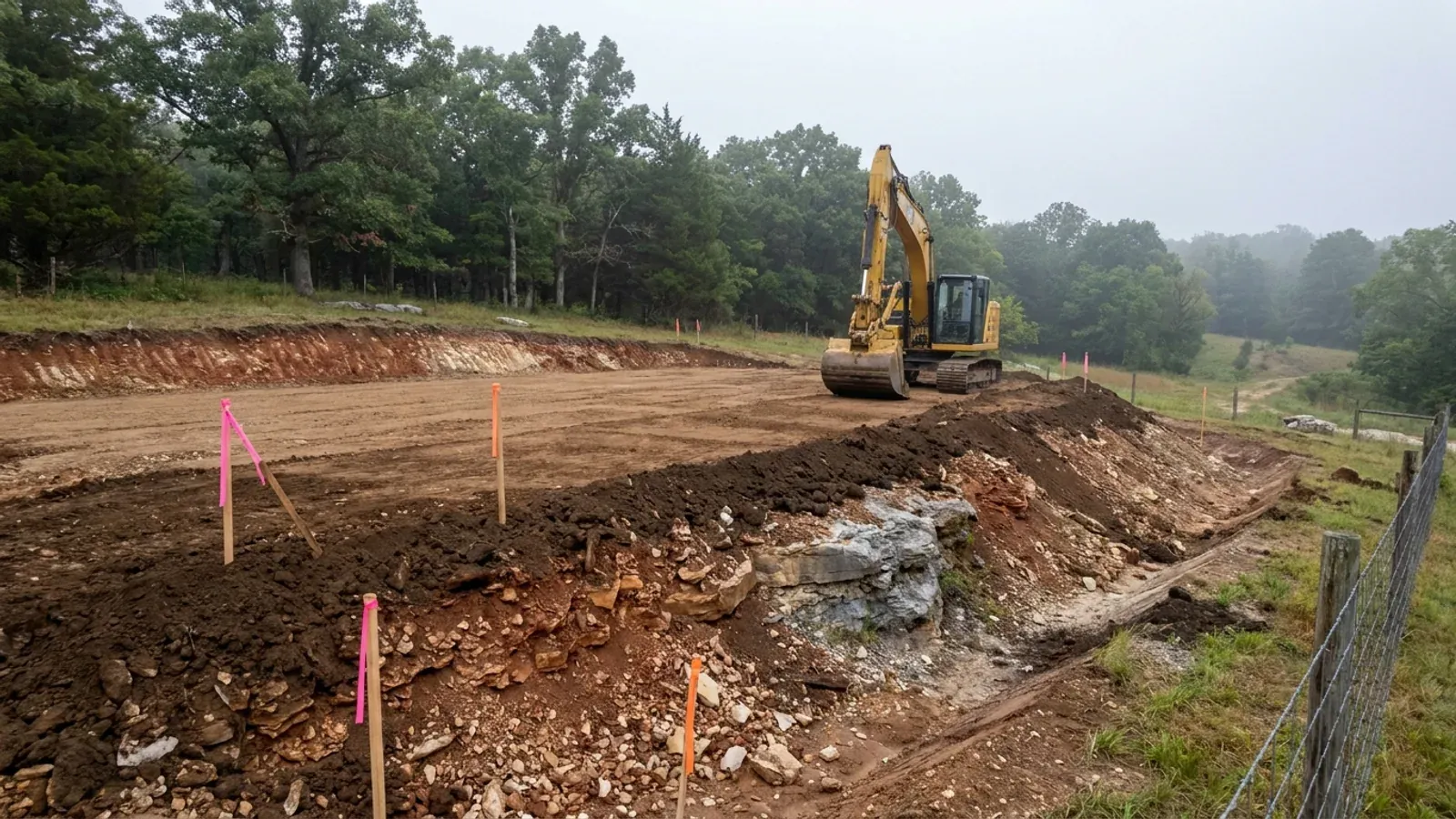
The expensive surprises are in the ground, not the building
What moves a Missouri budget is usually below grade, and which problem you have depends on where in the state you are. Across the Ozarks it is karst: the Department of Natural Resources maps more than sixteen thousand sinkhole points, and what matters there is what is under the slab rather than what the slab sits in. Across the north and centre it is claypan — dense, slow-draining subsoil that perches water above it for months of the year. In the Bootheel it is deep alluvium carrying the highest seismic demand in the state, where the same soils modelled for liquefaction attack post embedment and slab bearing rather than the frame above them. The same ground then decides the septic system, and Missouri does not run that on a percolation test alone: the rule allows a perc test or a soil morphology examination in a profile pit, and the authority reviewing your parcel picks which. Where a drainfield sits near a sinkhole's drainage, perc testing on its own is not permitted at all. Whether that authority is the state or your own county is itself a local question, and it changes what you have to file. So the site work, the foundation and the drainfield get resolved together rather than one at a time. We price the dirt before we price the building.
What we build in West Plains
All nine services are available in West Plains. What a build costs depends far more on the parcel than on square footage, so we price against your land rather than publishing a rate card.
Custom Plans
Barndominium floor plans drawn to your parcel and your soil, and to whichever Missouri authority — a county, a city, or none at all — will review them.
Barndominium Kits
Barndominium shell packages delivered to your Missouri land, drawn to the criteria your own county or city publishes — because the state publishes none.
Turnkey Builds
Start to finish barndominium construction in Missouri: the permits that genuinely apply, site work, shell and interior finish, under one contract.
What a build looks like
Three stages every West Plains project passes through, from a raw parcel to a finished home. Site work first, because that is where the budget is decided.
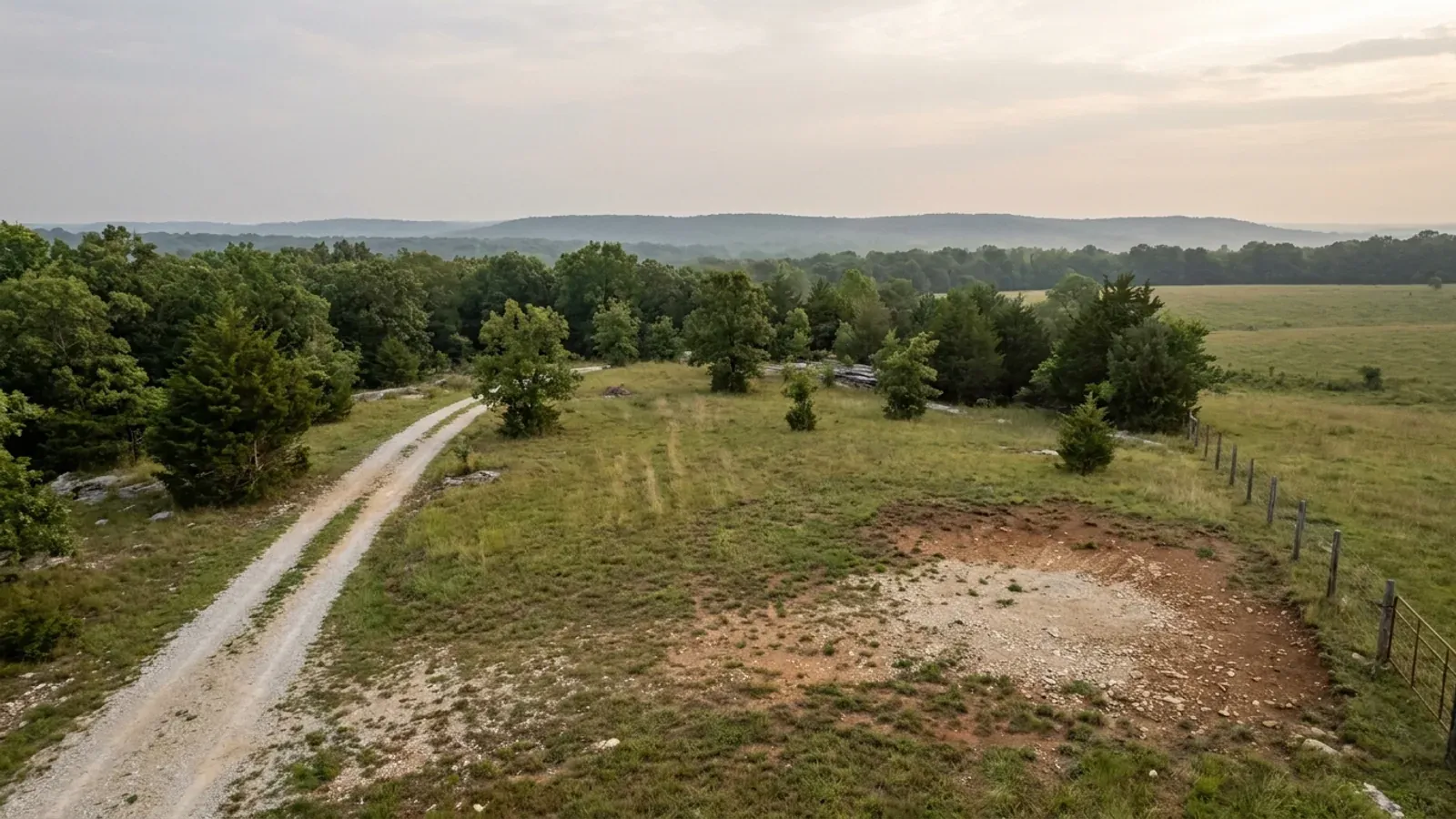
The parcel
Zoning, setbacks, flood zone and utility access get checked before anything is drawn.
Pad and permit
Clearing, grading and a compacted pad, while the submittal works through whichever office issues the permit where you are building.
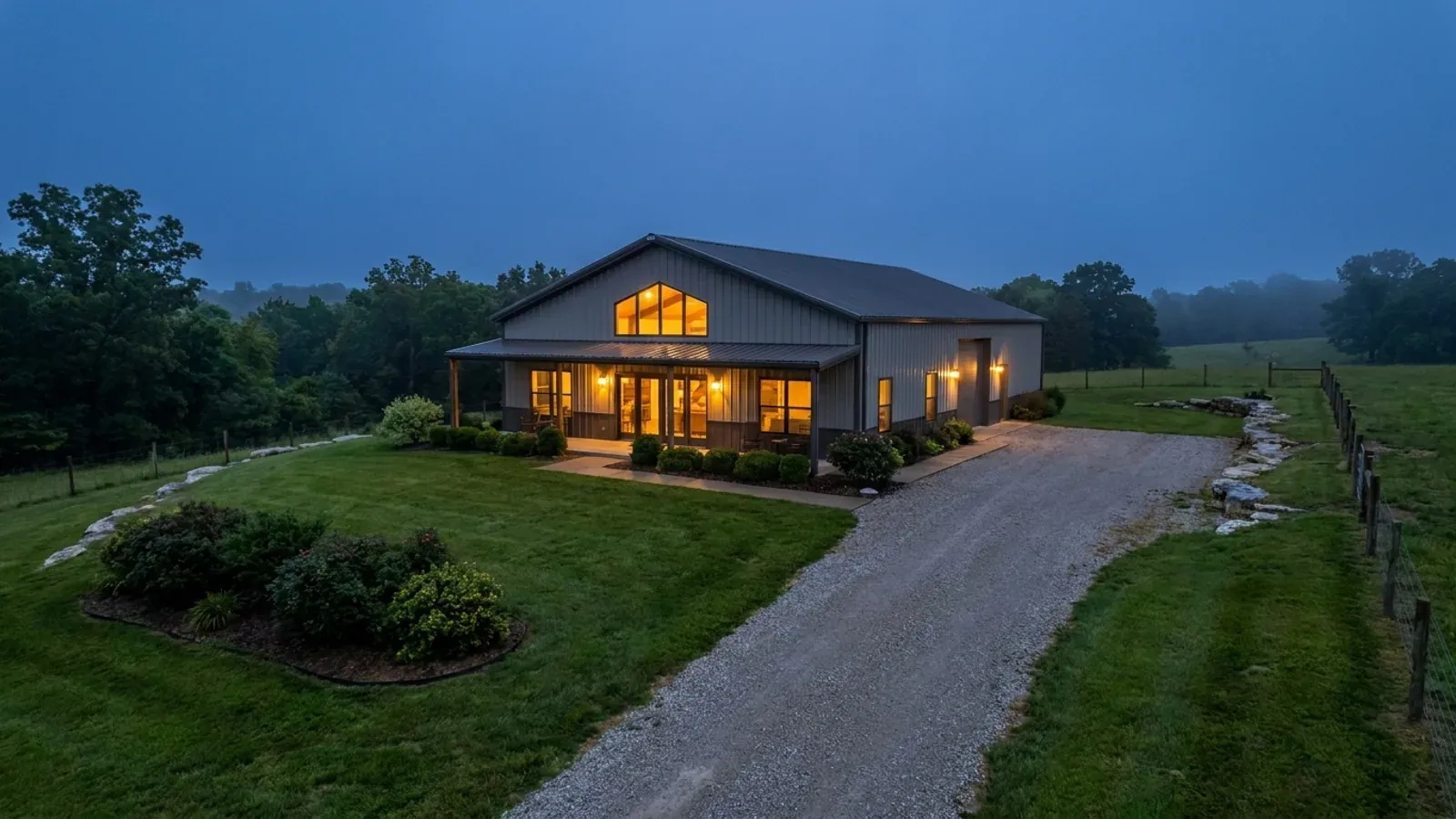
Frame to finish
Shell erected and dried in, then systems, insulation and interior finish through to CO.
Those are the rules where you are building in West Plains. Tell us what you want to build and we will draw it to them.
Where we build around West Plains
Howell County and the rural land around it. The buildable acreage for a project this size usually sits outside the city limits, which is frequently what changes who issues your permit.
Keep reading
The questions that usually come next once you know what West Plains allows.
Barndominium Cost Guide
Sourced per-square-foot ranges by tier and by size, with a calculator built on the same figures.
Read itIs It Legal in Missouri?
Classification, zoning, the HOA gate, and why "nonresidential farm building" does not cover a home.
Read itHow Long Does It Take?
Census build-duration data, and what actually sets the permit clock where you are building.
Read itNearby areas we build in
Others we cover nearby, and they are not interchangeable. One may be a county with an adopted building code, another a county with no legal authority to have one, another a city that permits inside its own limits whichever county the land sits in. So the office that issues the permit, whether anyone inspects the work at all, the fees, the zoning and the design figures can differ from one card to the next — sometimes across a single property line.
Building in West Plains: common questions
10 questions we get asked most often about building in West Plains. If yours is not on the list, ask it directly.
I am buying acreage outside West Plains. Will anyone inspect my house?
Is my three-acre tract really exempt from the septic permit?
Can I build a metal or post-frame house here, or does something ban the look?
How big a shop can I put up, and can I live in it while the house is being built?
What wind speed, snow load and frost depth should the drawings be engineered to?
Is flood insurance available on unincorporated Howell County land?
This is karst country. What does that mean for a slab and a drainfield?
Do I need a licensed contractor, and does the state license builders?
What does the city actually inspect, and how long does it take?
Is there any energy code here?
Building in West Plains?
Start with the plan. Tell us what you want to build and we will draw it, then confirm which office issues the permit for your parcel, what it will let you put there, and what wind load it has to meet. That conversation costs nothing.