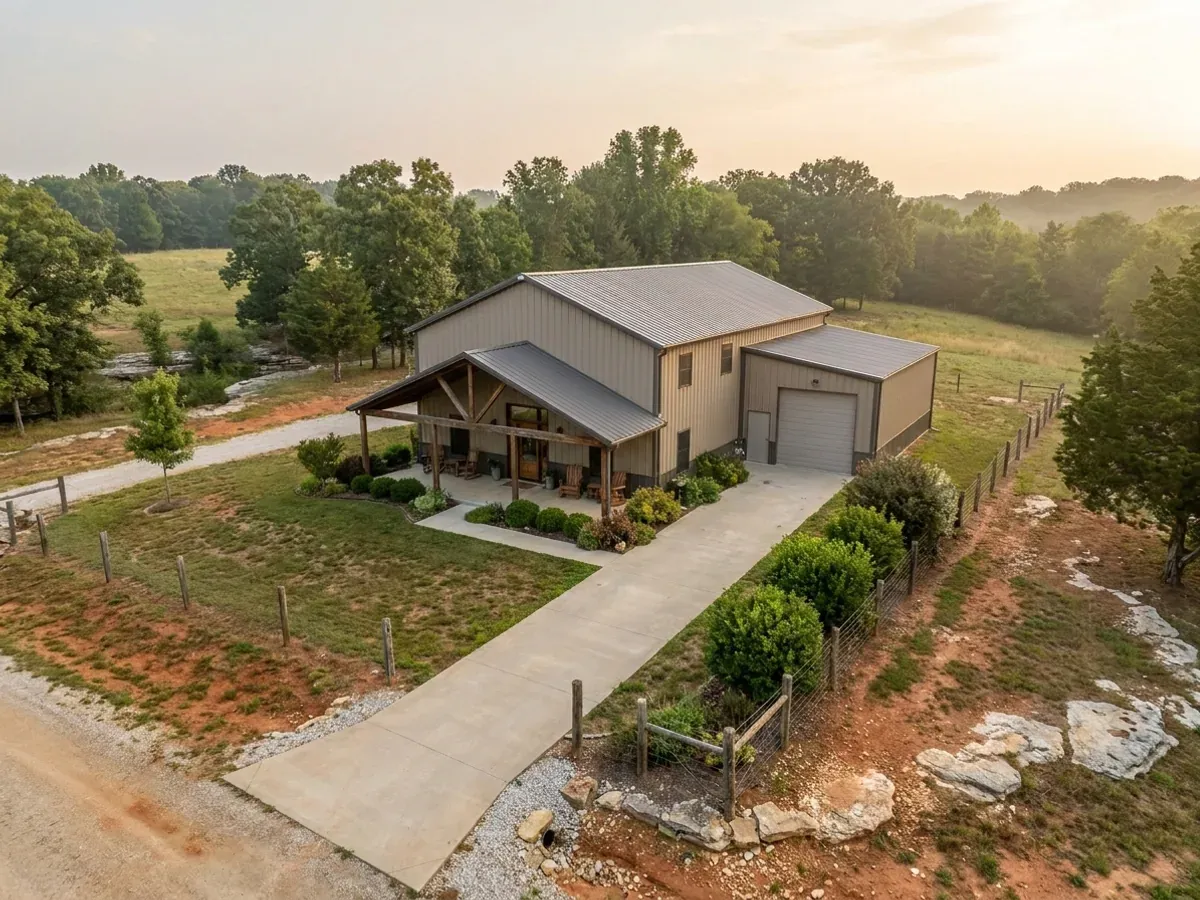
A completed barndominium home viewed from the front corner, with finished landscaping, a covered entry porch and an attached shop bay.

Turnkey Builds in Missouri

Turnkey means you sign once and get keys. We take the project from raw land through whatever permitting your parcel actually triggers, then site work, foundation, shell erection, mechanical rough-in and interior finish, on one contract and one schedule. Missouri makes the sequence unusual, and it is worth saying plainly rather than discovering: in much of rural Missouri nobody will inspect your building. The septic permit, the floodplain permit and the driveway permit are real and they are enforced, but not one of them looks at your framing, your foundation, your roof or your wiring, and your electric cooperative checks the meter base and nothing behind it. One contract exists so that one party is holding that chain — and so that the checks nobody else will run are arranged rather than assumed.

Permit-ready stamped drawings
Engineered for what your county actually requires

Turnkey Builds: how the work runs

Four stages, in this order. The sequence matters more than it looks: getting engineering and permitting settled before anything is fabricated is what keeps a build from stalling.

1

Feasibility, and finding out who actually gates your parcel

Before anything is drawn we establish four things about your land, because in Missouri they are all genuinely parcel-specific. Whether your county is in a classification that may hold a building code at all, and whether it does. Whether the county has zoning, which is a separate statute with a separate vote behind it. Which of three authority types permits your wastewater system, and whether the lot is large enough to sit outside the state programme. And whether the parcel is in a mapped flood hazard area and whether your county participates in the flood insurance programme, because seventeen Missouri counties chose not to.

2

The permit chain, in the order it actually bites

Missouri does not have one fixed statutory sequence the way some states do, so we run the chain in the order of how much each item can stop the job. Septic first, because it is the only one that is statewide. Then floodplain, but only if the parcel is in a special flood hazard area and the county participates. Then the driveway or entrance permit, from MoDOT for a state route or from the county road authority otherwise. Then a 911 address, which some Missouri counties assign and others do not. Then the electric utility, whose interest is the meter base and the service entrance. Then the well, which carries no landowner permit at all. Where your jurisdiction does have a building code, that submittal and its inspections slot in on top of all of it.

3

Site work and shell

Driveway and culvert, clearing, pad and slab, then the frame goes up and the building is dried in. Dried-in is the milestone that protects everything after it. Two Missouri scheduling items sit inside this step and both have clocks on them. The septic system has to be inspected before it is covered — a registered contractor gives notice before nine in the morning on the day preceding completion, the system stays open for inspection until three in the afternoon on the day of completion, and written confirmation of the result follows within three working days. And your well driller has sixty days from completion to file the water well report that produces the certification number, which is mailed to you as the owner.

4

Finish, and the handover in a county that will not do one

Mechanical, electrical, plumbing, insulation, interior finish and fixtures. In a jurisdiction with an adopted code that ends in final inspections and a certificate of occupancy. In a third-classification county with none, there is no certificate of occupancy to issue and nobody signs anything off — so the handover is a punch list we walk with you, plus the documentation of what was actually built: the sealed structural set, the septic construction permit and its inspection result, the well certification, and the utility's sign-off on the service entrance. That paperwork is the only record the building will ever have, which is a good reason to build it deliberately rather than end up with none.
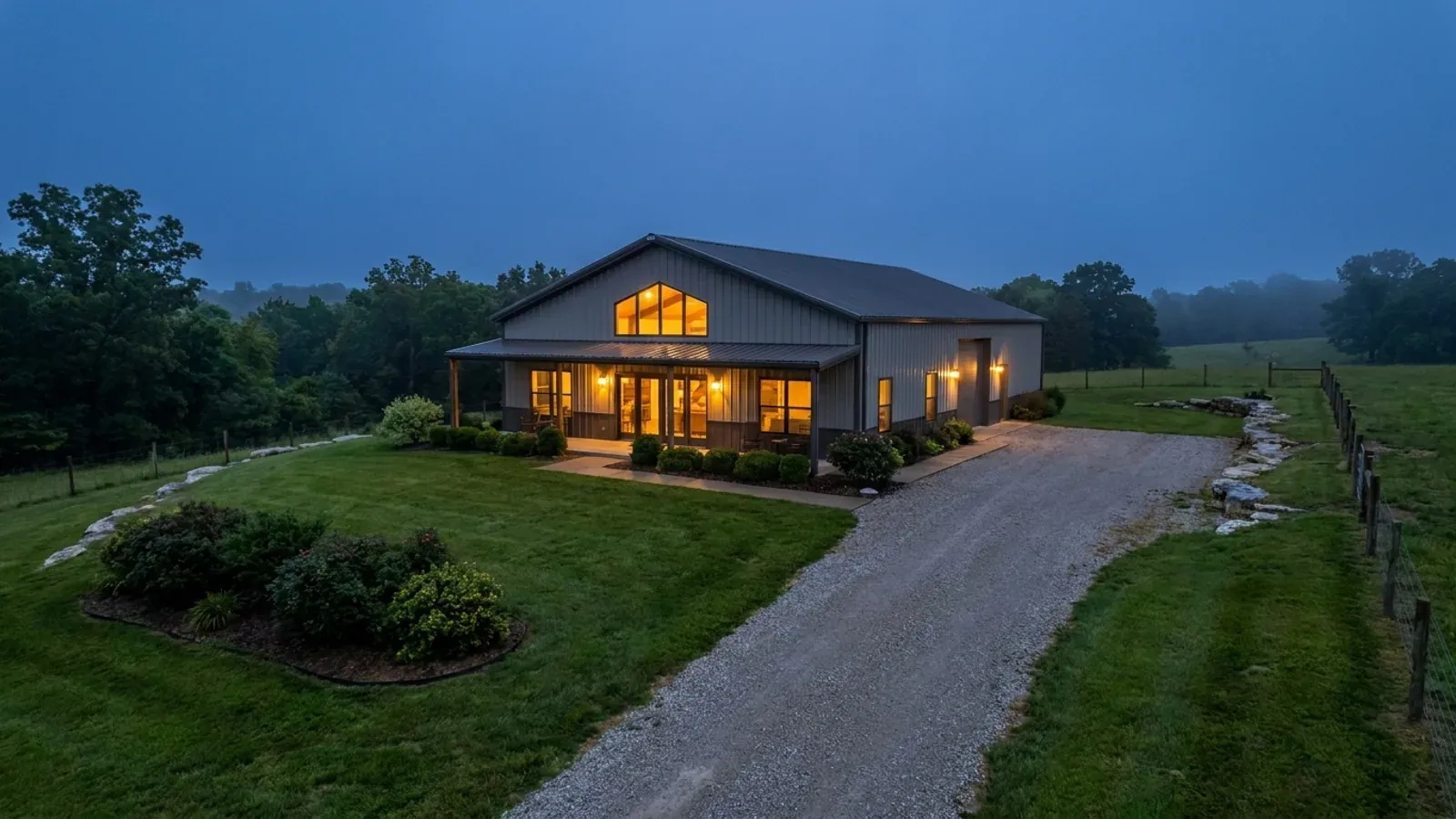
A finished barndominium at dusk with warm interior lighting glowing through its large windows.
The chain that does exist

The permits that bite in rural Missouri look at everything except the building

The septic construction permit is the one gate that is genuinely statewide. RSMo 701.046 requires notification and a construction permit before an on-site sewage disposal system is built, modified or majorly repaired — and the words are "the city, county or department", so where a county runs no programme of its own the Department of Health and Senior Services is itself the permitting authority. There is no gap. There is a real inspection attached to it, too, which in a county with no building department is likely to be the only inspection your project ever receives. Floodplain comes next, but only conditionally: the permit is issued by the local floodplain administrator, in unincorporated territory the county is the community, and seventeen counties and 146 municipalities that are floodprone had elected not to participate in the National Flood Insurance Program as of October 2017. Then the driveway permit, the 911 address in the counties that assign one, the utility's meter base, and the well. None of them opens a wall. None of them looks at a footing. If you want your barndominium checked, you have to arrange it.

Where we deliver turnkey builds

In Missouri the county line is a real boundary, and unusually it can decide whether there is a building code on your side of it at all. Only first- and second-classification counties may adopt one, and classification is set by assessed valuation rather than population — so a small county can have the authority while a much larger one does not. Cross a line and what changes is whether the build is inspected, who reviews the drawings, what they charge, how the land is zoned, and the design figures the work is engineered to. Two parcels twenty miles apart can carry completely different engineering, and sometimes completely different paperwork.

Serving clients across the entire region.

Every locality we build in has its own reviewer, its own fee schedule and its own filled-in design criteria. The service area pages set out what each one publishes.

View our full service area →
Before you commit

What actually decides the price

Square footage is the number everyone leads with, and it is rarely the one that moves a barndominium budget. These four do.

  • Which permits your parcel actually triggers

    This is a per-parcel answer in Missouri, not a state one, and it swings the schedule more than the budget. A build in a charter county or a first-classification county with an adopted code carries plan review, permit fees on that jurisdiction's own schedule, and inspections. A build in a third-classification county with no code and no zoning carries a septic permit, possibly a driveway permit, and nothing else — 89 of Missouri's 114 counties were third classification on the Missouri Association of Counties' May 2025 list, and a third-classification county has no building-code authority under RSMo 64.170 at all. Establishing which of those you are in is the first thing we do, because everything downstream is priced differently.

  • What the wastewater answer comes back as

    On Missouri acreage this is the item most likely to change the number, and occasionally to change whether the parcel is buildable. Missouri's rule sets hard edges by soil rate: slower than sixty minutes per inch and the system design has to be drafted and signed by a registered engineer unless the site was established by soil evaluation instead; slower than a hundred and twenty minutes per inch and an on-site system is not permitted at all except a lagoon or an engineered design under the rule's own provisions. There is also a real chance the state programme does not reach you: RSMo 701.031 excludes the owner of a single-family residence lot of three acres or more from it — though a county ordinance can still apply, and the duty to dispose of sewage sanitarily never goes away.

  • The site work nobody quotes honestly before seeing the land

    Four items account for most of the surprise on a rural Missouri build, and all four are parcel facts rather than estimating assumptions. The driveway and culvert, which is a MoDOT permit off a state route and a county permit off a county road. The distance and route of the power run to the building. Rock, which in the Ozarks is often shallow enough to change an excavation into a different job. And the well, whose casing requirement is not a guess here — the Missouri Well Construction Rules define thirteen drilling areas across the state on geology, groundwater hydrology, water quality and drilling conditions, and yield varies enormously by region, with most of the northwest province carrying less than 25 feet of clean sand. These are quoted as exclusions or allowances, in writing, rather than buried in a square-foot number.

  • How much of the inside is finished

    Two buildings with identical footprints diverge enormously on the split between finished living space and unfinished shop. Cabinets, flooring, fixtures and trim carry the widest range in the budget and it is the part you genuinely control. It is also the part where a number quoted before selections are made is not a real number, so it is carried as an allowance and reconciled against what you actually choose rather than guessed at and argued about later.

A completed barndominium home viewed from the front corner, with finished landscaping, a covered entry porch and an attached shop bay.

Turnkey Builds in Missouri: common questions

8 questions we get asked most often about building in Missouri. If yours is not on the list, ask it directly.

What does turnkey actually include?
Raw parcel through handover: feasibility on your land, the wastewater site evaluation and the septic construction permit, plans and drawings, whatever building or zoning permit your jurisdiction issues, clearing and pad, foundation, shell erection and dry-in, mechanical, electrical and plumbing, insulation, interior finish and fixtures, and every inspection that actually exists where you are building. One contract, one schedule, one point of contact. What is excluded is written down rather than assumed, because excluded items are where disputes come from — and on rural Missouri land the four that most often surprise a buyer are well depth and casing, rock in the excavation, the length of the power run, and the driveway culvert. Missouri sets no state-level scope for what a residential contract must contain, so the written exclusions sheet is doing real work here rather than repeating a form.
What order does a Missouri build actually happen in?
There is no single statutory sequence in Missouri, which is itself the answer worth having. What there is, is a chain of gates with very different amounts of bite, and we run it in that order. First the septic construction permit, because it is the only genuinely statewide gate: RSMo 701.046 requires an application and a construction permit before a system is built, and it names the city, the county or the department — so where a county has no programme, the Department of Health and Senior Services permits it directly and there is no gap. It also carries a real inspection, which in a county with no building department is often the only inspection the project gets. Second, the floodplain development permit, but only where the parcel sits in a special flood hazard area and the community participates. Third, the driveway or entrance permit — MoDOT for a state route, the county road authority otherwise. Fourth, a 911 address, which some counties assign for new construction and others do not. Fifth, the electric utility, whose requirement is its own meter base and service entrance specification. Sixth, the well, which needs no landowner permit at all — the permit is occupational and belongs to the driller. Where your jurisdiction has adopted a building code, its submittal, plan review and inspections sit on top of that chain rather than replacing it.
Who inspects my building in Missouri?
It depends entirely on where you are building, and for most of the state the honest answer is nobody. Under RSMo 64.170 only counties of the first and second classification may adopt a building code, and even then a county that did not have one on 28 August 2001 needs a referendum of its unincorporated voters first; Missouri's five charter counties act under their charters instead. On the Missouri Association of Counties' May 2025 list, 89 of the 114 counties are third classification and have no county building-code authority whatsoever. In those counties there is no plan review, no framing inspection and no certificate of occupancy. People assume the electric utility backstops this and it does not: Platte-Clay Electric Cooperative's own engineering rules state that the cooperative does not inspect members' wiring for compliance with electrical codes or regulations established by public bodies, and Cuivre River Electric Cooperative inspects the meter base only if the city or county requires it — its own jurisdiction table records "Not required" against unincorporated Lincoln County. What the utility does enforce, unconditionally, is its own meter base specification: a non-conforming meter base does not get energised. That covers the meter base. It covers nothing behind it.
My county issues building permits. Does that mean somebody checks the work?
Not necessarily, and Missouri is the state where that distinction is sharpest. "Do I need a permit?" and "will anyone look at my building?" are different questions here with different answers. The clearest illustration is a permit that lives in Missouri's tax statutes rather than its building statutes: RSMo 137.177, sitting in Title X on Taxation and Revenue, lets certain second-classification counties require a permit before a building costing over six hundred dollars is erected outside city limits, issued by the county clerk on payment of a five dollar fee — and the clerk then delivers a list of the permits issued to the county assessor every January and July. There is no code in it, no plan review and no inspection. It exists so the assessor learns about new improvements. That section is narrowly bracketed and does not apply everywhere, but the shape of the point is general: where a Missouri jurisdiction issues a permit, ask what the permit actually buys before inferring that a building official will look at your framing.
Do I need a licensed contractor in Missouri?
There is no such thing as a Missouri state contractor licence, and that is checkable rather than convenient. The Missouri Division of Professional Registration's board list runs to about forty boards — accountancy, architects and engineers and surveyors, electrical contractors, cosmetology, veterinary and the rest — and there is no general contractor board, no residential builder board, no home improvement board, no plumbing board and no mechanical board. RSMo Chapter 324's only construction-trade heading is Electrical Contractors, and even that statewide electrical licence is optional: RSMo 324.920 says a person working in a political subdivision that does not require a local licence, or one where they already hold the local licence, is not required to hold the statewide one. What does exist is municipal, and the list is short and knowable. Kansas City requires a Residential Building Contractor licence to contract to build or structurally alter a one- or two-family dwelling — and also for a detached accessory building over 400 square feet. Independence licenses contractors in four classes and requires a 75 percent passing score on a national exam or a construction-related degree. The City of St. Louis — which is an independent city and is not part of St. Louis County — requires a Construction Industry Contractor Graduated Business License from the License Collector. St. Charles County licenses electricians, plumbers, mechanical contractors, pool installers, drainlayers, third-party inspectors and blasters, but not general contractors. In unincorporated Greene County the county states the only licensing requirement is that wastewater installers be county- and state-certified. In unincorporated Jackson County, electrical, mechanical and plumbing work has required a Class A or B licence since 28 January 2014. Separately from all of that, Missouri sets a workers' compensation rule specific to this industry: most Missouri employers are not covered until they have five employees, but a construction employer who erects, demolishes, alters or repairs improvements is an employer under the chapter at one.
What paperwork am I owed before I pay anyone anything?
One document, and it is a genuine Missouri right almost nobody mentions. Under RSMo 429.012, an original contractor who performs work or furnishes material for a building or improvement must give the person they contracted with a written NOTICE TO OWNER, in ten-point bold type, before receiving payment of any kind — at the time the contract is signed, when materials are delivered, when work commences, or with the first invoice. The notice warns that a contractor's failure to pay suppliers or subcontractors can result in a mechanic's lien on your property, and tells you that you may ask for lien waivers from everyone supplying material or services. It is not a formality: RSMo 429.012.2 makes giving it a condition precedent to the creation, existence or validity of that contractor's own mechanic's lien. So a contractor who does not give you the notice has given up their lien. Two related Missouri facts worth having. A mechanic's lien must be filed within six months after the indebtedness accrued, and anyone other than the original contractor must give the owner ten days' notice before filing one. And do not expect a Consent of Owner form on a new build — RSMo 429.013 applies only to the repair, remodelling of or addition to owner-occupied residential property, and says expressly that it does not apply to the building or erection of the original residential unit.
My land is in a floodplain, or near a river. What changes?
A good deal, and one sentence in the state's own guidance settles the question buyers usually ask first. The Missouri floodplain guide published with FEMA lists construction of agricultural buildings among the activities requiring a local permit inside a special flood hazard area, adds that non-elevated agricultural structures may be permitted only by variance, and then states flatly that farm houses are not agricultural structures. So a barndominium in a mapped flood hazard area is variance territory, not exempt territory. The same conclusion arrives independently from the zoning side: Missouri's agricultural exemption from county zoning applies only to farm buildings "in an area not within the area shown on the flood hazard area map", so inside the mapped area the exemption does not apply at all. Who issues the permit is the local floodplain administrator, and in unincorporated territory the county is the community, acting under its own adopted floodplain ordinance. But do not assume there is one: seventeen counties and 146 municipalities that are floodprone had elected not to participate in the National Flood Insurance Program and did not enforce floodplain management regulations, as of October 2017. Missouri also has a statute nobody expects here — RSMo 49.600 provides that in a county without planning and zoning, no flood-program ordinance is effective unless the county's voters authorised it, and the voters can rescind it later by petition. The parcel's flood zone comes from FEMA's Flood Map Service Center, one parcel at a time, and it is worth pulling before land money moves.
Do I have to install fire sprinklers?
No, and this is one of the very few things Missouri genuinely says about every new house in the state. RSMo 67.281 requires a builder of one- or two-family dwellings or townhouses to offer the purchaser the option, at the purchaser's cost, of installing fire sprinklers, on or before the time the purchase contract is entered into. And then it removes the question from local hands entirely: notwithstanding any other provision of law, no purchaser of such a dwelling may be denied the right to choose or decline to install a fire sprinkler system by any code, ordinance, rule, regulation, order or resolution of any county or other political subdivision. So no Missouri city or county can make residential sprinklers mandatory in a new one- or two-family dwelling. You will get the offer from us because the statute requires it, and the decision is yours. If you do want them — a large open shop volume under the same roof as the living space is a reasonable case for it — it is far cheaper decided before the frame goes up than after.

Ready to put turnkey builds against a real plan? Start there and the rest follows.

Tell us about the land

Send the parcel ID or an address and we will come back with what can be built on it, the wind load it has to meet, and a realistic budget range. That conversation costs nothing.