Barndominium Builders in Crawford County, MO
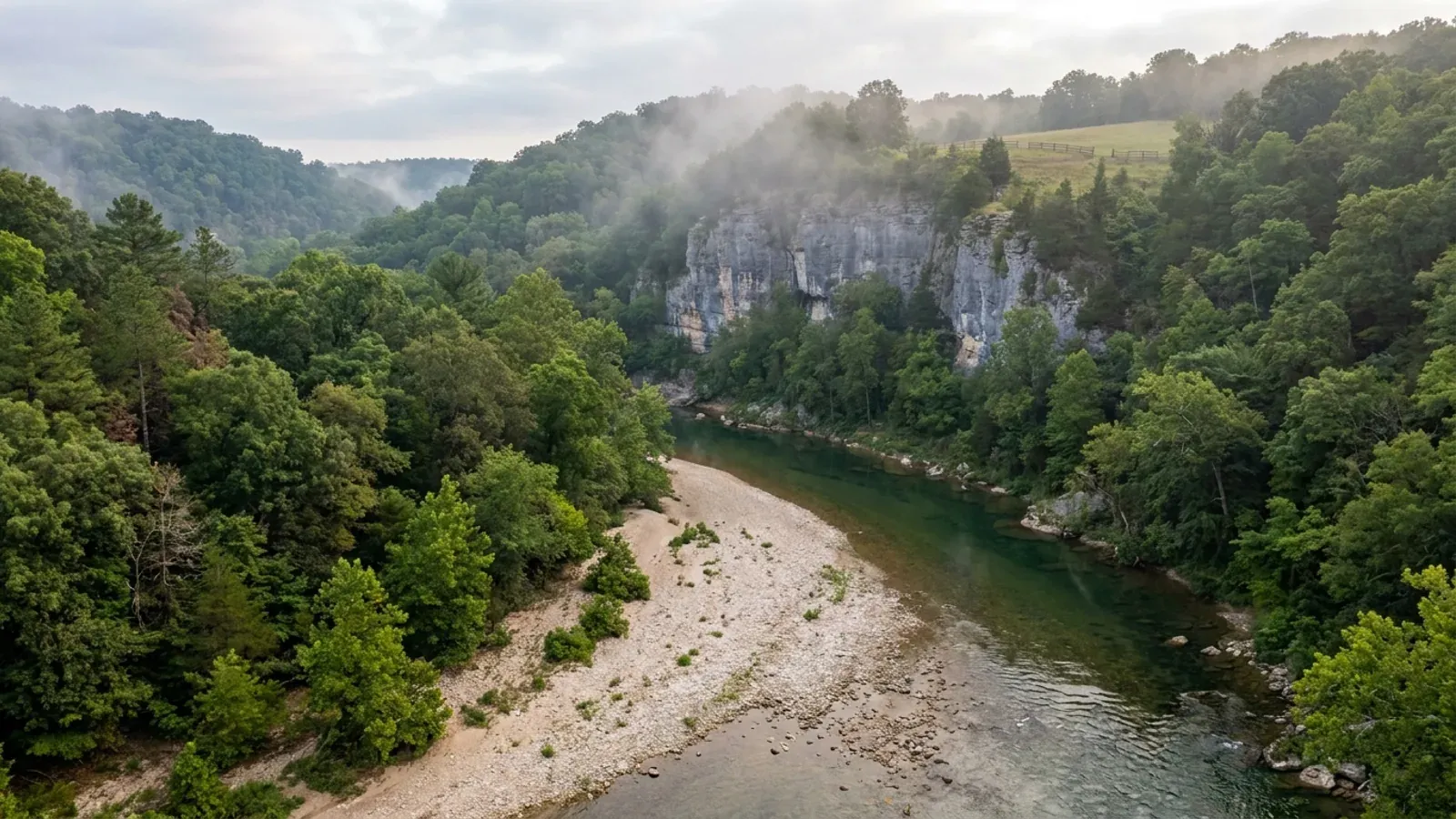
Crawford County is float-stream country. The Meramec, the Huzzah and the Courtois run through it, Onondaga Cave at Leasburg is a National Natural Landmark, and the whole of it sits on I-44 inside ninety minutes of St. Louis. That combination — cheap wooded acreage, canoe outfitters, weekend buyers and a metro within an easy drive — is what makes this a barndominium market rather than simply a rural one. The land data says the same thing in colder terms: 581 farms, 194,055 acres in farms, an average holding of 334 acres, and 62,668 of those acres carried as woodland. Land in farms is up 21 percent since 2017 while the number of farms fell 7 percent, which is what a recreational-acreage market looks like in an agricultural census. The regulatory answer here is unusual, and it is worth getting right before you buy. Crawford County is a county of the third classification. RSMo 64.170 empowers only counties of the first and second classification to control construction and issue building permits, so the county commission has no power to adopt a residential code, no county building permit to issue and no house to inspect. Its own published service list runs the County Clerk, assessment and collection, the Recorder of Deeds, the Circuit Court, the Treasurer, the Health Department, two road districts and the Sheriff — and stops there. That is not the end of it, though, and this is where Crawford differs from most of the counties around it. All four registered fire services in the county are Chapter 321 fire protection districts, and two of them regulate construction under RSMo 321.220(12). The Cuba Community Fire Protection District adopted the 2018 International Building Code and the 2018 International Fire Code by ordinance in December 2021, charges eight cents a square foot with a $150 minimum, and says its building ordinance reaches the unincorporated portions of Crawford County as well as the city of Cuba. The Bourbon Fire Protection District adopted the 2018 International Fire Code in 2021 and requires a building permit, plan review and an on-site inspection for new commercial construction. Neither district adopted a residential code, and the statute that lets them act bars them from requiring permits for farm buildings — so the question on any particular tract is which district it falls in and what the fire marshal says the district's code reaches. Inside the towns the answer changes again, and it changes twice. Cuba adopted the 2009 family of ICC codes; the city of Sullivan, whose limits reach across the Franklin County line into Crawford, adopted the 2018 International Residential Code with a filled-in design table. Three code generations inside one county line, and the largest share of the county's people — roughly two in three — living under none of them. What is left as the real gate is water and ground. The Crawford County Health Department in Steelville is the onsite wastewater permitting authority and holds an ordinance of its own, so the septic permit is the document that actually governs a build here. And the ground is karst: the state's inventory maps 92 sinkholes inside the county boundary. What that karst does not mean is shallow rock. Measured against the county's own soil survey, lithic and paralithic bedrock lies within about twenty inches on only 2.7 percent of the survey area. The constraints that bite are chert gravel, slope and a fragipan, not rock at the footing.
Crawford County at a glance
- County
- Crawford County
- Population
- 22,808
- ZIP codes
- 65565, 65453, 65441, 65535, 65456, 65449, 65446, 65586, 63080
- Site visits
- First site visits anywhere between Sullivan, Bourbon, Cuba, Leasburg and Steelville, usually within the week
Building conditions in Crawford County
Missouri sets no residential building code and no statewide way of adopting one, so the first question on any parcel is not what the code says — it is whether there is one. Only counties of the first and second classification may adopt a building code at all, and classification is set by assessed valuation rather than population, so a small county can hold the power while a much larger one does not. Zoning is a separate power with its own answer, granted only after a vote of the people and repealable by another. What changes from one jurisdiction to the next is whether the work is inspected, who issues the permit, what that office charges, how the parcel is zoned, and the design figures your drawings have to satisfy.
RSMo 64.170 (Effective 28 Aug 2008) and RSMo 48.020 (Effective 28 Aug 2026), rendered from revisor.mo.gov/main/OneSection.aspx 8 Sep 2026; Missouri Association of Counties, 'Missouri Counties by Classification', published May 2025, CLASS 3 block (total 89); Crawford County service list, crawfordcountymo.net/service-list/, read 8 Sep 2026
Missouri Division of Fire Safety, Fire Departments by County report generated 8 Sep 2026 from apps1.mo.gov/fsreg (Crawford: Bourbon FPD 02803, Cuba Community FPD 02804, Steelville FPD 02805, Leasburg FPD 02806); Cuba Community Fire Protection District Ordinances 21-01 and 21-02, enacted 14 Dec 2021, effective 1 Jan 2022, read from cubamofire.com 8 Sep 2026; Bourbon Fire Protection District fire prevention page and building permit application, bourbonfpd.com, read 8 Sep 2026
Cuba Community Fire Protection District Ordinance 21-02 §§ 1–2, enacted 14 Dec 2021, read from cubamofire.com 8 Sep 2026 and re-read from an independent navigation the same day; RSMo 321.220 (Effective 28 Aug 2025) and RSMo 321.228 (Effective 28 Aug 2012), rendered from revisor.mo.gov/main/OneSection.aspx 8 Sep 2026
Missouri DHSS onsite wastewater construction permit process county selector, health.mo.gov/business-professionals/onsite-wastewater-treatment/owts-construction-permit-process?county=Crawford, read 8 Sep 2026 (Agency: Crawford County Health Department; Authority Type: Ordinance; 202 W. Main St., Steelville, MO 65565; (573) 775-2555); RSMo 701.031 (Effective 28 Aug 2005) and RSMo 701.047 (Effective 28 Aug 1994), rendered from revisor.mo.gov 8 Sep 2026
Missouri DNR sinkhole layer, gis.dnr.mo.gov/host/rest/services/geology/sinkholes/MapServer layer 1, queried 8 Sep 2026 by point-in-polygon against the Census TIGERweb 2026 county boundary for STATE 29 COUNTY 055 (method validated the same day against Greene 1,471, Pulaski 138 and Camden 91); USDA-NRCS Soil Data Access, survey area MO055 Crawford County, Missouri, survey version 31 last refreshed 2 Sep 2025, queried 8 Sep 2026 — total 475,872 map-unit acres across 82 map units; bedrock figure is corestrictions.resdept_r, which is in CENTIMETRES, filtered to reskind 'Lithic bedrock' and 'Paralithic bedrock', de-duplicated to one MIN(resdept_r) per cokey, weighted by mapunit.muacres x comppct_r/100, threshold 51 cm = 20.1 in giving 12,890.96 acres (2.709%) and threshold 102 cm = 40.2 in giving 110,007.85 acres (23.12%)
City of Sullivan Code §§ 500.190–500.210, Ord. No. 3823, 11-20-2018, codified text current through legislation of 06-02-2026, read at ecode360.com/28373626 8 Sep 2026 (page title verified 'Article VII: International Residential Code - City of Sullivan, MO'); Census Vintage 2024 sub-county estimates sub-est2024_29.csv, Sullivan city (pt.) Crawford 1,502 and Franklin 5,423; OpenFEMA NfipCommunityStatusBook v1, community 290136, retrieved 8 Sep 2026; USGS ASCE 7-16 building-codes service, /ws/building-codes/asce7-16/calculate, five points queried 8 Sep 2026, payload request.status 'success'
Also worth knowing before you build in Crawford County
- Cuba adopted the 2009 codes, and caps a detached garage at 1,200 square feet
- Section 500.010 of Cuba's code, as it stands after Ordinance No. 1182 of 5 November 2020, adopts the 2009 International Building, Residential, Fire, Energy Conservation, Plumbing, Mechanical, Fuel Gas, Property Maintenance and Zoning codes together with the 2008 NFPA National Electrical Code, under the RSMo 67.280 power to incorporate technical codes by reference. The city's amendments to those codes are recorded as being on file in the city office rather than printed in the code, so Cuba publishes no design table of its own; the word 'frost' appears once in the whole code, in the mobile home park chapter. On the zoning side Cuba is the sharpest instrument in the county for anyone who wants a shop as well as a house. Section 400.1030.A.1 allows one detached garage or covered carport per residential structure in the R-1 district, sized at 250 square feet for each 3,000 square feet of lot area, and then states that 'in no event shall the garage or carport area exceed a total of twelve hundred (1,200) square feet' — a ratio to lot size with a hard ceiling that no amount of extra land will lift. Section 400.970 adds that an accessory structure in a rear yard may not cover more than 30 percent of the required rear yard area. What Cuba does not do is restrict what the building is made of: the word 'corrugated' does not appear anywhere in its code, 'metal' appears only in the scrap-metal, metal-tired-vehicle and culvert provisions, and there is no minimum roof pitch, no eave requirement and no design review of exterior materials.
- Sullivan deletes the energy testing and keeps the solid-rock footing
- Sullivan's adoption of the 2018 International Residential Code came with more than fifty amendments, and several of them matter to a steel-skinned building. The city deletes Chapter 11, Energy Efficiency, in its entirety and replaces it with Chapter 11 of the 2009 International Residential Code, then deletes the blower-door testing option at N1102.4.2.1 and the duct tightness testing at N1103.2.2, both the post-construction and the rough-in test. It rewrites R403.1 so that all exterior walls are supported on continuous solid or fully grouted masonry or concrete footings, or another approved structural system, on undisturbed natural soil or engineered fill; deletes the model footing tables and figures and substitutes its own, 8 inches by 24 inches for one and two storeys and 10 by 24 for three, good for foundation walls up to ten feet with anything taller requiring a designed footing. It keeps 'erected on solid rock' as one of the four permitted frost protection methods at R403.1.4.1 — a live provision in the codified text, not a repealed one — and exempts free-standing accessory structures of 200 square feet or less with an eave height of ten feet or less from frost protection entirely. R105.2 exempts the same 200-square-foot detached accessory building from needing a permit at all, and a new R106.2.1 requires a boundary survey by a licensed Professional Land Surveyor on every lot before a site location inspection.
- Roughly two in three people here live outside every city
- The Census Bureau's Vintage 2024 estimates put Crawford County at 22,808 people. Add up the incorporated places and the total inside city limits is about 8,069: Cuba 3,230, Bourbon 1,533, Steelville 1,445 as the county seat, the Crawford County part of Sullivan 1,502, Leasburg village 318 and St. Cloud village 41. That leaves roughly 14,700 people, close to 65 percent of the county, living in unincorporated territory — Berryman, Cherryville, Cook Station, Davisville, Dillard, Huzzah, Wesco and the miles of wooded acreage between them. It is also worth knowing that the county has been growing again: after falling from 23,054 at the 2020 base to 22,622 in 2022, it added 69 in 2023 and 117 more in 2024.
- 581 farms, 334 acres apiece, and a third of the farmland in trees
- The 2022 Census of Agriculture counts 581 farms in Crawford County holding 194,055 acres, an average of 334 acres each. Land in farms is up 21 percent since 2017 and the average holding up 31 percent, while the number of farms fell 7 percent — bigger blocks in fewer hands, which is the shape of a market where recreational buyers are assembling acreage rather than subdividing it. Of that land, 83,619 acres are pastureland, 62,668 acres are woodland and only 37,793 are cropland. By size, 191 of the farms fall between 50 and 179 acres, 140 between 180 and 499, and 57 run past a thousand.
- The electric cooperative is not a backstop for the building
- Outside the cities, power here comes from Crawford Electric Cooperative at 10301 N. Service Rd. in Bourbon, which states it serves almost 17,000 members through just over 21,500 meters across Crawford, Franklin, Washington, Gasconade, Jefferson, Dent and Phelps counties and has done since 1940. Its published route to a new connection is a signed membership application, photo identification, the account or meter number and the service address, and either a security deposit or a credit check — with a separate line extension policy and an appointment where a new line has to be built to the property. There is no building permit in that list, no inspection of the house and no requirement to produce anything from the county. Inside Cuba the picture is different, because the city runs its own electric, natural gas, water and sewer systems and its public works office is the place the city directs people for zoning questions and occupancy and safety permits.
- Flood mapping is old here, and one town has none
- Crawford County's unincorporated area has been in the regular National Flood Insurance Program since 1 May 1987, having been mapped by a flood hazard boundary map on 19 April 1983, and its currently effective flood insurance rate map is dated 20 May 2010. Steelville, Cuba and Leasburg village carry the same 20 May 2010 map date. Bourbon is listed with no special flood hazard area identified at all. None of the five Crawford County communities is recorded as non-participating. A sixteen-year-old effective map on ground drained by three float streams is worth treating as a starting point rather than an answer, particularly on a river tract where the mapped line and the ground you can see may not agree.
- The county seat does not publish its ordinances, and neither does Bourbon
- Cuba and Sullivan both publish complete codified ordinances online. The other two towns do not. Steelville's city website carries a Planning and Zoning Board with a named chair and five members meeting the second Tuesday of the month, and a separate Appeals and Adjustments board, so the county seat plainly zones — but the ordinances themselves are not posted, and the practical route is City Hall at 895 Frisco Street. Bourbon's official city site is a utility billing portal for water, sewer and trash and carries no ordinances, permits or code pages at all. On any parcel inside either town, the answer to what may be built has to come from the clerk rather than from a screen, and that is worth allowing time for.
City of Cuba, MO Code § 500.010 (CC 1996 § 6-65; Ord. No. 1077; Ord. No. 1182, 11-5-2020), §§ 400.970 and 400.1030 (CC 1996 §§ 25-251, 25-263; Ord. No. 891), read at ecode360.com/34812124 and ecode360.com/34816760 on 8 Sep 2026 with page titles verified as '- City of Cuba, MO'; full-code searches run the same day returned 0 hits for 'corrugated' and 0 for 'post-frame' against 169 for 'zoning' as a positive control
City of Sullivan Code § 500.210, Ord. No. 3823, 11-20-2018, amendments 1–46 to the 2018 International Residential Code, codified text current through legislation of 06-02-2026, read at ecode360.com/28373626 8 Sep 2026
Census Bureau Vintage 2024 population estimates, co-est2024-alldata.csv and sub-est2024_29.csv, downloaded from www2.census.gov 8 Sep 2026
USDA NASS 2022 Census of Agriculture, Crawford County, Missouri county profile cp29055.pdf, downloaded 8 Sep 2026
Crawford Electric Cooperative, crawfordelec.com/Service, read 8 Sep 2026 (page title verified 'Connect Service | Crawford Electric Cooperative'; bogus control path returned 'Resource Not Found'); City of Cuba public works page, cityofcubamo.gov/services/public_works.php, read 8 Sep 2026
OpenFEMA NfipCommunityStatusBook v1 filtered to state MO and county 'CRAWFORD COUNTY', retrieved 8 Sep 2026, last refresh 25 Aug 2026 — communities 290795 Crawford County, 290113 Bourbon, 290114 Steelville, 290561 Leasburg, 290856 Cuba
City of Steelville planning and zoning and city hall pages, steelville.com, read 8 Sep 2026 (bogus control path returned an honest 404 titled 'Page not found'); City of Bourbon official site, bourbonmo.com redirecting to cityofbourbononline.com, read 8 Sep 2026
The expensive surprises are in the ground, not the building
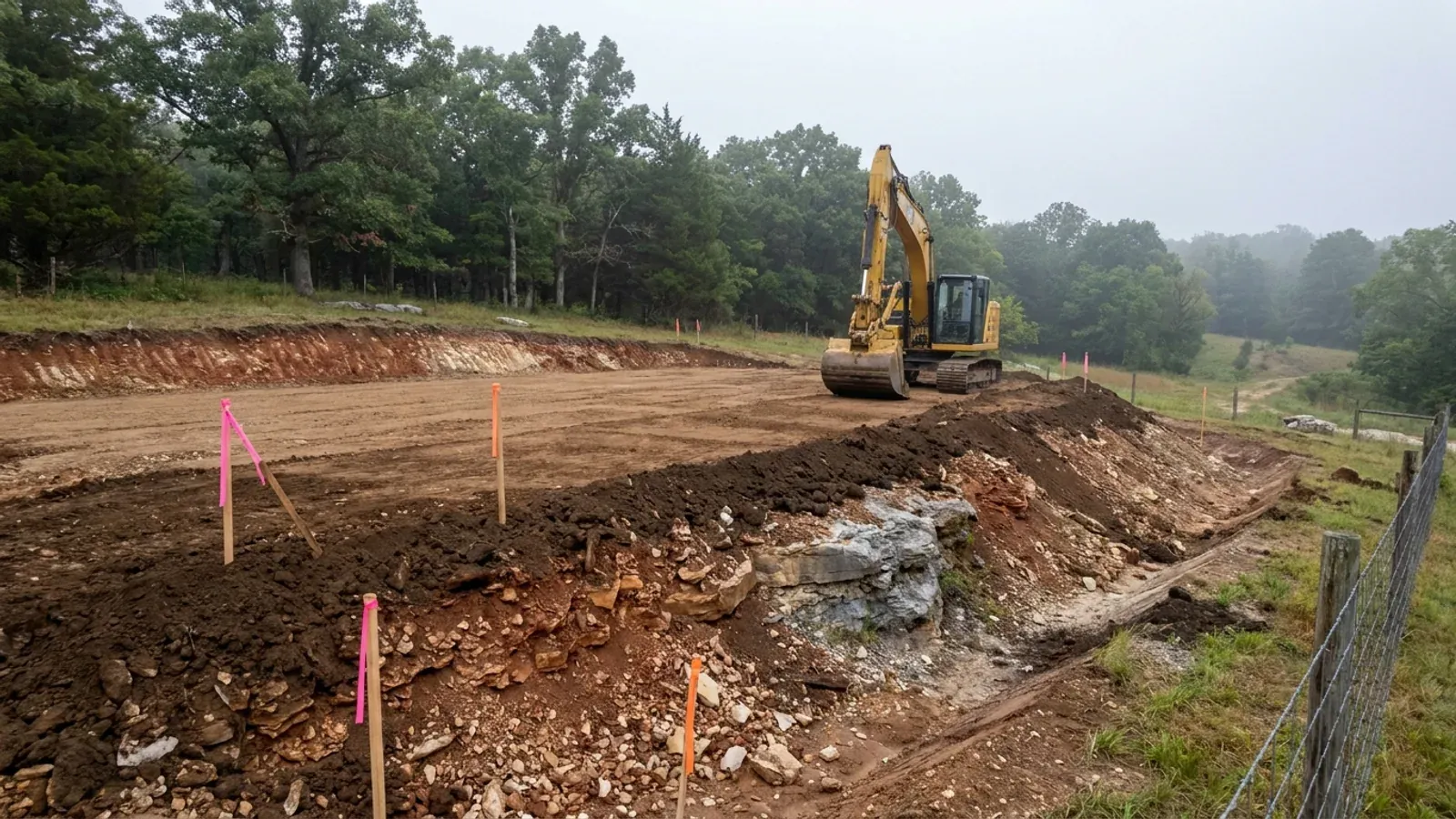
What moves a Missouri budget is usually below grade, and which problem you have depends on where in the state you are. Across the Ozarks it is karst: the Department of Natural Resources maps more than sixteen thousand sinkhole points, and what matters there is what is under the slab rather than what the slab sits in. Across the north and centre it is claypan — dense, slow-draining subsoil that perches water above it for months of the year. In the Bootheel it is deep alluvium carrying the highest seismic demand in the state, where the same soils modelled for liquefaction attack post embedment and slab bearing rather than the frame above them. The same ground then decides the septic system, and Missouri does not run that on a percolation test alone: the rule allows a perc test or a soil morphology examination in a profile pit, and the authority reviewing your parcel picks which. Where a drainfield sits near a sinkhole's drainage, perc testing on its own is not permitted at all. Whether that authority is the state or your own county is itself a local question, and it changes what you have to file. So the site work, the foundation and the drainfield get resolved together rather than one at a time. We price the dirt before we price the building.
What we build in Crawford County
All nine services are available in Crawford County. What a build costs depends far more on the parcel than on square footage, so we price against your land rather than publishing a rate card.
Custom Plans
Barndominium floor plans drawn to your parcel and your soil, and to whichever Missouri authority — a county, a city, or none at all — will review them.
Barndominium Kits
Barndominium shell packages delivered to your Missouri land, drawn to the criteria your own county or city publishes — because the state publishes none.
Turnkey Builds
Start to finish barndominium construction in Missouri: the permits that genuinely apply, site work, shell and interior finish, under one contract.
What a build looks like
Three stages every Crawford County project passes through, from a raw parcel to a finished home. Site work first, because that is where the budget is decided.
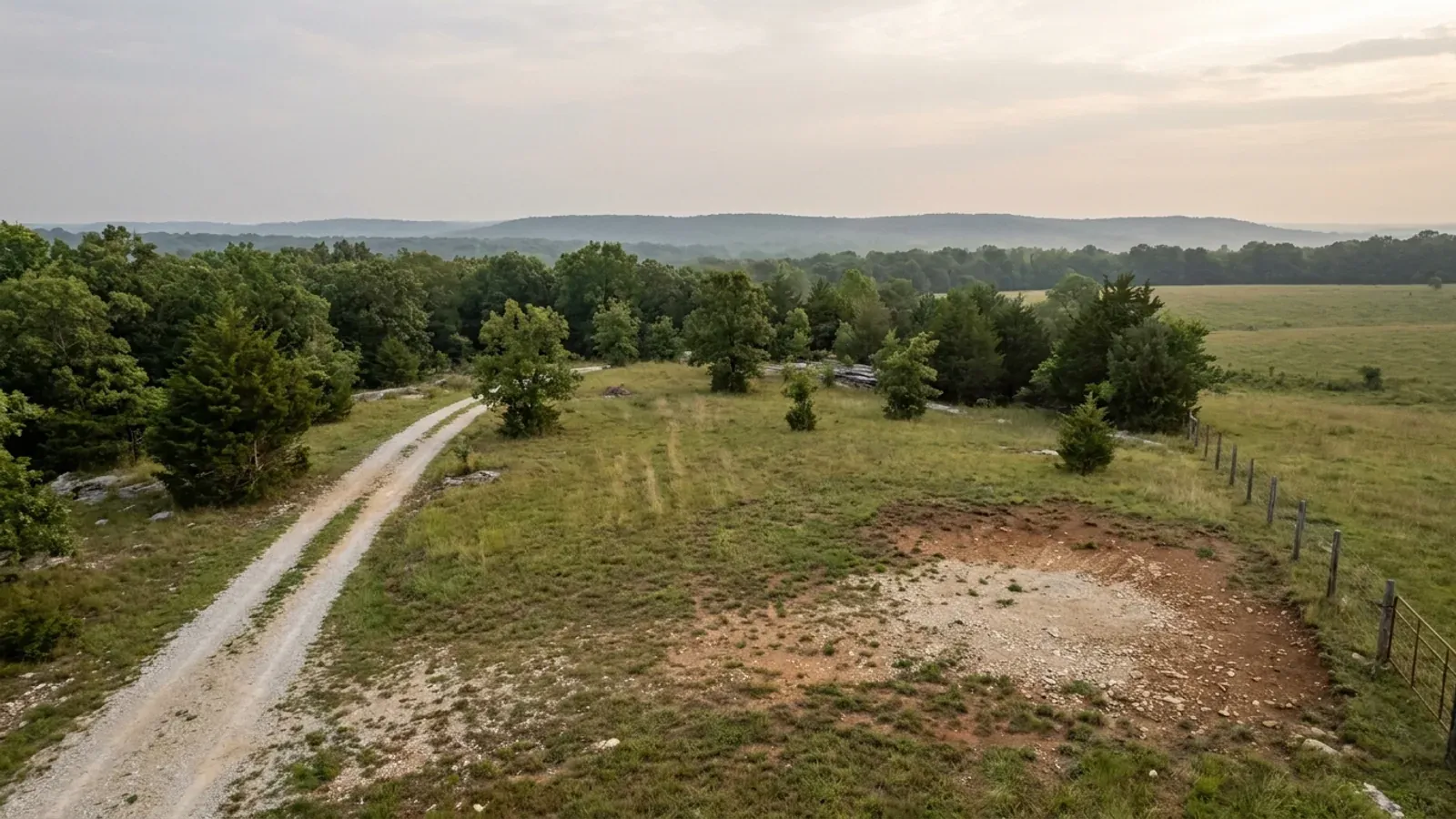
The parcel
Zoning, setbacks, flood zone and utility access get checked before anything is drawn.
Pad and permit
Clearing, grading and a compacted pad, while the submittal works through whichever office issues the permit where you are building.
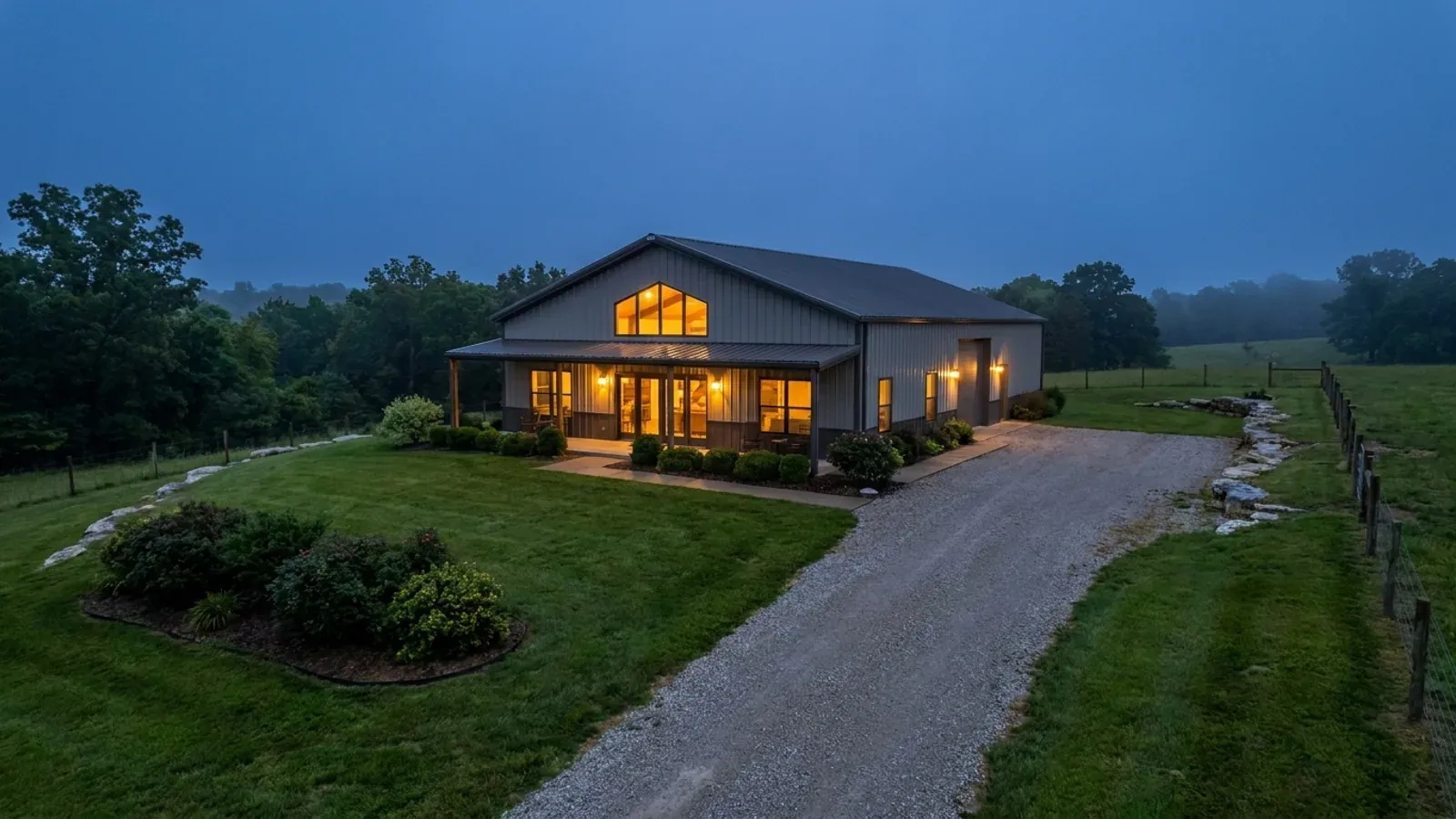
Frame to finish
Shell erected and dried in, then systems, insulation and interior finish through to CO.
Those are the rules where you are building in Crawford County. Tell us what you want to build and we will draw it to them.
Where we build around Crawford County
Crawford County and the rural land around it. The buildable acreage for a project this size usually sits outside the city limits, which is frequently what changes who issues your permit.
Keep reading
The questions that usually come next once you know what Crawford County allows.
Barndominium Cost Guide
Sourced per-square-foot ranges by tier and by size, with a calculator built on the same figures.
Read itIs It Legal in Missouri?
Classification, zoning, the HOA gate, and why "nonresidential farm building" does not cover a home.
Read itHow Long Does It Take?
Census build-duration data, and what actually sets the permit clock where you are building.
Read itNearby areas we build in
Others we cover nearby, and they are not interchangeable. One may be a county with an adopted building code, another a county with no legal authority to have one, another a city that permits inside its own limits whichever county the land sits in. So the office that issues the permit, whether anyone inspects the work at all, the fees, the zoning and the design figures can differ from one card to the next — sometimes across a single property line.
Building in Crawford County: common questions
8 questions we get asked most often about building in Crawford County. If yours is not on the list, ask it directly.
Do I need a building permit to build a barndominium in Crawford County?
A fire district issuing building permits sounds odd. Is that real?
My tract is over three acres — does that mean I skip the septic permit?
Onondaga Cave is here. Should the karst change how I build?
What wind speed, snow load and frost depth should the plans be designed to?
Can I put up a metal building, or are there restrictions on the exterior?
How big a shop can I build next to the house?
If the county does not inspect, does anybody?
Building in Crawford County?
Start with the plan. Tell us what you want to build and we will draw it, then confirm which office issues the permit for your parcel, what it will let you put there, and what wind load it has to meet. That conversation costs nothing.