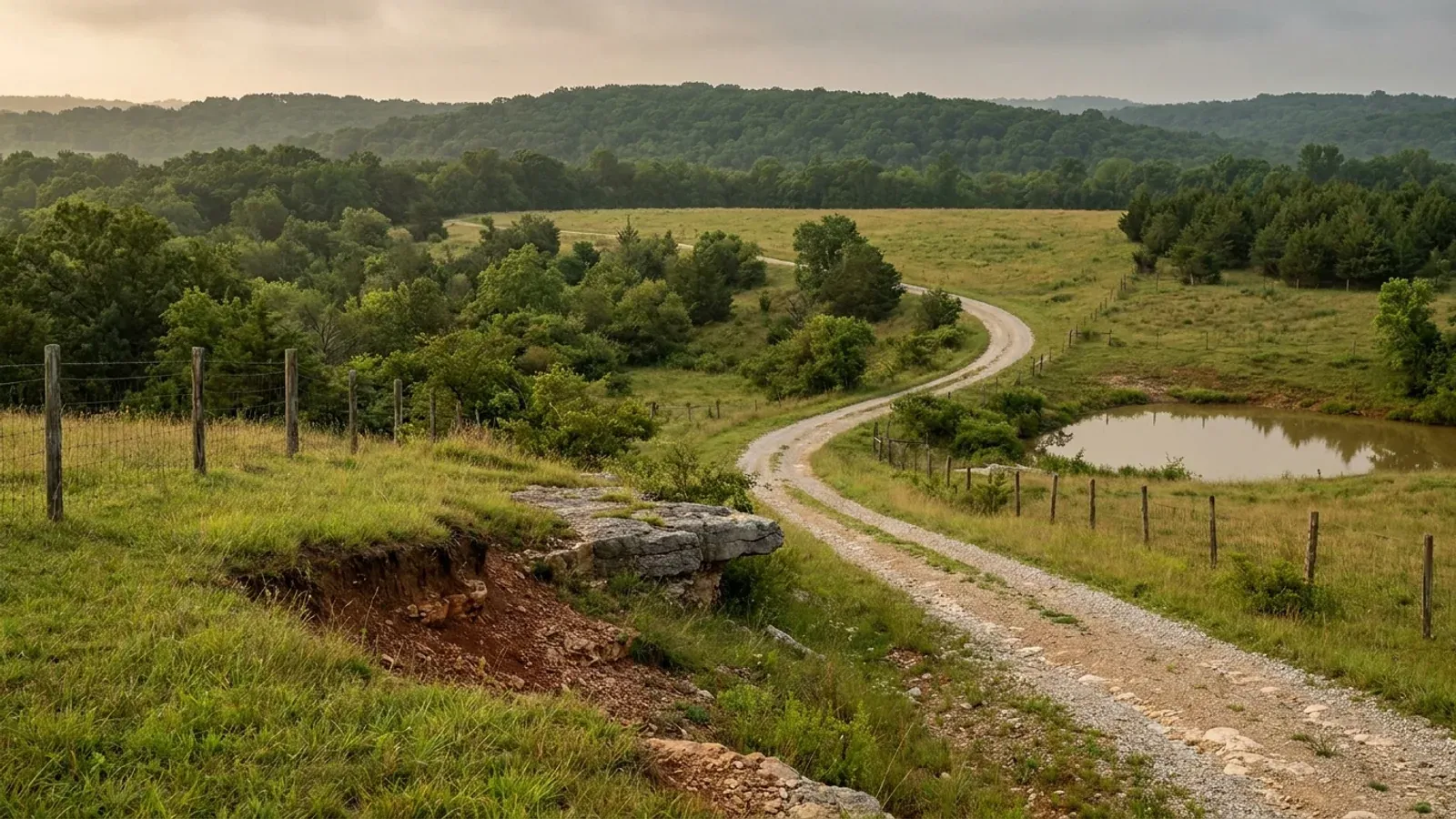
Barndominium Builders in St. Louis County, MO
This is the county the office sits in, in Jennings, and it is also the hardest county in Missouri to buy building acreage in: the 2022 Census of Agriculture counted 222 farms on 21,936 acres here, an average holding of 99 acres, with land in farms down 52 percent in five years. What is left is at the western edge — Wildwood, which spreads 35,082 people across 66.7 square miles of land, and the Eureka fringe — where the county's own NU Non-Urban zoning sets a three-acre minimum for a dwelling and caps every detached accessory structure on the lot at 1,000 square feet put together, which is the sentence a shop-and-house buyer needs to read before anything else. For a workshop-and-home building on land that is actually for sale, the honest answer is west and north of here: Franklin, Warren, Lincoln and Jefferson counties, all inside an hour of the Page Avenue and I-44 corridors. And the second thing to know is that "St. Louis County" is not one permitting authority — 88 incorporated municipalities sit wholly or partly inside it, many of them contracting code enforcement back to the County under SLCRO § 1115.050 while keeping their own zoning approval, so the answer for a specific suburb is that suburb's answer and not the county's.
St. Louis County at a glance
- County
- St. Louis County
- Population
- 992,929
- ZIP codes
- 63005, 63011, 63017, 63021, 63025, 63031, 63033, 63034, 63038, 63040, 63042, 63043, 63044, 63045, 63074, 63088, 63105, 63114, 63117, 63119, 63121, 63122, 63123, 63124, 63125, 63126, 63127, 63128, 63129, 63130, 63131, 63132, 63133, 63134, 63135, 63136, 63137, 63138, 63140, 63141, 63143, 63144, 63146
- Site visits
- Usually the same week — the office is in Jennings, inside the county
Building conditions in St. Louis County
Missouri sets no residential building code and no statewide way of adopting one, so the first question on any parcel is not what the code says — it is whether there is one. Only counties of the first and second classification may adopt a building code at all, and classification is set by assessed valuation rather than population, so a small county can hold the power while a much larger one does not. Zoning is a separate power with its own answer, granted only after a vote of the people and repealable by another. What changes from one jurisdiction to the next is whether the work is inspected, who issues the permit, what that office charges, how the parcel is zoned, and the design figures your drawings have to satisfy.
St. Louis County Revised Ordinances § 1008.010 (Floodplain Management Regulations, Findings of Fact and Purposes), read via the Municode API (productId 11512) 6 September 2026; Missouri Association of Counties, "Missouri Counties by Classification", published May 2025, CHARTER list (5 counties), PDF read 6 September 2026; Mo. Const. Art. VI, §§ 18(a) and 18(c)
SLCRO §§ 1116.020 and 1115.020, both Ordinance No. 27654, adopted 18 December 2019; administrative replacement at SLCRO §§ 1116.101 and 1115.101; read via the Municode API (productId 11512) 6 September 2026
SLCRO § 1116.103, Table R301.2(1) (Amendments to the International Residential Code for One- and Two-Family Dwellings, 2015 edition — Chapter 3 Building Planning), Ordinance No. 27654, 18 December 2019; read via the Municode API (productId 11512) 6 September 2026
SLCRO §§ 1115.050, 1115.051, 1116.050, 1116.051 and § 1116.101 (amended IRC R102.2.2), Ordinance No. 27654, 18 December 2019, read via the Municode API 6 September 2026; municipality count and unincorporated population derived from U.S. Census Bureau Vintage 2024 Subcounty Population Estimates, file sub-est2024_29.csv, SUMLEV 157 records for county FIPS 29189, fetched 6 September 2026
City of Jennings Code of Ordinances ch. 17.1 § 17.1-2 (Ord. No. 2530, §§ 1–2, 27 January 2020), § 7-16 (2018 IBC), § 7-31 (Ord. No. 2534, § 2, 27 January 2020), § 7-18 (Ord. No. 2535, 27 January 2020), § 7-2 (2018 IECC), and ch. 7 state-law reference to RSMo 77.500 and 67.280 — read via the Municode API (productId 11051) 6 September 2026; population and land area from U.S. Census Bureau Vintage 2024 Subcounty Population Estimates and the 2024 Census Gazetteer places file, fetched 6 September 2026
USDA NASS 2022 Census of Agriculture, County Profile — St. Louis County, Missouri (cp29189.pdf), downloaded and text-extracted 6 September 2026; county land area from the 2024 Census Gazetteer counties file (ALAND_SQMI 507.995), fetched 6 September 2026
Also worth knowing before you build in St. Louis County
- Wildwood and the Eureka fringe are the exception
- One place in St. Louis County still reads as country. Wildwood holds 35,082 people across 66.681 square miles of land — about 526 people per square mile, against 3,489 per square mile in Jennings — and the Eureka and far-western fringe beyond it is the other pocket where the land question has not already been answered. Both are municipalities with their own councils and their own ordinances, so the county's code and the county's NU zoning are the starting point for the question, not the end of it.
- A four-square-mile karst district in north county
- St. Louis County zones an approximately four-square-mile area of north county, in the Old Jamestown community, as the KP Karst Preservation District. The ordinance's own account: it is the "Florissant Karst", identified as one of the finest examples of deep funnel-shaped sinkholes in the central United States, internally drained with no surface channels, and presenting "serious constraints to urban development in particular soil creep near sinkhole depressions, localized flooding near sinkholes, and potential groundwater contamination." Development there may not block or fill a sinkhole, route stormwater between sinkholes or discharge developed stormwater into one, and most new development needs a geotechnical report submitted by a geotechnical engineer, with a signed and sealed certification carried on the site plans. A single-family dwelling needs three acres, the same as NU.
- The floodplain permit is separate, and it is somebody else's desk
- Development in a mapped flood hazard area of unincorporated St. Louis County needs its own floodplain development permit, issued by the Director of Highways and Traffic as floodplain administrator, in addition to the building permit under the Building or Residential Code and a land disturbance permit under the Land Disturbance Code. The county's regulations run against the Flood Insurance Rate Map index panels 29189CIND1A, 29189CIND2A and 29189CIND3A dated 4 February 2015 as amended. A separate permit for each structure is required, and construction may not start on any of them until all are in hand.
- The county licenses the trades, not the builder
- There is no general or building contractor licence in St. Louis County. Title XI of the county ordinances runs to electrical (ch. 1102), plumbing (ch. 1103) and mechanical (ch. 1108) licensing and contains no chapter licensing general or building contractors at all. The county's own permit machinery shows it: an integrated permit applicant must return the plumbing, electrical and mechanical permit forms carrying the name, signature and licence number of the appropriate subcontractor — the numbers demanded are the trades', not the builder's. Separately, anyone other than the property owner repairing storm damage must register with the building official first.
- Metal siding, roof pitch, eaves, design review: the county code regulates none of them on a house
- This is the question to settle before a steel package is ordered, because a jurisdiction that forbids exposed metal on a dwelling has made the building unbuildable as drawn. Unincorporated St. Louis County does not. Chapter 1003, the county's zoning ordinance, was read through for exterior material restrictions, minimum roof pitch, minimum eave projection, appearance or design review and minimum dwelling floor area, and the NU Non-Urban and KP Karst Preservation districts — the two that cover what open land the county has left — carry none of them. The word corrugated does not appear anywhere in the chapter. The one materials list in it is a definition, at § 1003.020, of "high quality material" as "building materials that are both durable and attractive including, but not limited to, brick, stone, treated or textured concrete masonry units, and wood", and no district regulation in the chapter invokes it. Two instruments in the chapter can reach appearance, and both are mapped or petitioned rather than general: § 1003.158 Form Based Development is a place-type overlay whose standards run to build-to lines, heights, building types, parking and impervious coverage with no materials palette at all, and § 1003.191 Landmark and Preservation Area is a designation the County Council makes by ordinance parcel by parcel, with "design and construction standards for building facades, setbacks, height, scale, material, color and texture, trim, roof design and landscaping" written into that particular ordinance. The building code says the same thing by omission: the county amends the 2015 IRC chapter by chapter from § 1116.101 through § 1116.144, and the series skips 1116.107 — Chapter 7, Wall Covering, is adopted with no local change, so the model code's own exterior covering provisions are what a plan reviewer here works from. All of that is unincorporated territory, and each of the county's municipalities answers this question for itself.
U.S. Census Bureau Vintage 2024 Subcounty Population Estimates (sub-est2024_29.csv, POPESTIMATE2024) and 2024 Census Gazetteer places file (ALAND_SQMI), both fetched 6 September 2026; Eureka is split between St. Louis County (13,198) and Jefferson County (79) in the same file's SUMLEV 157 records
SLCRO § 1003.109, "KP" Karst Preservation District Regulations, as amended by Ordinance No. 29528, § 1, 12 February 2026; read via the Municode API (productId 11512) 6 September 2026
SLCRO §§ 1008.030.1 and 1008.040.1 (Floodplain Management Regulations) and ch. 1114 (Land Disturbance Code); read via the Municode API (productId 11512) 6 September 2026
SLCRO Title XI chs. 1102, 1103 and 1108, and § 1115.101 (amended IBC §§ 105.1.1.1 and 105.1.4.1), Ordinance No. 27654, 18 December 2019; read via the Municode API (productId 11512) 6 September 2026, and corroborated in research/statewide/contractor-licensing.md § 3.2
St. Louis County Revised Ordinances ch. 1003 (Zoning Ordinance), read in full for exterior-material, roof-pitch, eave, design-review and floor-area provisions, with §§ 1003.020 (definition of "high quality material"), 1003.107 (NU), 1003.109 (KP), 1003.158 (Form Based Development) and 1003.191 (Landmark and Preservation Area) checked specifically; and SLCRO ch. 1116 (Residential Code), whose chapter-by-chapter amendments run §§ 1116.101—1116.106 and 1116.108—1116.144 with no § 1116.107 amending IRC Chapter 7, Wall Covering. Both pulled from the Municode JSON API (productId 11512, job 485155, Supplement 85, codified through Ordinance No. 29,532 enacted 17 February 2026), and the chapter 1116 section list re-read independently from the API's table of contents, 9 September 2026
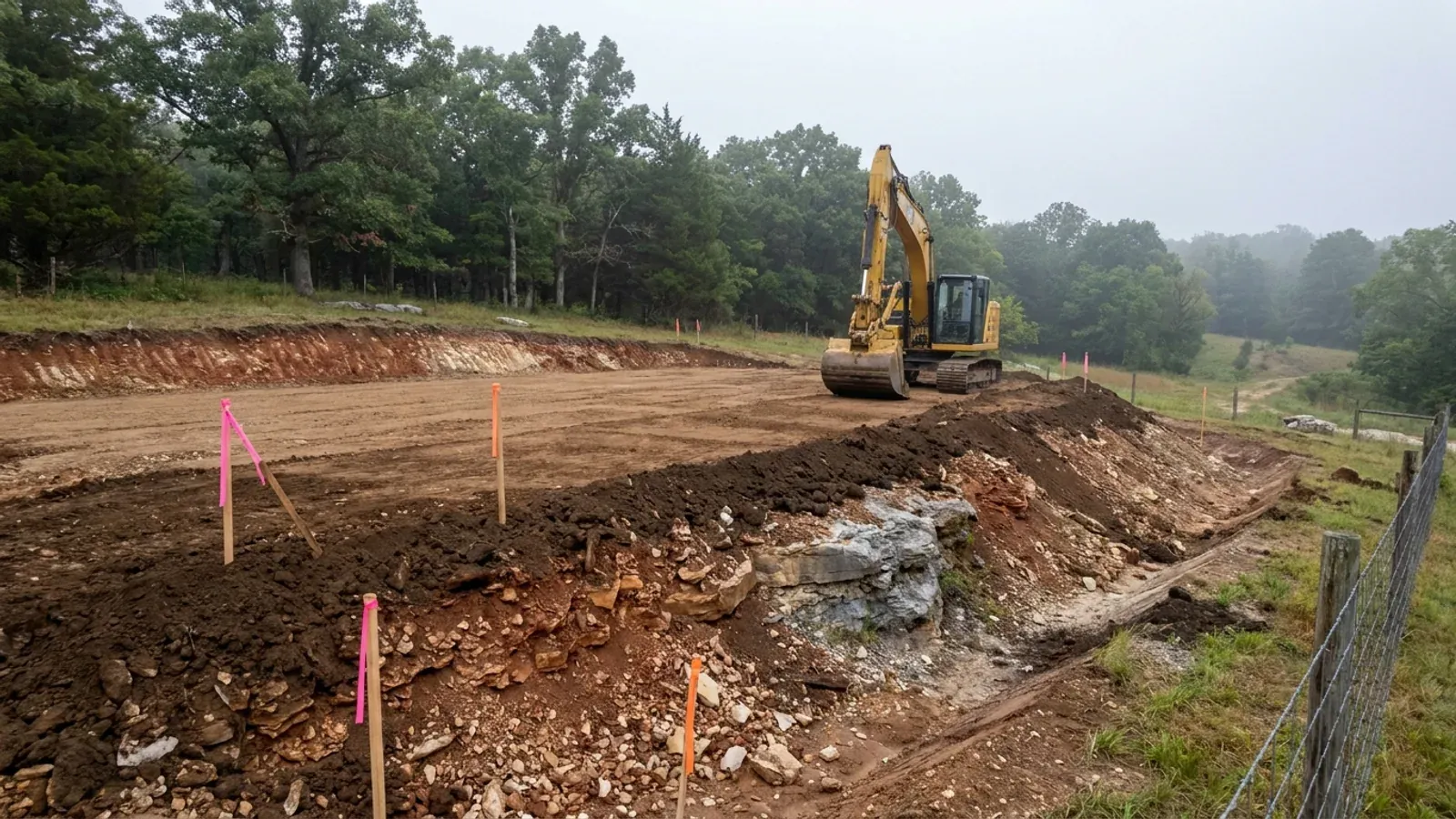
The expensive surprises are in the ground, not the building
What moves a Missouri budget is usually below grade, and which problem you have depends on where in the state you are. Across the Ozarks it is karst: the Department of Natural Resources maps more than sixteen thousand sinkhole points, and what matters there is what is under the slab rather than what the slab sits in. Across the north and centre it is claypan — dense, slow-draining subsoil that perches water above it for months of the year. In the Bootheel it is deep alluvium carrying the highest seismic demand in the state, where the same soils modelled for liquefaction attack post embedment and slab bearing rather than the frame above them. The same ground then decides the septic system, and Missouri does not run that on a percolation test alone: the rule allows a perc test or a soil morphology examination in a profile pit, and the authority reviewing your parcel picks which. Where a drainfield sits near a sinkhole's drainage, perc testing on its own is not permitted at all. Whether that authority is the state or your own county is itself a local question, and it changes what you have to file. So the site work, the foundation and the drainfield get resolved together rather than one at a time. We price the dirt before we price the building.
What we build in St. Louis County
All nine services are available in St. Louis County. What a build costs depends far more on the parcel than on square footage, so we price against your land rather than publishing a rate card.
Custom Plans
Barndominium floor plans drawn to your parcel and your soil, and to whichever Missouri authority — a county, a city, or none at all — will review them.
Barndominium Kits
Barndominium shell packages delivered to your Missouri land, drawn to the criteria your own county or city publishes — because the state publishes none.
Turnkey Builds
Start to finish barndominium construction in Missouri: the permits that genuinely apply, site work, shell and interior finish, under one contract.
What a build looks like
Three stages every St. Louis County project passes through, from a raw parcel to a finished home. Site work first, because that is where the budget is decided.
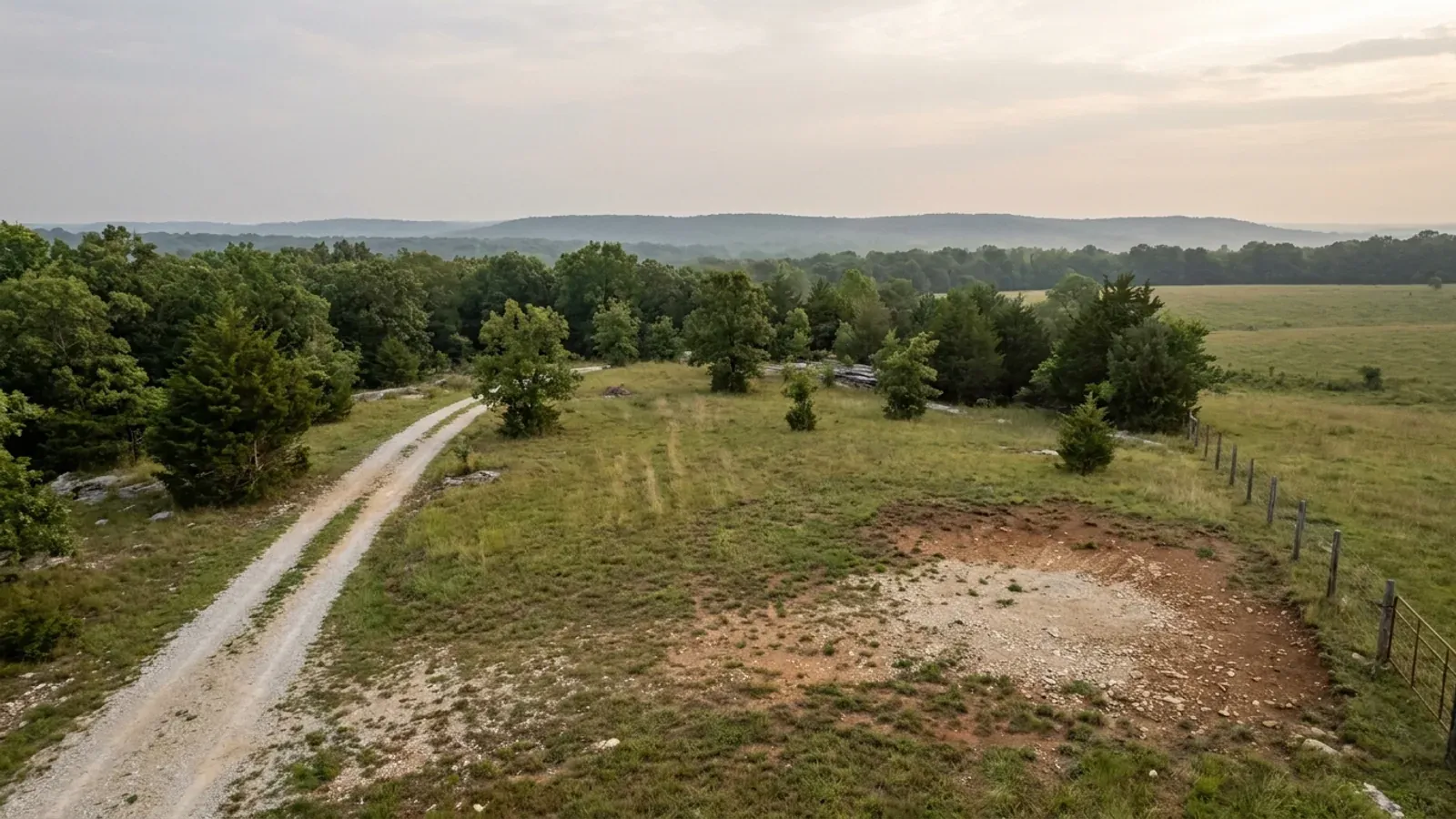
The parcel
Zoning, setbacks, flood zone and utility access get checked before anything is drawn.
Pad and permit
Clearing, grading and a compacted pad, while the submittal works through whichever office issues the permit where you are building.
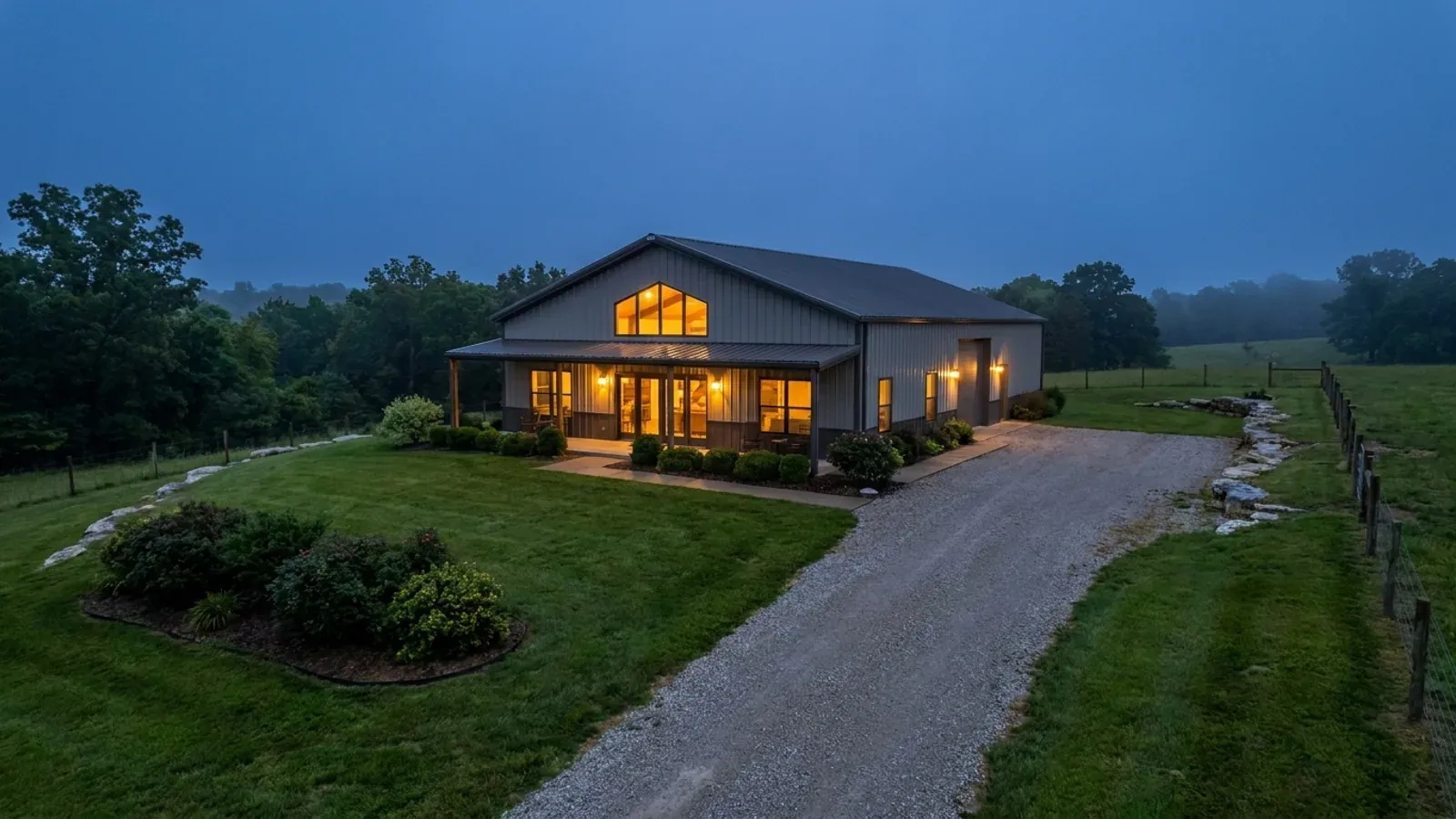
Frame to finish
Shell erected and dried in, then systems, insulation and interior finish through to CO.
Those are the rules where you are building in St. Louis County. Tell us what you want to build and we will draw it to them.
Where we build around St. Louis County
St. Louis County and the rural land around it. The buildable acreage for a project this size usually sits outside the city limits, which is frequently what changes who issues your permit.
Keep reading
The questions that usually come next once you know what St. Louis County allows.
Barndominium Cost Guide
Sourced per-square-foot ranges by tier and by size, with a calculator built on the same figures.
Read itIs It Legal in Missouri?
Classification, zoning, the HOA gate, and why "nonresidential farm building" does not cover a home.
Read itHow Long Does It Take?
Census build-duration data, and what actually sets the permit clock where you are building.
Read itNearby areas we build in
Others we cover nearby, and they are not interchangeable. One may be a county with an adopted building code, another a county with no legal authority to have one, another a city that permits inside its own limits whichever county the land sits in. So the office that issues the permit, whether anyone inspects the work at all, the fees, the zoning and the design figures can differ from one card to the next — sometimes across a single property line.
Building in St. Louis County: common questions
8 questions we get asked most often about building in St. Louis County. If yours is not on the list, ask it directly.
Is my address in St. Louis County or in the City of St. Louis?
Can I actually buy land to build a barndominium in St. Louis County?
Can I put up a separate shop building next to the house in unincorporated St. Louis County?
How big does the lot have to be, and how far back does the building have to sit?
Which building code applies, and what design numbers come with it?
The county says seismic design category C, but I have seen D for St. Louis. Which is right?
Does calling the building agricultural get me out of the county's code?
Do I need a licensed contractor to build here?
Building in St. Louis County?
Start with the plan. Tell us what you want to build and we will draw it, then confirm which office issues the permit for your parcel, what it will let you put there, and what wind load it has to meet. That conversation costs nothing.