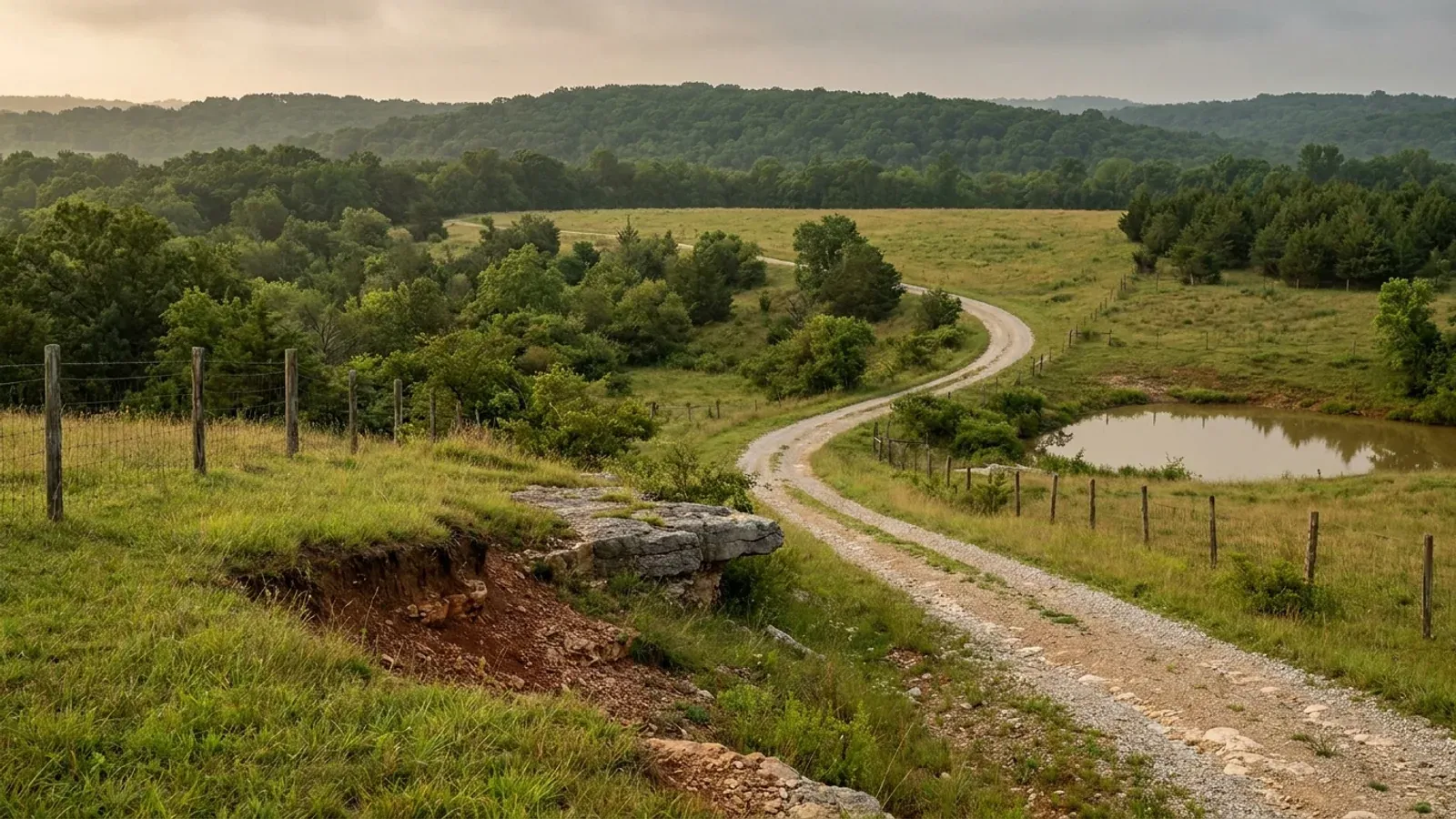
Barndominium Builders in Franklin County, MO
Franklin County is where the buildable acreage nearest St. Louis actually is — 922.7 square miles, 1,657 farms on 265,858 acres at a 160-acre average, and 56,227 of the county's 107,256 residents living outside any city limit at all. It is also one of the twenty-five Missouri counties whose statutory classification lets it hold a building code, and it holds one: the Building Department at 400 East Locust in Union permits and inspects new construction throughout unincorporated territory under the 2021 International Residential Code, in effect here since 23 April 2024, with a long set of the county's own amendments attached to it. Two of those amendments decide whether a shop-and-house works on a given parcel before anything else does. Monolithic slabs are allowed only on detached, uninhabitable structures; and all habitable space, plus any uninhabitable space with plumbing, must sit on a continuous frost wall carried to the county's 30-inch frost line. The same document then does something unusual for a county: it prints prescriptive post-frame tables of its own — a post-height capacity table and a pole barn header chart, down to the size of the precast pad under each post — and calls for a Missouri Registered Design Professional's sealed design once a building passes 5,000 square feet or falls outside the chart. Steel-frame construction needs that seal regardless of size. And the county's answer is not the answer inside a city: Washington, Union and Pacific each run their own building department, each adopted its own edition on its own date, and the three of them publish three different design wind speeds inside one county line.
Franklin County at a glance
- County
- Franklin County
- Population
- 107,256
- ZIP codes
- 63013, 63014, 63015, 63037, 63039, 63041, 63055, 63056, 63060, 63061, 63068, 63069, 63072, 63073, 63077, 63079, 63080, 63084, 63089, 63090, 63091
- Site visits
- Usually within a few days — Franklin County is the next county west along I-44 and Highway 100
Building conditions in Franklin County
Missouri sets no residential building code and no statewide way of adopting one, so the first question on any parcel is not what the code says — it is whether there is one. Only counties of the first and second classification may adopt a building code at all, and classification is set by assessed valuation rather than population, so a small county can hold the power while a much larger one does not. Zoning is a separate power with its own answer, granted only after a vote of the people and repealable by another. What changes from one jurisdiction to the next is whether the work is inspected, who issues the permit, what that office charges, how the parcel is zoned, and the design figures your drawings have to satisfy.
Franklin County, "Amendments to the 2021 Residential One- and Two-Family Dwelling Code", amended Table 403.1 footnote (b) and amended R403.1.4.1(1), published by the County Building Department at franklinmo.org (_files/ugd/605d96_b0bb7ab65d7d410e9c3001b2a0466f6e.pdf); downloaded and text-extracted 6 September 2026
Franklin County, "Amendments to the 2021 Residential One- and Two-Family Dwelling Code", "R301.2 Table. Insert the following"; published by the County Building Department at franklinmo.org (_files/ugd/605d96_b0bb7ab65d7d410e9c3001b2a0466f6e.pdf), downloaded and text-extracted 6 September 2026
Franklin County amended Table R301.2 (as above); City of Union Municipal Code § 500.065 item 8, Table 301.2 (Ord. No. 4636, 13 November 2023); City of Washington Code ch. 500 Attachment 1, Exhibit A, Table R301.2(1) (Ord. No. 23-13877, 4 December 2023, code supplement 8, January 2024); City of Pacific Municipal Code § 500.153 item 12, Table 301.2(1) (Ord. No. 3349, 20 December 2022) — all three municipal codes read on eCode360, 6 September 2026
Franklin County Building Department, "Building Codes" listing at https://www.franklinmo.org/building-dept, read 6 September 2026; adoption clause from the County's "Amendments to the 2021 Residential One- and Two-Family Dwelling Code" § 4; Missouri Department of Economic Development, "County Building Codes for Missouri", data.mo.gov dataset iq7s-izvt, last updated 11 August 2021
Franklin County, "Amendments to the 2021 Residential One- and Two-Family Dwelling Code", Tables R602.7(1) and R602.7(1)(1) with footnotes A–E; published by the County Building Department at franklinmo.org (_files/ugd/605d96_b0bb7ab65d7d410e9c3001b2a0466f6e.pdf), downloaded and text-extracted 6 September 2026
Franklin County, "Amendments to the 2021 Residential One- and Two-Family Dwelling Code", amended R105.2 Building item 12 and the attached "Agricultural Structure Exemption" form and plot plan; published by the County Building Department at franklinmo.org (_files/ugd/605d96_b0bb7ab65d7d410e9c3001b2a0466f6e.pdf), downloaded and text-extracted 6 September 2026
Also worth knowing before you build in Franklin County
- A soil evaluation or perc test is required regardless of acreage
- Missouri's own statute, RSMo 701.031, excludes a single-family residence lot of three acres or more from the state on-site sewage programme. Franklin County does not follow it. The county has run its own On-Site Sewage Disposal Systems Ordinance and Regulations since 1 January 1998 — the current version was adopted and amended on 23 September 2025 and took effect 1 October 2025 — and its permit guide states twice, in identical words, that soil evaluation results or percolation test results, with a detailed site plan, complete sewer design data and a choice of installer, "are mandatory at the time of application — regardless of acreage size." The person who performs the evaluation and the person who installs the system must both be certified and registered with the Franklin County Building Department, not merely with the state. A soil evaluation that fails to meet acceptable permeability rates means an engineered sewer design or possibly a lagoon. Homeowners may install their own system, but must sign an affidavit and stake the entire system for a walk-through with an inspector before the permit is approved.
- The most extensive soil in the county has a fragipan and a perched water table
- The single most widespread major soil component in Franklin County is the Union series, at about 82,437 acres of the county's mapped major components — more than any other, and ahead of Useful, Hobson, Wrengart and Goss. The federal series description is blunt about what it is: very deep, moderately well drained soils "formed in a layer of loess that contains a fragipan and in the underlying clayey residuum weathered from cherty limestone or cherty dolomite," with depth to the fragipan of 18 to 36 inches, permeability "moderate above the fragipan and slow in the fragipan," low saturated hydraulic conductivity, and "a zone of saturation perched immediately above the fragipan." Two design consequences follow without any guesswork: water that sits on a dense layer within a foot and a half to three feet of the surface, and a drainfield problem before there is ever a house problem. Rock outcrop is a major component on another 11,281 acres, which is the other half of the Ozark-border picture.
- 37 documented sinkholes, not the Ozark core
- Franklin County sits on the northern edge of the Ozarks, and the karst comes with it — but at a scale worth stating plainly rather than implying. A spatial query of Missouri DNR's live sinkhole inventory against the county boundary returns 37 documented sinkhole points inside Franklin County, out of 16,001 statewide. For scale, the same query returns 1,471 in Greene County and 0 in Atchison County. So the honest answer for a Franklin County parcel is that documented sinkholes are real, mapped and uncommon here — which is a reason to pull the parcel on the state's GeoSTRAT viewer before buying rather than a reason to assume the worst. Missouri DNR's own caution applies either way: many sinkholes "are not readily visible on the surface because voids are plugged or capped with soil or thin layers of rock," and may only be found during excavation or drilling.
- More than half the county lives where the county's rules govern
- Thirteen incorporated places sit wholly or partly inside Franklin County — Washington 15,521, Union 13,198, the Franklin County portion of Pacific 6,770, the Franklin County portion of Sullivan 5,423, St. Clair 4,748, New Haven 2,399, Gerald 1,359, Parkway 642, Oak Grove Village 405, Berger 269, Leslie 156, Miramiguoa Park 123 and Charmwood 16. Add them up and 51,029 of the county's 107,256 residents live inside a city; the other 56,227 live in the unincorporated balance, which is the territory the county's building code and the Unified Land Use Regulations actually reach. That majority is the reason this county's own rules are worth reading rather than skipping to a city's.
- Zoning here can be voted out, and the rules would go with it
- Franklin County zones under the enabling act for first-classification counties without a charter, RSMo 64.211 to 64.295. Two features of that act are worth a landowner's attention. First, it took a vote to create — RSMo 64.211 lets the commission adopt a county plan only "after approval by vote of the people of that county," on the ballot question "Shall county planning be established?" Second, it can be undone the same way: on a petition signed by voters equal to five percent of the county's vote for governor at the last preceding gubernatorial election, RSMo 64.212 puts termination to the electorate, and if a majority votes to terminate, "Any resolution, ordinance or regulation adopted under the program pursuant to the provisions of sections 64.211 to 64.295 shall be void and of no effect." Not merely unenforced — void. The building code is a separate power under separate sections and would not fall with it.
- The addressing authority, the driveway permit and the floodplain desk
- Three gates that are easy to miss and each sit with a different office. Addressing: a County Commission order of 27 August 1998 adopted a road-naming policy and created the Franklin County Addressing Authority for unincorporated areas, and since 2018 the Planning and Zoning Department has been that authority — a street address is requested from it by application. Driveways: an entrance permit is required to build or modify a driveway or entrance onto a county road, the fee is $60.00, any work in the roadway right-of-way carries the same $60.00 charge, and the homeowner buys and installs the culvert. Floodplain: development in the floodplain may require review by the Franklin County Floodplain Administrator and an outside contracted engineer under the county's Flood Damage Prevention Ordinance, on the state's floodplain development permit application, and the county warns that those reviews run longer.
- 1,657 farms, and the land base is holding
- The 2022 Census of Agriculture counted 1,657 farms in Franklin County on 265,858 acres, an average holding of 160 acres. Read the changes against each other: the number of farms fell 9 percent since 2017 while land in farms did not move at all and average farm size rose 10 percent — consolidation, not conversion, which is the opposite of what the inner counties show. Of that land, 131,988 acres are cropland, 57,309 pastureland, 63,837 woodland and 12,724 other. By size, 159 farms are 1 to 9 acres, 558 are 10 to 49, 594 are 50 to 179, 254 are 180 to 499, 45 are 500 to 999 and 47 are 1,000 acres or more. That distribution — nearly 1,100 holdings under 180 acres — is the shape of a market where parcels in the range a barndominium buyer wants still change hands.
Franklin County Building Department, "Building in Franklin County — Your Guide to the Permit Process", Informational Booklet 04/2022, items 3a and 3b and the On-Site Septic System Information section, published at franklinmo.org (_files/ugd/395081_59f7e3004ba74fbdbd7bc4664d14a6e4.pdf), downloaded and text-extracted 6 September 2026; current ordinance date from the Building Department page at https://www.franklinmo.org/building-dept, read 6 September 2026; RSMo 701.031, rendered 6 September 2026
USDA-NRCS Soil Data Access, tabular query of legend/mapunit/component for survey area MO071 (Franklin County), major components ranked by map-unit acres, run 6 September 2026; USDA-NRCS Official Series Description, UNION series (soilseries.sc.egov.usda.gov/OSD_Docs/U/UNION.html), fetched 6 September 2026
Missouri DNR / Missouri Geological Survey sinkholes map service, layer 1 SINKHOLES (gis.dnr.mo.gov/host/rest/services/geology/sinkholes/MapServer/1), count-only spatial query against the U.S. Census TIGERweb boundary polygon for county FIPS 29071, run 6 September 2026; statewide, Greene and Atchison counts from the same service on the same day; quotation from Missouri DNR, "Sinkholes" (dnr.mo.gov/land-geology/hazards/sinkholes)
U.S. Census Bureau Vintage 2024 Subcounty Population Estimates, file sub-est2024_29.csv, SUMLEV 157 and 050 records for county FIPS 29071 (including the "Balance of Franklin County" remainder record), fetched from www2.census.gov 6 September 2026
RSMo 64.211 (effective 28 August 1994) and RSMo 64.212 (L. 1979 H.B. 663, A.L. 1994 H.B. 1175, effective 28 August 1994), both rendered from revisor.mo.gov 6 September 2026 against a control test in which a bogus section redirected to /Main/nofish.aspx
Franklin County Addressing page (https://www.franklinmo.org/addressing), Highway Department driveway page (https://www.franklinmo.org/highway-driveway) and Planning and Zoning Department page (https://www.franklinmo.org/planning-zoning), all read 6 September 2026
USDA NASS 2022 Census of Agriculture, County Profile — Franklin County, Missouri (cp29071.pdf), downloaded from www.nass.usda.gov and text-extracted 6 September 2026, against a control in which a bogus county profile returned a genuine 196-byte HTTP 404; county land area 922.684 sq mi from the 2024 Census Gazetteer counties file, fetched 6 September 2026
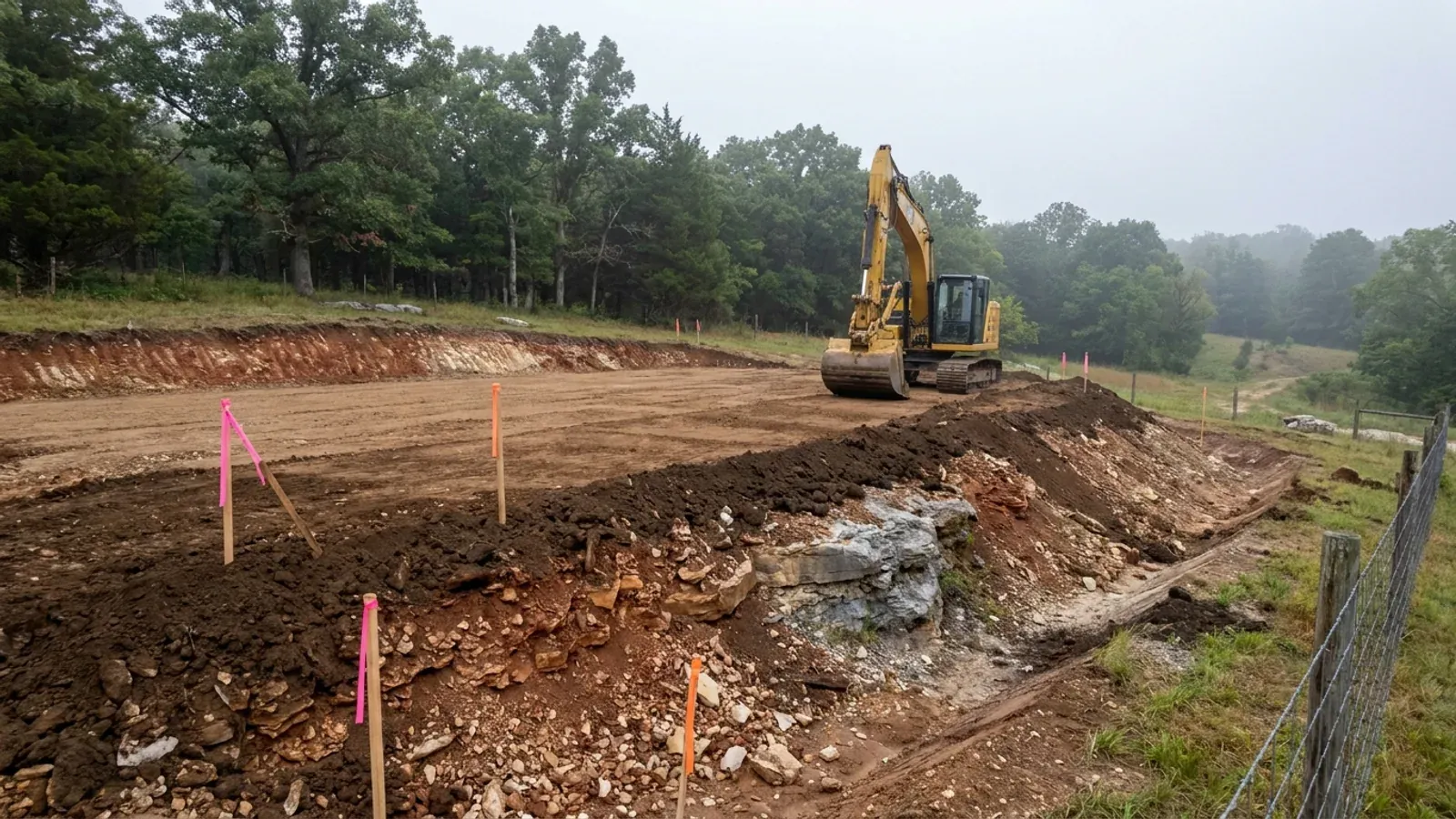
The expensive surprises are in the ground, not the building
What moves a Missouri budget is usually below grade, and which problem you have depends on where in the state you are. Across the Ozarks it is karst: the Department of Natural Resources maps more than sixteen thousand sinkhole points, and what matters there is what is under the slab rather than what the slab sits in. Across the north and centre it is claypan — dense, slow-draining subsoil that perches water above it for months of the year. In the Bootheel it is deep alluvium carrying the highest seismic demand in the state, where the same soils modelled for liquefaction attack post embedment and slab bearing rather than the frame above them. The same ground then decides the septic system, and Missouri does not run that on a percolation test alone: the rule allows a perc test or a soil morphology examination in a profile pit, and the authority reviewing your parcel picks which. Where a drainfield sits near a sinkhole's drainage, perc testing on its own is not permitted at all. Whether that authority is the state or your own county is itself a local question, and it changes what you have to file. So the site work, the foundation and the drainfield get resolved together rather than one at a time. We price the dirt before we price the building.
What we build in Franklin County
All nine services are available in Franklin County. What a build costs depends far more on the parcel than on square footage, so we price against your land rather than publishing a rate card.
Custom Plans
Barndominium floor plans drawn to your parcel and your soil, and to whichever Missouri authority — a county, a city, or none at all — will review them.
Barndominium Kits
Barndominium shell packages delivered to your Missouri land, drawn to the criteria your own county or city publishes — because the state publishes none.
Turnkey Builds
Start to finish barndominium construction in Missouri: the permits that genuinely apply, site work, shell and interior finish, under one contract.
What a build looks like
Three stages every Franklin County project passes through, from a raw parcel to a finished home. Site work first, because that is where the budget is decided.
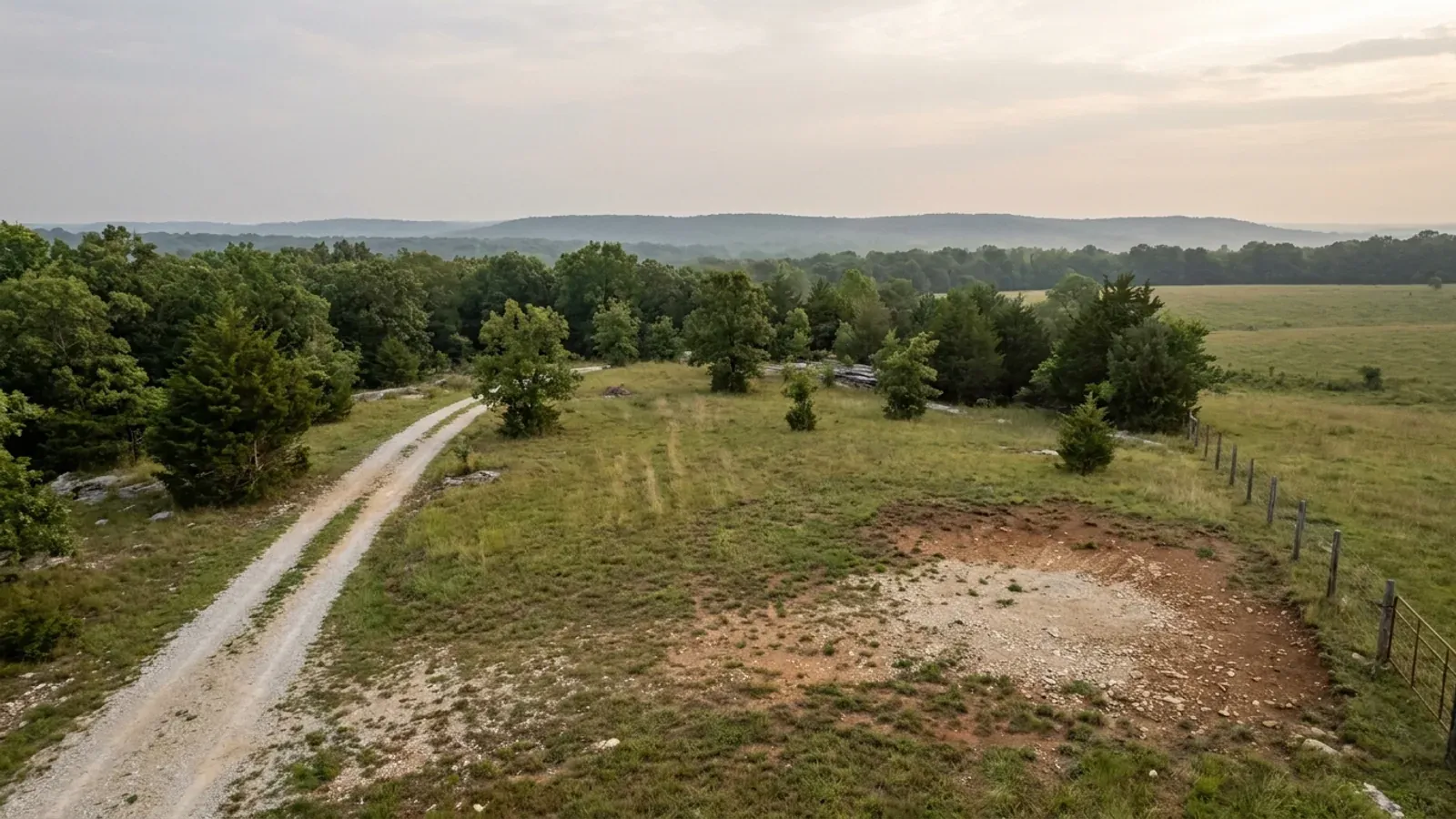
The parcel
Zoning, setbacks, flood zone and utility access get checked before anything is drawn.
Pad and permit
Clearing, grading and a compacted pad, while the submittal works through whichever office issues the permit where you are building.
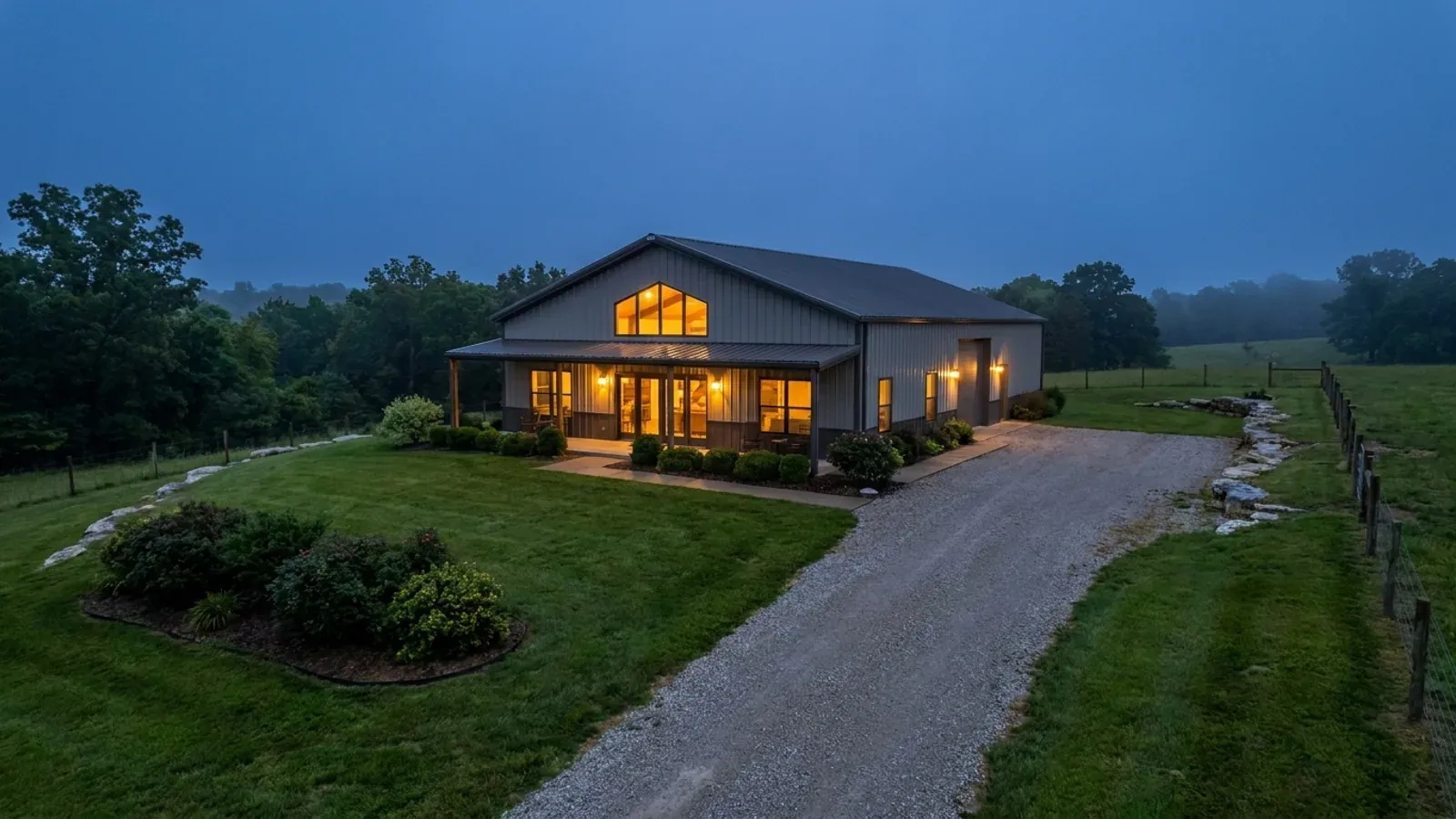
Frame to finish
Shell erected and dried in, then systems, insulation and interior finish through to CO.
Those are the rules where you are building in Franklin County. Tell us what you want to build and we will draw it to them.
Where we build around Franklin County
Franklin County and the rural land around it. The buildable acreage for a project this size usually sits outside the city limits, which is frequently what changes who issues your permit.
Keep reading
The questions that usually come next once you know what Franklin County allows.
Barndominium Cost Guide
Sourced per-square-foot ranges by tier and by size, with a calculator built on the same figures.
Read itIs It Legal in Missouri?
Classification, zoning, the HOA gate, and why "nonresidential farm building" does not cover a home.
Read itHow Long Does It Take?
Census build-duration data, and what actually sets the permit clock where you are building.
Read itNearby areas we build in
Others we cover nearby, and they are not interchangeable. One may be a county with an adopted building code, another a county with no legal authority to have one, another a city that permits inside its own limits whichever county the land sits in. So the office that issues the permit, whether anyone inspects the work at all, the fees, the zoning and the design figures can differ from one card to the next — sometimes across a single property line.
Building in Franklin County: common questions
9 questions we get asked most often about building in Franklin County. If yours is not on the list, ask it directly.
Can I pour one slab for the whole barndominium in Franklin County?
Does calling it an agricultural building get me out of the county building permit?
My land is over three acres — do I still need a septic permit and a soil test?
Which building code applies, and what design numbers come with it?
Is Washington, Union or Pacific the same as the county for permits?
Which zoning district will my land be in, and how big does the lot have to be?
Does the county have rules for post-frame and steel-frame buildings specifically?
What does the permit itself cost, and what else has to be paid?
The county says seismic design category C, but I have seen D for this part of Missouri. Which is right?
Building in Franklin County?
Start with the plan. Tell us what you want to build and we will draw it, then confirm which office issues the permit for your parcel, what it will let you put there, and what wind load it has to meet. That conversation costs nothing.