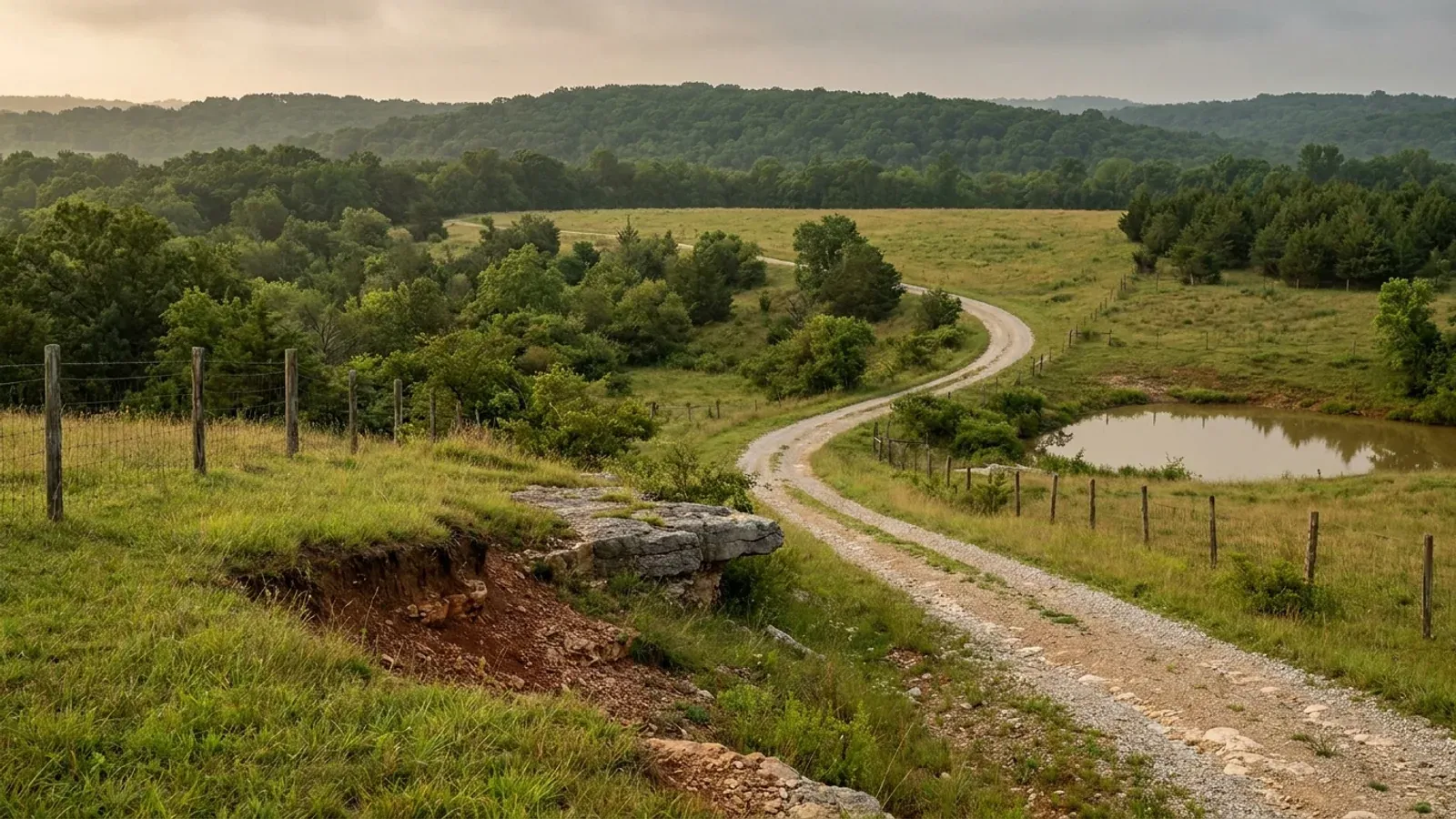
Barndominium Builders in St. Charles County, MO
This is the county where the St. Louis metro still has land in it. The 2022 Census of Agriculture counted 589 farms here on 170,588 acres at a 290-acre average, and land in farms went up ten percent between 2017 and 2022 — in the fastest-growing large county in the state, on 560 square miles. That acreage is west and south of the I-70 corridor: past Wentzville toward Foristell, which the Census counts at 376 people on the St. Charles side of a town split with Warren County, and New Melle at 547, and on down toward Augusta at 268. The county is one of Missouri's five charter counties, it runs a real building department, and it publishes a filled-in Table R301.2 — 20 lbs/ft² ground snow, 107 mph, seismic design category C, a 30-inch frost line — in the ordinance text itself, which is the one page a post-frame foundation quote should be built from. The provision that decides whether a shop-and-house works here is in the "A" Agricultural District: accessory structures are capped on a ladder tied to parcel size, 1,200 square feet under an acre rising to 4,800 square feet at five acres, and at ten acres or more the ordinance sets no maximum square footage at all. Two things a reader on the I-70 corridor has to know before any of that. First, the county's code and the county's zoning reach the unincorporated territory, and only 93,858 of the county's 423,726 residents live there — Wentzville, O'Fallon, St. Peters, St. Charles city, Lake Saint Louis and twelve more municipalities permit for themselves, and Wentzville publishes 115 mph on the same 2021 code edition the county reads 107 from. Second, if the land is in the Missouri or Mississippi bottoms, the Density Floodway Overlay District caps development at eighteen percent of the parcel's surface area unless a no-rise certification is produced, and that limit is measured against the parcel as it was recorded on or before 15 December 1992.
St. Charles County at a glance
- County
- St. Charles County
- Population
- 423,726
- ZIP codes
- 63301, 63303, 63304, 63332, 63341, 63348, 63365, 63366, 63367, 63368, 63373, 63376, 63385, 63386
- Site visits
- Usually within the week — the office is one county east, off the same I-70
Building conditions in St. Charles County
Missouri sets no residential building code and no statewide way of adopting one, so the first question on any parcel is not what the code says — it is whether there is one. Only counties of the first and second classification may adopt a building code at all, and classification is set by assessed valuation rather than population, so a small county can hold the power while a much larger one does not. Zoning is a separate power with its own answer, granted only after a vote of the people and repealable by another. What changes from one jurisdiction to the next is whether the work is inspected, who issues the permit, what that office charges, how the parcel is zoned, and the design figures your drawings have to satisfy.
St. Charles County Charter, Article XII (Certificate of Adoption), Article I §§ 1.501 and 1.601, and Article XI §§ 11.100 and 11.200, read on eCode360 (code version 2026-05-11) 6 September 2026; Missouri Association of Counties, "Missouri Counties by Classification", published May 2025, CHARTER list (5 counties); Mo. Const. Art. VI, §§ 18(a) and 18(c)
Ordinances of St. Charles County, Missouri § 500.150, Table R301.2 (Adoption of Residential Code for One- and Two-Family Dwellings of St. Charles County — Chapter 3 Building Planning), read on eCode360 (code version 2026-05-11) 6 September 2026, and cross-read against the County's own "Residential Building Code" amendments PDF at sccmo.org/DocumentCenter/View/22409, downloaded and text-extracted 6 September 2026 — the two agree line for line; St. Louis County termite comparison from SLCRO § 1116.103, Table R301.2(1), Ordinance No. 27654, 18 December 2019
Ordinances of St. Charles County, Missouri §§ 405.080.B.3, 405.080.D and 405.080.E ("A" Agricultural District), accessory-structure ladder as amended by Ord. No. 18-011 § 1, 29 January 2018; read on eCode360 (code version 2026-05-11) 6 September 2026
City of Wentzville, "Building Codes and Design Parameters", wentzvillemo.gov/departments/community-development/building-codes/, read 6 September 2026 (the page names the adopting sections 500.070 and 500.080 of the City Municipal Code and states the city code is not yet codified on its municipal code service); county Table R301.2 at OSCCMo § 500.150; municipality count and unincorporated population derived from U.S. Census Bureau Vintage 2024 Subcounty Population Estimates, file sub-est2024_29.csv, SUMLEV 157 records for county FIPS 29183 (18 rows, one of which is the "Balance of St. Charles County" remainder record), fetched 6 September 2026
USDA NASS 2022 Census of Agriculture, County Profile — St. Charles County, Missouri (cp29183.pdf), downloaded and text-extracted 6 September 2026; county land area from the 2024 Census Gazetteer counties file (ALAND_SQMI 560.501), fetched 6 September 2026; St. Louis County comparison from cp29189.pdf, same series
Ordinances of St. Charles County, Missouri §§ 405.345, 405.370.A and 405.370.C (Density Floodway Overlay District) and §§ 405.270 and 405.275 (adoption of the Flood Insurance Rate Maps, Ord. No. 21-008, 25 January 2021); read on eCode360 (code version 2026-05-11) 6 September 2026
Also worth knowing before you build in St. Charles County
- The county writes its own septic code, and it bites at closing
- St. Charles County does not leave on-site wastewater to the state. It adopts its own Private Sewage Disposal Code, and two provisions matter before you buy. A public sewer counts as "available" — meaning a private system is not permitted — when the nearest property line is within 200 feet of one. And on the transfer of ownership of any property served by a private sewage disposal system or a private well, the owner must have the system inspected for compliance by a third-party inspector licensed by St. Charles County, fix every violation found, and obtain a certificate of compliance, unless the system is new or a certificate has been issued within the last 180 days. The county licenses those inspectors and the installers under their own chapters of the county ordinances.
- The county licenses seven trades and no builder
- There is no general or building contractor licence in St. Charles County. The Building and Code Enforcement Division's own statement is that "Electricians, plumbers, mechanical (HVAC) contractors, pool installers, drainlayers, third party inspectors, and blasters are required to have a license through the St. Charles County Building and Code Enforcement Division before doing any work in the county that requires a permit" — seven trades, and a builder is not one of them. The county code says the same thing from the other end: Title VI of the county ordinances carries licensing chapters for plumbing contractors, on-site wastewater inspectors, on-site wastewater installers, electrical contractors, pool installers, mechanical contractors and blasting contractors, and no chapter licensing general or building contractors at all. The county does require its licensed trades to carry a bond and insurance as a condition of the licence.
- The county rewrote the blower-door number, and prints one climate zone
- The county's adopted energy provisions are worth knowing before the envelope is designed, because it changed them. Its Energy Conservation Code replaces the residential insulation and fenestration table outright with a single row for Climate Zone 4A — fenestration U-factor 0.35, skylight 0.60, ceiling R-38, wood-frame wall R-13, mass wall 5/10, floor R-19, basement wall 10 continuous or 13, slab R-10 to two feet, crawl space 10/13. And in the residential code it rewrote the air-leakage section so the dwelling "may be tested" against a ceiling of 5.0 air changes per hour rather than being required to hit the model figure, while allowing the Code Official to require an approved third party independent of the installer to inspect the air barrier and insulation.
- Two hundred square feet, and the fee is a formula
- A detached one-story accessory structure of 200 square feet or less needs no building permit in unincorporated St. Charles County, and neither does a fence up to seven feet, a retaining wall under four feet that carries no surcharge, or an unattached deck of 200 square feet or less that stays within 30 inches of grade and does not serve the required exit door. Above that, the basic building permit fee is not a flat number: it is a minimum of $60.00, or the gross area of the building multiplied by the square-foot construction cost and the permit fee multiplier published in the International Code Council's Building Valuation Data, or the actual cost of construction, whichever comes out higher. The Director recomputes the multiplier every year and posts it by 30 January, and the county's miscellaneous permit fees are recalculated each 1 January with no single increase above four percent a year — so get the current schedule rather than a figure someone quoted last season.
- Claypan soil and a wellhead district that bans deep ponds
- Two site conditions shape what a slab and a septic field can do here. St. Charles County is one of the 38 Missouri counties carrying a Central Claypan soil series as a major map-unit component in the national soil database — the family the USDA describes as poorly drained, very slowly permeable, with a perched water table sitting between six inches and a foot and a half of the surface from December to May in most years. And the county's Wellhead Protection Overlay District, drawn as a circle around the wellheads of public alluvial wells, prohibits private potable water wells into known and potential sources of contamination and prohibits ponds or lakes dug deeper than fifteen feet, to keep excavation out of the sand and gravel aquifer under the river bottom.
- The metal-siding prohibition here is on the shop, not the house — and it stops at three acres
- St. Charles County does prohibit metal siding, and quoting the prohibition without reading who it reaches would give a barndominium buyer exactly the wrong answer. The rule is § 405.090.E.7, in the single-family districts, under the heading Design requirements: "All accessory, non-residential buildings over two hundred (200) square feet, except accessory structures and stables in the 'RR' District, must be constructed of building materials and designed architecturally to be in substantial compliance with the primary structure. The use of metal siding, including, but not limited to, aluminum and steel, in the construction of an accessory structure is prohibited, except when the accessory structure is located on a lot of three (3) acres, or greater." It reaches accessory buildings and never the dwelling. Nothing in the RR, R1A, R1B, R1C, R1D or R1E district regulations says what the house itself may be clad in, and neither the roof pitch nor the eave is regulated anywhere in them. The two exceptions do most of the work in practice: RR carries a three-acre minimum lot to begin with, and on any lot of three acres or more the prohibition simply does not apply — the same three-acre line at which the county's accessory-building cap steps up to 3,600 square feet. The identical sentence appears without either exception in the R2, R3A and R3B districts, where a detached accessory structure is limited to 250 square feet per residential unit in any case. The county's one flat ban on the material sits somewhere else entirely: § 405.520 provides that no structure used for an agriculture- or winery-related tourism conditional use "may be built of metal or have any metal siding", alongside roof pitches of at least 7/12 and exterior walls clad in at least two of stone, brick or wood. That is a tasting room, not a dwelling. What the single-family districts do fix for the house is size rather than material: a minimum dwelling size of 1,000 square feet of living space.
Ordinances of St. Charles County, Missouri § 500.300, Private Sewage Disposal Code of St. Charles County §§ 101.2, 101.3 and 116.1 (Ord. No. 17-061 § 9, 5 July 2017, as amended through Ord. No. 25-085, 15 December 2025); OSCCMo Title VI chs. 626 (On-Site Wastewater Treatment System Inspector Business License) and 627 (Installer Business License); read on eCode360 (code version 2026-05-11) 6 September 2026
St. Charles County Community Development, "Contractor Licensing and Renewals", sccmo.org/1544, page text read 6 September 2026; OSCCMo Title VI chs. 625, 626, 627, 630, 632, 633 and 637, chapter list read on eCode360 (code version 2026-05-11) 6 September 2026; corroborated in research/statewide/contractor-licensing.md §§ 3.1 and 3.2
Ordinances of St. Charles County, Missouri § 500.320 (Energy Conservation Code of St. Charles County, replaced Table R402.1.3) and § 500.150 (amended IRC N1102.4.1.1 through N1102.4.1.3); read on eCode360 (code version 2026-05-11) 6 September 2026
Ordinances of St. Charles County, Missouri § 500.150 (amended IRC R105.2, work exempt from permits) and § 505.020.A and .D (Permit and Inspection Fees — Generally, as amended by Ord. No. 24-081, 30 September 2024); read on eCode360 (code version 2026-05-11) 6 September 2026
USDA-NRCS Soil Data Access query and Official Series Description for the MEXICO series, as compiled in research/statewide/site-conditions.md §§ 6a and 6b (queried 5 September 2026); Ordinances of St. Charles County, Missouri §§ 405.402 and 405.404.C (Wellhead Protection Overlay District, Ord. No. 11-008 § 1, 7 March 2011), read on eCode360 (code version 2026-05-11) 6 September 2026
Ordinances of St. Charles County, Missouri § 405.090.D.7 and § 405.090.E.1 and .E.7 ("RR," "R1A," "R1B," "R1C," "R1D" and "R1E" Single-Family Residential Districts, as last amended by Ord. No. 25-006, 24 February 2025); §§ 405.095.E, 405.100.E and 405.105.E (R2, R3A and R3B design requirements); and § 405.520.F.2 (Development Standards For Certain Conditional Uses — agriculture- and winery-related tourism). Read on eCode360 (customer ST3436, code version 2026-05-11) 9 September 2026, with the § 405.090.E.7 text re-read from an independent second request the same day; a full-text search of the codified county code returns "metal siding" in those five sections and no others, returns "corrugated" only in the solid-waste recycling definitions and a storm-sewer pipe specification, and returns no amendment to IRC Chapter 7 or R703 anywhere in ch. 500
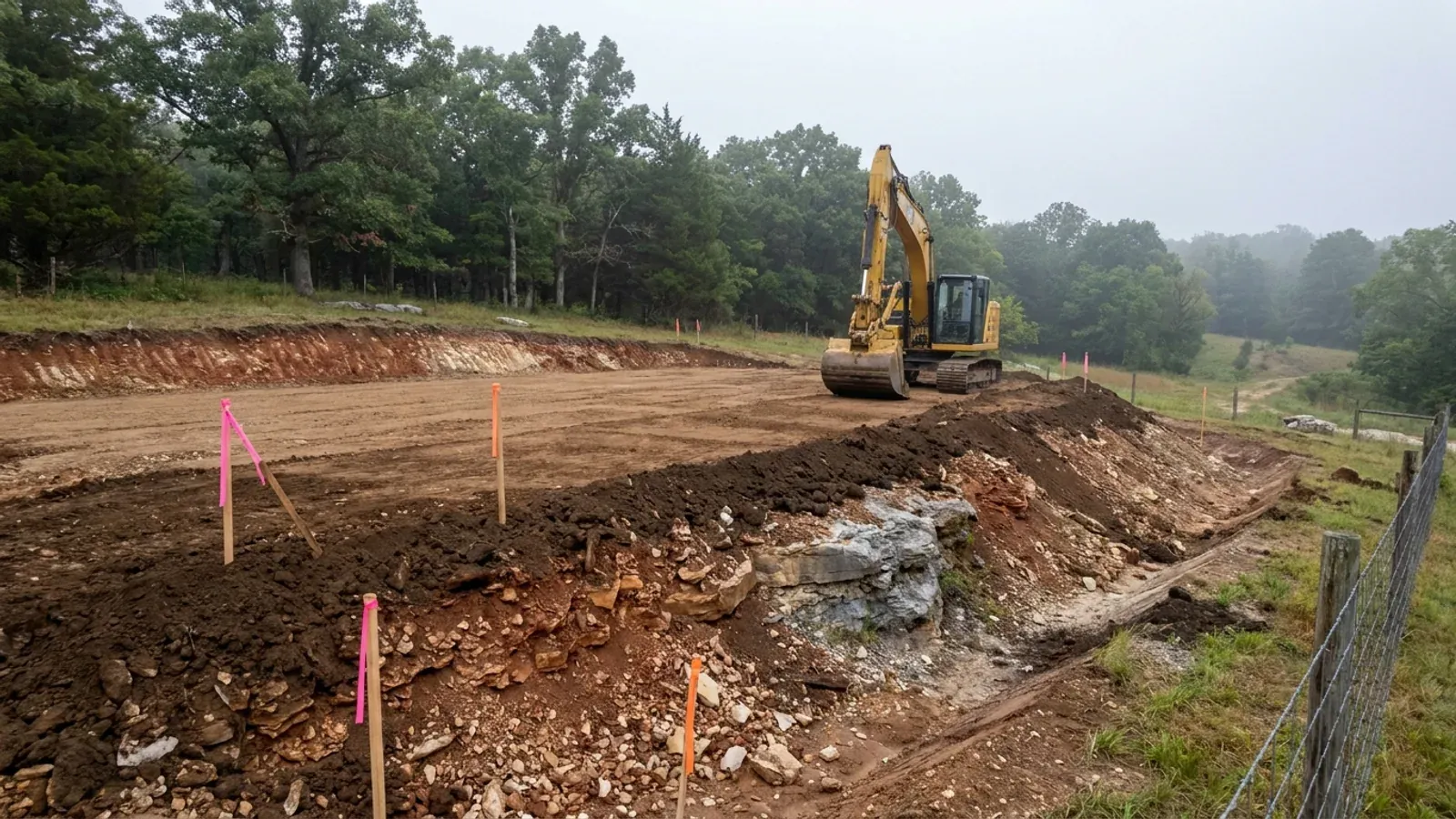
The expensive surprises are in the ground, not the building
What moves a Missouri budget is usually below grade, and which problem you have depends on where in the state you are. Across the Ozarks it is karst: the Department of Natural Resources maps more than sixteen thousand sinkhole points, and what matters there is what is under the slab rather than what the slab sits in. Across the north and centre it is claypan — dense, slow-draining subsoil that perches water above it for months of the year. In the Bootheel it is deep alluvium carrying the highest seismic demand in the state, where the same soils modelled for liquefaction attack post embedment and slab bearing rather than the frame above them. The same ground then decides the septic system, and Missouri does not run that on a percolation test alone: the rule allows a perc test or a soil morphology examination in a profile pit, and the authority reviewing your parcel picks which. Where a drainfield sits near a sinkhole's drainage, perc testing on its own is not permitted at all. Whether that authority is the state or your own county is itself a local question, and it changes what you have to file. So the site work, the foundation and the drainfield get resolved together rather than one at a time. We price the dirt before we price the building.
What we build in St. Charles County
All nine services are available in St. Charles County. What a build costs depends far more on the parcel than on square footage, so we price against your land rather than publishing a rate card.
Custom Plans
Barndominium floor plans drawn to your parcel and your soil, and to whichever Missouri authority — a county, a city, or none at all — will review them.
Barndominium Kits
Barndominium shell packages delivered to your Missouri land, drawn to the criteria your own county or city publishes — because the state publishes none.
Turnkey Builds
Start to finish barndominium construction in Missouri: the permits that genuinely apply, site work, shell and interior finish, under one contract.
What a build looks like
Three stages every St. Charles County project passes through, from a raw parcel to a finished home. Site work first, because that is where the budget is decided.
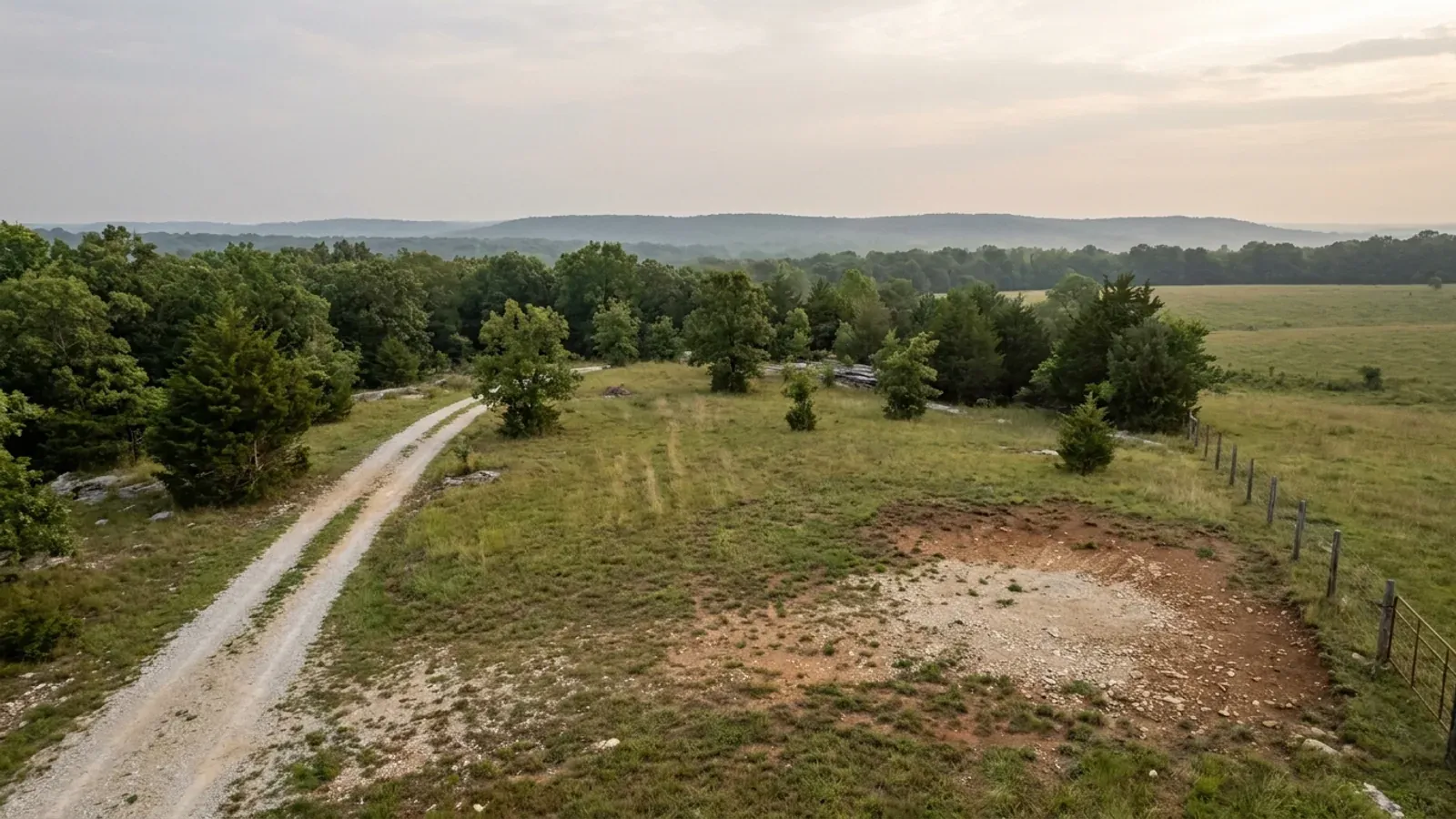
The parcel
Zoning, setbacks, flood zone and utility access get checked before anything is drawn.
Pad and permit
Clearing, grading and a compacted pad, while the submittal works through whichever office issues the permit where you are building.
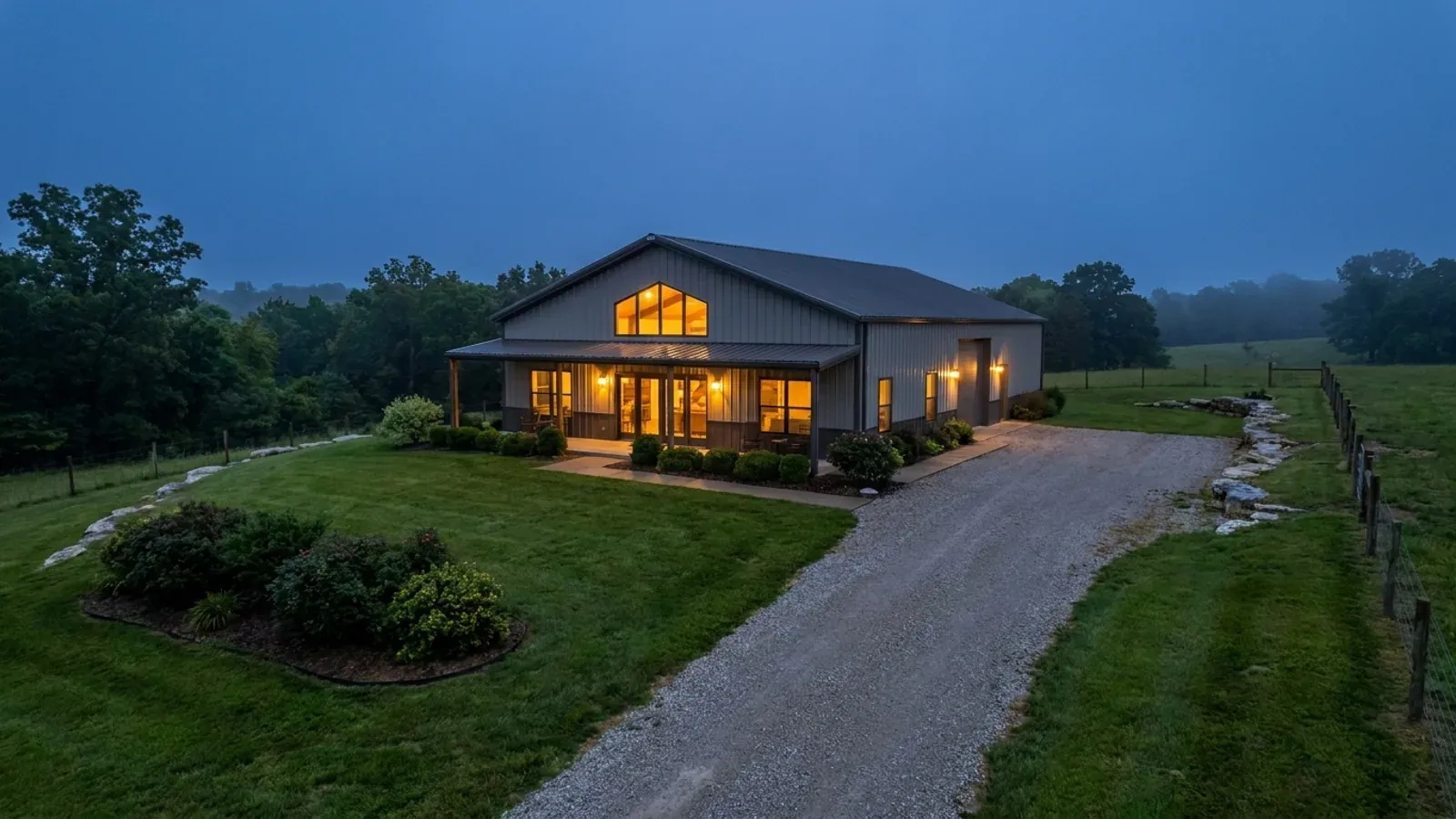
Frame to finish
Shell erected and dried in, then systems, insulation and interior finish through to CO.
Those are the rules where you are building in St. Charles County. Tell us what you want to build and we will draw it to them.
Where we build around St. Charles County
St. Charles County and the rural land around it. The buildable acreage for a project this size usually sits outside the city limits, which is frequently what changes who issues your permit.
Keep reading
The questions that usually come next once you know what St. Charles County allows.
Barndominium Cost Guide
Sourced per-square-foot ranges by tier and by size, with a calculator built on the same figures.
Read itIs It Legal in Missouri?
Classification, zoning, the HOA gate, and why "nonresidential farm building" does not cover a home.
Read itHow Long Does It Take?
Census build-duration data, and what actually sets the permit clock where you are building.
Read itNearby areas we build in
Others we cover nearby, and they are not interchangeable. One may be a county with an adopted building code, another a county with no legal authority to have one, another a city that permits inside its own limits whichever county the land sits in. So the office that issues the permit, whether anyone inspects the work at all, the fees, the zoning and the design figures can differ from one card to the next — sometimes across a single property line.
Building in St. Charles County: common questions
8 questions we get asked most often about building in St. Charles County. If yours is not on the list, ask it directly.
Is there a building code where I want to build in St. Charles County?
How big a shop can I put up next to the house?
How much land do I need, and how far back does the house sit?
Which design numbers apply, and why do I keep seeing two wind speeds?
The county says seismic design category C, but I have seen D for the St. Louis area. Which is right?
My land is in the river bottom. What changes?
Does calling the building agricultural get me out of the county's rules?
Do I need a licensed contractor, and what about septic and wells?
Building in St. Charles County?
Start with the plan. Tell us what you want to build and we will draw it, then confirm which office issues the permit for your parcel, what it will let you put there, and what wind load it has to meet. That conversation costs nothing.