Barndominium Builders in Lincoln County, MO
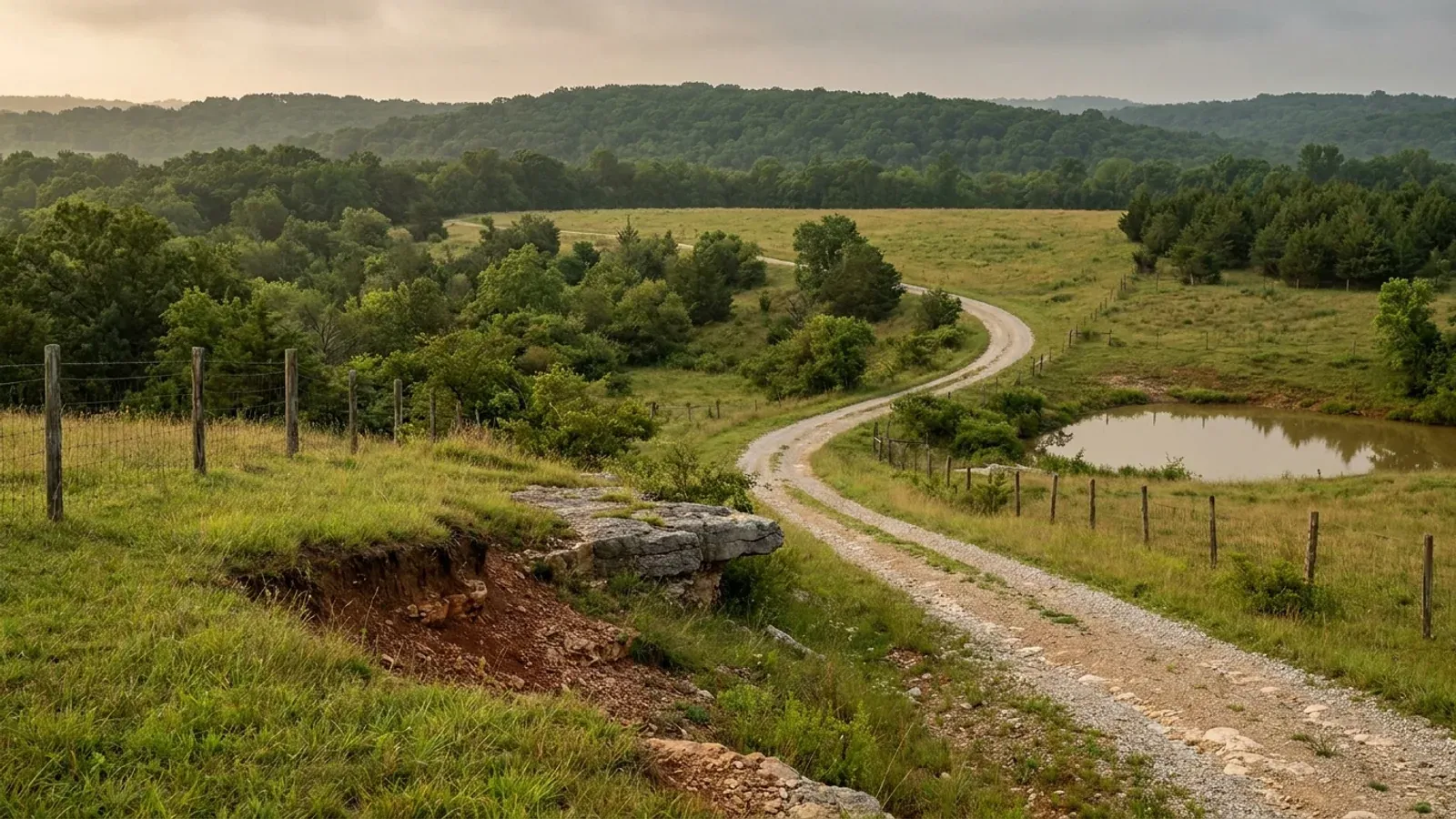
Lincoln County is where St. Louis exurbia runs out and genuine farm country begins: 1,040 farms working 218,355 acres at a 210-acre average, and 41,235 of its 65,888 residents living outside every city limit, in territory where the county issues no building permit at all and applies no zoning. It says so itself, on its own planning and zoning page, and then sends readers somewhere else for each of the things that actually gate a build — the fire district for occupancy permits and electric codes, the Health Department for septic, the Floodplain Management Office for anything in the Cuivre River or Mississippi bottoms. That first referral is the part almost nobody knows about: the Lincoln County Fire Protection District publishes an adopted International Residential Code covering its own territory, under a power that comes from RSMo Chapter 321 and has nothing to do with the county's classification. Lincoln is also one of only three second-classification counties in Missouri, which means it is one of the 25 counties that legally could adopt a county building code — and has not. Buy land here and the questions that decide your build are which fire district you are in, whether your tract is over forty acres for septic purposes, and whether any part of it is in the mapped floodplain.
Lincoln County at a glance
- County
- Lincoln County
- Population
- 65,888
- ZIP codes
- 63379, 63362, 63343, 63389, 63377, 63349, 63347, 63369, 63344
- Site visits
- Usually the same week — Troy and Moscow Mills are a straight run north on Highway 61
Building conditions in Lincoln County
Missouri sets no residential building code and no statewide way of adopting one, so the first question on any parcel is not what the code says — it is whether there is one. Only counties of the first and second classification may adopt a building code at all, and classification is set by assessed valuation rather than population, so a small county can hold the power while a much larger one does not. Zoning is a separate power with its own answer, granted only after a vote of the people and repealable by another. What changes from one jurisdiction to the next is whether the work is inspected, who issues the permit, what that office charges, how the parcel is zoned, and the design figures your drawings have to satisfy.
Missouri Association of Counties, "Missouri Counties by Classification", published May 2025, CLASS 2 list (TOTAL 3) and CLASS 3 list (TOTAL 89) — PDF downloaded from mocounties.com and text-extracted 6 September 2026; RSMo 64.170 and RSMo 48.020, rendered from revisor.mo.gov 6 September 2026
Lincoln County, Missouri, "Planning and Zoning in Lincoln County, Missouri", www.lincolncomo.gov/planning-and-zoning — page source retrieved and read 6 September 2026, after control-testing the host with a bogus path that returns a genuine HTTP 404; RSMo 64.170, 64.510 and 64.530, rendered from revisor.mo.gov 6 September 2026
Lincoln County Fire Protection District (Lincoln County Fire & Rescue), "Residential Codes In Unincorporated Lincoln County", lcfpd1.org, post dated 1 March 2017 — page source read 6 September 2026 after control-testing the host with a bogus path that returns a genuine HTTP 404; RSMo 321.220, effective 28 August 2025, rendered from revisor.mo.gov 6 September 2026 including the Revisor's annotation citing 282 S.W.2d 171; district list from the Fire & Ambulance Districts navigation on www.lincolncomo.gov, read 6 September 2026
U.S. Census Bureau Vintage 2024 Subcounty Population Estimates, sub-est2024_29.csv, SUMLEV 157 records for county FIPS 29113 including the "Balance of Lincoln County" remainder record; and Vintage 2024 County Population Estimates, co-est2024-alldata.csv — both fetched from www2.census.gov 6 September 2026 after control-testing the host with a bogus path that returns a genuine HTTP 404
Lincoln County On-Site Sewage Disposal System Ordinance 1995-12, Revised Version April 1999, §§ 1, 2, 4, 6, 7.3 and 21, published by the Lincoln County Health Department, Office of Environmental Sanitation at lchdmo.org/s/OnsiteOrdinance1995-12Revisions1999.pdf; "Lincoln County On-site Septic System Application Process" with the installer, soil-evaluator and engineer rosters, lchdmo.org/s/onsite-application-842026.pdf — both downloaded and text-extracted 6 September 2026 after control-testing the host with a bogus /s/ path that returns a genuine HTTP 404; RSMo 701.031 and RSMo 701.047, rendered from revisor.mo.gov 6 September 2026
County of Lincoln Floodplain Development Permit Application, published by Lincoln County at www.lincolncomo.gov/media/Emergency Management/Permit-Application-2016.pdf, downloaded and text-extracted 6 September 2026; the 2018 Lincoln County Floodplain Ordinance and the Floodplain Management Office contact are published on the county's Floodplain Administration page, www.lincolncomo.gov/floodplain-administration, read 6 September 2026; RSMo 49.600, effective 4 March 1991, rendered from revisor.mo.gov 6 September 2026; FEMA NFIP Community Status Book Report — Missouri, www.fema.gov/cis/MO.pdf, the report printing its own date as 09/06/2026, downloaded and text-extracted 6 September 2026
Also worth knowing before you build in Lincoln County
- 1,040 farms on 218,355 acres, averaging 210 acres
- The 2022 Census of Agriculture counted 1,040 farms in Lincoln County working 218,355 acres, an average holding of 210 acres. Land in farms fell 5 percent and average farm size 4 percent since 2017 while the number of farms rose 1 percent — subdivision showing up in the data rather than consolidation. The land splits into 142,157 acres of cropland, 45,740 of woodland and 15,904 of pasture. The size distribution is what makes this a shop-and-house market rather than a commodity one: 405 of the 1,040 farms are under 50 acres, 82 of them under ten, and 420 farms sold less than $2,500 of product in the census year. Those are tracts people live on, not operations people run.
- No adopted design table here — and what the federal numbers actually say
- Because this county has adopted no building code, there is no county Table R301.2(1), and so there is no adopted design wind speed, ground snow load, frost line depth or seismic design category to quote for Lincoln County. Anyone who quotes one has taken it off a national map. What can be stated is the federal calculation, which is a different thing and should be labelled as one. Queried at the county's own Census internal point, the USGS design-values service returns, for Risk Category II at Site Class D: under ASCE 7-16, Ss 0.234 g, S1 0.115 g and seismic design category C; under ASCE 7-22, Ss 0.380 g, S1 0.140 g and again category C. Lincoln County is named by Missouri's own geologists in the New Madrid group — a 1991 state emergency management and federal estimate for a magnitude 7.6 event in the zone put Lincoln, together with St. Louis, Pike, Marion, Lewis, Butler, Bollinger, Cape Girardeau and Perry counties, at around 1 percent of buildings collapsed and 10 percent with severe structural damage. Missouri's seismic statute will not force any of that onto a house: RSMo 319.203.2 exempts single-family and duplex residences and private structures under 10,000 square feet. Only a local adopted code does — which here means your fire district's, if it has one.
- Claypan on the divides, loess on the hills, river bottom on the east
- A query against the USDA soil database for survey area MO113 returns 33 major map-unit components for Lincoln County, and they fall into three groups that mean three different foundations. The claypan series are here: Mexico and Putnam, both classed by USDA as smectitic and vertic — the shrink-swell mineralogy is in the taxonomy itself — both poorly drained, both with permeability USDA calls very slow, and both carrying a perched water table with an upper limit of about half a foot to a foot and a half below the surface through the winter and spring in most years. The hills carry loess soils including the Winfield series, moderately well drained, with a perched seasonal high water table two to three and a half feet down from November to April. The eastern side of the county is Mississippi and Cuivre bottomland — Haymond, Chequest, Dupo, Portage, Kampville, Tice. The county's own septic ordinance draws the consequence in its own appendix: for a low-pressure-pipe absorption field it rates clay, sandy clay and silty clay with high shrink-swell potential "Not suitable". Pull the parcel's map units before design; on this county's soils the septic system, not the house, is usually what limits the site.
- Your cooperative's meter-base list reads "Not required" against this county
- Cuivre River Electric Cooperative's rural residential service guide carries a short table of the offices a member contacts "to have your meter base inspected". St. Charles County Planning & Zoning has a phone number there. Warren County Planning & Zoning has a phone number. The City of Troy has a phone number. Against Lincoln County the entry reads "Not required". That is a named electric cooperative stating in writing, in a document dated 28 April 2026, that no meter-base inspection is required in unincorporated Lincoln County — and it substitutes none of its own beyond its construction specification, which it does enforce: "Any meter base failing to meet these requirements will not be energized by the Cooperative." Note carefully what that covers and what it does not. It is the meter base. The panel interior, the branch circuits and the wiring inside the house are inspected by the cooperative not at all. Note also what the same table shows about city limits: Troy is on it and the county is not.
- 275 miles of gravel, 88 bridges and five sets of flood gates
- The Lincoln County Highway Department publishes what it maintains: 205 miles of asphalt roadway, 275 miles of gravel roadway, 88 bridges, five sets of flood gates, 42 slab and low-water crossings, more than 4,400 culverts and more than 2,700 signs. More gravel than asphalt is the honest picture of access here, and the five sets of flood gates and 42 low-water crossings are the honest picture of what the rivers do to it. Two exclusions matter before you buy. Roads inside a subdivision are private, owned and maintained by the property owners on them, not by the county. Roads inside the Elsberry Special Road District or inside any city limits are maintained by those entities instead. And a numbered or lettered route — the county gives Highway 47, Highway 61, Highway C and Highway H as its own examples — belongs to the state, so a new entrance onto one is a MoDOT matter, not a county one.
- The only construction licence this county issues is for septic installers
- Missouri issues no statewide general contractor or residential builder licence, and the state's Division of Professional Registration has no general contractor or home builder board to hold one from. Lincoln County issues no contractor licence either — with one exception that is genuinely enforced. The Health Department licenses on-site sewage disposal system installers, and by county rule all septic installation, repair or modification work must be performed by a Lincoln County licensed installer, with at least one certified installer on site at all times during the work. The ordinance sets the bar: an 85 percent pass on a closed-book examination and 90 percent on an open-book examination, a state on-site training certificate, a $10,000 bond, $500,000 of general liability cover and a $25 annual county licence fee — with a separate homeowner licence valid for six months only and good only for a system on the homeowner's own primary residence. Ask any builder here for the name of the licensed installer they intend to use, and check it against the county's published roster. Inside the cities the picture changes again, because each city in Lincoln County runs its own planning and zoning and its own permitting.
USDA NASS 2022 Census of Agriculture, County Profile — Lincoln County, Missouri (cp29113.pdf), downloaded from www.nass.usda.gov and text-extracted 6 September 2026, after control-testing the host with a bogus county profile that returns a genuine 196-byte HTTP 404
USGS Seismic Design Web Service, earthquake.usgs.gov/ws/building-codes/asce7-16/calculate and .../asce7-22/calculate, latitude 39.062255 longitude -90.962916, riskCategory II, siteClass D, both queried 6 September 2026 and both returning request status "success" in the payload — a bogus reference document returns an HTML application shell at the same path, so the payload status was checked and not the HTTP code; county internal point from the 2024 Census Gazetteer counties file; Missouri Department of Natural Resources, Missouri Geological Survey, "Facts about the New Madrid Seismic Zone", dnr.mo.gov, read 6 September 2026, citing a 1991 SEMA and FEMA report; RSMo 319.203
USDA-NRCS Soil Data Access (SDMDataAccess.sc.egov.usda.gov/Tabular/post.rest), major map-unit components for survey area MO113 "Lincoln County, Missouri", queried 6 September 2026; USDA-NRCS Official Series Descriptions for MEXICO, PUTNAM and WINFIELD (soilseries.sc.egov.usda.gov — control-tested, a bogus series returns a genuine HTTP 404), read 6 September 2026; Lincoln County On-Site Sewage Disposal System Ordinance 1995-12 rev. April 1999, Adopted Standards appendix, Table 14
Cuivre River Electric Cooperative, Rural Residential Guide, Form #UG40-7, dated April 28th, 2026, published at www.cuivre.com as "CREC UG #40 Rural Residential Guide 2022.pdf" — downloaded and text-extracted 6 September 2026 after control-testing the host with a bogus path that returns a genuine HTTP 404
Lincoln County Highway Department, www.lincolncomo.gov/highway-department, page source read 6 September 2026
Lincoln County On-Site Sewage Disposal System Ordinance 1995-12, Revised Version April 1999, §§ 3.11A, 3.11B and 6, and the department's current "Lincoln County On-site Septic System Application Process" document, both published at lchdmo.org and read 6 September 2026; Missouri Division of Professional Registration board list and RSMo Chapter 324; Lincoln County planning and zoning page, www.lincolncomo.gov/planning-and-zoning, read 6 September 2026
The expensive surprises are in the ground, not the building
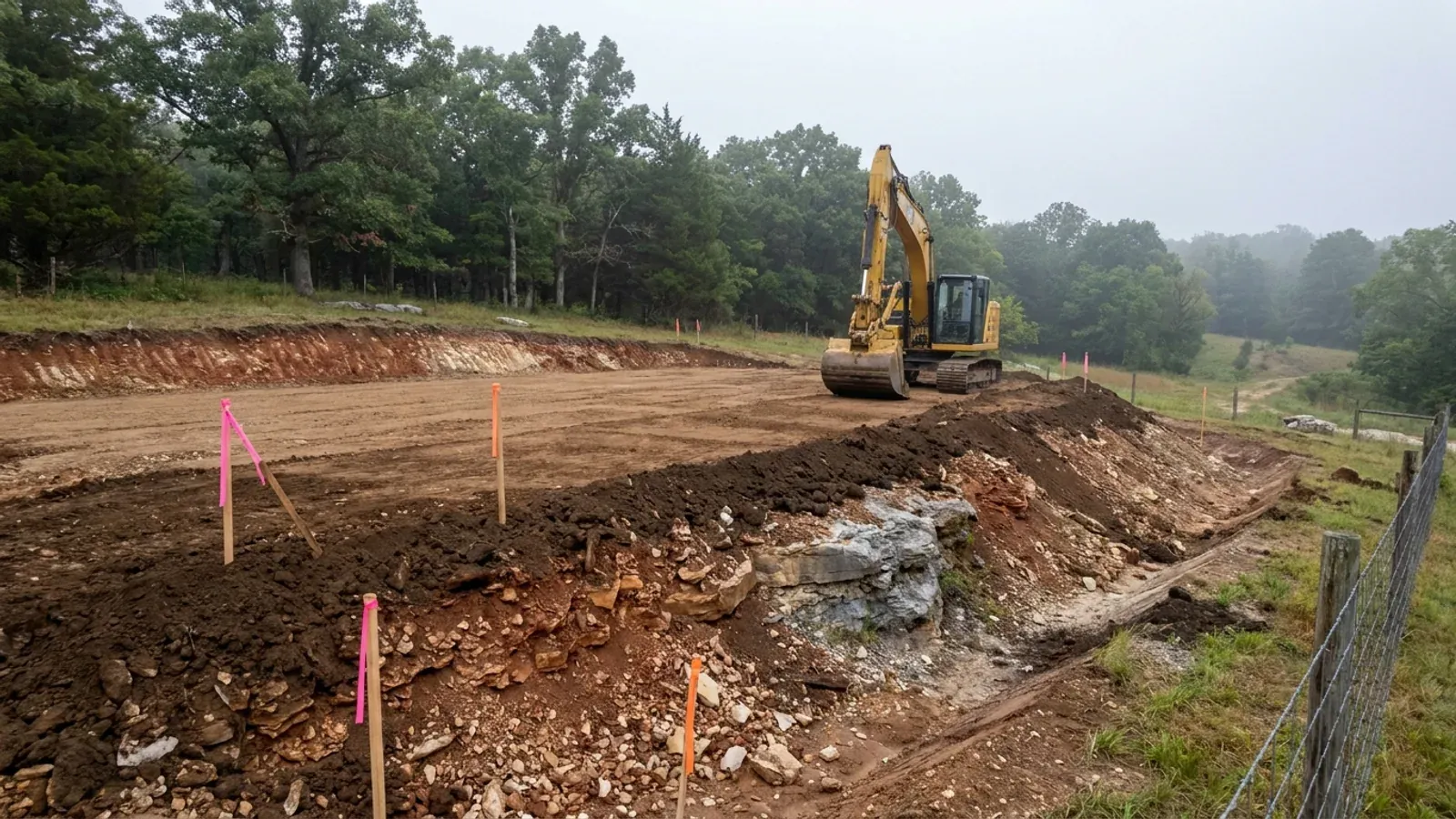
What moves a Missouri budget is usually below grade, and which problem you have depends on where in the state you are. Across the Ozarks it is karst: the Department of Natural Resources maps more than sixteen thousand sinkhole points, and what matters there is what is under the slab rather than what the slab sits in. Across the north and centre it is claypan — dense, slow-draining subsoil that perches water above it for months of the year. In the Bootheel it is deep alluvium carrying the highest seismic demand in the state, where the same soils modelled for liquefaction attack post embedment and slab bearing rather than the frame above them. The same ground then decides the septic system, and Missouri does not run that on a percolation test alone: the rule allows a perc test or a soil morphology examination in a profile pit, and the authority reviewing your parcel picks which. Where a drainfield sits near a sinkhole's drainage, perc testing on its own is not permitted at all. Whether that authority is the state or your own county is itself a local question, and it changes what you have to file. So the site work, the foundation and the drainfield get resolved together rather than one at a time. We price the dirt before we price the building.
What we build in Lincoln County
All nine services are available in Lincoln County. What a build costs depends far more on the parcel than on square footage, so we price against your land rather than publishing a rate card.
Custom Plans
Barndominium floor plans drawn to your parcel and your soil, and to whichever Missouri authority — a county, a city, or none at all — will review them.
Barndominium Kits
Barndominium shell packages delivered to your Missouri land, drawn to the criteria your own county or city publishes — because the state publishes none.
Turnkey Builds
Start to finish barndominium construction in Missouri: the permits that genuinely apply, site work, shell and interior finish, under one contract.
What a build looks like
Three stages every Lincoln County project passes through, from a raw parcel to a finished home. Site work first, because that is where the budget is decided.
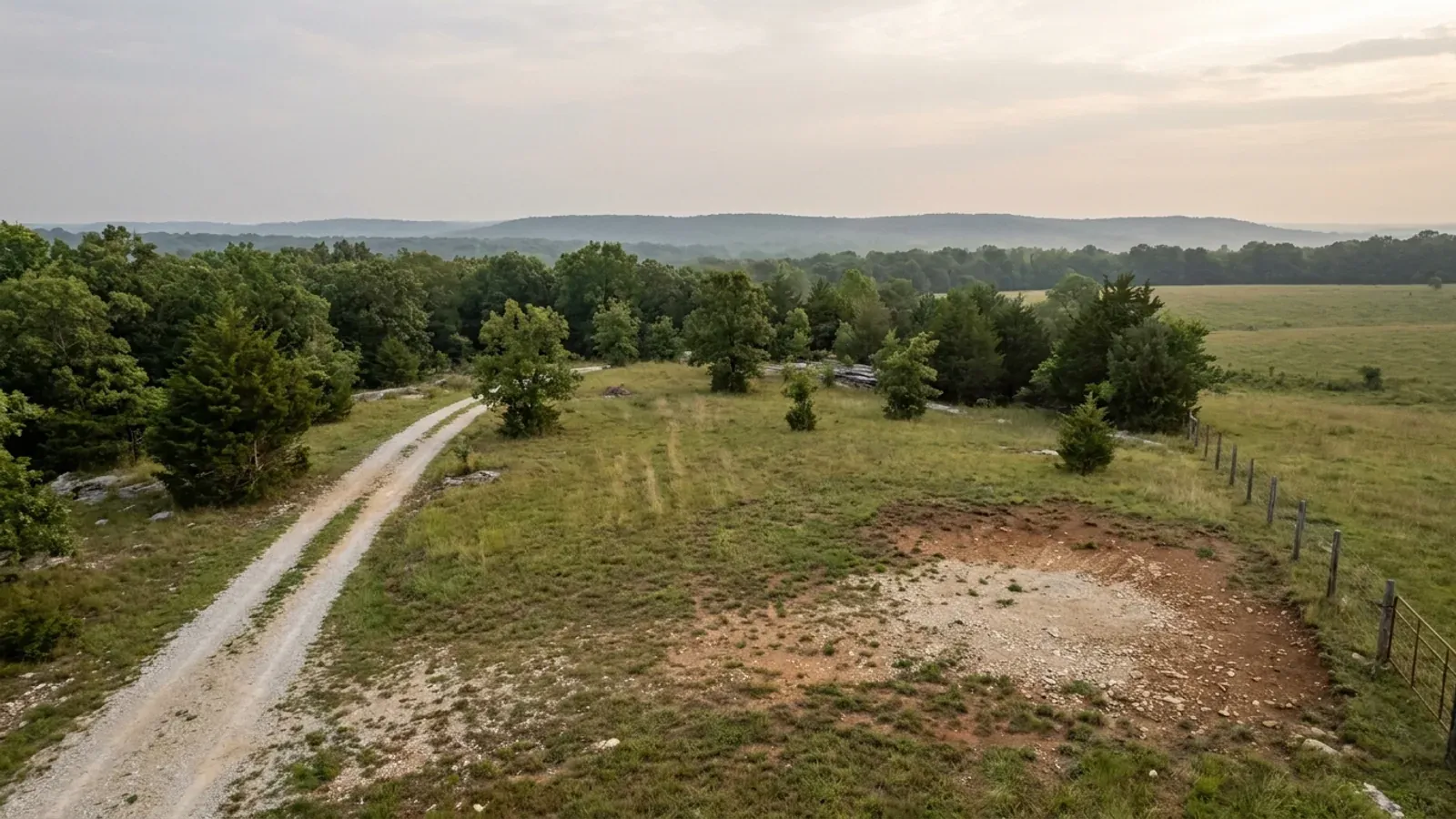
The parcel
Zoning, setbacks, flood zone and utility access get checked before anything is drawn.
Pad and permit
Clearing, grading and a compacted pad, while the submittal works through whichever office issues the permit where you are building.
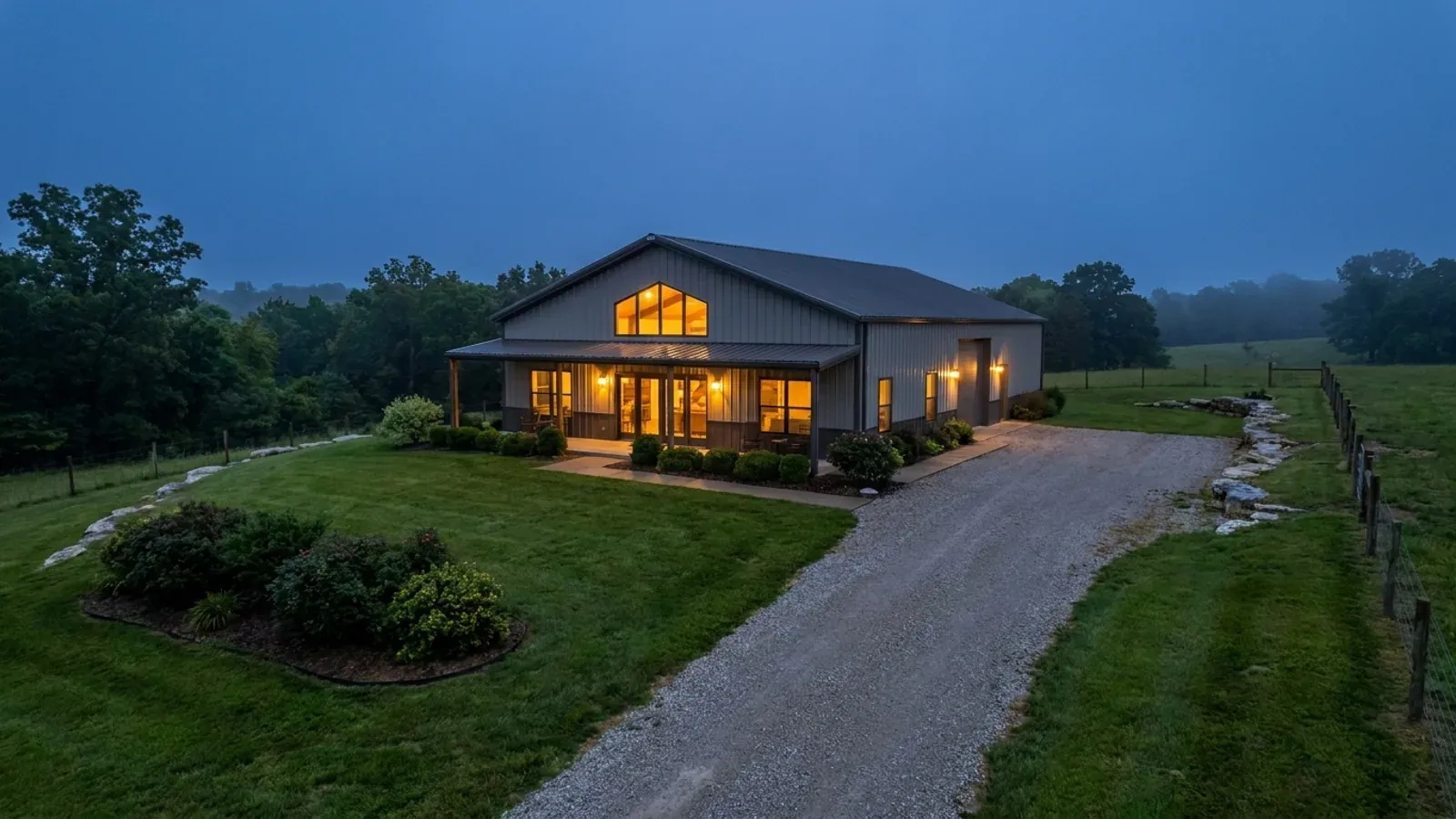
Frame to finish
Shell erected and dried in, then systems, insulation and interior finish through to CO.
Those are the rules where you are building in Lincoln County. Tell us what you want to build and we will draw it to them.
Where we build around Lincoln County
Lincoln County and the rural land around it. The buildable acreage for a project this size usually sits outside the city limits, which is frequently what changes who issues your permit.
Keep reading
The questions that usually come next once you know what Lincoln County allows.
Barndominium Cost Guide
Sourced per-square-foot ranges by tier and by size, with a calculator built on the same figures.
Read itIs It Legal in Missouri?
Classification, zoning, the HOA gate, and why "nonresidential farm building" does not cover a home.
Read itHow Long Does It Take?
Census build-duration data, and what actually sets the permit clock where you are building.
Read itNearby areas we build in
Others we cover nearby, and they are not interchangeable. One may be a county with an adopted building code, another a county with no legal authority to have one, another a city that permits inside its own limits whichever county the land sits in. So the office that issues the permit, whether anyone inspects the work at all, the fees, the zoning and the design figures can differ from one card to the next — sometimes across a single property line.
Building in Lincoln County: common questions
10 questions we get asked most often about building in Lincoln County. If yours is not on the list, ask it directly.
Do I need a building permit to build a barndominium in unincorporated Lincoln County?
What does "second classification" actually mean, and why does it matter to me?
I heard there is no code out here at all. Is that right?
My land is over three acres, so I do not need a septic permit — correct?
Will a percolation test do for my septic design here?
How much of my building has to be raised if I am in the floodplain?
Can I call it an agricultural building and skip all of this?
If nobody inspects the building, how do I know it was built right?
Does anyone in Missouri license the builder itself?
Where in Lincoln County is the land, and what is it like?
Building in Lincoln County?
Start with the plan. Tell us what you want to build and we will draw it, then confirm which office issues the permit for your parcel, what it will let you put there, and what wind load it has to meet. That conversation costs nothing.