Barndominium Builders in Lawrence County, MO
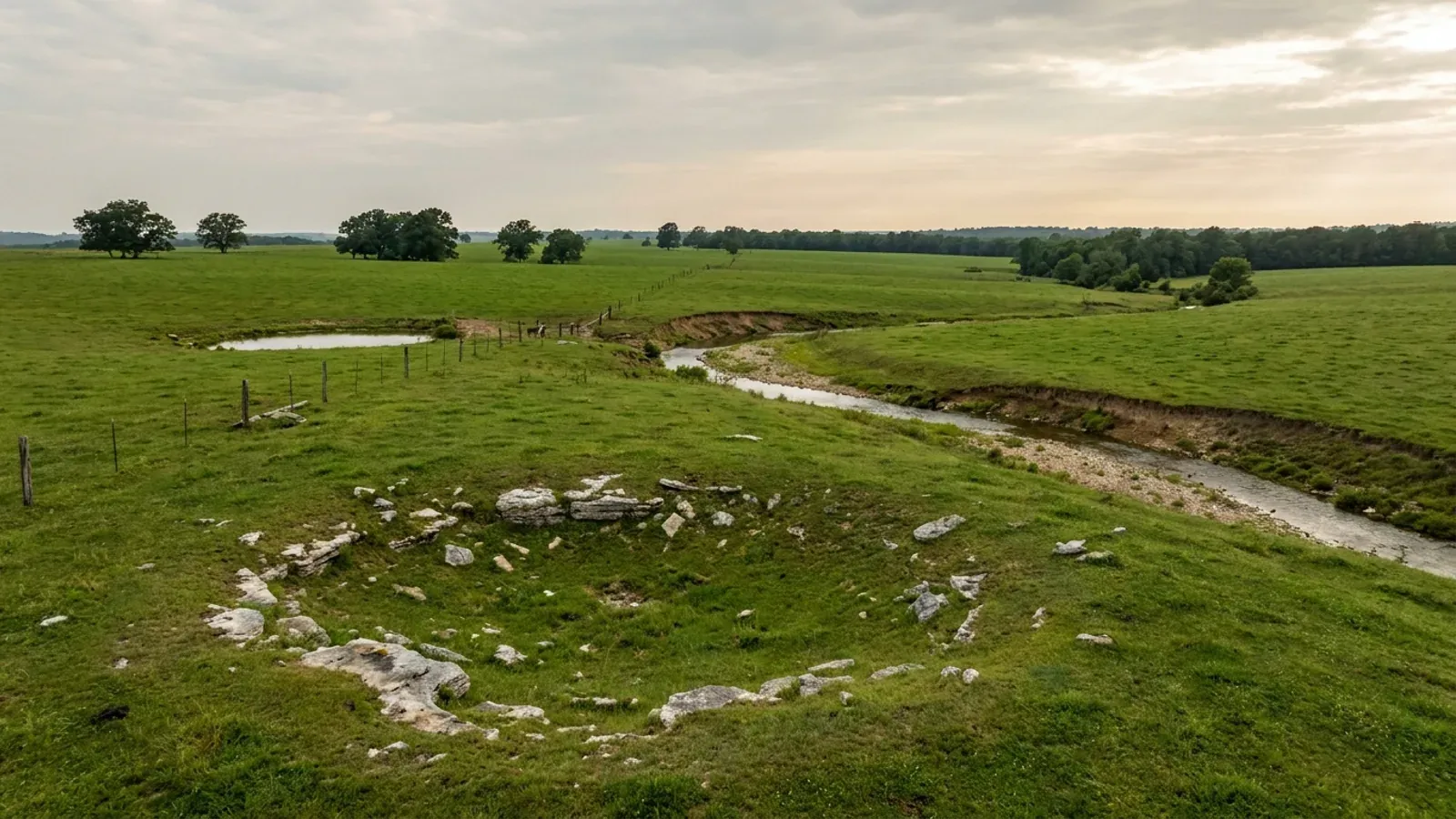
Lawrence County is the ground between Springfield and Joplin, and on the questions that decide how a barndominium gets built it is nothing like either. It is a county of the third classification, which under RSMo 64.170 means the county commission is not empowered to adopt a building code at all — not that it has declined to, but that the statute does not reach it. The county says the same thing in its own words on its Planning and Zoning page: no zoning restrictions, no building codes or regulations, no county building permits in the unincorporated parts of the county, and no certificates of occupancy. One permit is named there, and it is the septic permit. That makes the county line a real boundary for anyone shopping a steel package. Forty miles west, the City of Joplin amends section R104.11 of its residential code to bar pole-barn and laminated-pole construction from residential dwelling units, and Carthage and Neosho carry versions of the same drafting. Nothing of the kind appears in Lawrence County. Monett's own residential handout goes the other way and prints a preservative-retention specification for pole-barn posts used as a structural foundation. Inside the county the picture changes town by town rather than at a county-wide line. Aurora and Monett are both on the 2018 International Residential Code and publish different numbers in it. Mount Vernon, the county seat, is on the 2012 codes with the 2011 National Electrical Code and fills in no design table at all. Marionville adopts the 2012 building and residential codes. Pierce City still runs a fire-limits ordinance passed in 1960 in which the permit authority is the Fire Chief. Cross a city line here and the answer changes; leave the city limits and there is no county answer waiting. What is left is the list of things that genuinely do gate a build on unincorporated ground: a septic construction permit from the Lawrence County Health Department, which its ordinance requires for every single-family dwelling with no acreage threshold; a 911 address from the county's Office of Emergency Management; a floodplain development permit from the county floodplain administrator if the parcel touches the mapped hazard area; and an approach onto whichever of the county's thirteen independent special road districts your frontage belongs to. The ground itself has a specific answer too, and it is not the one the word Ozarks suggests. Bedrock is shallow on very little of this county. A fragipan is not.
Lawrence County at a glance
- County
- Lawrence County
- Population
- 39,151
- ZIP codes
- 65712, 65605, 65708, 65705, 65707, 65723, 65769, 65756, 65654, 65664
- Site visits
- Same-week site visits across the county — Mount Vernon, Aurora, Monett, Marionville, Miller, Pierce City, Verona, Freistatt, Stotts City, Halltown and the open ground between them. Lawrence County sits on I-44 thirty miles west of Springfield and forty miles east of Joplin, so both markets are an easy drive and neither treats this county as its own.
Building conditions in Lawrence County
Missouri sets no residential building code and no statewide way of adopting one, so the first question on any parcel is not what the code says — it is whether there is one. Only counties of the first and second classification may adopt a building code at all, and classification is set by assessed valuation rather than population, so a small county can hold the power while a much larger one does not. Zoning is a separate power with its own answer, granted only after a vote of the people and repealable by another. What changes from one jurisdiction to the next is whether the work is inspected, who issues the permit, what that office charges, how the parcel is zoned, and the design figures your drawings have to satisfy.
Lawrence County, Missouri, Planning & Zoning page, www.lawrencecountymo.org/planning-zoning, read 8 September 2026; RSMo § 64.170.1, Effective 28 August 2008, read at revisor.mo.gov/main/OneSection.aspx?section=64.170 on 8 September 2026; Missouri Association of Counties, "Missouri Counties by Classification" (published May 2025), CLASS 3 (TOTAL 89).
City of Monett, MO Code § 500.129 Additions, Insertions and Changes (Ord. No. 8904, 3-21-2022), and § 500.127, read on eCode360 (customer MO3366, code date 11 June 2026) 8 September 2026 and re-read on an independent navigation the same day; City of Aurora, MO Code § 500.070 (Ord. No. 2021-3226, 5-11-2021), eCode360 customer AU3230, code date 28 July 2026; City of Mount Vernon, MO Code § 500.020.F (Ord. No. 2.199, 9-8-2020); City of Monett Residential Building Handout, updated 3-19-24, monettmo.gov DocumentCenter View/136; City of Joplin Code § 26-67 as recorded on the Joplin entry.
City of Aurora, MO Code § 500.070.A.2, Table R301.2(1) insertions (Ord. No. 2021-3214, 2-9-2021; Ord. No. 2021-3226, 5-11-2021), eCode360 customer AU3230, code date 28 July 2026, read 8 September 2026 and re-read on an independent navigation the same day; City of Monett, MO Code § 500.129, Section R301.2(1) insertions (Ord. No. 8904, 3-21-2022), eCode360 customer MO3366, code date 11 June 2026, read and re-read 8 September 2026; City of Mount Vernon, MO Code Ch. 500 Art. I searched for R301.2, eCode360 customer MO3369, 8 September 2026.
City of Aurora, MO Code §§ 500.020, 500.060 and 500.030 (Ord. No. 2010-2860; Ord. No. 2021-3214; Ord. No. 2021-3226; Ord. No. 2025-3362, 12-23-2025), eCode360 AU3230; City of Monett Building and Zoning and Property Maintenance Information Guide, monettmo.gov DocumentCenter View/1180, and Code §§ 500.010 and 500.127; City of Mount Vernon, MO Code §§ 500.010, 500.020 and 500.030 (Ord. No. 2.199, 9-8-2020), eCode360 MO3369; City of Marionville, MO Code § 500.010 (Ord. No. 02-2013, 2-14-2013), eCode360 MA3357; Pierce City, MO Code §§ 500.010, 500.020 and 500.030 (Ord. No. 3547 §§ 101–103, 5-10-1960), eCode360 PI3403. All read 8 September 2026.
City of Aurora, MO Code § 500.050 Certain Accessory Buildings Require Review And Approval (Ord. No. 2010-2860 § 1, 2-9-2010; Ord. No. 2021-3226, 5-11-2021) and § 400.280.A.3 (Ord. No. 2021-3223, 5-11-2021) and § 400.410.E (Ord. No. 2021-3223, 5-11-2021), eCode360 AU3230, code date 28 July 2026; City of Monett, MO Code §§ 400.050.A.6–7, 400.030.A.4 and 400.073.A.7 (Ord. No. A-1867, 2-22-1984; Ord. No. A-5055, 11-30-1988; Ord. No. 7874, 8-20-2008; Ord. No. 8942, 2-21-2023), eCode360 MO3366, code date 11 June 2026. All read 8 September 2026.
Lawrence County Health Department Wastewater Treatment Systems Ordinance, approved by the Lawrence County Commission November 2024 (signed by Presiding Commissioner Bob Senninger, Eastern Commissioner Tim Selvey, Western Commissioner David Botts, attested by County Clerk Tammy Riebe), §§ 1, 2, 3.11, 6.01–6.06, 9.03, 14.01–14.05 and Exhibit A (Updated 2025), www.lawrencecohealth.com/s/Wastewater-Treatment-Systems-Ordinance-11-24.pdf, an image-only scan read page by page 8 September 2026; Missouri DHSS OWTS Construction Permit Process county selector, ?county=Lawrence, returning Agency: Lawrence County Health Dept., Authority Type: Ordinance, read 8 September 2026; RSMo § 701.031, Effective 28 August 2005; RSMo § 192.300, Effective 15 June 2021.
Also worth knowing before you build in Lawrence County
- The ground here is not shallow to bedrock — it is fragipan, on three fifths of the county
- The Ozarks reputation for rock within a spade's depth does not describe Lawrence County. Measured from the USDA Natural Resources Conservation Service Soil Data Access tabular service on 8 September 2026 for survey area MO109, Lawrence County, Missouri, whose map units total 392,557 acres across 88 units: a lithic or paralithic bedrock restriction within 51 centimetres — about twenty inches — falls on 5,502 component-weighted acres, or 1.40 per cent of the survey area. Extend the threshold to 102 centimetres, about forty inches, and it is 12,241 acres, 3.12 per cent. All of the shallow bedrock is lithic; the shallowest paralithic contact in the whole survey area is at 66 centimetres. What does govern foundations here is a fragipan — a dense, brittle, root-restricting subsoil layer — recorded on 235,013 component-weighted acres, 59.9 per cent of the survey area, at depths from 41 to 86 centimetres, which is roughly sixteen to thirty-four inches. The shallow end of that range sits above the 24-inch frost line that both Aurora and Monett publish, so on a good deal of this county a footing trench is being cut into or through it. The five largest soil components by area are Wilderness, Viraton, Hoberg, Creldon and Keeno, and moderately well drained soils account for 232,392 acres, 59.2 per cent — the drainage signature a fragipan produces. Chert is a secondary story rather than the main one: horizons with 35 per cent or more rock fragments in the top 100 centimetres occur on 81,457 acres, 20.8 per cent. A perched water table over a fragipan is a different design problem from rock, and it is the one to price for here.
- Seven fire protection districts, and none of them is a building department
- A Chapter 321 fire protection district can be a construction authority in Missouri, and where a county has no code the question is not academic. The Missouri Division of Fire Safety's Fire Departments by County report, generated 8 September 2026, lists ten registered fire services in Lawrence County: municipal departments at Aurora, Marionville and Miller, and seven districts organised under Chapter 321 — Aurora Rural, Freistatt, Halltown, Miller Rural, Mt. Vernon, Pierce City and Stotts City. Monett is served from Barry County by the City of Monett Fire Department and the Monett Rural Fire Protection District. None of the seven publishes an adopted building or residential code, and the only county-wide fire instrument found is a temporary burn ban ordered by the County Commission with the State Fire Marshal's authorisation. The statutory frame is worth knowing either way. RSMo 321.220(12), effective 28 August 2025, lets a district board adopt fire protection and fire prevention ordinances whose administrative standards may be "industrial codes adopted by nationally organized and recognized trade bodies", makes a violation a misdemeanour prosecuted by the county prosecutor, and expressly bars a district from imposing regulations or requiring permits on the erection, maintenance, repair, alteration or extension of farm buildings or farm structures. RSMo 321.228, effective 28 August 2012, then does the dividing: where a city or county adopts, implements and enforces a residential construction regulatory system, any district wholly or partly inside it is "without power, authority, or privilege to enforce or implement" one there, and any it has adopted is advisory only. So inside Aurora, Monett, Mount Vernon, Marionville and Pierce City the districts are preempted. On unincorporated ground the county runs no such system, so the route stands open and unused. Districts keep, everywhere, the final say on hydrant location, specification and flow rates and on fire lanes, and may inspect the alteration, enlargement, replacement or repair of a one- or two-family dwelling — not its new construction — and may charge no fee for either. Boundaries are not mapped publicly here, so ask which district covers a specific address rather than assuming.
- This is a county of small holdings, and the tract sizes match what gets built on them
- The 2022 Census of Agriculture county profile records 1,599 farms in Lawrence County on 312,640 acres, an average of 196 acres, with land in farms down 6 per cent since 2017 while average farm size rose 3 per cent. The distribution is the useful part. Eighty-four farms are 1 to 9 acres and 577 are 10 to 49 acres — 41 per cent of all farms in the county are under fifty acres, and the ten-to-fifty band alone is 36 per cent. Another 519 are 50 to 179 acres. Only 55 exceed a thousand. Land in farms breaks down as 147,127 acres of pastureland against 113,536 of cropland, 37,111 of woodland and 14,866 other, and 89 per cent of the county's $254.6 million in agricultural sales is livestock, poultry and products rather than crops. The county's total land area is 611.753 square miles. What that adds up to for a buyer is a supply of parcels in exactly the five-to-forty-acre range this kind of building suits, in a county where the surrounding use is pasture rather than row crop, and where nothing in county law limits what goes on them.
- The metal-siding question, scoped: nothing in this county reaches a site-built house on rural ground
- Two jurisdictions in Lawrence County say something about metal on a building, and neither reaches the house a reader here would build. Mount Vernon's section 405.740 sets development guidelines for the Downtown "B-2" district and the Comprehensive Plan Downtown Overlay District, in which the use of aluminium siding and metal ribbed panels is discouraged and "Corrugated metal facades should be complemented with abundant use of masonry". They are guidelines applied through site plan review, and section 405.715 makes site plan review applicable to building permit applications in the multifamily, commercial and industrial zoning districts — not to a single-family dwelling, and not outside the downtown. Pierce City's sections 500.040 and 500.050 do prohibit frame, wooden and metal structures, but only inside the fire limits described in section 500.010, a four-street block bounded by Main, Myrtle, the old St. Louis–San Francisco Railway line and Olive; and even inside them the exceptions expressly permit dwellings not exceeding two storeys separated by at least five feet from the adjoining lot line. Everywhere else the search comes up empty in the strongest sense: the word "corrugated" appears twice in Monett's entire code and both times it is storm-sewer pipe, twice in Aurora's and both times the same, and not once in Pierce City's. Neither Monett nor Aurora imposes a minimum roof pitch or an eave projection on a dwelling, and neither runs architectural or appearance review. The one provision in the county that names metal roofing names it approvingly: Aurora's Small Houses section 400.410.F.6 requires that such a house "must be pitch roof constructed of metal roofing or composite shingles". Monett does set a minimum dwelling floor area of 800 square feet exclusive of garage or carport in District A. Unincorporated Lawrence County sets none of this, because it sets nothing.
- What actually gates a build on unincorporated ground, in order
- With no county building permit there is still a sequence, and skipping a step in it stops the job as surely as a failed inspection would. First, the septic construction permit from the Lawrence County Health Department, which its ordinance requires before installation and which needs a soil evaluation from a county-registered soil scientist; the department publishes lists of registered installers, pumpers and soil scientists and a setback distance table. Second, a 911 address, requested through the county's Office of Emergency Management; the Lawrence County Emergency Services Board was created by the County Commission under RSMo 190.335 after voters approved a half-cent sales tax in April 2019, and its new 7,474-square-foot centre at 1533 Missouri Drive in Mount Vernon began operating on 27 September 2023 and dispatches for the whole county. Third, if the parcel touches the mapped flood hazard area, a floodplain development permit — the county participates in the National Flood Insurance Program as community 290198 with a currently effective map date of 2 August 2012, and the application and the floodplain administrator's contact are both published by Emergency Management. Fourth, an approach onto the road, which is a matter for whichever of the county's thirteen special road districts holds your frontage; each is an independent entity with its own elected board, and the assessor's office can identify which one a parcel falls in. Two villages in the county are not in the flood insurance programme at all — Stotts City and Halltown — which is a single status recorded under two field names and which affects the availability of federally backed flood insurance and disaster assistance inside those limits.
- The agricultural question here has a statutory answer, not an exemption
- Asking what the farm-building exemption is in Lawrence County starts from the wrong end, because an exemption is a carve-out from a rule and the county has almost no rules to carve. There is no county building code to be exempt from, no county zoning ordinance, and no county building permit. The one county instrument that reaches a rural parcel is the health department's wastewater ordinance, and the limit on it is statutory rather than a local exemption. RSMo 192.300.1(2) provides that a county health ordinance shall not "impose standards or requirements on an agricultural operation and its appurtenances, as such term is defined in section 537.295, that are inconsistent with, in addition to, different from, or more stringent than" the provisions of that chapter or chapters 260, 640, 643 and 644. The Lawrence County ordinance quotes that limit in its own Section 1 as the authority it is enacted under. The Missouri Supreme Court applied the same limb in 2023 to strike down county health regulations imposing air and water quality standards on animal feeding operations. Separately, RSMo 321.220(12) bars a fire protection district from requiring permits for the erection, maintenance, repair, alteration or extension of farm buildings or farm structures. Inside the cities the picture is ordinary zoning: Monett's District AG permits accessory uses including sheds, garages, barns, silos and bunkhouses by name, with a five-acre minimum lot per family, and Aurora zones an A-1 Agricultural district.
- What the cities charge, and what a plan set costs to have looked at
- Where a permit does exist here it is cheap by square foot and the review is the variable. Aurora's fee schedule at section 500.030.B sets new or remodelled residential construction at $0.15 per square foot and garages, carports and outbuildings at $0.07 per square foot, whether separate or attached, with residential plan review at $25, commercial plan review at $100 plus $50 per hour, a $25 meter loop replacement, $20 for basic electrical, plumbing or mechanical work, $50 for land disturbance, a $20 minimum on everything, and $100 to file an appeal with the Building Board of Appeals. Aurora also added a plan review cost recovery subsection under which the city may send subdivision and commercial plans to a third-party review firm and recover the full cost from the applicant, with a deposit taken against a written estimate first and no permit, final plat or certificate of occupancy issued until it is repaid. Monett's schedule at section 500.030 is $0.10 per square foot for residential single-family housing, duplexes and apartments and $0.05 per square foot for garages and detached buildings, with commercial work and remodelling at $3.00 per $1,000 of construction cost, and a provision allowing consultant review costs to be added to the permit fee. Monett's building department inspects footings and setbacks, floor joists, open wall for framing, electrical, plumbing and HVAC, and a final, and issues the certificate of occupancy that the city requires before utilities are connected.
- Monett is two counties, and which half you are in changes who you talk to
- Monett is the largest municipality anyone would call a Lawrence County town, and most of it is not in Lawrence County. The Census Bureau's 2024 sub-county estimates put the city at 10,108 people, of whom 3,658 are in the Lawrence County part and 6,450 in the Barry County part. City hall is at 217 5th Street on the Barry side, the fire department is registered to Barry County, and the city's flood insurance community record is filed under Lawrence County/Barry County jointly as community 290023. Pierce City sits the other way round — it straddles the same line on paper but its entire 1,272 residents are counted on the Lawrence County side. The largest place wholly inside Lawrence County is Aurora at 7,573, followed by Mount Vernon the county seat at 4,703 and Marionville at 2,090, then Miller at 714, Verona at 512, Freistatt at 183, Stotts City at 178, Halltown at 103 and Hoberg at 47. Wentworth, often listed nearby, is in Newton County. County population is 39,151. The practical consequence is that a Monett address does not tell you which county's recorder holds the deed or which health department permitted the septic, and it is worth settling before anything is ordered.
USDA-NRCS Soil Data Access tabular service, sdmdataaccess.sc.egov.usda.gov/Tabular/post.rest, queried 8 September 2026. Survey area MO109 (Lawrence County, Missouri), 392,557 total map-unit acres. Method stated in full: corestrictions.resdept_r is in CENTIMETRES; thresholds used were 51 cm (about 20 inches) and 102 cm (about 40 inches); reskind limited to 'Lithic bedrock' and 'Paralithic bedrock' for the bedrock figures and 'Fragipan' for the fragipan figure; acres are component-weighted as mapunit.muacres x component.comppct_r / 100; components were de-duplicated by taking one acreage per cokey so a component carrying two restriction records is counted once. Chert figure joins chorizon to chfrags with hzdept_r < 100 cm and fragvol_r >= 35, de-duplicated the same way.
Missouri Department of Public Safety, Division of Fire Safety, "Registered Fire Departments — Missouri" (Fire Departments by County report), apps1.mo.gov/fsreg/dl.ashx?f=report&k=fdco&o=pdf, report generated 9/8/2026, Lawrence County block at pages 61–62; RSMo § 321.220(12), Effective 28 August 2025, and RSMo § 321.228, Effective 28 August 2012, both read at revisor.mo.gov on 8 September 2026.
USDA National Agricultural Statistics Service, 2022 Census of Agriculture County Profile, Lawrence County, Missouri (cp29109), pages 1–2; U.S. Census Bureau 2024 Gazetteer Files, counties, GEOID 29109, ALAND 1,584,432,304 sq m = 611.753 sq mi. Both read 8 September 2026.
City of Mount Vernon, MO Code §§ 405.715 and 405.740 (Ord. No. 2.56 § 2 (Art. 12 §§ 2, 7), 1-9-2001), eCode360 MO3369; Pierce City, MO Code §§ 500.010, 500.040 and 500.050 (Ord. No. 3547 §§ 101, 201, 202, 5-10-1960; Ord. Nos. 03-12, 03-13 and 03-19, 2003), eCode360 PI3403; City of Aurora, MO Code § 400.410.F.6 (Ord. No. 2021-3223, 5-11-2021), eCode360 AU3230; City of Monett, MO Code § 400.050.A.6 (Ord. No. A-5055, 11-30-1988), eCode360 MO3366. Full-text searches for 'corrugated', 'laminated', 'pole barn', 'metal siding' and 'roof pitch' run against each of the four codes 8 September 2026.
Lawrence County Health Department septic programme page and Wastewater Treatment Systems Ordinance § 6.01, www.lawrencecohealth.com/septic; Lawrence County Office of Emergency Management page, www.lawrencecountymo.org/emergency-management-1 (911 address form, floodplain development permit application, floodplain administrator contact); Lawrence County Emergency Services 911, www.lawrencecountymo911.gov, general information section citing RSMo 190.335 and the April 2019 sales tax; Lawrence County Road Districts page, www.lawrencecountymo.org/road-districts; FEMA OpenFEMA NfipCommunityStatusBook v1, filtered state 'MO' and county 'LAWRENCE COUNTY', returning eight communities, queried 8 September 2026. All read 8 September 2026.
RSMo § 192.300.1(2), Effective 15 June 2021, with the annotation to Cedar County Commission v. Governor Mike Parson, 661 S.W.3d 766 (Mo. banc 2023), read at revisor.mo.gov 8 September 2026; Lawrence County Health Department Wastewater Treatment Systems Ordinance § 1 Authority, which quotes RSMo 192.300 in full; RSMo § 321.220(12), Effective 28 August 2025; City of Monett, MO Code § 400.073.A.7 (Ord. No. 8942, 2-21-2023) and § 400.074.A.5.
City of Aurora, MO Code § 500.030.B and § 500.030.D (Ord. No. 2025-3362, 12-23-2025), eCode360 AU3230, code date 28 July 2026; City of Monett, MO Code § 500.030 Fee Schedule (Ord. No. 8904, 3-21-2022), eCode360 MO3366, code date 11 June 2026; City of Monett Residential Building Handout, updated 3-19-24, inspections section, and Building and Zoning and Property Maintenance Information Guide, certificate of occupancy section. All read 8 September 2026.
U.S. Census Bureau, Population Estimates Program, sub-est2024.csv (incorporated places and minor civil divisions, vintage 2024), rows for state 29, counties 009 and 109, POPESTIMATE2024; co-est2024-alldata.csv, SUMLEV 050, STATE 29, COUNTY 109, POPESTIMATE2024 = 39,151; FEMA OpenFEMA NfipCommunityStatusBook v1, community 290023 MONETT, CITY OF, county field 'LAWRENCE COUNTY/BARRY COUNTY'. All read 8 September 2026.
The expensive surprises are in the ground, not the building
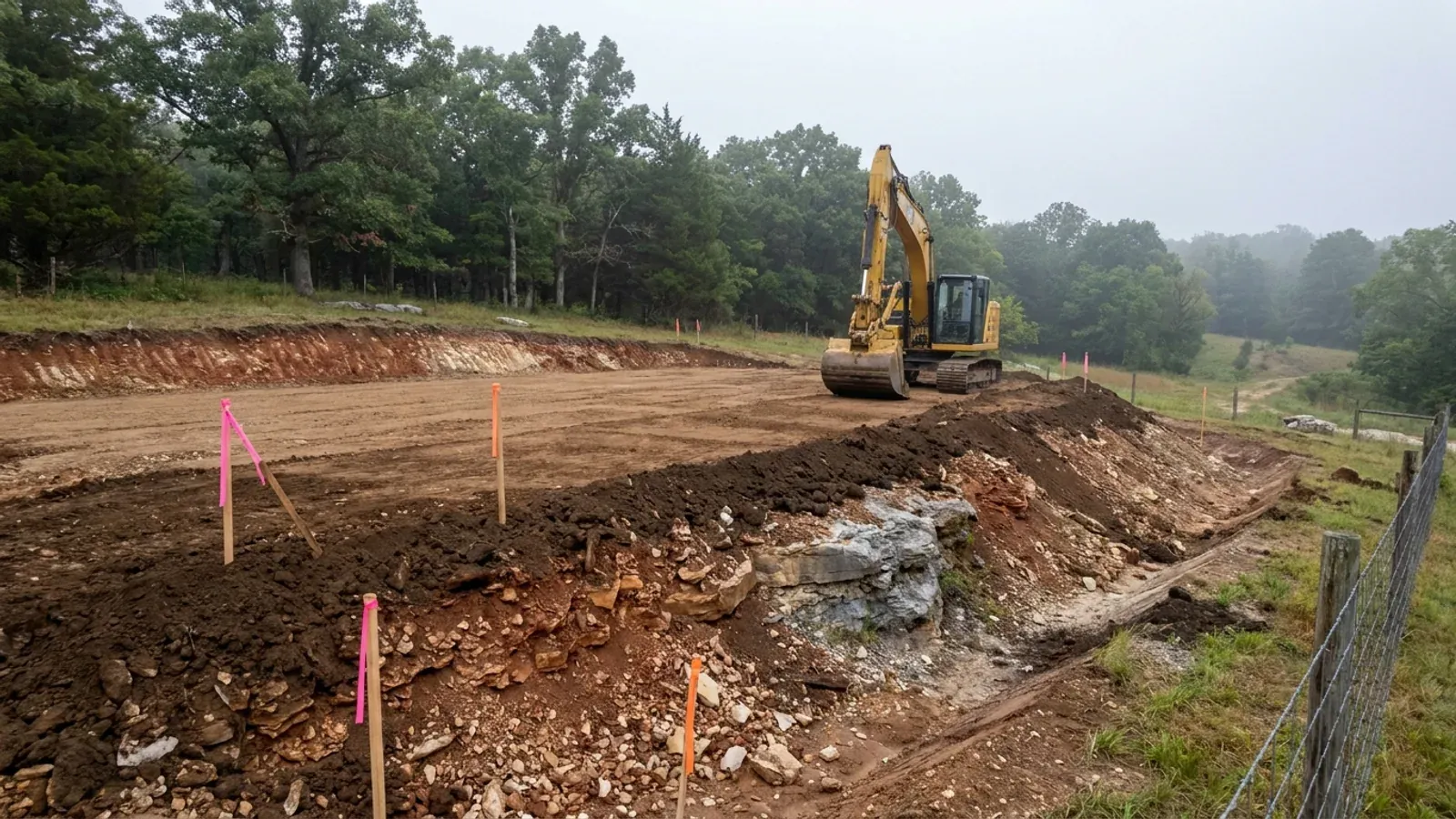
What moves a Missouri budget is usually below grade, and which problem you have depends on where in the state you are. Across the Ozarks it is karst: the Department of Natural Resources maps more than sixteen thousand sinkhole points, and what matters there is what is under the slab rather than what the slab sits in. Across the north and centre it is claypan — dense, slow-draining subsoil that perches water above it for months of the year. In the Bootheel it is deep alluvium carrying the highest seismic demand in the state, where the same soils modelled for liquefaction attack post embedment and slab bearing rather than the frame above them. The same ground then decides the septic system, and Missouri does not run that on a percolation test alone: the rule allows a perc test or a soil morphology examination in a profile pit, and the authority reviewing your parcel picks which. Where a drainfield sits near a sinkhole's drainage, perc testing on its own is not permitted at all. Whether that authority is the state or your own county is itself a local question, and it changes what you have to file. So the site work, the foundation and the drainfield get resolved together rather than one at a time. We price the dirt before we price the building.
What we build in Lawrence County
All nine services are available in Lawrence County. What a build costs depends far more on the parcel than on square footage, so we price against your land rather than publishing a rate card.
Custom Plans
Barndominium floor plans drawn to your parcel and your soil, and to whichever Missouri authority — a county, a city, or none at all — will review them.
Barndominium Kits
Barndominium shell packages delivered to your Missouri land, drawn to the criteria your own county or city publishes — because the state publishes none.
Turnkey Builds
Start to finish barndominium construction in Missouri: the permits that genuinely apply, site work, shell and interior finish, under one contract.
What a build looks like
Three stages every Lawrence County project passes through, from a raw parcel to a finished home. Site work first, because that is where the budget is decided.
The parcel
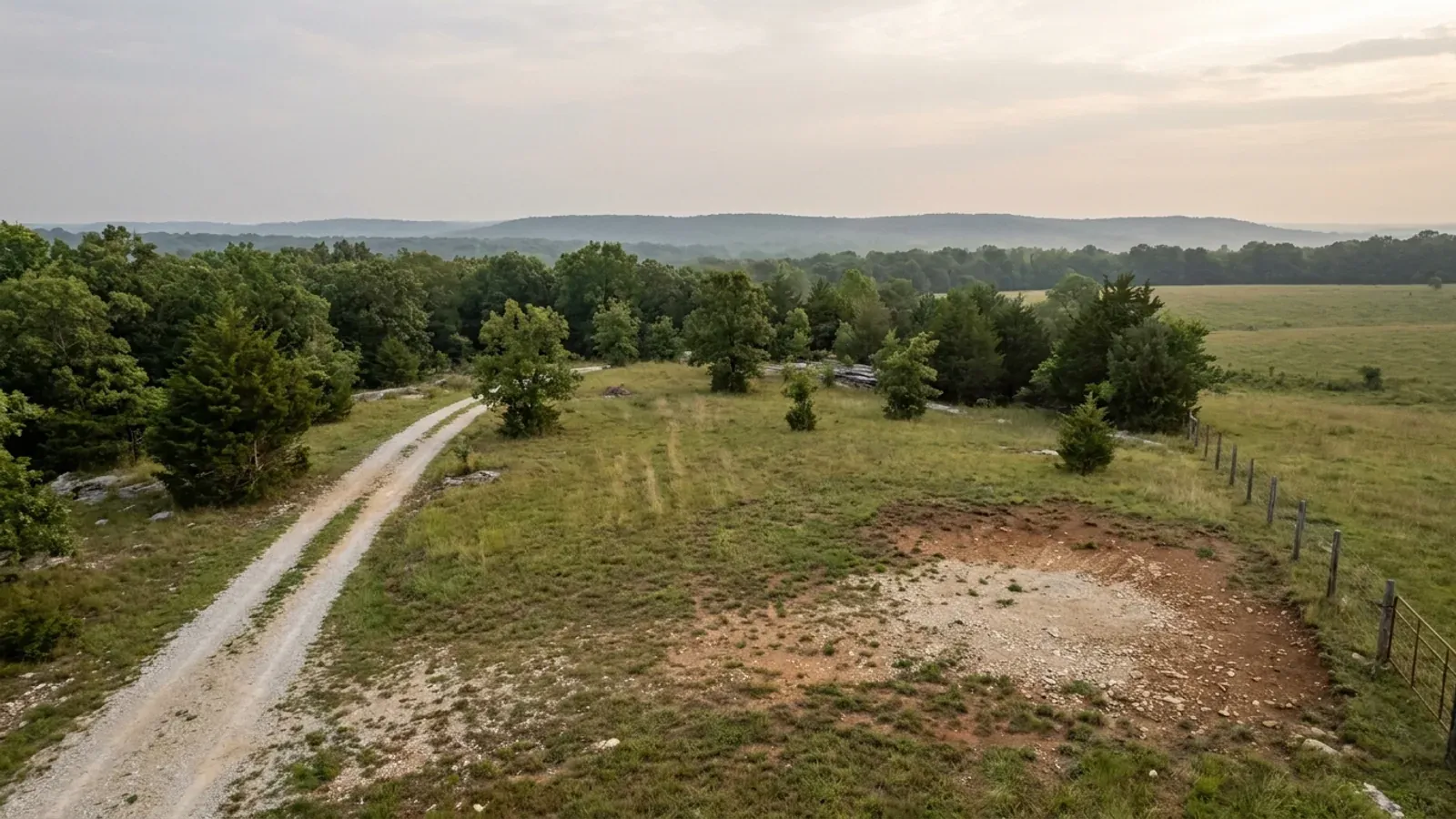
Zoning, setbacks, flood zone and utility access get checked before anything is drawn.
Pad and permit
Clearing, grading and a compacted pad, while the submittal works through whichever office issues the permit where you are building.
Frame to finish
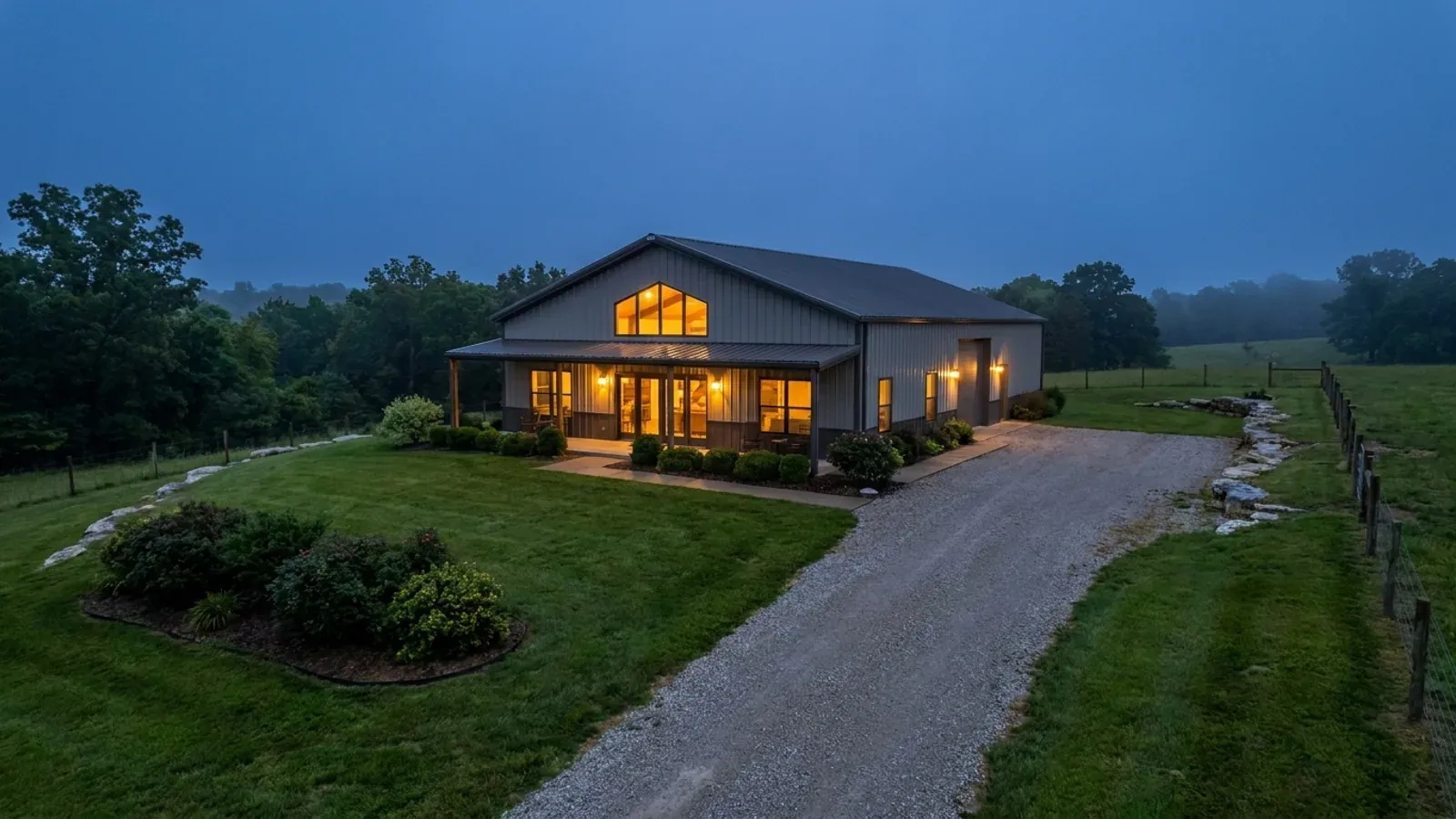
Shell erected and dried in, then systems, insulation and interior finish through to CO.
Those are the rules where you are building in Lawrence County. Tell us what you want to build and we will draw it to them.
Where we build around Lawrence County
Lawrence County and the rural land around it. The buildable acreage for a project this size usually sits outside the city limits, which is frequently what changes who issues your permit.
Keep reading
The questions that usually come next once you know what Lawrence County allows.
Barndominium Cost Guide
Sourced per-square-foot ranges by tier and by size, with a calculator built on the same figures.
Read itIs It Legal in Missouri?
Classification, zoning, the HOA gate, and why "nonresidential farm building" does not cover a home.
Read itHow Long Does It Take?
Census build-duration data, and what actually sets the permit clock where you are building.
Read itNearby areas we build in
Others we cover nearby, and they are not interchangeable. One may be a county with an adopted building code, another a county with no legal authority to have one, another a city that permits inside its own limits whichever county the land sits in. So the office that issues the permit, whether anyone inspects the work at all, the fees, the zoning and the design figures can differ from one card to the next — sometimes across a single property line.
Building in Lawrence County: common questions
10 questions we get asked most often about building in Lawrence County. If yours is not on the list, ask it directly.
Do I need a building permit to build a house in unincorporated Lawrence County?
I heard Joplin bans pole-barn houses. Does that apply here?
What snow load and wind speed should my building be designed for?
My lot is over three acres. Doesn't that mean I don't need a septic permit?
How big a shop can I put up next to the house?
Will anyone stop me putting metal siding or a metal roof on the house?
If the county does not inspect, does anyone?
Is the ground here rocky? What should I expect for a foundation?
Which building code applies in Aurora, Monett or Mount Vernon?
Is flood insurance available on rural parcels here?
Building in Lawrence County?
Start with the plan. Tell us what you want to build and we will draw it, then confirm which office issues the permit for your parcel, what it will let you put there, and what wind load it has to meet. That conversation costs nothing.