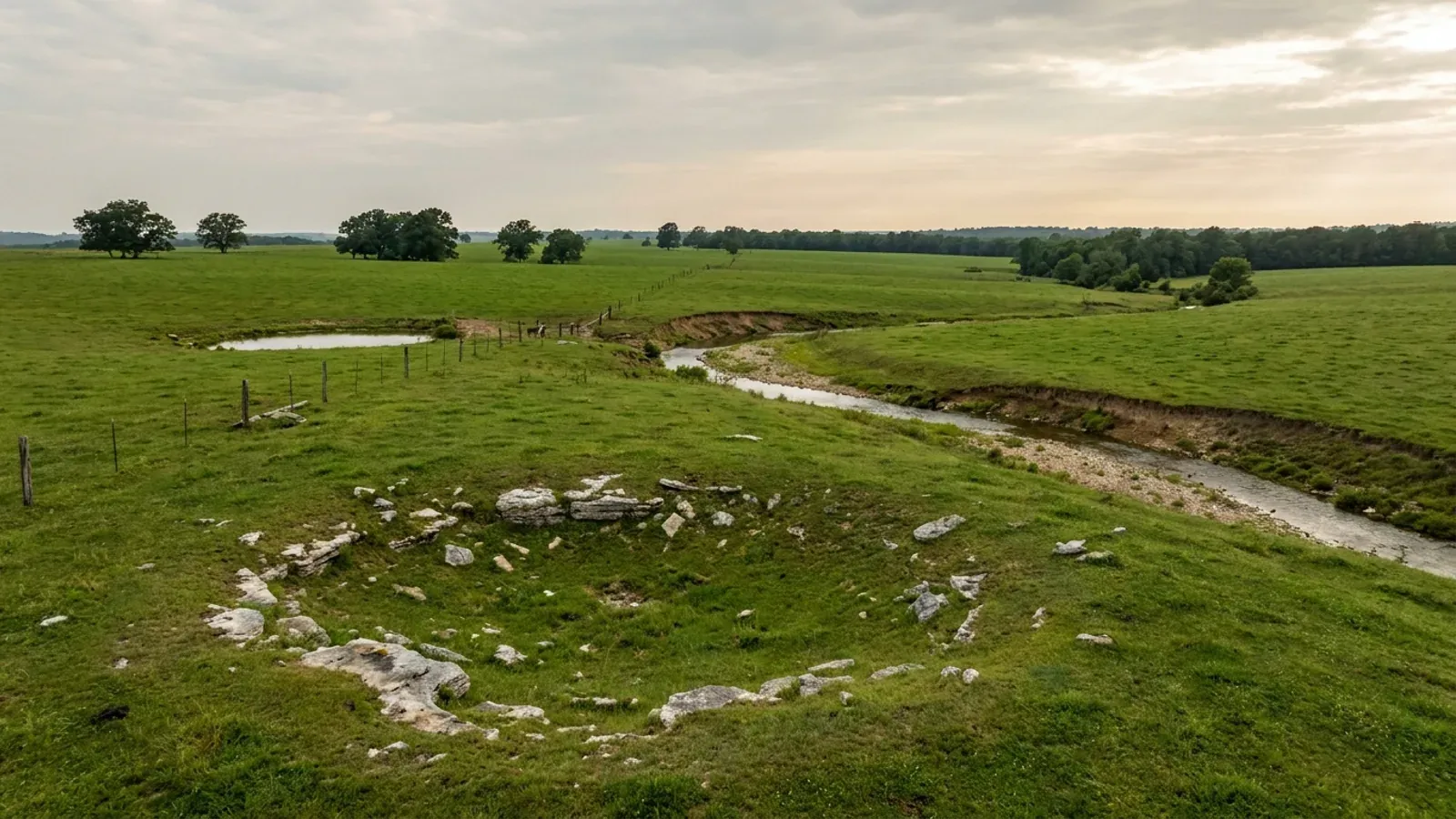
Barndominium Builders in Joplin, MO
Joplin is the one Missouri market where the building code says out loud what the building is allowed to be made of, and the answer is unusually specific. The city adopts the 2018 International Residential Code at City Code section 26-66 and then amends it at section 26-67 so that "the alternative method commonly known as 'pole barn' or 'laminated pole' type structures shall be limited to commercial buildings and accessory buildings only and not for residential dwelling units." The companion amendment to the International Building Code at section 26-62 adds that corrugated sheet iron, corrugated sheet steel and "strong barn" material "will not be permitted to be used as an exterior finish on any commercial or residential building" and "shall also not be permitted or allowed as roofing material on any type building or structure." Both amendments are in force under Ordinance No. 2019-047 of 18 March 2019. Inside the city limits, then, a barndominium is a stick- or steel-framed house with a non-corrugated skin, not a post-frame shell — and that changes the plan set before it changes anything else. The city's own filled-in Table R301.2(1) reads 30 psf ground snow, 90 mph wind, seismic design category A, severe weathering, a 30-inch frost line, a 9-degree winter design temperature and an air freezing index of 500. Carthage, seventeen miles up US 71 in the same county and on the same 2018 edition, publishes 20 psf snow against Joplin's 30 — a fifty per cent difference in the roof load, one county, one code year. Step outside the city limits and the whole apparatus changes hands: Jasper County is first classification and could adopt a building code under RSMo 64.170, but it has not, and instead its Health Department issues a $50 building permit that checks the 911 address, lot size, floodplain, mine-waste areas and stormwater rather than any structural standard. Newton County, second classification, publishes no building permit at all and regulates only the septic system. What gates a build here is not always the code: on ground inside the Superfund boundary drawn across the old Tri-State lead-and-zinc field, no residential building permit issues until the soil tests below 400 ppm lead and 75 ppm cadmium.
Joplin at a glance
- County
- Jasper County
- Population
- 53,605
- ZIP codes
- 64801, 64804, 64836, 64870
- Site visits
- Same-week site visits across Joplin and the country either side of it — Webb City, Carterville, Duquesne, Carl Junction, Oronogo, Duenweg, Airport Drive and Carthage on the Jasper side, and Redings Mill, Silver Creek, Shoal Creek Drive, Saginaw, Diamond and Neosho on the Newton side. The city limit is the line that matters for scheduling as much as for permitting: a project inside it runs through the Joplin Building Division, and a project a mile out runs through a county health department instead, on a completely different set of requirements.
Building conditions in Joplin
Missouri sets no residential building code and no statewide way of adopting one, so the first question on any parcel is not what the code says — it is whether there is one. Only counties of the first and second classification may adopt a building code at all, and classification is set by assessed valuation rather than population, so a small county can hold the power while a much larger one does not. Zoning is a separate power with its own answer, granted only after a vote of the people and repealable by another. What changes from one jurisdiction to the next is whether the work is inspected, who issues the permit, what that office charges, how the parcel is zoned, and the design figures your drawings have to satisfy.
City of Joplin Code of Ordinances section 26-67, Amendments to the International Residential Code, amendment to Section R104.11 (Ord. No. 2015-164, § 1, 10-19-15; Ord. No. 2019-047, § 1, 3-18-19), Municode Supplement 41 Update 2, online content updated 27 August 2026, codified through Ord. No. 2026-091 enacted 15 June 2026; City of Carthage Code of Ordinances section 6-392 (Ord. No. 10-49, § III, 12-28-10; Ord. No. 21-23, § I(Exh. A), 6-8-21), Municode Supplement 41, codified through Ord. No. 26-30 adopted 12 May 2026; both read 8 September 2026.
City of Joplin Code of Ordinances section 26-62, Amendments to the International Building Code, amendment to Section 1404.11 (Ord. No. 2015-164, § 1, 10-19-15; Ord. No. 2019-047, § 1, 3-18-19), Municode Supplement 41 Update 2, online content updated 27 August 2026; Joplin Development Code Table 5-7, Nonresidential Building Materials (Chapter 29-A, adopted by Ord. No. 2022-119, 1 August 2022); read 8 September 2026.
City of Joplin Code of Ordinances section 26-67, Table R301.2(1) as amended, and section 26-62, amendments to International Building Code sections 1608 and 1809.5 (Ord. No. 2015-164, § 1, 10-19-15; Ord. No. 2019-047, § 1, 3-18-19), Municode Supplement 41 Update 2, content updated 27 August 2026; City of Carthage Code of Ordinances section 6-392, Table R301.2(1) as amended (Ord. No. 21-23, § I(Exh. A), 6-8-21), Municode Supplement 41, codified through Ord. No. 26-30 adopted 12 May 2026; both read 8 September 2026.
City of Joplin Code of Ordinances section 26-76, Soil testing for lead and cadmium prior to building permit issuance in designated areas (Ord. No. 2009-164, § 1, 10-2-09; Ord. No. 2011-127, § 1, 10-17-11; Ord. No. 2019-047, § 1, 3-18-19), Municode Supplement 41 Update 2, content updated 27 August 2026; Jasper County Health Department, Environmental Contamination Ordinance (effective 1 July 2006), sections IV, VI, VII and IX, and the department's published Soil Testing and Process for Remediation guidance at jaspercountymo.gov/environmental-services; read 8 September 2026.
City of Joplin Code Comparative Table — Ordinances, entries for Ord. No. 2009-164 (10-2-09, added 26-76), Ord. No. 2011-127 (10-17-11, 26-76), Ord. No. 2011-142 (11-7-11, 26-67), Ord. No. 2015-164 (10-19-15, repealed 26-61—26-63 and 26-66—26-75) and Ord. No. 2019-047 (3-18-19); editor's note to Chapter 26 Article III; sections 26-67 and 26-76 as codified; Municode Supplement 41 Update 2, content updated 27 August 2026. City of Joplin Storm Shelter Info and Storm Shelter Inventory pages, joplinmo.org/640 and /620. All read 8 September 2026.
Joplin Development Code section 5.01.C, Accessory Buildings - Residential, Table 5-2 Residential Accessory Structures, and subsections C.2 and C.3 (Chapter 29-A of the Joplin Municipal Code, Zoning Ordinance and Procedures Manual adopted by Ordinance No. 2022-119, 1 August 2022, as published by the City of Joplin Planning Division), read 8 September 2026.
Also worth knowing before you build in Joplin
- Jasper County has no building code — but its health department still issues the building permit
- This is the distinction that catches people who assume no code means no paperwork. Jasper County is first classification and could adopt a building code under RSMo 64.170; it has not, and its own departments index runs Circuit Court, GIS, Health, Highway and Juvenile with no building or planning office. What it does have is a health department permit. The Jasper County Wastewater Treatment Systems Ordinance, effective 1 September 1995 and revised 5 December 2023, provides at section 4.01 that no person shall commence construction on any structure to be used for a residence or commercial facility with restroom facilities without a building permit issued by Jasper County, and at section 5.01 that any person establishing a residence or commercial facility anywhere in the county shall apply to the county for one "except for property within political jurisdictions which issue building permits." The health department describes what that permit actually checks: the property is reviewed for proper 911 address, lot size, floodplain, mine waste areas and stormwater control in unincorporated urban areas. It is a siting and sanitation review, not a structural one — nobody inspects the framing. The fee is $50. The ordinance also sets a floor no zoning ordinance sets here: no onsite system may go on a lot smaller than 0.92 acre for lots platted and recorded or approved by the Department of Natural Resources after 6 May 1999, and no more than one residence may be attached to one system, with a duplex counting as one residence. And the enforcement mechanism is the electricity: the ordinance forbids installing an electrical meter loop or meter to serve a new commercial, residential or mobile-home structure until written clearance has been received from Jasper County, with that clearance issued to the utility on issuance of the septic permit or the building permit.
- Newton County issues no building permit at all — only a septic permit
- Cross the line into Newton County, which is the southern third of Joplin and the direction most acreage buyers look, and even the health-department building permit disappears. Newton County is second classification, one of only three in the state, so RSMo 64.170 would let it adopt a building code; it has not, and its own Offices and Departments page — sixteen offices, among them Assessor, Auditor, Central Dispatch, Collector, County Clerk, Commissioners, Coroner, Emergency Management, Prosecuting Attorney, Public Administrator, Recorder of Deeds, Sheriff and Treasurer — contains no building, planning or zoning office of any kind. What the county regulates is wastewater. The Newton County Health Department conducts site reviews and plan reviews for onsite wastewater treatment systems with a design flow under 3,000 gallons per day under its Wastewater Treatment Systems Ordinance #95-6, and publishes its permit fees as $150 for a single-family dwelling, $225 for a non-single-family dwelling and $30 for a repair, with installer registration at $30 general, $40 advanced, $30 for a soil scientist and $30 for a tank cleaner. Lagoons for two or more single-family sites and for commercial facilities go to the Department of Natural Resources instead. The Missouri Department of Health and Senior Services lists Newton County Health Dept. at PO Box 447, Neosho, as the county's permitting agency with Authority Type: Ordinance — the same authority type it lists for Jasper — and its own alert notes that in an incorporated city the local authority may defer the permit back to the state. So on the Newton side of a Joplin land search the entire regulatory apparatus for a house is the septic permit and the deed restrictions, which is a genuinely different proposition from the Jasper side and from inside the city.
- The ground here is deep, and that is the opposite of what people expect from the Ozarks
- Measured from the USDA Natural Resources Conservation Service Soil Data Access service on 8 September 2026, the two soil survey areas under this market are among the deepest-to-rock in the region. In the Jasper County survey area (MO097, 410,393 acres), the map units carrying a lithic, paralithic or densic bedrock restriction within 20 inches total about 34 acres — under one hundredth of one per cent — and within 40 inches about 220 acres. In the Newton County survey area (MO145, 401,069 acres), the same figures are about 592 acres and about 619 acres. Shallow rock is effectively not a foundation problem on either side of the city, which is not what "the Ozarks" leads people to expect. What does vary, sharply, is the rest of the profile. A fragipan — a dense, slowly permeable layer that matters to both footings and drainfields — is mapped on about 11,375 acres of the Jasper survey area, under 3 per cent, but on about 216,763 acres of the Newton survey area, roughly 54 per cent, dominated by the Nixa, Tonti, Hoberg, Creldon and Keeno soils. Its shallowest mapped top in either county is 41 inches and it is at 51 inches under Newton's dominant Nixa soils, so it sits below Joplin's published 30-inch frost line rather than inside it. Shrink-swell runs the other way: components with a horizon of linear extensibility 6 per cent or greater within the top 60 inches cover about 123,685 acres of the Jasper survey area, roughly 30 per cent, against about 21,151 acres in Newton, roughly 5 per cent. And slope: components at 15 per cent or steeper are about 1.3 per cent of the Jasper area against about 13.6 per cent of Newton's. In short, the Jasper side is flat prairie ground with a real expansive-soil question and no rock; the Newton side is cherty upland with a fragipan under half of it, steeper ground, and very little expansion. Those are two different foundation conversations inside one city.
- Undermined ground is a due-diligence question here, and the state keeps the maps
- Joplin grew on top of shallow lead and zinc workings, and the workings did not go away. The Missouri Geological Survey operates the Missouri Mine Map Repository, which it describes as an inventory of more than 1,000 former and abandoned mines in Missouri, and indexes its holdings township by township. For the townships that carry Joplin — T27N R32W and T27N R33W in Jasper County — the repository lists maps including the "Map of Duenweg Mining District," the "Mining Map of Missouri Lead & Zinc Co." over sections 2 and 11 to 14 of T27N R33W, and two sheets of the "Central Drainage District, Jasper County, Missouri; Exhibit B" covering dozens of sections across T27N, T28N and T29N, all recorded for zinc and lead. Newton County is indexed the same way; the Federal Mining & Smelting Co. sheets for the Spring City District cover sections in T26N R33W. High-resolution electronic and paper copies are ordered by telephone from the survey at 573-368-2100. Two cautions belong with that. First, the repository prints its own limit on every county index page: "This information is inclusive of maps archived in or scanned by the Missouri Mine Map Repository. It does not contain maps for all underground mines in the state of Missouri" — so a blank square is not evidence of solid ground. Second, no local instrument regulates building over a void. The Joplin Development Code contains no subsidence provision, and the county building permit's mine-related check is for mine waste rather than for workings. That makes the question a pre-purchase one for the buyer and the title work, not something a plan reviewer will catch.
- The fire district is not a building department here, and the statute says why
- Two things are worth separating. Inside the Joplin city limits, RSMo 321.228, effective 28 August 2012, settles the question: where a city adopts, implements and enforces a residential construction regulatory system — defined at 321.228.1(2) to include any ordinance pertaining to residential construction, any permitting programme and any inspection programme, including a nationally recognised model code with local amendments — every fire protection district wholly or partly inside that city "shall be without power, authority, or privilege to enforce or implement" one there. Joplin plainly adopts, implements and enforces one. Districts keep three things the statute names: final regulatory authority over the location and specification of fire hydrants, hydrant flow rates and fire lanes; permission to inspect the alteration, enlargement, replacement or repair of a detached one- or two-family dwelling, which is not new construction; and no fee for either. Outside the limits the question is open on its facts, and the answer found on this pass is a negative worth having. The Redings Mill Fire Protection District, which describes itself as covering the northwest corner of Newton County — the ground immediately south of Joplin — publishes emergency response, public education, business pre-planning, outdoor burning conditions, smoke detectors, 911 address signs and a storm shelter registry, and no adopted building or residential code, no permit programme and no plan review. The Jasper County fire services listed by the county are municipal departments in Carthage, Carl Junction, Carterville, Duenweg, Webb City, Jasper, Joplin, Oronogo, Reeds and Sarcoxie plus the Tri-Cities service. Ask which district covers a specific address before assuming what it does and does not require, because coverage boundaries are not published parcel by parcel.
- Joplin's permit fee is a multiplier, and starting without one doubles it
- City Code section 26-91 sets the building department's fees as multipliers of project value rather than as a flat schedule. A residential plan review is 0.0005 multiplied by the value of the project, capped at $2,500; a residential permit is 0.003 multiplied by the same value, with residential repairs and alterations subject to a $75.00 floor for commercial work and a $25.00 floor for residential. Project value is either supplied by the applicant and verified by the building official, or calculated from the building valuation data published in the Building Safety Journal each February and modified for Joplin with a 0.87 multiplier, and in no case may it fall below the same data at a 0.65 multiplier. Reinspections are $25.00 per trip residential and $50.00 commercial, charged when the address is wrong, the work is not ready, the work is not in compliance, or for anything else not the inspectors' fault. Inspections outside 8 a.m. to 5 p.m. Monday to Friday cost $25.00 per half hour with a one-hour minimum, prepaid. Certificates of occupancy and of completion are issued at no fee. And section 26-91(8) is the one to note: where work has started before the permit was obtained, "the fees specified shall be doubled," with a fine of up to $500.00 per day per violation on top. Separately, the city licenses contractors — section 26-102 makes it unlawful to engage in the business of contracting without a licence from the director of finance, and section 26-103 requires a $10,000 licence and permit bond plus public liability cover with combined single limits of $300,000 and a workers' compensation certificate. Section 26-101(b) carves out the owner-builder: a person who builds not more than one house or one residential outbuilding in a calendar year for their own residence is not a contractor and needs no licence, though section 26-64 still requires them to hold the permit, buy the materials, do the labour personally and pass every inspection.
- One city, two counties — and the flood panels only name one of them
- Joplin is a two-county city and the split is not token. The Census Bureau's 2024 subcounty estimates put the city at 53,605 people, of whom 45,792 live on the Jasper County side and 7,813 on the Newton County side — the Newton portion alone is larger than most towns in this corner of the state, and it is the direction the city has been growing. Jasper County holds 126,479 people and Newton County 61,519. The surrounding places this page covers sit in Jasper: Carthage 15,703, Webb City 13,391, Carl Junction 8,435 and Duquesne 2,332; Neosho, the Newton County seat, holds 13,782. The split has a practical edge in the code itself. The flood-hazard row of Joplin's own Table R301.2(1) lists twenty-five Flood Insurance Rate Map panels dated 2 November 2012, and every panel number in it begins 29097 — the Jasper County code. Not one Newton County panel appears. The same list, panel for panel, also appears in Carthage's table. It is worth confirming the current effective panel for a specific parcel on the Newton side rather than reading it off the city's table, and worth remembering that the county line inside the city changes the septic authority, the county building-permit requirement and the soil-testing ordinance even where it changes nothing about the city's code.
Jasper County Wastewater Treatment Systems Ordinance, effective 1 September 1995, revision dated 12/05/2023, sections IV (Prohibitions) 4.01, V (Permits) 5.01 and XI (Fees) 11.01—11.04; Jasper County Health Department Environmental Services page, Building Permits and On-Site Wastewater sections, jaspercountymo.gov/environmental-services; Jasper County departments index, jaspercountymo.gov/department; all read 8 September 2026.
Newton County, Missouri, Offices and Departments page, newtoncountymo.com/offices.html; Newton County Health Department, Waste Water (Septic) Permits page, naming Wastewater Treatment Systems Ordinance #95-6 and publishing the permit and registration fees, newtoncountyhealth.org/environmental-health/waste-water-permits; Missouri Department of Health and Senior Services, OWTS Construction Permit Process county selector, results for Jasper and Newton, health.mo.gov; Missouri Association of Counties, Missouri Counties by Classification, published May 2025; all read 8 September 2026.
USDA Natural Resources Conservation Service, Soil Data Access tabular service (sdmdataaccess.sc.egov.usda.gov/Tabular/post.rest), queries against the legend, mapunit, component, corestrictions and chorizon tables for survey areas MO097 (Jasper County, Missouri) and MO145 (Newton County, Missouri), run 8 September 2026; acreage figures are component-percentage-weighted against mapunit.muacres.
Missouri Department of Natural Resources, Missouri Geological Survey, Mine Shafts page (dnr.mo.gov/land-geology/hazards/mine-shafts) and Missouri Mine Map Repository; Mine Maps — Jasper County and Mine Maps — Newton County township indexes and the township map lists for 27N-33W, 27N-32W and 26N-33W at dnrservices.mo.gov/geology/geosrv/geores/; Joplin Development Code, checked for subsidence provisions with none found; all read 8 September 2026.
RSMo § 321.228, Residential construction regulatory system, preemption of law by local governmental body over fire protection district, when, exceptions, Effective 28 August 2012 (L. 2012 H.B. 1647 merged with S.B. 769), revisor.mo.gov; Redings Mill Fire Protection District, Customer Resources, Fire District Info and District Map pages, rmfd.org; Jasper County, Missouri, Fire Departments page, jaspercountymo.gov/fire-departments; all read 8 September 2026.
City of Joplin Code of Ordinances sections 26-91 (Ord. No. 2015-213, § 1, 12-7-15; Ord. No. 2016-074, § 1, 5-2-16; Ord. No. 2017-191, § 1, 12-18-17), 26-101 to 26-104 (Ord. No. 2008-068, § 4, 5-5-08; Ord. No. 2017-169, § 1, 11-6-17) and 26-64 (Ord. No. 2008-068, § 2, 5-5-08; Ord. No. 2019-047, § 1, 3-18-19), Municode Supplement 41 Update 2, online content updated 27 August 2026, read 8 September 2026.
U.S. Census Bureau, Subcounty Resident Population Estimates sub-est2024_29.csv (SUMLEV 157 place-part records for Joplin city in Jasper and Newton counties) and co-est2024-alldata.csv, vintage 2024; U.S. Census Bureau 2024 Gazetteer place file 2024_gaz_place_29.txt, land area 38.081 sq mi and internal point 37.075218 / -94.501259; City of Joplin Code of Ordinances section 26-67, Table R301.2(1) flood hazards row; City of Carthage Code of Ordinances section 6-392, Table R301.2(1) flood hazards row; all read 8 September 2026.
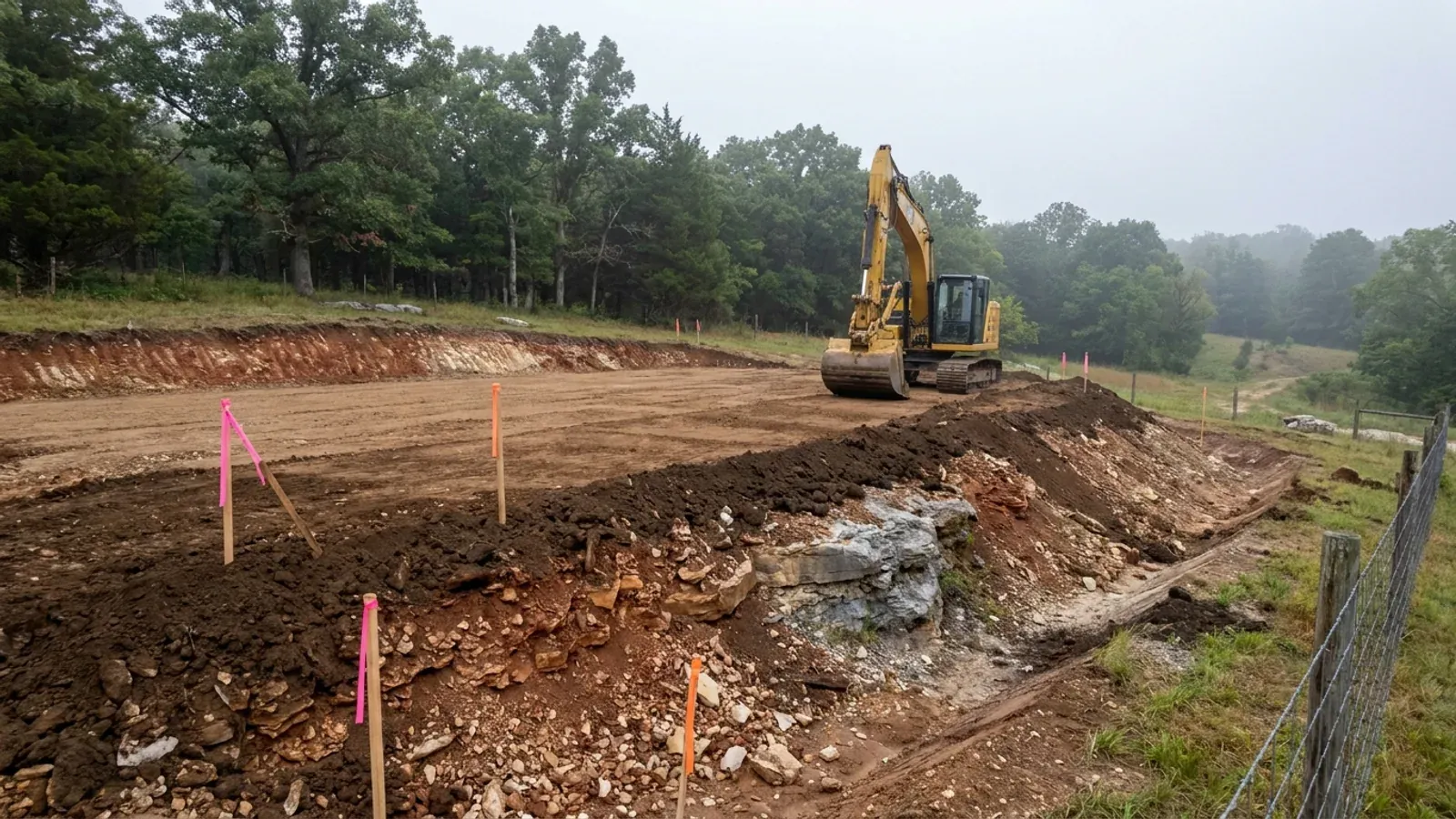
The expensive surprises are in the ground, not the building
What moves a Missouri budget is usually below grade, and which problem you have depends on where in the state you are. Across the Ozarks it is karst: the Department of Natural Resources maps more than sixteen thousand sinkhole points, and what matters there is what is under the slab rather than what the slab sits in. Across the north and centre it is claypan — dense, slow-draining subsoil that perches water above it for months of the year. In the Bootheel it is deep alluvium carrying the highest seismic demand in the state, where the same soils modelled for liquefaction attack post embedment and slab bearing rather than the frame above them. The same ground then decides the septic system, and Missouri does not run that on a percolation test alone: the rule allows a perc test or a soil morphology examination in a profile pit, and the authority reviewing your parcel picks which. Where a drainfield sits near a sinkhole's drainage, perc testing on its own is not permitted at all. Whether that authority is the state or your own county is itself a local question, and it changes what you have to file. So the site work, the foundation and the drainfield get resolved together rather than one at a time. We price the dirt before we price the building.
What we build in Joplin
All nine services are available in Joplin. What a build costs depends far more on the parcel than on square footage, so we price against your land rather than publishing a rate card.
Custom Plans
Barndominium floor plans drawn to your parcel and your soil, and to whichever Missouri authority — a county, a city, or none at all — will review them.
Barndominium Kits
Barndominium shell packages delivered to your Missouri land, drawn to the criteria your own county or city publishes — because the state publishes none.
Turnkey Builds
Start to finish barndominium construction in Missouri: the permits that genuinely apply, site work, shell and interior finish, under one contract.
What a build looks like
Three stages every Joplin project passes through, from a raw parcel to a finished home. Site work first, because that is where the budget is decided.
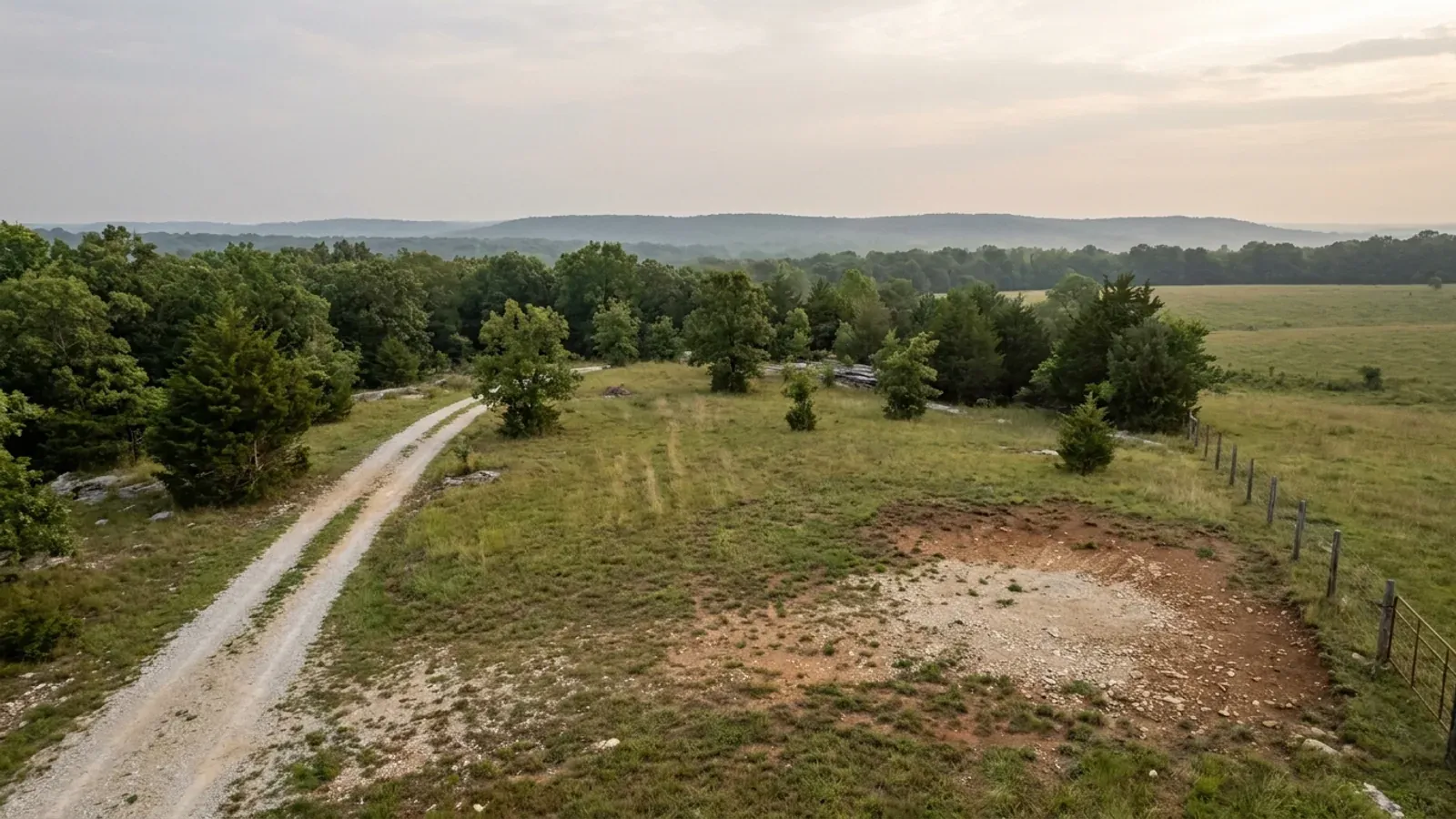
The parcel
Zoning, setbacks, flood zone and utility access get checked before anything is drawn.
Pad and permit
Clearing, grading and a compacted pad, while the submittal works through whichever office issues the permit where you are building.
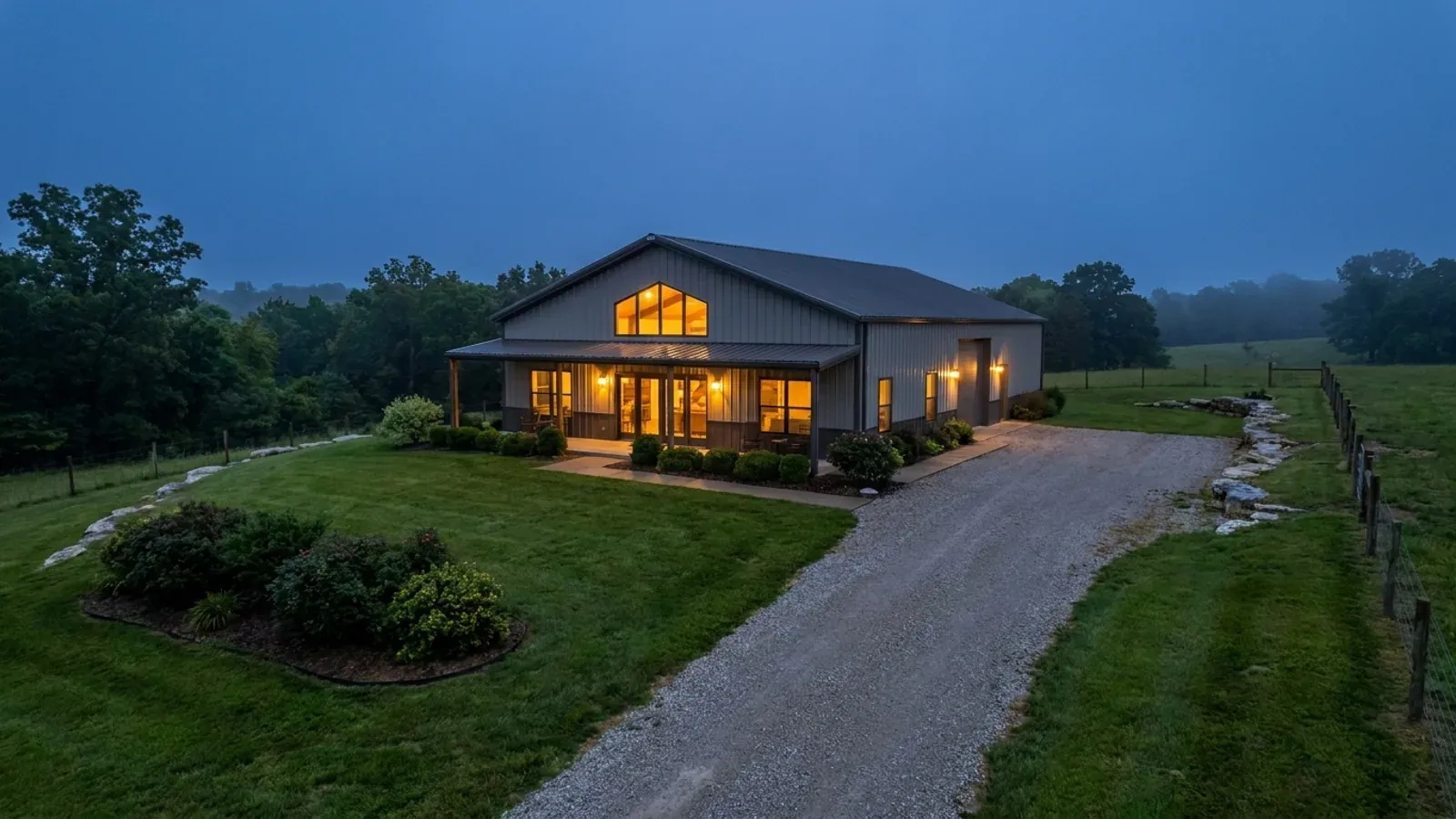
Frame to finish
Shell erected and dried in, then systems, insulation and interior finish through to CO.
Those are the rules where you are building in Joplin. Tell us what you want to build and we will draw it to them.
Where we build around Joplin
Jasper County and the rural land around it. The buildable acreage for a project this size usually sits outside the city limits, which is frequently what changes who issues your permit.
Keep reading
The questions that usually come next once you know what Joplin allows.
Barndominium Cost Guide
Sourced per-square-foot ranges by tier and by size, with a calculator built on the same figures.
Read itIs It Legal in Missouri?
Classification, zoning, the HOA gate, and why "nonresidential farm building" does not cover a home.
Read itHow Long Does It Take?
Census build-duration data, and what actually sets the permit clock where you are building.
Read itNearby areas we build in
Others we cover nearby, and they are not interchangeable. One may be a county with an adopted building code, another a county with no legal authority to have one, another a city that permits inside its own limits whichever county the land sits in. So the office that issues the permit, whether anyone inspects the work at all, the fees, the zoning and the design figures can differ from one card to the next — sometimes across a single property line.
Building in Joplin: common questions
9 questions we get asked most often about building in Joplin. If yours is not on the list, ask it directly.
Can I build a post-frame barndominium in Joplin?
Is metal siding allowed in Joplin?
Do I need a building permit outside Joplin city limits?
How big a shop can I build, and can it be bigger than the house?
Do I have to test the soil for lead before I can build?
What snow and wind loads will my roof be designed to?
Did the 2011 tornado change Joplin's building code?
Is the ground around Joplin hard to build on?
Does anyone inspect a house built in the unincorporated county?
Building in Joplin?
Start with the plan. Tell us what you want to build and we will draw it, then confirm which office issues the permit for your parcel, what it will let you put there, and what wind load it has to meet. That conversation costs nothing.