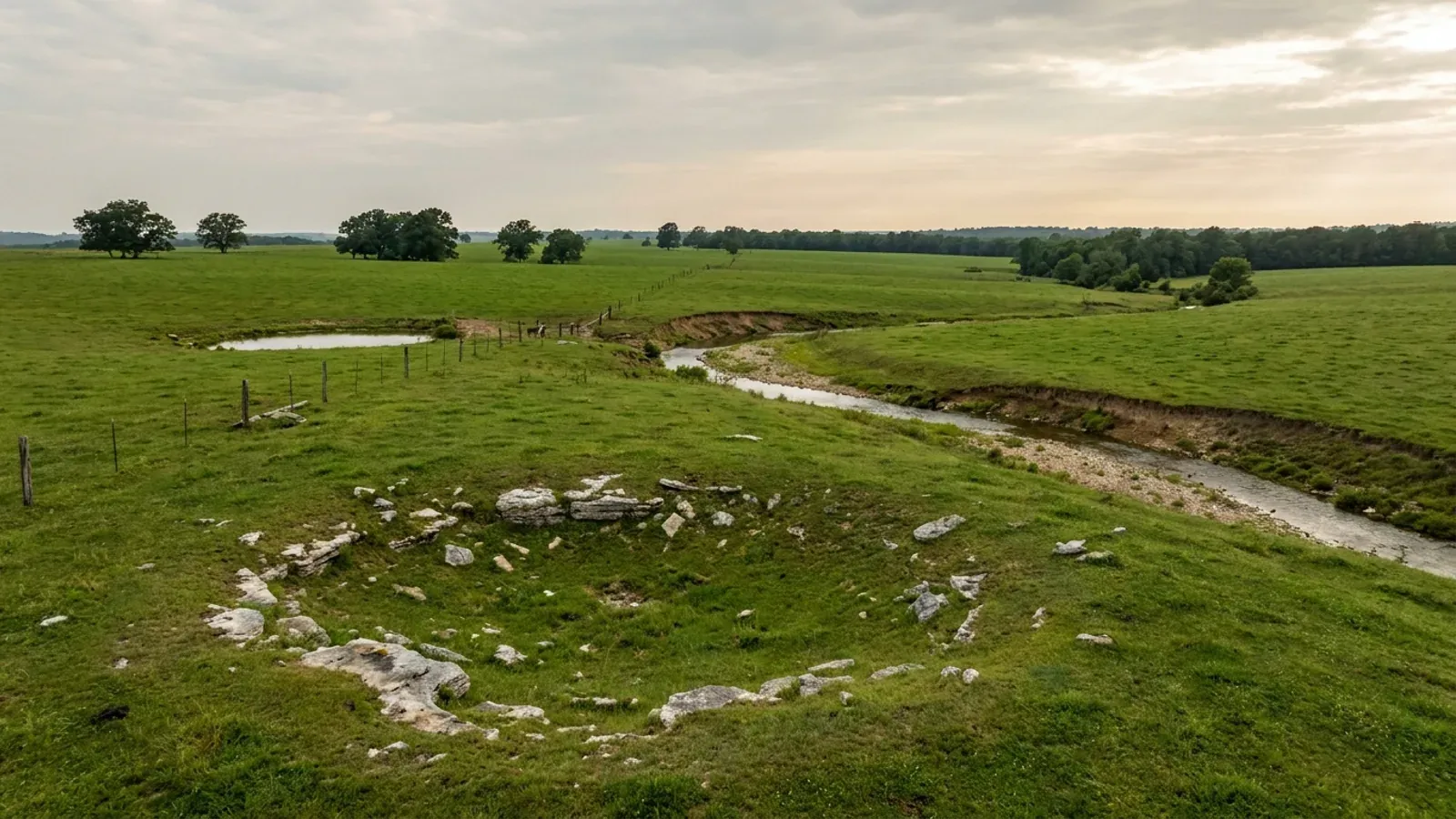
Barndominium Builders in Newton County, MO
Newton County is one of only three counties in the second classification in the whole state — Callaway, Lincoln and Newton — which under RSMo 64.170.1 puts it in the small group of counties the legislature actually permits to adopt building regulations, issue building permits and appoint a building commission. It has not done it. The county's own Offices and Departments index runs Assessor, Auditor, Central Dispatch, Collector, County Clerk, Commissioners, Coroner, Emergency Management, Human Resources, Juvenile Office, Prosecuting Attorney, Public Administrator, Recorder of Deeds, Sheriff, Surveyor and Treasurer, and there is no building office, no planning office and no zoning office anywhere in it. So on unincorporated ground there is no county building code, no county zoning district, no setback ordinance, no minimum dwelling size, no cap on how big a shop can be, and no county building permit of any kind. What there is instead is a short, specific list. Newton County Central Dispatch assigns the 911 address, and it will not assign one to a vacant parcel — the address comes when a house is going up. The Newton County Health Department issues the wastewater permit under its Wastewater Treatment Systems Ordinance #95-6, and that ordinance is unusually reaching: its own manual states in terms that "under this ordinance there is no land/acreage requirements," so the three-acre exclusion in RSMo 701.031 that people expect to rescue a big rural lot does not operate here at all. And because the county has never adopted planning and zoning, the one land-use rule it does administer arrives through RSMo 49.600, the statute that lets a county in exactly this position adopt National Flood Insurance Program regulations only after its own voters authorise it — the Federal Emergency Management Agency records unincorporated Newton County as participating, with an initial Flood Insurance Rate Map of 17 April 1985 and a current effective map of 26 November 2010. Inside the municipalities the answer changes completely. Neosho, the county seat, adopts the 2018 International Building Code and the 2018 International Residential Code, runs a Building Inspection Department at 203 E Main Street, and amends the building code in two ways that matter more to this kind of building than anything else in the county: it prohibits corrugated sheet iron, corrugated sheet steel and "strong barn" material as an exterior finish and as roofing, and it fills in a 15-pound-per-square-foot design roof snow load and a 15-inch frost depth. Seneca adopts the 2018 International Building and Residential Codes alongside 2009 mechanical, plumbing and property maintenance codes. And under all of it is the ground itself: this is the Missouri end of the Tri-State lead and zinc field, more than 600 square miles of the county sit inside a federal Superfund site, and the only instrument anywhere in the county that speaks to building near an old mine is a 150-foot setback buried in the health department's septic table.
Newton County at a glance
- County
- Newton County
- Population
- 61,519
- ZIP codes
- 64850, 64865, 64844, 64840, 64866, 64867, 64873, 64842
- Site visits
- Same-week site visits across the county — Neosho, Seneca, Granby, Diamond, Stark City, Newtonia, Fairview, Wentworth, Stella, Ritchey, Loma Linda, Leawood, Saginaw and the Newton County side of Joplin, plus the unincorporated country in between, which is where half the county's people actually live. The line that changes the paperwork is the city limit, not the county line: a project inside Neosho or Seneca runs through a municipal building inspector on an adopted code, and a project a mile outside runs through a health department and a dispatch centre instead, on a completely different list of requirements.
Building conditions in Newton County
Missouri sets no residential building code and no statewide way of adopting one, so the first question on any parcel is not what the code says — it is whether there is one. Only counties of the first and second classification may adopt a building code at all, and classification is set by assessed valuation rather than population, so a small county can hold the power while a much larger one does not. Zoning is a separate power with its own answer, granted only after a vote of the people and repealable by another. What changes from one jurisdiction to the next is whether the work is inspected, who issues the permit, what that office charges, how the parcel is zoned, and the design figures your drawings have to satisfy.
Missouri Association of Counties, "Missouri Counties by Classification" (published May 2025), www.mocounties.com/s/Missouri-Counties-by-Classification-2025.pdf, downloaded and text-extracted 8 September 2026; RSMo § 64.170, effective 28 August 2008, and § 48.020, effective 28 August 2026, revisor.mo.gov; Newton County, Missouri, Offices and Departments page, newtoncountymo.com/offices.html, read 8 September 2026.
City of Neosho Code of Ordinances Section 500.050, Amendments (Code 1979 § 7-19; Ord. No. 01-2013 § 1, 1-22-2013; Ord. No. 27-2019, 4-2-2019; Ord. No. 256-2021, 12-7-2021; Ord. No. 309-2022, 5-17-2022; Ord. No. 537-2024, 7-16-2024; Ord. No. 612-2025, 4-15-2025), and Section 500.020, Building Code — Adoption (2018 International Building Code, Ord. No. 256-2021, 12-7-2021), read on eCode360 code version 19 dated 7 April 2026; City of Joplin Code of Ordinances Section 26-62, amendments to International Building Code Sections 1404.11, 1608 and 1809.5. Both read 8 September 2026.
Newton County Health Department, Wastewater Treatment System Manual (naming Wastewater Treatment Systems Ordinance #95-6, effective September 1995, revised 1 May 1997, with further revisions May 2022 for fees and July 2022 for Section 7), sections I.A.2, I.A.3, II.B and the published fee schedule, newtoncountyhealth.org; Missouri Department of Health and Senior Services, OWTS Construction Permit Process county selector, result for Newton, health.mo.gov; RSMo §§ 701.031 and 701.047, revisor.mo.gov. All read 8 September 2026.
Newton County Health Department, Wastewater Treatment System Manual, Table 1 Setback Distances and footnotes (3) and (4), newtoncountyhealth.org; Missouri Department of Natural Resources, Missouri Geological Survey, Missouri Mine Map Repository and its Mine Map Repository Holdings section-township-range inventory spreadsheet (mgs-mine-map-repository-sec-town-range.xlsx, header dated September 2012), dnr.mo.gov/land-geology/maps-data-research/mine-map-repository; RSMo §§ 256.112, 256.113 and 256.115, all effective 28 August 1993, revisor.mo.gov; City of Neosho Code of Ordinances Chapters 405 and 410, searched for subsidence, mine and sinkhole provisions with none found, eCode360 code version 19 dated 7 April 2026. All read 8 September 2026.
United States Environmental Protection Agency, Superfund Site Profile, NEWTON COUNTY MINE TAILINGS, Newton County, MO (site id 0701651), cumulis.epa.gov/supercpad/SiteProfiles, and EPA Region 7, "Newton County Mine Tailings National Priorities List (NPL) Superfund Site, Newton County, Missouri — Fact Sheet, March 2023", epa.gov/mo; land area from the U.S. Census Bureau 2024 Gazetteer county file, 624.755 square miles; both read 8 September 2026.
Newton County Central Dispatch Center, Frequently Asked Questions and Tornado Shelters pages, nc-cdc.org; Newton County Health Department, Wastewater Treatment System Manual, section I.A.3.B, newtoncountyhealth.org; both read 8 September 2026.
Also worth knowing before you build in Newton County
- The county caps nothing on a shop; Neosho caps a share of the rear yard, Seneca a share of the lot
- For a buyer whose real question is how big the shop can be, the three answers inside this county are unusually far apart, and the county's own is the simplest one on the list: there is no cap. Unincorporated Newton County has no zoning ordinance, so there is no floor-area limit on a detached building, no height limit, no count-per-lot rule, no ratio to the house and no setback beyond what the septic system's own clearances require. Inside Neosho the rule is a coverage rule rather than an area rule. Section 405.210.A.3.e provides that "in any district, a detached accessory building not exceeding twenty-four (24) feet or two (2) stories in height, or in any case not higher than the main building, may occupy not more than thirty percent (30%) of a rear yard." So the binding constraints there are the share of the rear yard and the height of the house — twenty-four feet is generous for a shop sidewall, but the never-higher-than-the-main-building clause is the one that bites on a tall door. Neosho's permit thresholds sit alongside it and differ between the two codes it adopts: the building code amendment raises the permit exemption at Section 105.2 from 120 to 200 square feet, while the residential code amendment at Section 522.020 exempts "storage buildings on skids under twelve (12) feet by twelve (12) feet," which is 144. Seneca takes a third approach again, capping all buildings on the lot together: in its residential district "all buildings, including accessory buildings, shall not cover more than thirty percent (30%) of the area of the lot," with detached accessory buildings allowed in a rear yard at five feet from side and rear lot lines, out of public easements, and never nearer the front lot line than the main building. Three jurisdictions, three different things being measured, and the unincorporated county measuring nothing.
- Checked the exterior standards in both zoning codes: nothing restricts a site-built house
- A reassuring negative is still a finding, and this one took reading the whole of two zoning codes to establish. Neosho's Chapter 405 was searched in full — general provisions, all fifteen district sections, the supplementary regulations and the administration article — for the standards that decide whether a barndominium is buildable as drawn. There is no minimum dwelling floor area anywhere in it. There is no minimum roof pitch on a dwelling. There is no minimum eave projection. There is no exterior material list applying to a house; the words corrugated, metal siding and roof pitch appear nowhere in the chapter in a residential context. There is no design review over a detached house outside the Historic Preservation District and the Downtown Historic Preservation District, whose certificate-of-appropriateness process is a downtown instrument rather than a subdivision one. Seneca's Chapter 405 does carry a 4:12 minimum roof pitch, a shingle requirement and minimum dimensions of twenty-two by forty feet — but the scope is written into the provision itself and it reaches only a manufactured or modular home placed in a residential district, not a site-built dwelling. And in unincorporated Newton County there is no zoning at all, so none of it applies. The one exterior restriction that genuinely reaches a house in this county is not in a zoning code and not an appearance standard: it is Neosho's corrugated-metal prohibition in its building-code amendments, and it stops at the city limit.
- Four villages here cannot get federal flood insurance at all
- Unincorporated Newton County participates in the National Flood Insurance Program, which is worth stating precisely because it is the only land-use programme the county administers and it exists on a different legal footing from everything else. RSMo 49.600 applies to "all counties which have not adopted county planning and zoning" — which is Newton — and provides that no flood-compliance order or ordinance is effective unless the commission puts it to the county's voters, and that voters may later rescind it on an initiative petition signed by five per cent of those who voted in the last governor's election, after which "the program shall be discontinued within thirty days." The statute also carves out the incorporated portions of a county, the raising of livestock, crops, orchards or forestry, and farm buildings used for those purposes outside the mapped flood hazard area. The Federal Emergency Management Agency's community status data records Newton County, community 290820, as participating, with an initial Flood Insurance Rate Map of 17 April 1985 and a current effective map dated 26 November 2010 — the same map date Neosho inserts into its own building code at Section 1612.3. Then the part that matters to a buyer looking at cheap ground: four incorporated villages in this county do not participate — Ritchey, Stella, Cliff Village and Shoal Creek Estates. In a non-participating community, federally backed flood insurance is not available, which reaches financing as well as insurance on anything in a mapped flood hazard area. Granby, Neosho, Seneca, Diamond, Wentworth, Redings Mill, Saginaw, Shoal Creek Drive, Grand Falls Plaza, Dennis Acres, Loma Linda and Newtonia are all recorded as participating.
- Three code generations inside one county line, and one of them has no code at all
- Where a county has no code of its own, what its towns adopt is the whole answer, and here they do not agree. Neosho adopts the 2018 International Building Code including Appendix Chapters C, F, G, I and J, the 2018 International Residential Code, the 2018 International Plumbing, Mechanical, Fuel Gas, Property Maintenance, Existing Building and Fire Codes, and the National Electrical Code, and its Building Inspection Department publishes those as in force since 1 October 2019. Its residential amendments are short and practical: sprinkler systems are not required, citing RSMo 67.281; no permit is required for roof replacement or repairs; the occupancy load for a single- or two-family dwelling is calculated at two occupants per bedroom; water hammer arrestors and dishwasher air gap devices are not required; air leakage testing is not required; and Appendices E, I, K, L, Q, R and S are not enforced. Seneca adopts the 2018 International Building Code and the 2018 International Residential Code as its Building Code, together with the 2017 National Electrical Code — but pairs them with the 2009 International Mechanical, Plumbing, Property Maintenance and Private Sewage Disposal Codes, a nine-year gap between the structural side and the trades side inside one ordinance. And unincorporated Newton County adopts nothing at all, which means a house built a mile outside either city is built to whatever the owner, the builder and the lender's appraiser agree on. That is a genuine reason to name a code edition in the construction contract even where nobody is enforcing one, because it is the only place the standard will otherwise be written down.
- Neosho licenses contractors and prices the licence by where the business is
- There is no statewide general contractor licence in Missouri and Newton County issues none — its offices index contains no licensing body of any kind for the building trades. Neosho does. The city requires all contractors and subcontractors to be licensed by the appropriate trade and to hold a current city contractor's licence, with every new application approved by the building inspector before a licence issues. The supporting documents are a certificate of insurance at a minimum of $100,000 bodily injury and $50,000 property damage, and proof of workers' compensation cover, which state law requires of any construction company with one or more employees. The fee is set by where the business is located rather than by its size: $25.00 for a business inside the city limits of Neosho, $50.00 for one located inside Newton County, and $100.00 for one located outside Newton County — and a contractor from outside the city pays the greater of the inside-city fee or the fee charged by their own city of residence, and has to produce that city's fee schedule to prove it. Permit fees on the building side are simple arithmetic: all new construction and alterations on single-family residential buildings and duplexes, and all new construction of residential garages and detached buildings, are charged at twenty-five cents per square foot with a $25.00 minimum, commercial at $5.00 per $1,000 of construction cost with a $30.00 minimum, a fence permit at $30.00 flat, and a land disturbance permit at $25.00. Reinspection is $10.00 residential and $25.00 commercial where the address was wrong, the work was not ready, or the work was not in compliance. Residential submittals need the online portal application, a sealed lot survey with a plot plan showing the building footprint and setbacks, and a drawing or blueprint of the residence; a permit that changes a building's footprint needs a fresh sealed survey.
- The ground is not shallow to rock — it is chert, and there is a hardpan under half the county
- The word Ozarks makes people expect bedrock a spade's depth down, and in this county that expectation is wrong in a way that changes what the foundation conversation should actually be about. Measured from the United States Department of Agriculture Natural Resources Conservation Service Soil Data Access service on 8 September 2026 for the Newton County survey area, MO145, which covers 401,069 acres in 53 map units: soil components carrying a lithic, paralithic or densic bedrock restriction within twenty inches account for about 592 acres, roughly fifteen hundredths of one per cent, and within forty inches about 619 acres. Shallow rock is effectively not a constraint here. Three other things are. The first is chert gravel, and it is everywhere: components with at least one horizon in the top forty inches carrying thirty-five per cent or more rock fragments by volume cover about 227,400 acres, roughly fifty-seven per cent of the survey area, and at fifteen per cent or more the figure is about 266,600 acres. Of the rock-fragment records in the survey area, the overwhelming majority are chert fragments or cherty limestone fragments. The dominant soil, Nixa, occupies about 85,200 acres — more than a fifth of the county — and carries thirty-five to fifty per cent gravel from the plough layer down; Clarksville, the next largest at about 46,000 acres, runs forty to sixty-five per cent through the whole profile. That is excavation and trenching cost, and it is drainfield behaviour. The second is a fragipan, a dense slowly permeable layer, mapped on about 216,800 acres — some fifty-four per cent of the county — under the Nixa, Tonti, Hoberg, Creldon and Keeno soils. Its shallowest mapped top anywhere in the survey area is forty-one inches and it sits at about fifty-one inches under Nixa, so it is below any frost line published in this county rather than inside it, but it is exactly the layer that decides whether a lateral field works. The county's own septic manual acknowledges it in terms, warning that sand-lined trenches "must not be used over fragipans or other restrictive layers which have perched water tables." The third is slope: components at fifteen per cent or steeper cover about 54,400 acres, roughly thirteen and a half per cent. Expansive clay, by contrast, is a minor issue here — components with a horizon of at least six per cent linear extensibility in the top five feet cover about 21,150 acres, a little over five per cent.
- The fire districts here are not building departments, and the statute explains when one could be
- Missouri has a route by which a fire protection district, rather than a county, ends up regulating construction, and it is worth checking rather than assuming. RSMo 321.220(12) lets a district board adopt fire ordinances whose standards may be industrial codes adopted by nationally organised and recognised trade bodies. RSMo 321.228, effective 28 August 2012, then sets the limit: where a city, town, village or county "adopts or has adopted, implements, and enforces a residential construction regulatory system" — defined to include any ordinance pertaining to residential construction, any permitting programme and any inspection programme, and expressly including a nationally recognised model code with local amendments — any fire protection district wholly or partly inside it "shall be without power, authority, or privilege to enforce or implement" one there, and any such system it adopts "shall be treated as advisory only." Districts keep three things the statute names: final regulatory authority over the location and specification of fire hydrants, hydrant flow rates and fire lanes; permission to inspect the alteration, enlargement, replacement or repair of a detached one- or two-family dwelling, which is not new construction; and no fee for either. Applied here, the first step answers itself inside Neosho and Seneca, both of which plainly adopt, implement and enforce such a system. On unincorporated ground the question stays open on its facts, and the answer found is a negative. The Seneca Area Fire Protection District publishes a single-page website with no adopted code, no permit programme and no plan review; the Redings Mill Fire Protection District, covering the north-west corner of the county, publishes emergency response, public education, outdoor burning conditions, business pre-planning, smoke detectors, 911 address signs and a storm shelter registry, and no code and no permits. Note the distinction the statute turns on: a district adopting the International Fire Code is doing something ordinary and lawful everywhere, and it does not make the district a building department. Ask which district covers a specific address before assuming what it does and does not require, because coverage boundaries here are not published parcel by parcel.
- Half the county lives outside any town, and the farms are the size people actually buy
- This is a shop-and-house market on the numbers, not by assertion. The Census Bureau's vintage-2024 estimates put Newton County at 61,519 people. Neosho holds 13,782, the Newton County part of Joplin 7,813, Seneca 2,316, Granby 2,097, Loma Linda 1,005, Diamond 890, Leawood 634, Fairview 430, Shoal Creek Drive 369, Saginaw 327, Newtonia 213, Stella 169, Redings Mill 165, Stark City 130, Shoal Creek Estates 109, Grand Falls Plaza 106, Wentworth 99, Ritchey 68, Dennis Acres 56 and Cliff Village 36 — and the balance of the county, meaning everyone outside any incorporated place, holds 30,705. Just about half the county's population is on ground with no zoning, no building code and no municipal permit over it. The land tells the same story. The 2022 Census of Agriculture records 1,414 farms in Newton County across 239,381 acres, at an average of 169 acres, in a county of 624.8 square miles. The size distribution is the point: 88 farms of 1 to 9 acres, 463 of 10 to 49, 522 of 50 to 179, 236 of 180 to 499, 73 of 500 to 999 and 32 of 1,000 or more — so seven in ten holdings here fall between ten and 180 acres, which is precisely the tract a shop-and-house buyer is shopping for. It is livestock and poultry country rather than row-crop country: of $588,080,000 in agricultural products sold, $574,464,000 was livestock, poultry and products and only $13,616,000 was crops, and poultry and eggs alone accounted for $534,613,000 — better than nine dollars in ten. Land in farms breaks down as 113,824 acres of pastureland, 81,442 of cropland, 34,401 of woodland and 9,714 other, and the largest single crop by area is forage at 52,904 acres. A working poultry or cattle place with a house and a real shop on it is the normal building here, not an exception to it.
City of Neosho Code of Ordinances Section 405.210.A.3.e, Height and Area Exceptions (Ord. No. 468-2011 § 1, 3-15-2011), Section 500.050 and Section 522.020 (Ord. No. 21-2019, 4-2-2019), eCode360 code version 19 dated 7 April 2026; City of Seneca Code of Ordinances Chapter 405, Article II district regulations and Article III supplementary regulations, eCode360 code version 10 dated 8 December 2025; Newton County, Missouri, Offices and Departments page (no zoning body), newtoncountymo.com/offices.html. All read 8 September 2026.
City of Neosho Code of Ordinances Chapter 405, Zoning Regulations, Articles I to IV in full (Ord. No. 468-2011 § 1, 3-15-2011, as amended), eCode360 code version 19 dated 7 April 2026; City of Seneca Code of Ordinances Chapter 405, Article II, manufactured/modular home criteria, eCode360 code version 10 dated 8 December 2025; read 8 September 2026.
RSMo § 49.600, National flood insurance program, adoption and rescission procedure — exemptions, effective 4 March 1991, revisor.mo.gov; Federal Emergency Management Agency, OpenFEMA NfipCommunityStatusBook dataset, seventeen Newton County, Missouri records, dataset last refreshed 25 August 2026, queried via the FEMA open API 8 September 2026; City of Neosho Code of Ordinances Section 500.050, amendment inserting the flood map date at Section 1612.3.
City of Neosho Code of Ordinances Sections 500.020, 500.070, 505.010, 510.010, 515.010, 520.010, 521.010, 522.010 and 522.020 (Ord. No. 27-2019, 4-2-2019; Ord. No. 21-2019, 4-2-2019; Ord. No. 256-2021, 12-7-2021), eCode360 code version 19 dated 7 April 2026, and the City of Neosho Building Inspections and Frequently Referenced Codes pages, neoshomo.gov/170 and /171; City of Seneca Code of Ordinances Sections 500.010 to 500.060 (Ord. No. 500.010-500.060, 7-13-2015 and 1-14-2019), eCode360 code version 10 dated 8 December 2025. All read 8 September 2026.
City of Neosho Contractor Information page, neoshomo.gov/172, and Building Inspections page, neoshomo.gov/170; City of Neosho 2024 Building Permit Fees schedule, neoshomo.gov/DocumentCenter/View/779; City of Neosho Code of Ordinances Section 500.050.B.5, Fees, and B.3, Application for Permit, eCode360 code version 19 dated 7 April 2026; Newton County, Missouri, Offices and Departments page, newtoncountymo.com/offices.html. All read 8 September 2026.
USDA Natural Resources Conservation Service, Soil Data Access tabular service (sdmdataaccess.sc.egov.usda.gov/Tabular/post.rest), queries against the legend, mapunit, component, corestrictions, chorizon and chfrags tables for survey area MO145, Newton County, Missouri, run 8 September 2026; acreage figures are component-percentage-weighted against mapunit.muacres. Fragipan guidance quoted from the Newton County Health Department Wastewater Treatment System Manual, sand-lined trench provisions.
RSMo §§ 321.220 and 321.228, Residential construction regulatory system, preemption of law by local governmental body over fire protection district, when, exceptions, effective 28 August 2012 (L. 2012 H.B. 1647 merged with S.B. 769), revisor.mo.gov; Seneca Area Fire Protection District, safpd.org, whose published sitemap lists one page, last modified 14 April 2026; Redings Mill Fire Protection District, Customer Resources and Fire District Info pages, rmfd.org; City of Neosho Code of Ordinances Section 500.070, adopting the 2018 International Fire Code (Ord. No. 27-2019, 4-2-2019). All read 8 September 2026.
U.S. Census Bureau, Vintage 2024 subcounty population estimates sub-est2024_29.csv (SUMLEV 157 records for Newton County, including the Balance of Newton County record) and county estimates co-est2024-alldata.csv; U.S. Census Bureau 2024 Gazetteer counties file, Newton County land area 624.755 square miles and internal point 36.908371 / -94.335034; USDA National Agricultural Statistics Service, 2022 Census of Agriculture County Profile, Newton County, Missouri (cp29145). All downloaded and read 8 September 2026.
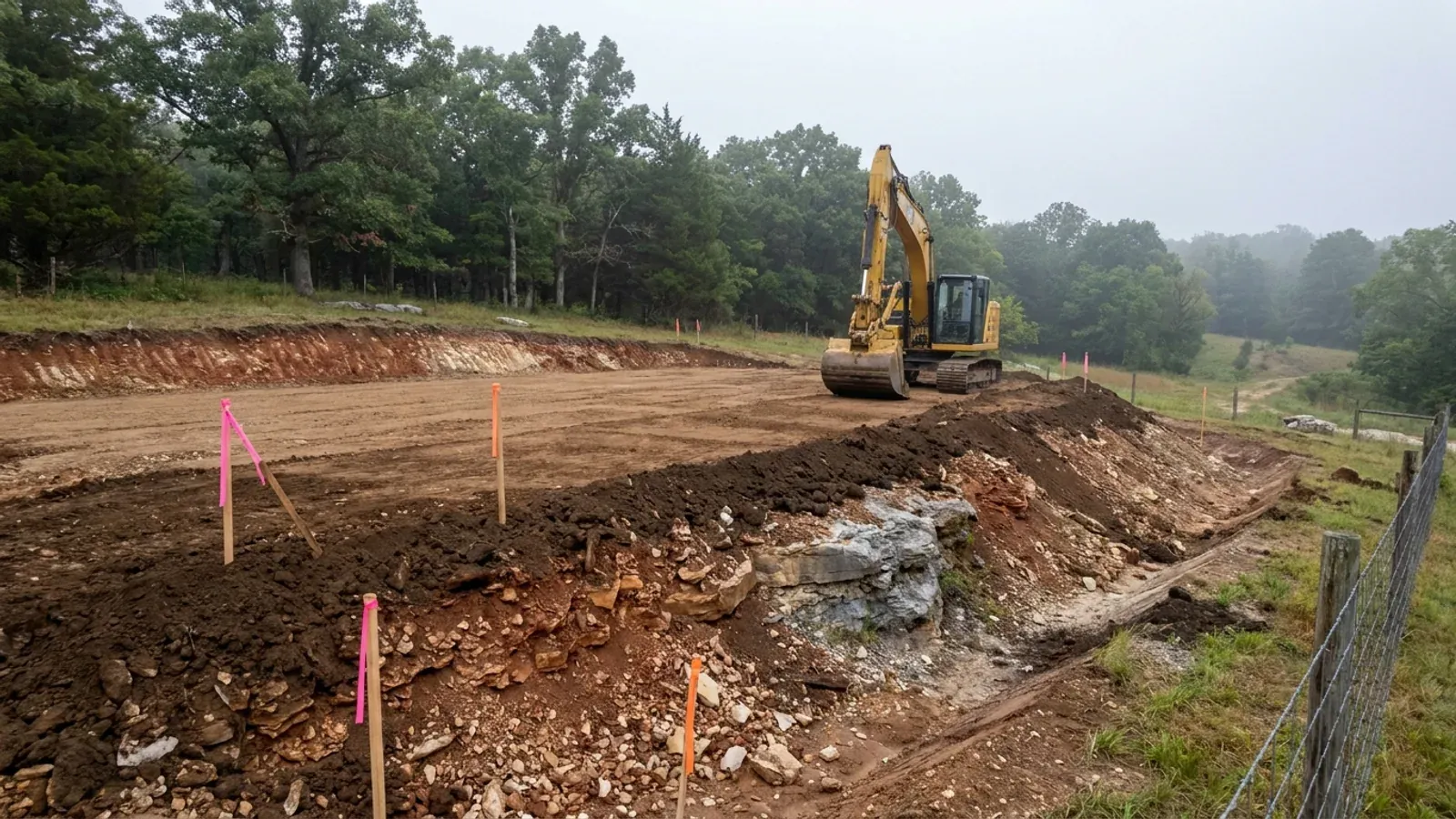
The expensive surprises are in the ground, not the building
What moves a Missouri budget is usually below grade, and which problem you have depends on where in the state you are. Across the Ozarks it is karst: the Department of Natural Resources maps more than sixteen thousand sinkhole points, and what matters there is what is under the slab rather than what the slab sits in. Across the north and centre it is claypan — dense, slow-draining subsoil that perches water above it for months of the year. In the Bootheel it is deep alluvium carrying the highest seismic demand in the state, where the same soils modelled for liquefaction attack post embedment and slab bearing rather than the frame above them. The same ground then decides the septic system, and Missouri does not run that on a percolation test alone: the rule allows a perc test or a soil morphology examination in a profile pit, and the authority reviewing your parcel picks which. Where a drainfield sits near a sinkhole's drainage, perc testing on its own is not permitted at all. Whether that authority is the state or your own county is itself a local question, and it changes what you have to file. So the site work, the foundation and the drainfield get resolved together rather than one at a time. We price the dirt before we price the building.
What we build in Newton County
All nine services are available in Newton County. What a build costs depends far more on the parcel than on square footage, so we price against your land rather than publishing a rate card.
Custom Plans
Barndominium floor plans drawn to your parcel and your soil, and to whichever Missouri authority — a county, a city, or none at all — will review them.
Barndominium Kits
Barndominium shell packages delivered to your Missouri land, drawn to the criteria your own county or city publishes — because the state publishes none.
Turnkey Builds
Start to finish barndominium construction in Missouri: the permits that genuinely apply, site work, shell and interior finish, under one contract.
What a build looks like
Three stages every Newton County project passes through, from a raw parcel to a finished home. Site work first, because that is where the budget is decided.
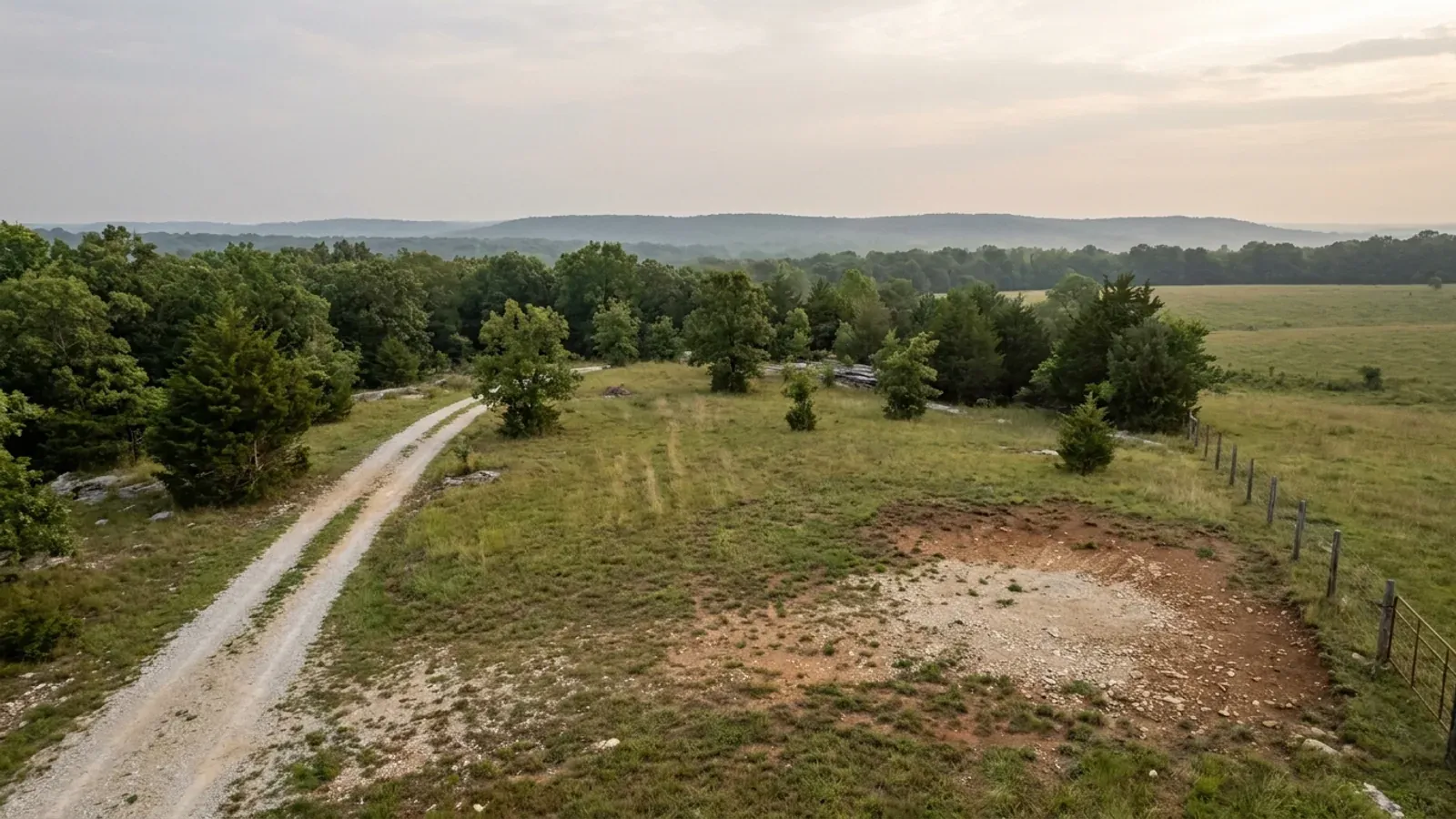
The parcel
Zoning, setbacks, flood zone and utility access get checked before anything is drawn.
Pad and permit
Clearing, grading and a compacted pad, while the submittal works through whichever office issues the permit where you are building.
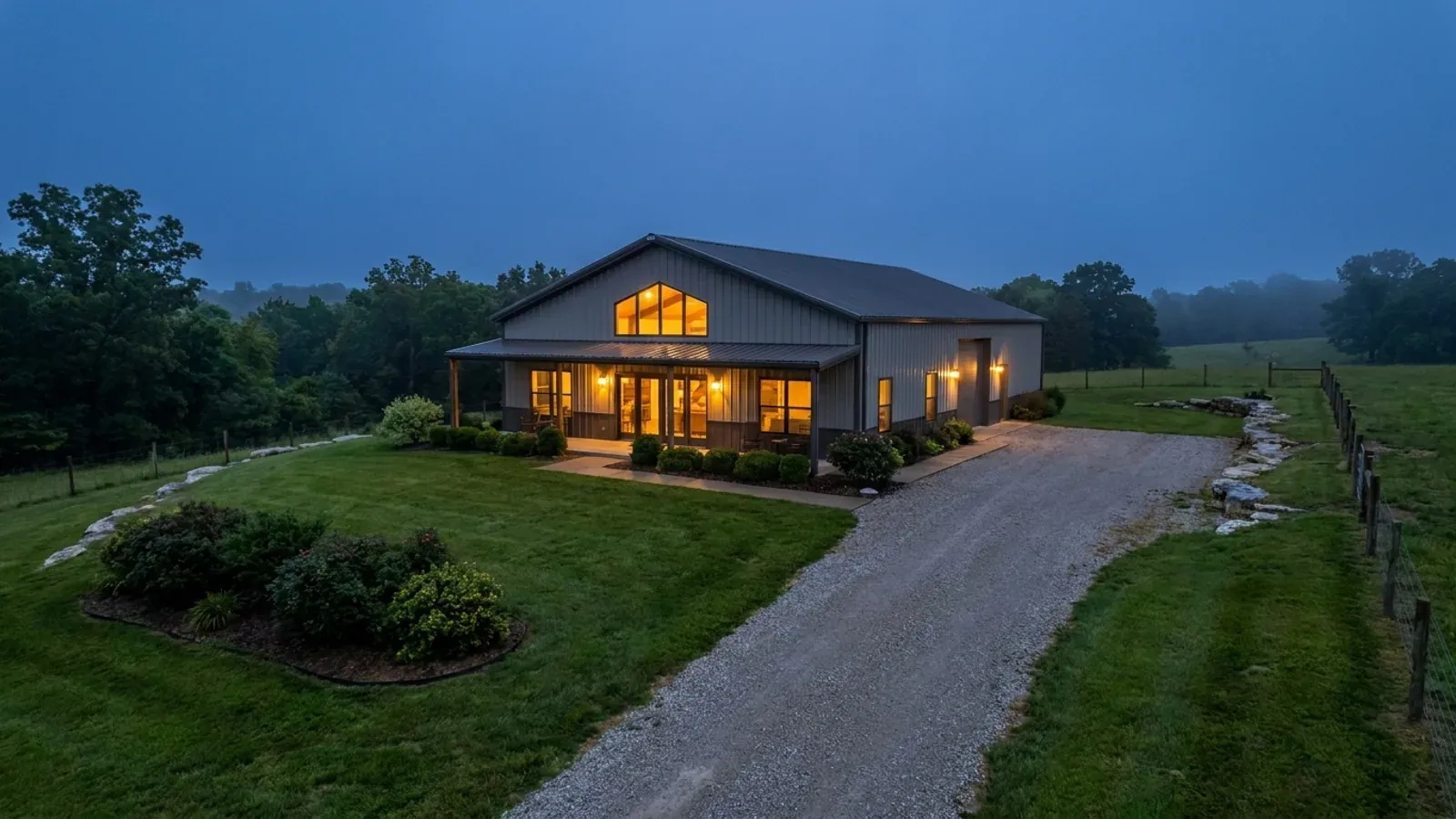
Frame to finish
Shell erected and dried in, then systems, insulation and interior finish through to CO.
Those are the rules where you are building in Newton County. Tell us what you want to build and we will draw it to them.
Where we build around Newton County
Newton County and the rural land around it. The buildable acreage for a project this size usually sits outside the city limits, which is frequently what changes who issues your permit.
Keep reading
The questions that usually come next once you know what Newton County allows.
Barndominium Cost Guide
Sourced per-square-foot ranges by tier and by size, with a calculator built on the same figures.
Read itIs It Legal in Missouri?
Classification, zoning, the HOA gate, and why "nonresidential farm building" does not cover a home.
Read itHow Long Does It Take?
Census build-duration data, and what actually sets the permit clock where you are building.
Read itNearby areas we build in
Others we cover nearby, and they are not interchangeable. One may be a county with an adopted building code, another a county with no legal authority to have one, another a city that permits inside its own limits whichever county the land sits in. So the office that issues the permit, whether anyone inspects the work at all, the fees, the zoning and the design figures can differ from one card to the next — sometimes across a single property line.
Building in Newton County: common questions
10 questions we get asked most often about building in Newton County. If yours is not on the list, ask it directly.
Do I need a building permit to build a house in unincorporated Newton County?
Can I build a metal barndominium in Newton County?
My land is over three acres — am I exempt from the septic permit?
Is a barn or shop exempt because my place is agricultural?
Is the ground here undermined, and does anyone check before I build?
Should I have the soil and the well tested for lead?
How big a shop can I build, and can it be bigger than the house?
What snow load, wind speed and frost depth will my house be designed to?
Does anyone inspect a house built in the unincorporated county?
Which parts of Newton County have a problem getting flood insurance?
Building in Newton County?
Start with the plan. Tell us what you want to build and we will draw it, then confirm which office issues the permit for your parcel, what it will let you put there, and what wind load it has to meet. That conversation costs nothing.