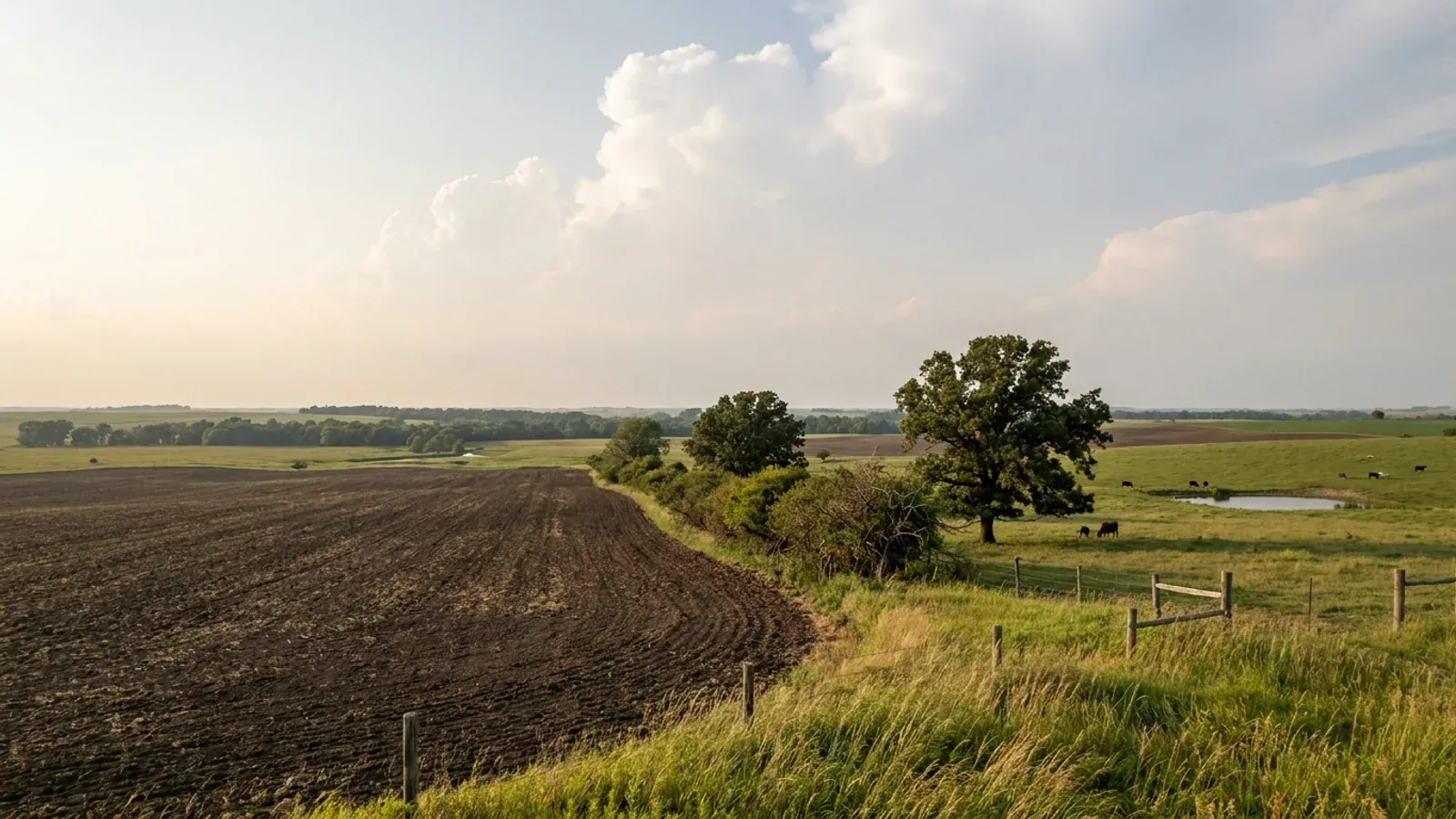
Barndominium Builders in Jackson County, MO
Jackson County is a charter county, and that is not a formality here — it is where the county's power to regulate your build comes from. Charter counties sit outside the four-class system the rest of Missouri's counties are sorted into, and Jackson's own Constitutional Home Rule Charter, at Article II section 16(3), gives the County Legislature power over "public health, police and traffic, building construction, and planning and zoning in the part of the county outside of incorporated cities." Building construction is named in the charter itself. The second half of that sentence is the practical half. Jackson County holds 727,362 people, and only 23,969 of them live in what the Census Bureau calls the balance of the county — the unincorporated ground the Jackson County Department of Public Works actually permits and inspects. Kansas City alone holds 317,383 Jackson County residents, Independence 121,629, Lee's Summit 103,651 and Blue Springs 61,246, and every one of those cities permits its own construction. So a Jackson County address tells you almost nothing; roughly three residents in a hundred are under the county's building department, and the ground they live on is the eastern and southern third of the county — Sni-A-Bar and Fort Osage township country around Buckner, Sibley, Grain Valley, Oak Grove and Lone Jack, and the ridges around Lake Lotawana and Greenwood. Public Works maintains more than 425 miles of road out there. What governs a build on that ground is a code the county jumped fourteen years to reach: Ordinance 5765, adopted 7 August 2023, repealed the 2009 editions the county had been running and put the 2018 International Codes and the 2017 National Electrical Code in their place. And the most useful thing about the Unified Development Code that sits alongside it is what is not in it. There is no minimum roof pitch, no eave requirement, no architectural review and no restriction on exterior materials anywhere in it — the word corrugated does not appear in the document. The county's own residential permit checklist lists metal as an exterior material and metal as a roofing material, in print, on the form. The binding constraints here are different ones: a 300-square-foot minimum dwelling size, a 10-acre minimum lot in the Agricultural district, an engineer-sealed septic design, and a building code that gives a barn no exemption at all.
Jackson County at a glance
- County
- Jackson County
- Population
- 727,362
- ZIP codes
- 64075, 64086, 64058, 64016, 64029, 64070, 64088, 64056, 64015, 64064, 64082, 64034, 64014, 64057
- Site visits
- Same-week site visits across the unincorporated county, from the Fort Osage and Blue Mills country above Buckner and Sibley east through Grain Valley and Oak Grove and south to Lone Jack, Greenwood and the Lake Lotawana ridges
Building conditions in Jackson County
Missouri sets no residential building code and no statewide way of adopting one, so the first question on any parcel is not what the code says — it is whether there is one. Only counties of the first and second classification may adopt a building code at all, and classification is set by assessed valuation rather than population, so a small county can hold the power while a much larger one does not. Zoning is a separate power with its own answer, granted only after a vote of the people and repealable by another. What changes from one jurisdiction to the next is whether the work is inspected, who issues the permit, what that office charges, how the parcel is zoned, and the design figures your drawings have to satisfy.
U.S. Census Bureau, Vintage 2024 Subcounty Population Estimates, Missouri file sub-est2024_29.csv, SUMLEV 050 for county FIPS 29095 and SUMLEV 157 place parts within that county including the Balance of Jackson County record, downloaded from www2.census.gov 8 September 2026; Jackson County Department of Public Works, Road and Right of Way Maintenance page, jacksongov.org, read 8 September 2026
Constitutional Home Rule Charter, Jackson County, Missouri, Article II section 16(3), revision printed 6/19 and updated 2023, PDF at jacksongov.org, downloaded and read 8 September 2026 and re-read independently; Missouri Association of Counties, 'Missouri Counties by Classification', published May 2025, mocounties.com; Mo. Const. Art. VI § 18(a) and § 18(c) via revisor.mo.gov; Jackson County Unified Development Code § 24001.2, ch. 240
Jackson County Code ch. 54 § 5400 as amended by Ord. 5765, Eff. 8/9/23, PDF '54-building-code-8-9-2023.pdf' linked from the County Code index at jacksongov.org, downloaded and text-extracted 8 September 2026; Jackson County Legislature File 5765, 'Chapter 54 - building code', status Passed, introduced 7/6/2023, final action 8/7/2023, sponsor Jeanie Lauer, full text with strike-and-bracket showing the 2009 editions replaced, jacksonco.legistar.com, read 8 September 2026
Jackson County Unified Development Code, ch. 240, § 24002.2(a)(56) as amended by Ord. 5912 (passed 16 December 2024), and a full-text search of the 2026 codified UDC PDF '240-udc_2026.pdf' from the County Code index at jacksongov.org returning zero occurrences of 'corrugated' and no exterior-material, roof-pitch, eave or design-review standard for detached dwellings; compared against the 2023 UDC PDF, whose § 24002.2(a)(56) carried neither the 300 sq ft minimum nor the prohibition; Jackson County Public Works, Building Permit Application Check List for Residential Homes; Jackson County Legislature File 5912, status Passed, jacksonco.legistar.com — all read 8 September 2026
Jackson County Code ch. 54 §§ 5401.2(b), 5409.3, 5409.4 and 5410.1 (Ord. 5765, Eff. 8/9/23); Jackson County Unified Development Code § 24001.4, ch. 240; Unincorporated Jackson County Building Permits, January 2025, Department of Public Works Development Division, pole barn permit requirements and fees — all from jacksongov.org, downloaded and read 8 September 2026
Missouri Department of Health and Senior Services, on-site wastewater treatment county authority selector at health.mo.gov/business-professionals/onsite-wastewater-treatment/owts-construction-permit-process?county=Jackson, agency block server-rendered and read 8 September 2026; Jackson County Individual On-Site Wastewater Disposal Permits, April 2020, Department of Public Works Development Division, Basic Information; Unincorporated Jackson County Building Permits, January 2025, on-site wastewater sections — both jacksongov.org, read 8 September 2026
Also worth knowing before you build in Jackson County
- The county adopted a code and then published no design table
- Unincorporated Jackson County adopted the 2018 International Residential Code and left Table R301.2(1) empty. There is no county design wind speed, no ground snow load, no frost line depth, no seismic design category, no weathering classification, no termite line and no air freezing index in Chapter 54, in Ordinance 5765, in the January 2025 building permit packet, in the residential permit checklist or in the building inspection requirements sheet. Nothing published by the county fills in the row. The USGS Seismic Design Web Service, queried on ASCE 7-16 at Site Class D for a point in the eastern unincorporated county, returns seismic design category B, with mapped values SDS 0.109 and SD1 0.110 — that is a federal calculation and not a figure Jackson County has adopted, and it is recorded here as a starting point for a design professional, not as the county's number. What is not usable here is a neighbour's table. Kansas City's own amended Table R301.2(1) publishes 115 mph, 20 psf ground snow, a 36-inch frost line and seismic design category A, and Kansas City permits only inside Kansas City. Get the footing depth and the design loads confirmed in writing by the Jackson County Building Official before a foundation plan is sealed.
- One county, four code generations — and Blue Springs moved to 2024
- Which side of a city limit a parcel falls on decides which decade's code the house is built to, and in Jackson County there are four answers live at once. Unincorporated Jackson County is on the 2018 International Codes with the 2017 NEC and the 2018 IECC, by Ordinance 5765 effective August 2023. The City of Blue Springs has adopted the 2024 IBC, IRC, IFC, IPC, IMC and IEBC with the 2023 NEC and the 2017 ICC A117.1, effective 1 June 2026 after a 90-day transition, and states that the International Energy Conservation Code 'has been adopted for reference purposes only and is not enforced as a mandatory requirement.' The City of Lee's Summit is enforcing the 2018 I-Codes and 2017 NEC and has adopted the 2024 I-Codes and 2023 NEC to take effect 1 October 2026, with projects submitted before that date reviewed under the older set. Grain Valley's Board of Aldermen adopted the 2018 International Building Codes and the 2017 National Electric Code at its meeting of 26 July 2021, effective immediately. Oak Grove lists the 2018 IBC, IRC, IMC, IPC, IFGC, IFC, ISPSC, IPSDC and IPMC and the 2017 NEC — but the 2012 International Energy Conservation Code. Kansas City runs the 2018 IRC with a separately adopted 2021 IECC. There is no statewide residential building code in this state and no mechanism for adopting one, so nothing reconciles those answers. The parcel decides.
- Five fire districts checked, and a statute that settles it
- In parts of Missouri a fire protection district, not the county, is the body that enforces a residential code — Chapter 321 of the statutes permits it and it happens. It does not happen here, for two reasons. First, each district was checked. Central Jackson County Fire Protection District, serving Blue Springs, Grain Valley, Lake Tapawingo and some surrounding county, publishes 2024 International Fire Code amendments and additions and runs a plan review service — but its own page states that those reviews 'will be sent to the building departments for the municipality in which the project resides,' and the amendments it publishes are fire code provisions on apparatus access roads, key boxes, extinguishers, addressing and system testing, not residential construction requirements. Fort Osage Fire Protection District covers 110 square miles of north-eastern Jackson County including Buckner, Levasy, Sibley, River Bend and parts of the unincorporated county, with two of its three stations on unincorporated ground, and publishes no building code and no construction permit programme. Lone Jack Fire Protection District, covering the south-eastern corner, publishes burn permit rules and nothing else. Sni Valley Fire Protection District's own site carries no code, permit or plan-review page. Southern Jackson County Fire Protection District — the district formed from the merger of the Prairie Township and Lotawana districts — offers voluntary home fire-safety inspections and smoke detector installation, not construction inspection. Second, and decisively: RSMo 321.228.2 provides that where a county 'adopts or has adopted, implements, and enforces a residential construction regulatory system,' any fire protection district wholly or partly inside it 'shall be without power, authority, or privilege to enforce or implement a residential construction regulatory system,' and any such district system 'shall be treated as advisory only.' The districts keep final authority over fire hydrant location and specification, hydrant flow rates and fire lanes; they may inspect the alteration, enlargement, replacement or repair of a one- or two-family dwelling; and they may not charge a fee for either.
- Trade licences since 2014, and the affidavit that lets an owner do the work
- Jackson County licenses no general contractor and no builder. It licenses three trades, and it has done since 28 January 2014. Chapter 54 § 5411.1 requires that all work defined in the chapter as electrical, mechanical or plumbing work be performed by the holder of a Class A or B licence in that trade, or by a Class C holder working under the direct supervision of a Class A or B holder, with one A or B licensee required on site at all times for each C licensee. Class A takes four years in the trade plus a Prometric or ICC journeyman or master's exam passed at 70 or better; Class B takes ten years in the trade; Class C is for apprentices in a Department of Labor-approved programme, accredited technical students, or out-of-jurisdiction workers. Every licence requires a certificate of liability insurance with a minimum limit of $1 million per occurrence from an insurer rated at least A.M. Best B+V, and failure to maintain it is grounds for automatic, immediate suspension. Class A and B licences run three years and renewal requires eight continuing education units annually; the fees are $175 for A or B and $45 for C. There is one exception that matters to an owner-builder: § 5411 states that the licensing requirement 'shall not apply to any person performing work on any structure that he or she owns, provided that person signs an affidavit indicating his or her intent to occupy the structure for at least one year after the completion of the work.'
- The shop cannot go up first, and it cannot go in front
- Two rules in the county's own permit guidance shape a house-plus-shop build more than anything in the code book. On sequencing, the county states that on residentially zoned property a building under 200 square feet is exempt from a building permit; a building of 200 square feet and under 600 square feet will be permitted without the primary permitted use in place; and a building larger than 600 square feet 'must have permitted primary permitted use in place' before a building permit will be issued. In plain terms, on residential ground the shop over 600 square feet waits for the house. On siting, UDC § 24005.2(c)(1) requires detached accessory buildings to be placed in the rear yard and prohibits them in front of the principal building, with a detached garage the only exception. There is no maximum floor area on a detached accessory building in the Agricultural or Residential-Ranchette districts — the cap is on heated living space, not on the building. An accessory dwelling unit may be built only in AG and RR, only on a building permit, must be a permanent structure, may not be sold separately from the principal dwelling, is limited to one storey unless it sits over a garage, and 'shall not exceed 1,000 square feet of heated area.' The county's permit packet applies the same 1,000 square foot ceiling to finished area inside a garage or pole barn and charges it at the residential rate.
- Prairie clay over shale, not Ozark rock — and no presumptive bearing value anywhere
- This is western Missouri prairie and glacial upland, and the soils under it behave nothing like Ozark chert. The USDA Natural Resources Conservation Service's soil survey of Jackson County, queried by map unit acreage, is led by the Snead-Rock outcrop complex, Sibley and Sibley-Urban land complexes, Arisburg silt loam, Sharpsburg silt loam, Higginsville silt loam, Sampsel silty clay loam, Kennebec silt loam and Greenton silty clay loam. Three of those are the ones a foundation designer needs to know about. Snead is described in its Official Series Description as 'moderately deep, moderately well drained, slowly permeable soils that formed in residuum from calcareous, clayey, gray shales and thin interbedded limestone.' Greenton is 'very deep and deep, somewhat poorly drained, slowly permeable' soil 'formed in thin loess and the underlying residuum from clay shales and thinly bedded limestone', classified fine, smectitic, mesic Aquertic Argiudolls. Sampsel is classified fine, smectitic, mesic Vertic Argiaquolls. Smectitic and vertic are the words that cost money: those are shrink-swell clays, and slowly permeable ones, which is the same property that drives the county's engineer-designed septic requirement. Nothing in the Jackson County Code fixes a presumptive soil bearing value the way some neighbouring counties do by ordinance, so the allowable bearing pressure under a pier or a footing here is a site question, established on the ground, not a number to be read off a table.
- The farmland is going fast — a quarter of it in five years
- USDA's 2022 Census of Agriculture counts 588 farms in Jackson County working 80,664 acres, at an average of 137 acres per farm, across the county's 604.52 square miles of land. Of that land in farms, 53,062 acres are cropland, 17,066 pastureland, 4,920 woodland and 5,616 other. The direction of travel is the number to hold on to: land in farms fell 24 percent between the 2017 and 2022 censuses, and the number of farms fell 17 percent. That is the tightest squeeze on rural acreage of any county in the Kansas City metro, and it is why the Agricultural district's 10-acre minimum lot size and the requirement that any property creation under 10 acres be platted are worth understanding before a purchase rather than after. A tract that can be split is a different proposition from one that cannot.
Jackson County Code ch. 54 (Ord. 5765, Eff. 8/9/23), Unincorporated Jackson County Building Permits January 2025, Building Permit Application Check List for Residential Homes and Building Inspection Requirements — all searched for design criteria with no result, jacksongov.org, 8 September 2026; USGS Seismic Design Web Service, /ws/building-codes/asce7-16/calculate at latitude 38.9, longitude -94.25, riskCategory II, siteClass D, request status success, queried 8 September 2026; Kansas City figures from KCMO Code of Ordinances § 18-57 Table R301.2(1)
Jackson County Code ch. 54 § 5400 (Ord. 5765); City of Blue Springs Codes Administration Division page, bluespringsgov.com; City of Lee's Summit Building Codes and Amendments page, cityofls.net; City of Grain Valley Building and Codes page, cityofgrainvalley.org; City of Oak Grove Overview of Building Codes page, cityofoakgrove.com; Kansas City Code of Ordinances §§ 18-57 and 18-367 — all read 8 September 2026
RSMo § 321.228, subsections 1 to 3, L. 2012 H.B. 1647 merged with S.B. 769, effective 28 August 2012, rendered from revisor.mo.gov 8 September 2026; Central Jackson County Fire Protection District plan reviews, general code guidance and 2024 IFC amendments pages, cjcfpd.org; Fort Osage Fire Protection District, Fire District & Stations page, fortosagefire.org; Lone Jack Fire Protection District, lonejackfire.org; Sni Valley Fire Protection District complete page index via its own site map, snivalleyfire.org; Southern Jackson County Fire Protection District Public Services page, sjcfd.org — all read 8 September 2026
Jackson County Code ch. 54 §§ 5411, 5411.1, 5411.2, 5411.3, 5411.4 and 5411.5 (Ord. 4597, Eff. 01/13/14, as codified in the 9 August 2023 revision), jacksongov.org; Unincorporated Jackson County Building Permits, January 2025, Preface — read 8 September 2026
Unincorporated Jackson County Building Permits, January 2025, Garages, Pole Barns and accessory-building paragraphs; Jackson County Unified Development Code § 24005.2(b) and (c), ch. 240 — both jacksongov.org, read 8 September 2026
USDA-NRCS Soil Data Access tabular service, sdmdataaccess.sc.egov.usda.gov, query of legend and mapunit tables for survey area MO095 ranked by map unit acreage, run 8 September 2026; USDA-NRCS Official Series Descriptions for SNEAD, GREENTON and SAMPSEL, soilseries.sc.egov.usda.gov, read 8 September 2026; Jackson County Code ch. 54 and Unified Development Code ch. 240, searched for a presumptive bearing provision with no result
USDA National Agricultural Statistics Service, 2022 Census of Agriculture County Profile for Jackson County, Missouri, cp29095.pdf, downloaded from nass.usda.gov and read 8 September 2026; U.S. Census Bureau 2024 Gazetteer county file, land area for GEOID 29095; Jackson County Unified Development Code Exhibit 240.8 and Jackson County Individual On-Site Wastewater Disposal Permits, April 2020
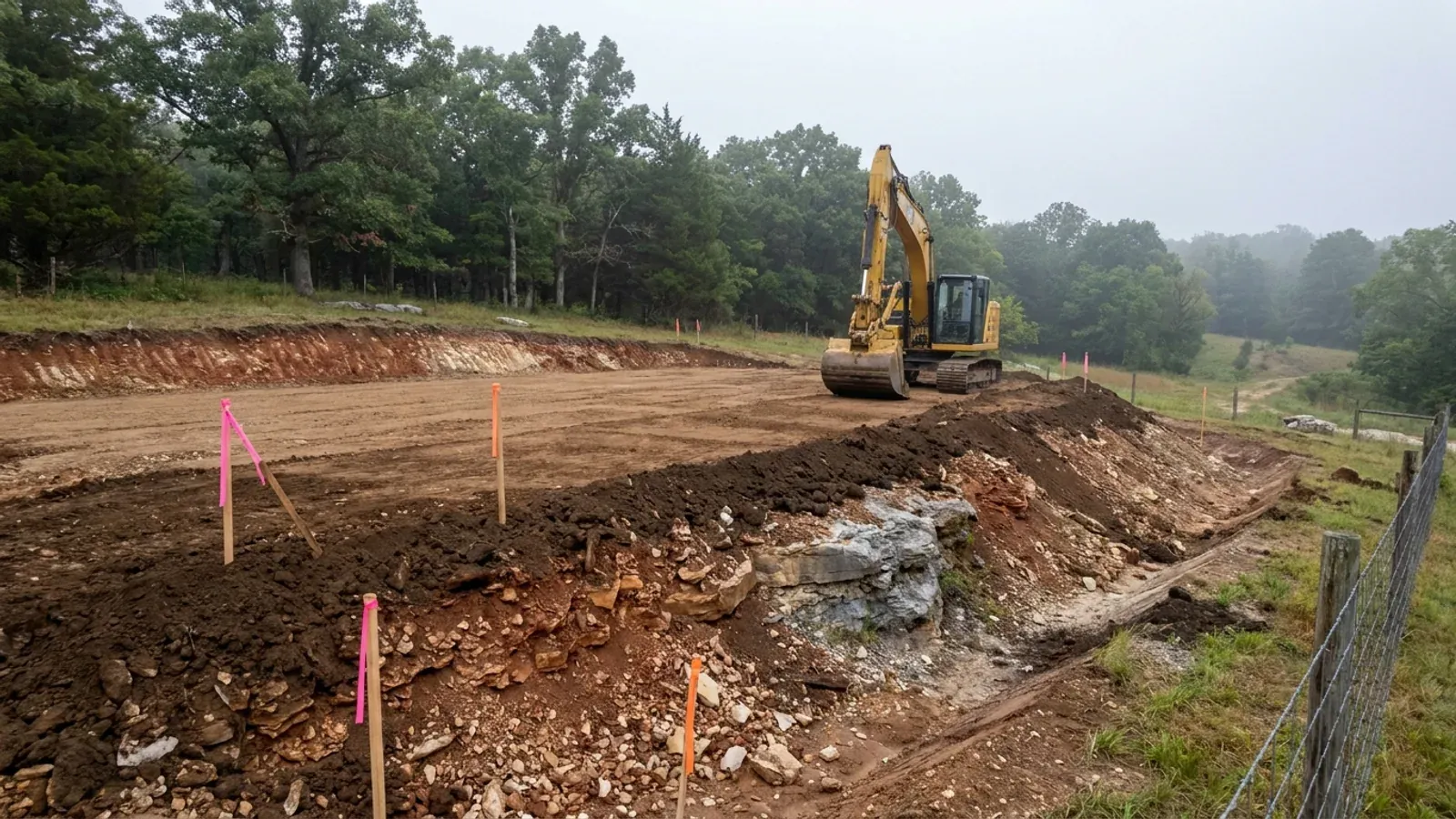
The expensive surprises are in the ground, not the building
What moves a Missouri budget is usually below grade, and which problem you have depends on where in the state you are. Across the Ozarks it is karst: the Department of Natural Resources maps more than sixteen thousand sinkhole points, and what matters there is what is under the slab rather than what the slab sits in. Across the north and centre it is claypan — dense, slow-draining subsoil that perches water above it for months of the year. In the Bootheel it is deep alluvium carrying the highest seismic demand in the state, where the same soils modelled for liquefaction attack post embedment and slab bearing rather than the frame above them. The same ground then decides the septic system, and Missouri does not run that on a percolation test alone: the rule allows a perc test or a soil morphology examination in a profile pit, and the authority reviewing your parcel picks which. Where a drainfield sits near a sinkhole's drainage, perc testing on its own is not permitted at all. Whether that authority is the state or your own county is itself a local question, and it changes what you have to file. So the site work, the foundation and the drainfield get resolved together rather than one at a time. We price the dirt before we price the building.
What we build in Jackson County
All nine services are available in Jackson County. What a build costs depends far more on the parcel than on square footage, so we price against your land rather than publishing a rate card.
Custom Plans
Barndominium floor plans drawn to your parcel and your soil, and to whichever Missouri authority — a county, a city, or none at all — will review them.
Barndominium Kits
Barndominium shell packages delivered to your Missouri land, drawn to the criteria your own county or city publishes — because the state publishes none.
Turnkey Builds
Start to finish barndominium construction in Missouri: the permits that genuinely apply, site work, shell and interior finish, under one contract.
What a build looks like
Three stages every Jackson County project passes through, from a raw parcel to a finished home. Site work first, because that is where the budget is decided.
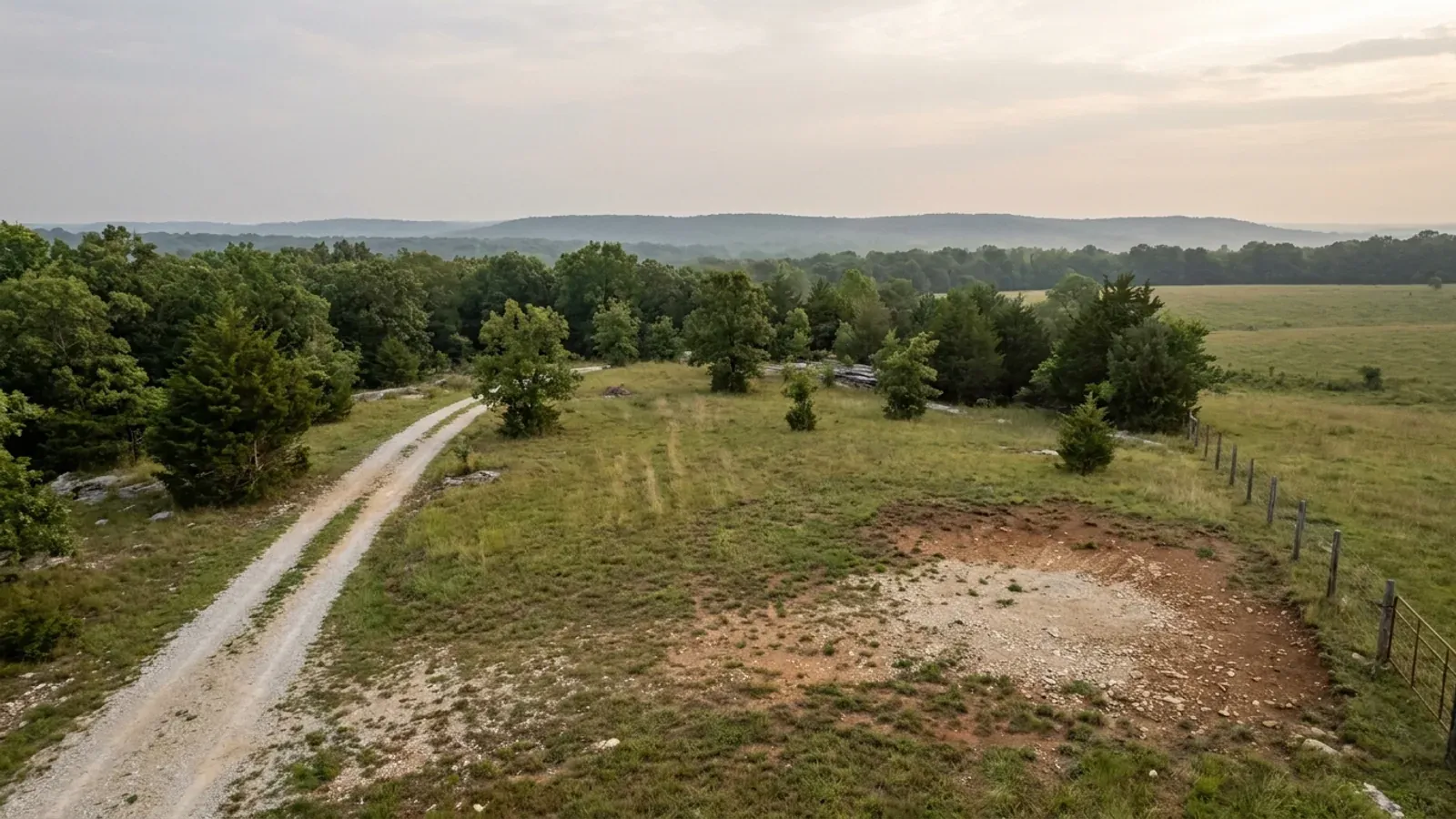
The parcel
Zoning, setbacks, flood zone and utility access get checked before anything is drawn.
Pad and permit
Clearing, grading and a compacted pad, while the submittal works through whichever office issues the permit where you are building.
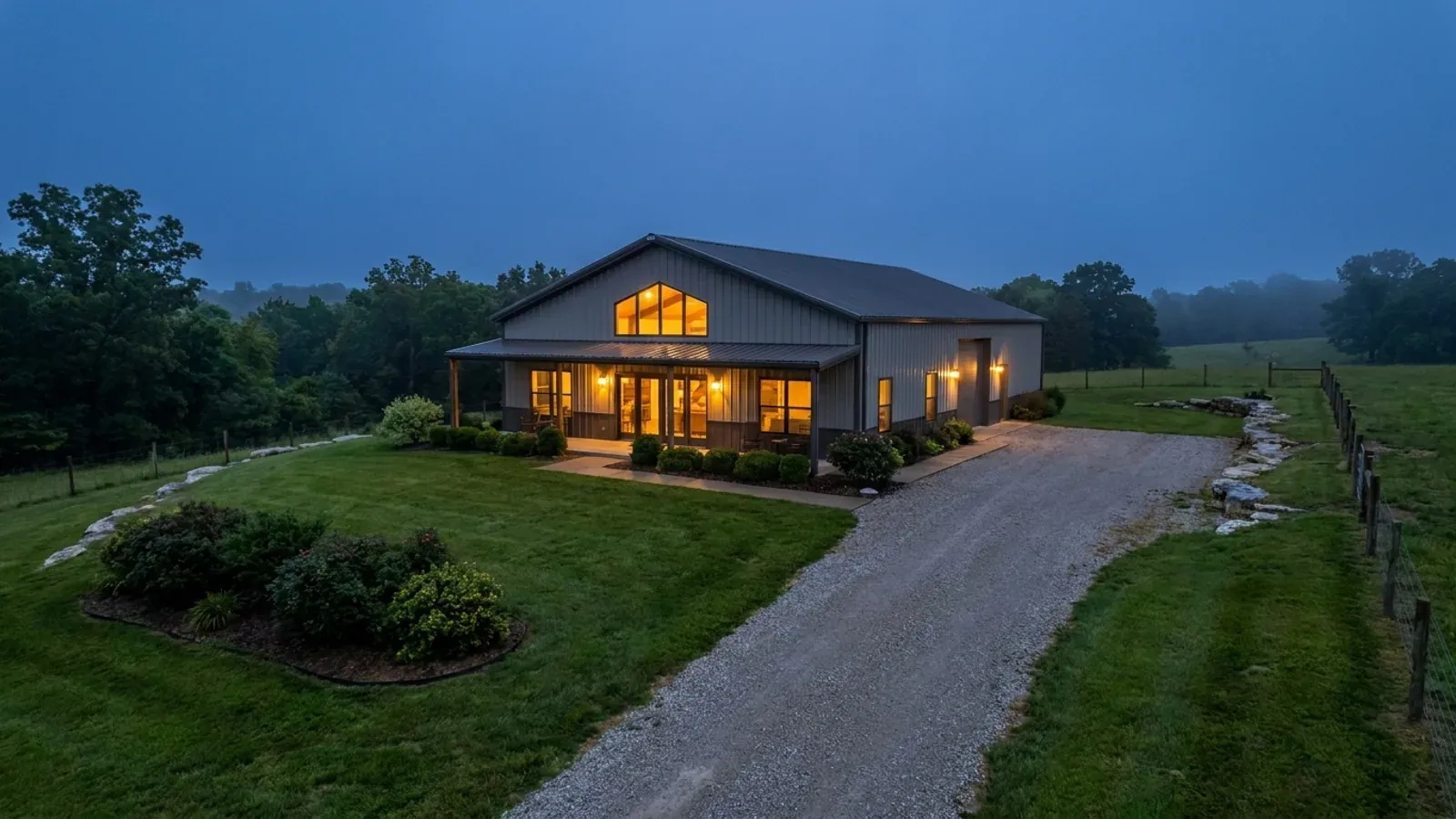
Frame to finish
Shell erected and dried in, then systems, insulation and interior finish through to CO.
Those are the rules where you are building in Jackson County. Tell us what you want to build and we will draw it to them.
Where we build around Jackson County
Jackson County and the rural land around it. The buildable acreage for a project this size usually sits outside the city limits, which is frequently what changes who issues your permit.
Keep reading
The questions that usually come next once you know what Jackson County allows.
Barndominium Cost Guide
Sourced per-square-foot ranges by tier and by size, with a calculator built on the same figures.
Read itIs It Legal in Missouri?
Classification, zoning, the HOA gate, and why "nonresidential farm building" does not cover a home.
Read itHow Long Does It Take?
Census build-duration data, and what actually sets the permit clock where you are building.
Read itNearby areas we build in
Others we cover nearby, and they are not interchangeable. One may be a county with an adopted building code, another a county with no legal authority to have one, another a city that permits inside its own limits whichever county the land sits in. So the office that issues the permit, whether anyone inspects the work at all, the fees, the zoning and the design figures can differ from one card to the next — sometimes across a single property line.
Building in Jackson County: common questions
8 questions we get asked most often about building in Jackson County. If yours is not on the list, ask it directly.
My land is in Jackson County. Who actually issues my building permit?
Can I build a steel or post-frame house with metal siding in unincorporated Jackson County?
Can I build the shop first and add the house later?
Is there an agricultural exemption if I call it a barn?
What does the septic system cost me in time and paperwork?
What wind speed, snow load and frost depth do I design to?
Do I need a licensed contractor, and can I do the work myself?
Which building code applies — and does it change if I move a few miles?
Building in Jackson County?
Start with the plan. Tell us what you want to build and we will draw it, then confirm which office issues the permit for your parcel, what it will let you put there, and what wind load it has to meet. That conversation costs nothing.