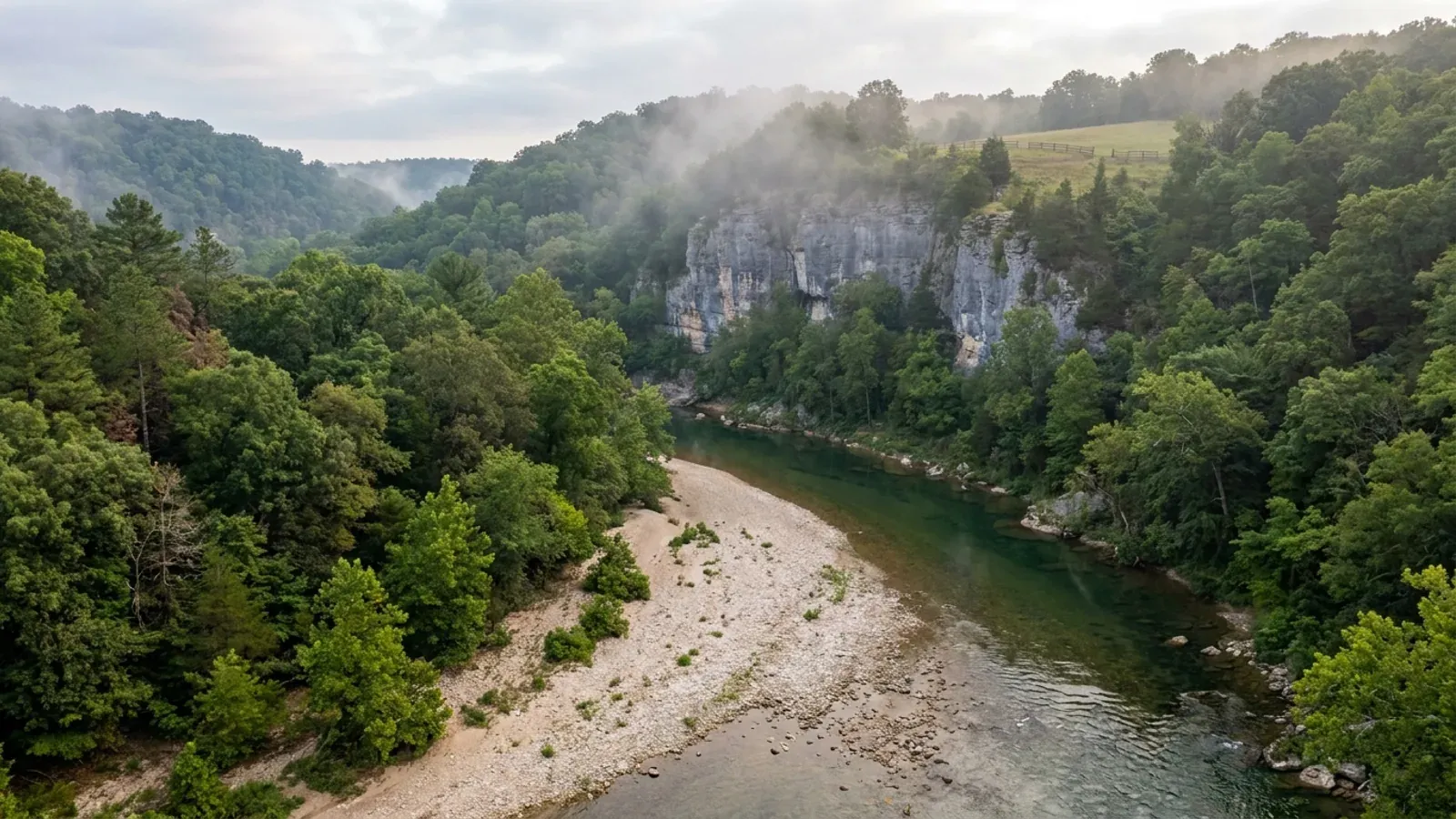
Barndominium Builders in Lebanon, MO
Lebanon sits on I-44 between two markets with completely different answers to the same question, and the line that decides which answer applies to your land is the city limit. Inside the limits the City of Lebanon runs a Code Administration Department with a director, a planning and zoning manager and two building inspectors, and it enforces the 2021 International Building, Residential, Property Maintenance, Plumbing, Mechanical, Fuel Gas and Existing Building Codes together with the 2020 National Electrical Code, all adopted by Ordinance No. 6922 on 13 May 2024. Outside the limits nothing of the kind exists, and the reason is statutory rather than a matter of local preference. Laclede County is a county of the third classification, and RSMo 64.170 empowers only counties of the first and second classification to adopt a building code at all. That is not a gap the county can close by deciding to; it cannot change until the county's assessed valuation moves it into another class. More than half the county's residents live on that ground: of 36,738 people, 20,176 live in the balance of the county outside any incorporated place. That does not mean nobody looks at the building. It means the county does not. The gates outside the city limits are real, they are just held by other offices: the Laclede County Health Department permits and inspects the on-site wastewater system under the county's own ordinance, the county 911 department assigns the address, and a public water supply district or a well and a driveway entrance each have their own process. Inside the limits the city adds a Memorandum of Understanding before a permit issues and an occupancy permit before the building may be used at all. Two Lebanon rules matter more to a barndominium buyer than anything else on this page, and both live inside the city limits. The city's amendment to IRC section R104.11 says that the alternative methods 'commonly known as "storage container," "pole barn" or "laminated pole" type structures shall be limited to residential accessory structures or commercial buildings with the approval of engineered drawings or approval from the building official,' and then adds flatly that 'accessory buildings shall not be used for residential dwelling units.' And zoning section 48-102(c)(2) caps a detached private residential garage at 50 percent of the ground-floor area of the dwelling, at 1,000 square feet, and at five vehicles, with a concrete floor required. A post-frame house with a shop bigger than the house is a straightforward proposition on unincorporated Laclede County ground and a conversation with the building official inside the city. What Lebanon does not do is regulate what the building is made of. Its zoning chapter, readopted in full by Ordinance No. 6886 on 26 February 2024, contains no exterior material restriction, no minimum roof pitch, no eave projection requirement and no design or appearance review that reaches a site-built single-family dwelling. The one place corrugated metal is excluded and eaves are specified is section 48-39, the RS-5 district for Class A manufactured and mobile homes on foundations, and it reaches manufactured housing in that district and nothing else.
Lebanon at a glance
- County
- Laclede County
- Cities & counties covered
- Lebanon 15,538 · Laclede County 36,738 · Balance of Laclede County (unincorporated) 20,176
- Site visits
- Same-week site visits across Laclede County — Lebanon and the I-44 corridor, Phillipsburg and Conway west toward Webster County, Sleeper and Stoutland north toward the Camden County line, Falcon and Eldridge east, and the Osage Fork and Niangua river country south
Building conditions in Lebanon
Missouri sets no residential building code and no statewide way of adopting one, so the first question on any parcel is not what the code says — it is whether there is one. Only counties of the first and second classification may adopt a building code at all, and classification is set by assessed valuation rather than population, so a small county can hold the power while a much larger one does not. Zoning is a separate power with its own answer, granted only after a vote of the people and repealable by another. What changes from one jurisdiction to the next is whether the work is inspected, who issues the permit, what that office charges, how the parcel is zoned, and the design figures your drawings have to satisfy.
Missouri Association of Counties, 'Missouri Counties by Classification', published May 2025 (mocounties.com), downloaded and read 8 September 2026, which lists Laclede in the CLASS 3 block of 89 counties out of 114; RSMo 64.170 (effective 28 Aug 2008) and RSMo 64.205, rendered from revisor.mo.gov 8 September 2026; RSMo 48.020 for the valuation basis; population from the Census Bureau Vintage 2024 sub-county estimates (sub-est2024.csv).
Lebanon Code of Ordinances § 8-54(7), enacted by Ord. No. 6922, § 3, adopted 13 May 2024; read from the codified text stamped version 10 February 2026 (current) on library.municode.com, 8 September 2026, and re-read in a separate navigation from a different node. Springfield's figures from that city's Land Development Code art. XIII (Gen. Ord. 6736, adopted 8 August 2022, effective 1 January 2023).
Lebanon Code of Ordinances § 8-54(2) and § 8-54(6), enacted by Ord. No. 6922, § 3, adopted 13 May 2024; § 48-102(d)(3), enacted by Ord. No. 6886, § 1, adopted 26 February 2024. Read on library.municode.com 8 September 2026 with the page title verified in the same read, and re-read in a separate navigation.
Lebanon Code of Ordinances § 48-102(c)(1) and (c)(2), enacted by Ord. No. 6886, § 1, adopted 26 February 2024. Read on library.municode.com 8 September 2026 and re-read byte for byte in a separate navigation from a different node id, with the page title captured in the same evaluation as the text.
Lebanon Code of Ordinances ch. 48, in particular §§ 48-6, 48-33, 48-35, 48-36, 48-39(e) and 48-39(f)(1)—(2), 48-102 and 48-273, all enacted by Ord. No. 6886, § 1, adopted 26 February 2024; read in full on library.municode.com 8 September 2026 with the page title verified in the same evaluation as each read.
Missouri DHSS OWTS construction permit process county selector, health.mo.gov/business-professionals/onsite-wastewater-treatment/owts-construction-permit-process?county=Laclede, queried 8 September 2026 against a known-good control (?county=Camden) and a bogus control (?county=Zzzbogus, which returns 'The submitted value ... is not allowed' and 'No results found'); Laclede County Health Department, Environmental Sanitation FAQs and Environmental and Sanitation fee page, lacledecountyhealth.com, read 8 September 2026; RSMo 701.031 (effective 28 Aug 2005) and RSMo 701.047 (effective 28 Aug 1994), rendered from revisor.mo.gov 8 September 2026.
Also worth knowing before you build in Lebanon
- Seven tax-based fire districts and three dues-based departments — and none of them runs a building code
- A fire protection district can be a building-code authority in Missouri, which surprises people, so it is worth checking rather than assuming. RSMo 321.220(12) lets a district board adopt fire protection and fire prevention ordinances whose administrative standards may be 'industrial codes adopted by nationally organized and recognized trade bodies', with violations prosecuted as misdemeanors by the county prosecutor — and the same subdivision carves farm buildings out, providing that such ordinances 'shall not be exercised so as to impose regulations or to require permits with respect to the erection, maintenance, repair, alteration, or extension of farm buildings or farm structures.' In Laclede County the fire coverage divides into two kinds and the distinction is legally real. Seven are tax-based: Lebanon Rural, the Lebanon Fire Department, Nebo/Falcon, Tri-County, Bennett Springs, Hazelgreen and Competition. Three are dues-based volunteer departments rather than Chapter 321 districts: Conway, Sleeper Stoutland and Eldridge Fire and Rescue — and a department that is not a fire protection district has no RSMo 321.220 power at all. Lebanon Rural is the largest and the one to check first: it protects, in its own words, '172 square miles of central Laclede county, surrounding the city of Lebanon', with three stations, ten trucks and twenty-five personnel. Its own site describes fire response, emergency medical service, training and recruitment, and carries no adopted building or residential code, no permit programme, no plan review and no inspection programme; its documents page is empty. That is recorded here as a negative rather than an absence of looking, and it is only one district — ask which district covers your address before assuming the same answer holds there.
- RSMo 321.228 is why a fire district cannot run a residential code inside Lebanon
- Missouri answers the fire-district question with a two-step test, and Lebanon and unincorporated Laclede County land on opposite sides of it. RSMo 321.228, effective 28 August 2012, defines a 'residential construction regulatory system' as any bylaw, ordinance, order, rule or regulation adopted, implemented or enforced by a city, town, village or county that pertains to residential construction, to any permitting system or programme relating to it, or to any system or programme for the inspection of it — expressly including 'the whole or any part of a nationally recognized model code, with or without amendments.' Where a city or county adopts, implements and enforces one, any fire protection district wholly or partly inside it 'shall be without power, authority, or privilege to enforce or implement' one there, and any such system a district adopts 'shall be treated as advisory only'. Lebanon plainly runs one, so inside the city limits the districts are preempted. Outside the limits Laclede County runs none, so the RSMo 321.220(12) route is legally open even though, on the checking recorded here, no district in the county has taken it. Three things a district keeps either way, under subsection 3: final regulatory authority over the location and specification of fire hydrants, hydrant flow rates and fire lanes; the right to inspect the alteration, enlargement, replacement or repair of a detached one- or two-family dwelling, though not new construction; and no fee for either. It is also worth separating two things that look alike: a district adopting the International Fire Code or a fire prevention code is doing something this section does not reach at all, and that is ordinary and lawful everywhere.
- 334 mapped sinkholes — this is real karst, and the number is measured rather than assumed
- Lebanon sits on the Salem Plateau at the head of the Osage Fork and the Niangua, and 'the Ozarks' is a region rather than a ground condition, so the sensible thing is to count. The Missouri Department of Natural Resources publishes a statewide sinkholes layer holding 16,001 mapped points. Intersected against the Laclede County boundary it returns 334. For scale, the same query returns 1,471 for Greene County, 484 for Texas County, 138 for Pulaski, 91 for Camden and 58 for Webster — so Laclede is genuinely karst country, roughly four times its Camden neighbour and six times Webster next door, but well short of the Springfield plateau. What that means for a build is specific rather than general. A sinkhole is a direct opening to groundwater, so it constrains where a drainfield may go before it constrains where a house may go, and Missouri's on-site wastewater rules bar a percolation test alone as the basis of a design where there is significant groundwater contamination potential, which includes a drainfield within 100 feet of a sinkhole's drainage. Neither the City of Lebanon nor Laclede County publishes a sinkhole setback of its own, so the operative constraint is what the county health department's evaluator concludes about your particular parcel — which is a good reason to have the soil evaluation done before the offer rather than after it.
- The ground is deep and cherty, not shallow to rock — and the fragipan is the real foundation story
- The reflex assumption about Ozark ground is bedrock a few inches down, and for Laclede County that is wrong by a wide margin. Across the county's soil survey area, 491,629 acres in 56 map units, lithic or paralithic bedrock is mapped within roughly 20 inches on 9,642 component-weighted acres — 2.0 percent. Rock outcrop is a named component on 1,871 acres, well under half a percent. What actually governs foundations here is two other things. The first is chert: 317,038 acres, 64.5 percent of the survey area, sit in map units whose own published names carry cherty, gravelly, stony, rocky or Rock outcrop, and the dominant soils are Wilderness at 96,063 acres, Clarksville at 81,011 and Viraton at 59,975. The second, and the one that matters at footing depth, is a fragipan — a dense, slowly permeable subsoil layer that perches water above it. A fragipan is mapped on 179,724 component-weighted acres, 36.6 percent of the county, and on the two largest soils it starts at 25 inches (Wilderness) and 21 inches (Viraton), with the shallowest occurrence in the county at 17 inches. Lebanon's published 18-inch frost line therefore puts a footing or a pier bottom immediately above the fragipan on most of this ground rather than through it, which is exactly the position where perched water and frost heave interact. Terrain is a much smaller problem here than further south: 114,016 acres, 23.2 percent, fall in map units whose slope class begins at 15 percent or steeper.
- Two Laclede County communities are suspended from the flood insurance programme
- FEMA's Community Status Book, refreshed 25 August 2026, lists four communities in Laclede County and splits them two and two. The City of Lebanon (CID 290197) and Laclede County itself (CID 290811) are both participating in the National Flood Insurance Program, with initial flood insurance rate maps of 1 June 1982 and 17 April 1985 respectively and a current effective map date of 29 September 2010 for both. The City of Conway (CID 290196) and the Village of Evergreen (CID 290991) do not participate — a status FEMA has carried for Conway since 10 May 1975 and for Evergreen since 29 September 2011. In a non-participating community, federally backed flood insurance is not available for a building in the mapped special flood hazard area and certain federal disaster assistance for such buildings is restricted, which is a lender problem long before it is a builder problem. Inside Lebanon the flood rule has a procedural edge worth knowing: the city amends IRC section R106.1.4 to require a conditional use approved by the Zoning and Planning Commission to build on any lot in a flood hazard area, with the lowest floor elevation set by a Missouri architect or engineer, a letter confirming the finished floor elevation submitted to the building official, and that letter recorded by the owner with the Laclede County Recorder's office. There is also a discrepancy on the face of the code worth raising with the department rather than resolving on paper: Lebanon's own Table R301.2 prints flood hazard dates of '1976 and 2023', where FEMA records 1 June 1982 and 29 September 2010.
- Lebanon registers every contractor and subcontractor — but registration is not a competency licence
- Missouri issues no statewide general contractor licence, and Lebanon does not create one either, but it does require registration and the distinction is worth being precise about. Since 2 January 2018 the city has required every contractor and subcontractor working in the city to register, and its own notice puts the scope broadly: 'This includes all building trades, home inspectors, tree trimers, lawn care etc.' The instrument is Form 99-04, the Building Trade Occupational Registration Application. The fee is $25.00 per year, valid 1 January to 31 December; registration must be in place before starting any project; the applicant ticks a trade from a list running electric, plumbing, HVAC, general, dirt, concrete, roofing, framing and other; and the application requires proof of worker's compensation, by certificate of insurance or by an affidavit signed by the applicant attesting to an exemption, plus proof that any delinquent taxes or financial obligations owed the city are paid. What it does not do is certify skill, and the form says so itself: 'The City of Lebanon shall not be responsible for the nature and/or quality of any work performed by licensee.' Unincorporated Laclede County registers nobody, because there is no county building office to register with. Separately, the city does not require design plans and specifications for every job: section 8-27(c)(1) excepts a single-family dwelling house, a building for not more than two families, and a building used exclusively for farm purposes — though the exception is expressly subject to inspection and to compliance with the adopted codes.
- The county's own department list has no building or planning office on it
- The strongest evidence that a jurisdiction does not do something is usually its own index of what it does. Laclede County's website is four pages, and the County Departments page enumerates the entire county government: as elected officials, the assessor, circuit court, collector, coroner, county clerk, prosecuting attorney, public administrator, recorder, sheriff, surveyor and treasurer; as departments, 911, emergency management, purchasing, maintenance, and roads and bridges. There is no building department, no building inspector, no code enforcement officer and no planning and zoning department anywhere on it, and the county publishes no zoning ordinance, subdivision regulations or building code. That is consistent with what RSMo 64.170 permits a third-classification county to have, and it means the chain outside the city limits runs through offices that are not construction offices at all. Two of them are on that same list and both are worth calling early. Laclede County 911, on (417) 533-5983, assigns the address a new build needs before a utility will connect and before anything can be found in an emergency; having the address of an adjoining property speeds the mapping. And Roads and Bridges, on (417) 533-7023, is the office for anything touching a county road, including a new driveway entrance. Public water outside the city comes from Laclede County Public Water Supply Districts 1, 2 and 3 rather than from the county.
- The RU-1 rural district is where acreage inside the city limits actually is
- Lebanon is not a dense city — 15,538 people over 14.6 square miles of land — and it carries a rural district in its own zoning that most towns this size do not. RU-1 Rural requires a minimum lot area of 43,560 square feet, one full acre, and the same acre per family, with a 150-foot minimum lot width and setbacks of 50 feet front, 20 feet side and 50 feet rear, at a 35-foot maximum height. Two things about it are unusual and useful. First, the Permissive and Conditional Use Table at section 48-32 marks both a single-family dwelling and farm use as permissive in RU-1, with livestock available as a conditional use, so an acreage lifestyle is contemplated inside the limits rather than merely tolerated. Second, RU-1 is the one residential district in the chapter that states no minimum living space and no minimum building width, where RS-1 sets 960 square feet and 28 feet and RS-2 sets 840 square feet and 28 feet. Set against that, the paved-driveway rule at section 48-102(a) applies in RU-1 as it does everywhere else: a driveway of asphalt or concrete, at least 12 feet wide, and at least 25 feet long or to the front line of the structure, whichever is greater. Underground utilities including cable are required on all lots in the same districts. Ten minutes out on unincorporated ground there is no lot minimum, no setback ordinance and no driveway specification, because there is no zoning to set them.
- This is farm country by a wide margin — 307,082 acres in farms at a 257-acre average
- Laclede County ran 1,194 farms across 307,082 acres in the 2022 Census of Agriculture, at an average size of 257 acres, against a Missouri average of 308. Against a county land area of about 765 square miles, roughly 63 percent of the county is in farms, and the farm-size distribution is the one that matters to somebody shopping for a homesite rather than an operation: 51 farms of 1 to 9 acres, 279 of 10 to 49 acres, 423 of 50 to 179 acres, 274 of 180 to 499, 103 of 500 to 999 and 64 of 1,000 or more. Sales are 90 percent livestock, poultry and products and 10 percent crops, which on this ground means cattle and hay on the ridges and the cherty uplands, and it is the reason so much of the county is fenced pasture rather than row crop. Two practical consequences follow. A parcel split out of a working farm is common here, which is exactly the situation where an existing on-site sewage system, an existing well and an existing farm entrance all belong to the seller's operation rather than to your lot. And because RSMo's agricultural exemptions run to farm buildings rather than to dwellings, a barndominium used as a house is not exempt from anything by being on farmland — the exemption stops where the dwelling starts.
- Building inside the limits ends with a Memorandum of Understanding and an occupancy permit
- Lebanon's permit process has two steps at either end that catch people who have only built in unincorporated Missouri before. At the front, the city requires a site plan reviewed and approved before a building permit issues, and before it issues a Memorandum of Understanding must be signed reciting that the owner understands the permit is granted on the express condition that construction conforms to the city's ordinances in all respects, including compliance with the approved site plan, and that the building may not be occupied or used until compliance is made. The owner must also certify on that memorandum who will be inspecting the job. Any change to the approved site plan or building plans has to go back to whoever prepared them and to the city. At the back, the city states it is a violation to occupy the building or use the site until construction is complete and an occupancy permit is issued, and its property maintenance amendment makes it unlawful to let or permit occupancy of a residential unit until all utilities — electric, water, sewer and a heat source for heating water and heating the unit — are properly connected and operating and any electrical deficiencies are corrected. A site plan approval goes stale after twelve months if no permit is issued and the code requirements have changed in the meantime. None of this exists on unincorporated county ground, where there is no occupancy permit to withhold.
RSMo 321.220(12), effective 28 August 2025, rendered from revisor.mo.gov 8 September 2026; the tax-based and dues-based lists from the Sleeper Stoutland Volunteer Fire Department's own 'Laclede County Fire Districts' page (ssvfds.org), read 8 September 2026; coverage and services from lebanonrural.org home, About Us, Documents and Links pages, read 8 September 2026.
RSMo 321.228, effective 28 August 2012 (L. 2012 H.B. 1647 merged with S.B. 769), rendered in full from revisor.mo.gov 8 September 2026 against a bogus-section control.
Missouri DNR sinkholes layer, gis.dnr.mo.gov ArcGIS REST service geology/sinkholes, layer 1, queried 8 September 2026 by spatial intersect against the Census TIGERweb county polygon for GEOID 29105 in EPSG:26915. Method validated against the publisher's own total: the unfiltered count returns 16,001, matching DNR's published figure of approximately 16,000, and the Greene and Texas County counts reproduce figures obtained independently.
USDA-NRCS Soil Data Access (SDMDataAccess.sc.egov.usda.gov), tabular queries against soil survey area MO105, Laclede County, Missouri, run 8 September 2026 against a bogus-table control that returns an OGC ServiceException reading 'Invalid object name'. Component-weighted acreages computed as map unit acres times component percentage; restriction depths from the corestrictions table; frost line from Lebanon Code of Ordinances § 8-54(7).
FEMA OpenFEMA NfipCommunityStatusBook API, filtered to Missouri and read for Laclede County rows on 8 September 2026 (lastRefresh 25 August 2026); Lebanon Code of Ordinances § 8-54(4) and § 8-54(7), Ord. No. 6922, § 3, adopted 13 May 2024.
City of Lebanon Form 99-04, Building Trade Occupational Registration Application (lebanonmissouri.org DocumentCenter), and the Code Administration Reminder To The Public notice recording the 2 January 2018 start date, both read 8 September 2026; Lebanon Code of Ordinances § 8-27(b), (c) and (e).
Laclede County Missouri Government Center, County Departments and Resources pages (lacledecountymissouri.org), read 8 September 2026 against a bogus-path control returning an honest HTTP 404 titled 'Page not found'; RSMo 64.170, rendered from revisor.mo.gov 8 September 2026.
Lebanon Code of Ordinances §§ 48-32, 48-33, 48-35, 48-36, 48-102(a) and (b) and 48-273, all enacted by Ord. No. 6886, § 1, adopted 26 February 2024, read on library.municode.com 8 September 2026; land area from the Census Bureau 2024 Gazetteer place file for Missouri; population from Vintage 2024 estimates.
USDA NASS, 2022 Census of Agriculture, Laclede County, Missouri county profile (cp29105.pdf, nass.usda.gov), downloaded and read 8 September 2026 against a bogus-county control returning a 196-byte HTTP 404.
City of Lebanon, Guidelines to Obtain a Building Permit page and its linked site plan procedure sheet (lebanonmissouri.org), read 8 September 2026 against a control showing the host serves a real page for a wrong slug on a valid numeric id and an honest HTTP 404 for a bogus id; Lebanon Code of Ordinances §§ 8-27, 8-28 and 8-55(2), Ord. No. 6922, adopted 13 May 2024.
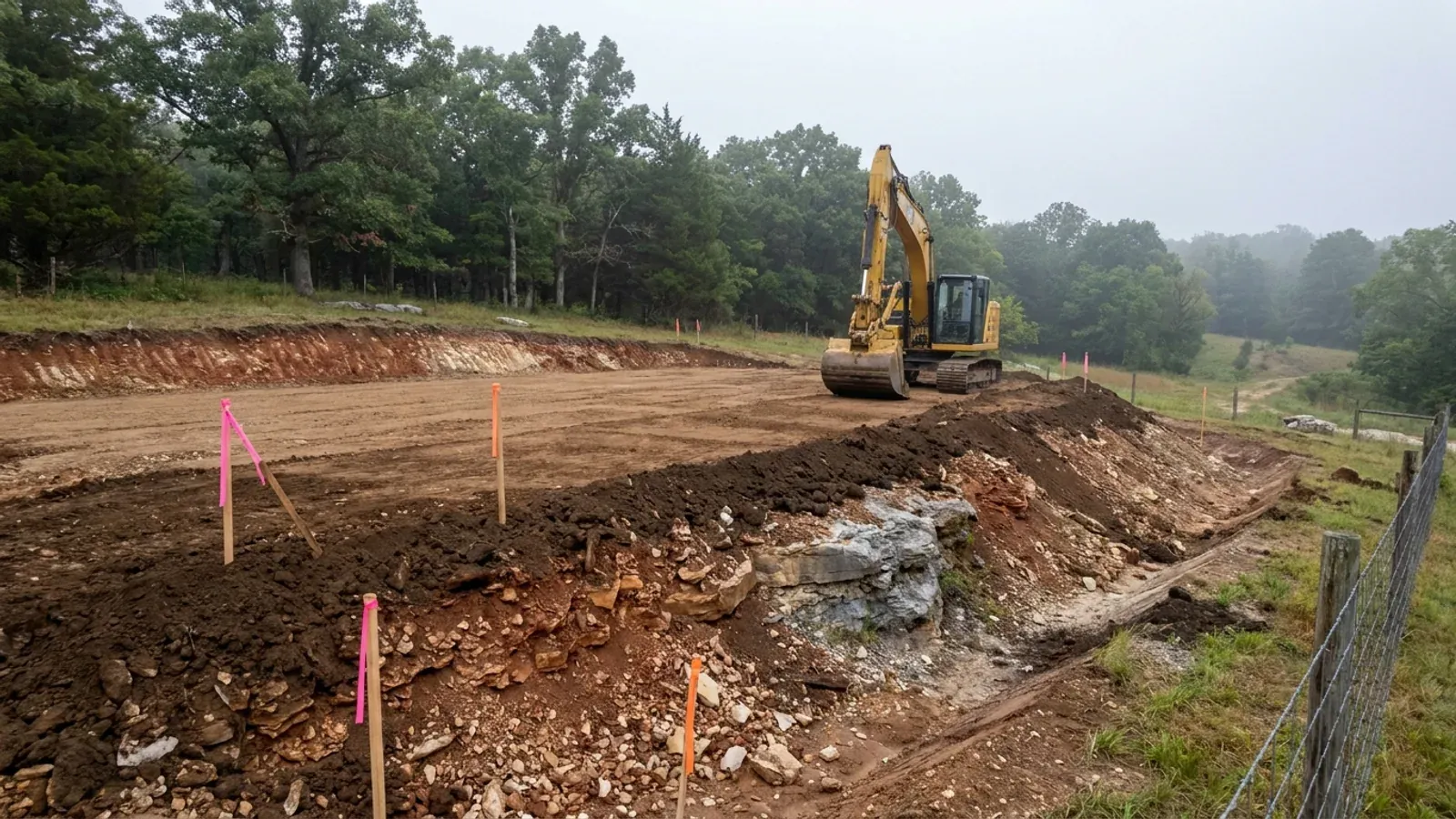
The expensive surprises are in the ground, not the building
What moves a Missouri budget is usually below grade, and which problem you have depends on where in the state you are. Across the Ozarks it is karst: the Department of Natural Resources maps more than sixteen thousand sinkhole points, and what matters there is what is under the slab rather than what the slab sits in. Across the north and centre it is claypan — dense, slow-draining subsoil that perches water above it for months of the year. In the Bootheel it is deep alluvium carrying the highest seismic demand in the state, where the same soils modelled for liquefaction attack post embedment and slab bearing rather than the frame above them. The same ground then decides the septic system, and Missouri does not run that on a percolation test alone: the rule allows a perc test or a soil morphology examination in a profile pit, and the authority reviewing your parcel picks which. Where a drainfield sits near a sinkhole's drainage, perc testing on its own is not permitted at all. Whether that authority is the state or your own county is itself a local question, and it changes what you have to file. So the site work, the foundation and the drainfield get resolved together rather than one at a time. We price the dirt before we price the building.
What we build in Lebanon
All nine services are available in Lebanon. What a build costs depends far more on the parcel than on square footage, so we price against your land rather than publishing a rate card.
Custom Plans
Barndominium floor plans drawn to your parcel and your soil, and to whichever Missouri authority — a county, a city, or none at all — will review them.
Barndominium Kits
Barndominium shell packages delivered to your Missouri land, drawn to the criteria your own county or city publishes — because the state publishes none.
Turnkey Builds
Start to finish barndominium construction in Missouri: the permits that genuinely apply, site work, shell and interior finish, under one contract.
What a build looks like
Three stages every Lebanon project passes through, from a raw parcel to a finished home. Site work first, because that is where the budget is decided.
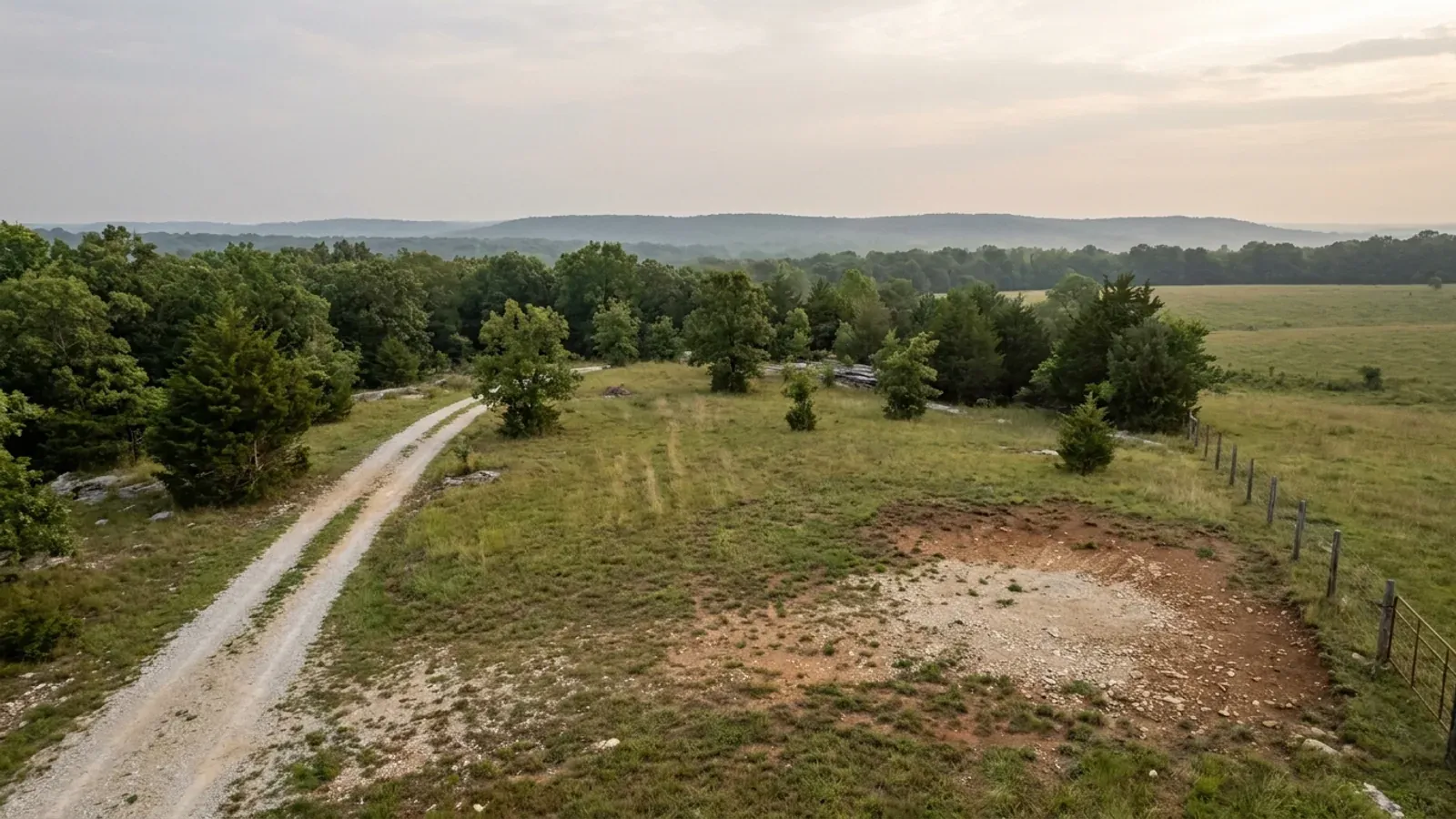
The parcel
Zoning, setbacks, flood zone and utility access get checked before anything is drawn.
Pad and permit
Clearing, grading and a compacted pad, while the submittal works through whichever office issues the permit where you are building.
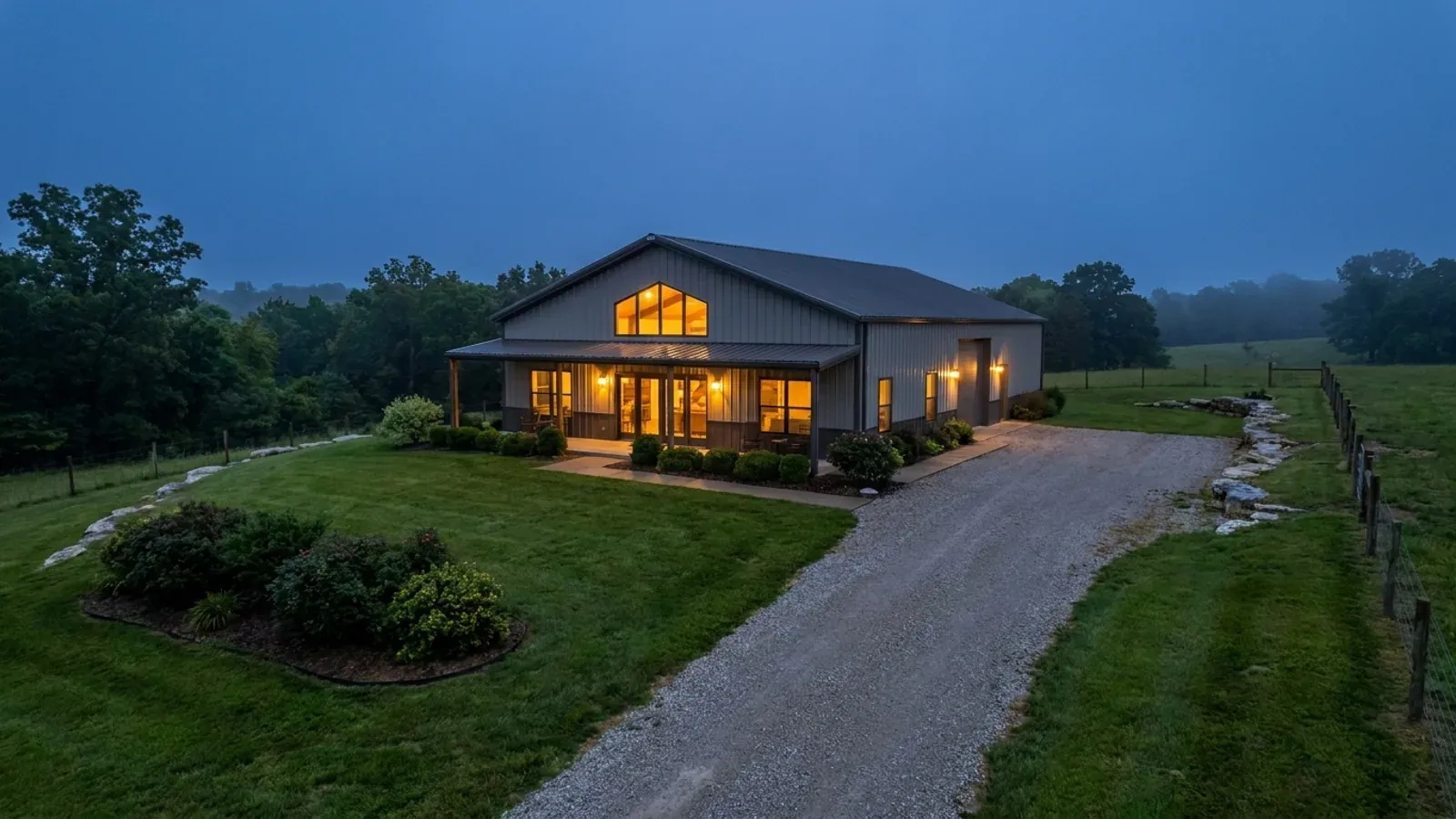
Frame to finish
Shell erected and dried in, then systems, insulation and interior finish through to CO.
Those are the rules where you are building in Lebanon. Tell us what you want to build and we will draw it to them.
Where we build around Lebanon
Laclede County and the rural land around it. The buildable acreage for a project this size usually sits outside the city limits, which is frequently what changes who issues your permit.
Keep reading
The questions that usually come next once you know what Lebanon allows.
Barndominium Cost Guide
Sourced per-square-foot ranges by tier and by size, with a calculator built on the same figures.
Read itIs It Legal in Missouri?
Classification, zoning, the HOA gate, and why "nonresidential farm building" does not cover a home.
Read itHow Long Does It Take?
Census build-duration data, and what actually sets the permit clock where you are building.
Read itNearby areas we build in
Others we cover nearby, and they are not interchangeable. One may be a county with an adopted building code, another a county with no legal authority to have one, another a city that permits inside its own limits whichever county the land sits in. So the office that issues the permit, whether anyone inspects the work at all, the fees, the zoning and the design figures can differ from one card to the next — sometimes across a single property line.
Building in Lebanon: common questions
10 questions we get asked most often about building in Lebanon. If yours is not on the list, ask it directly.
I am buying acreage outside Lebanon. Will anyone inspect my house?
Can I build a post-frame barndominium inside the Lebanon city limits?
How big a shop can I put beside the house?
Are metal siding or metal roofs restricted here?
My land is over three acres. Do I still need a septic permit?
How deep do the footings have to go, and what does the ground do to them?
Could a fire district make me get a permit even though the county cannot?
What does a building permit cost in Lebanon?
Which county am I actually in, and does the answer differ between Springfield and the Lake?
Is my land in a flood zone, and does it matter which town it is near?
Building in Lebanon?
Start with the plan. Tell us what you want to build and we will draw it, then confirm which office issues the permit for your parcel, what it will let you put there, and what wind load it has to meet. That conversation costs nothing.