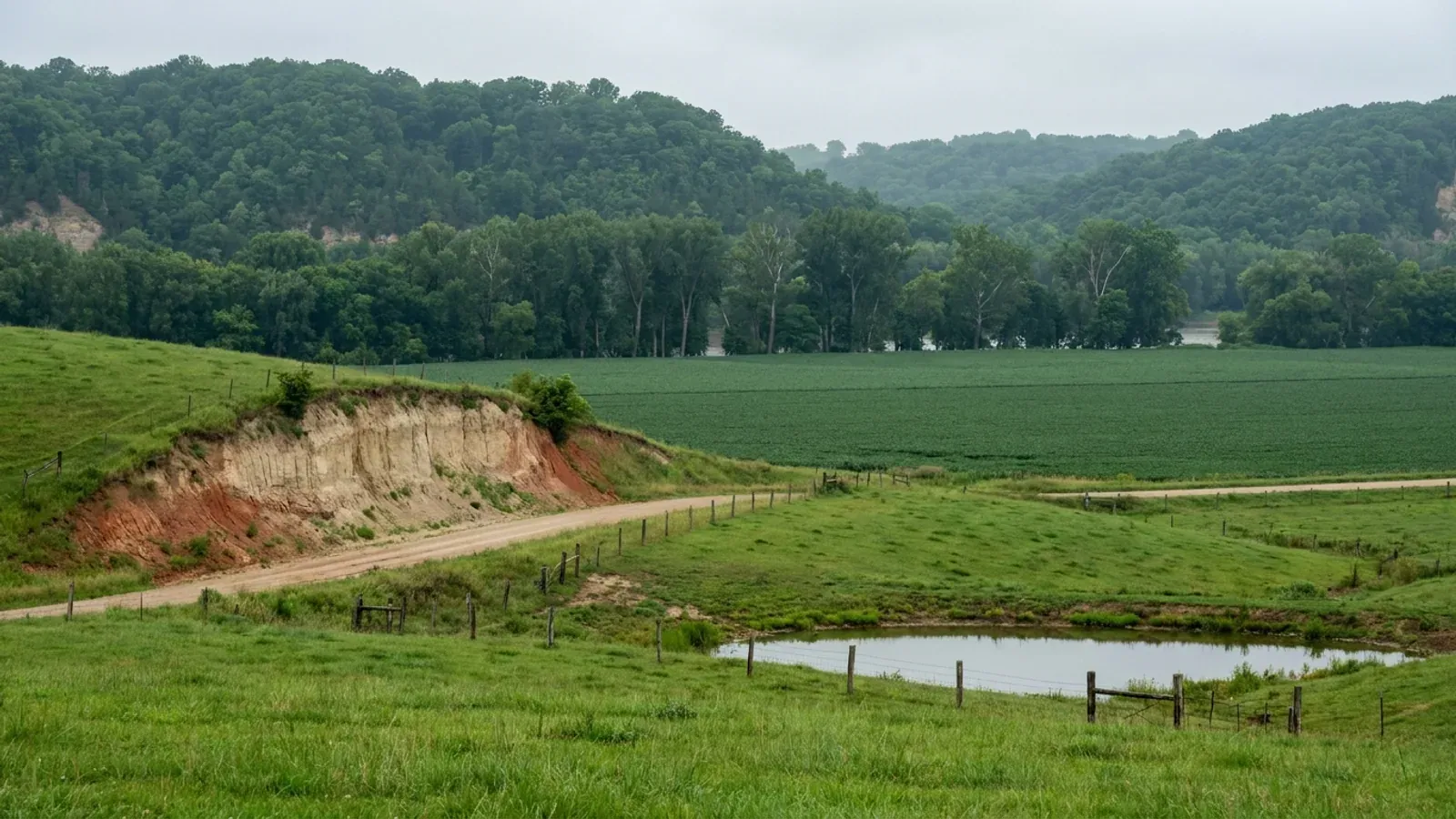
Barndominium Builders in Jefferson City, MO
Jefferson City is the rare mid-sized Missouri place where both the city and its county regulate construction — and they regulate it very differently, which makes the city limit the single most consequential line on a Cole County land search. Inside the limits the City of Jefferson permits and inspects under the 2018 International Residential Code, adopted at City Code section 8-21 by Ordinance No. 16241 on 5 July 2022, with its own filled-in Table R301.2(1): 20 psf ground snow, a 115 mph design wind speed, seismic design category B, severe weathering, a 24-inch frost line, termite moderate to heavy, a 4-degree winter design temperature, ice barrier underlayment required, an air freezing index of 903 and a 55-degree mean annual temperature. Ten minutes outside, in unincorporated Cole County, the county's own Public Works department issues building permits against the 2000 International Building Code, the 2000 International Residential Code, the 2000 International Plumbing Code and the 2002 National Electrical Code — codes the county adopted in 1999 and last refreshed in 2003. Cole County may lawfully have that code because it is a first-classification county under the Missouri Association of Counties list published May 2025, and because it adopted before 28 August 2001, the date RSMo 64.170.2 began requiring a public vote. Callaway County, across the Missouri River, is second classification and publishes no building code and no zoning ordinance at all. The practical differences run the other way from what most buyers expect. Inside the city a detached garage or workshop is capped by Exhibit 35-40A at 2,500 square feet even on parcels over five acres, no more than three accessory buildings are allowed above an acre, their combined footprint may not exceed the lot coverage of the house, and section 35-40.B.3.g forbids a full bathroom or a kitchen in any accessory building that is not a pool house. Unincorporated Cole County has no zoning code at all — its Master Plan of 20 December 2010 discusses county zoning entirely as something the Commission could adopt — so there is no district, no use table and no accessory-building cap out there, only a construction permit, a subdivision plat and a septic permit. Exterior materials are permitted in both places for a site-built house, with one narrow exception: the Capitol Avenue Neighborhood Conservation Overlay District downtown prohibits corrugated metal walls and metal roofing outright. Everywhere else in the city, and everywhere in the county, there is no material or roof-pitch restriction on a house at all.
Jefferson City at a glance
- County
- Cole County
- Population
- 42,564
- ZIP codes
- 65101, 65109
- Site visits
- Same-week site visits across Jefferson City and the Cole County countryside around it — Russellville, Lohman, Centertown, Taos, Wardsville, St. Martins and Brazito to the south and west, and across the river into Holts Summit, New Bloomfield and the Callaway County side. The city limits are the line that matters for scheduling as well as for permitting: a project inside them runs through one building department, and a project ten minutes out runs through a different one with a different code year.
Building conditions in Jefferson City
Missouri sets no residential building code and no statewide way of adopting one, so the first question on any parcel is not what the code says — it is whether there is one. Only counties of the first and second classification may adopt a building code at all, and classification is set by assessed valuation rather than population, so a small county can hold the power while a much larger one does not. Zoning is a separate power with its own answer, granted only after a vote of the people and repealable by another. What changes from one jurisdiction to the next is whether the work is inspected, who issues the permit, what that office charges, how the parcel is zoned, and the design figures your drawings have to satisfy.
City of Jefferson Code of Ordinances section 8-21, Adoption of the 2018 International Residential Code (Ord. No. 15706, § 3, 8-21-2017; Ord. No. 16241, § 3, 7-5-2022), Municode Supplement 22 Update 1, content updated 23 July 2026, codified through Ord. No. 16608 enacted 15 June 2026; and Cole County, Missouri, Building Permits page (colecounty.org/280), listing the 2000 IBC, 2000 IRC, 2000 IPC and 2002 NEC and carrying the public meeting notice for the proposed 2018 code adoption, read 8 September 2026.
City of Jefferson Code of Ordinances section 8-22, Amendments to the 2018 International Residential Code, Table R301.2(1) (Ord. No. 16241, § 4, 7-5-2022), and section 8-19, amendment to International Building Code section 1809.5 (Ord. No. 16241, § 2, 7-5-2022), Municode Supplement 22 Update 1, content updated 23 July 2026; USGS ASCE 7-16 building-codes web service, Risk Category II, Site Class D, at 38.5767 / -92.1735, queried 8 September 2026, returning Ss 0.193 g, S1 0.106 g and seismic design category C.
City of Jefferson Zoning Code section 35-40, Accessory buildings, structures and uses, subsections A, B.1, B.3.b and Exhibit 35-40A, B.3.c and B.3.g (Ord. No. 16466, §§ 4, 5, adopted 22 October 2024), Municode Supplement 22 Update 1, content updated 23 July 2026, read 8 September 2026.
City of Jefferson Zoning Code section 35-34.B.4.h and B.5.a and b, Capitol Avenue Neighborhood Conservation Overlay District (Ord. No. 15647, § 2, adopted 17 April 2017); section 35-34.A, Lower Jefferson Conservation District (Ord. No. 13251, adopted 20 August 2001); section 35-59.F, fencing materials; Article II, District Regulations, sections 35-24 to 35-28; and Exhibit 35-51A, all read on Municode Supplement 22 Update 1, content updated 23 July 2026, on 8 September 2026.
Cole County, Missouri, Rules for Land Subdivision for Development and Construction, 1999, effective 1 September 1999, sections 1.1 (legal authority, RSMo 64.800 to 64.840), 4.7 (construction permit) and the five-acre transfer exemption, published by Cole County Planning; and The Cole County, Missouri, Master Plan, 20 December 2010, sections 14.3.1 and 14.3.2. Both read 8 September 2026. RSMo 64.800 and 64.845 rendered from revisor.mo.gov the same day.
Missouri Department of Health and Senior Services, OWTS Construction Permit Process county selector, health.mo.gov/business-professionals/onsite-wastewater-treatment/owts-construction-permit-process?county=Cole and ?county=Callaway, both queried 8 September 2026; Cole County Onsite Wastewater Ordinance, re-adopted and approved August 2021 (previously readopted 2017), sections 1.7, 3.3, 3.5, 3.6, 3.9, 3.10 and 4.5, published at colecounty.org DocumentCenter, read 8 September 2026; RSMo 701.031 and 701.047.
Also worth knowing before you build in Jefferson City
- The 2019 tornado changed the city's building rules not at all — and the record proves it
- An EF-3 tornado crossed Jefferson City on the night of 22 May 2019. It is reasonable to assume the city tightened its construction rules afterwards, and the ordinance record shows it did not. Ordinance No. 15706, passed 21 August 2017 — twenty-one months before the storm — already carried every design figure the city publishes today, byte for byte: ground snow load 20 psf, wind design speed 115 mph, seismic design category B, weathering severe, frost line depth 24 inches, termite moderate to heavy, winter design temperature 4 degrees, ice barrier underlayment yes, air freezing index 903, mean annual temperature 55 degrees. It also already carried the 200 mph storm-shelter figure, then numbered section 423.5 and reading that the City of Jefferson design wind speed for tornado shelters shall be 200 MPH with reference to design criteria in ICC 500 section 304.2, along with the 2009 energy chapter substitution and the R403.1.3.3 seismic deletion. When the city moved from the 2015 codes to the 2018 codes by Ordinance No. 16241 on 5 July 2022, every one of those provisions carried across unchanged; only the section number of the shelter amendment moved, from 423.5 to 423.2. Two things follow for a buyer. There is no post-tornado storm-shelter mandate on a house here — the 200 mph figure sits in the International Building Code amendments, which reach assembly, educational and similar occupancies, not detached one- and two-family dwellings. And if you want a safe room, 200 mph is the number the city's own code names for one.
- A fire district cannot run a building department here, and the local one does not try
- Missouri lets a fire protection district board adopt fire ordinances whose standards may be industrial codes adopted by nationally organised and recognised trade bodies, and in a handful of Missouri counties a district has become the effective construction authority on the ground. Cole County is not one of them, and the reason is statutory. RSMo 321.228.2, effective 28 August 2012, provides that where a city, town, village or county adopts or has adopted, implements and enforces a residential construction regulatory system, any fire protection district wholly or partly located within it shall be without power, authority, or privilege to enforce or implement one, and that any such system adopted by a district or its board shall be treated as advisory only. Section 321.228.1(2) defines a residential construction regulatory system broadly enough to include any permitting or inspection programme and the whole or any part of a nationally recognised model code. Both halves of Cole County are covered: the City of Jefferson runs one inside its limits, and Cole County runs one outside them. Districts keep three things regardless — final regulatory authority over the location and specification of fire hydrants, hydrant flow rates and fire lanes; permission to inspect the alteration, enlargement, replacement or repair of a detached one- or two-family dwelling, though not new construction; and a bar on charging a fee for either. The Cole County Fire Protection District, whose administration building is at 5206 Monticello Road, publishes no building or residential code and no permit programme on its own site. Ask by name which district covers your address before you assume the same of the others.
- No claypan on this side of the river — but a brittle layer right where the footing goes
- Central Missouri has a claypan reputation, and it is earned north of the Missouri River rather than south of it. A query of the USDA-NRCS Soil Data Access service for the two survey areas either side of Jefferson City returns none of the five recognised Central Claypan series — Mexico, Putnam, Adco, Leonard or Armstrong — as a major map-unit component anywhere in Cole County. Callaway County, across the river, carries about 83,000 acres of them, roughly fifteen percent of its survey area, with Mexico alone on about 64,600 acres. Cole County's ground is the Ozark border instead: Wrengart is the most extensive soil in the county at about 43,500 acres, followed by Gravois, Gatewood, Gunlock and Moko. What Wrengart does is the design story. Its official series description classes it as a Fragic Oxyaquic Hapludalf, formed in loess and residuum from cherty limestone, and states that the depth to the top of a brittle horizon is 20 to 44 inches and that in undisturbed areas a perched water table has an upper limit of 2 to 3.5 feet from January to April in most years. Both of those land at or just below the city's 24-inch frost line. Across the whole county a fragipan is mapped on about 30,500 acres and some restriction of any kind sits within 24 inches on about 52,900 acres of the 257,100-acre survey area — call it a fifth of it. Shallow rock is the smaller worry: bedrock within about 20 inches covers roughly six percent. The practical move is the same either way, and it is cheap: pull the parcel's map units on Web Soil Survey before the foundation is designed.
- Nine sinkholes in Cole County, against 438 one county north
- Karst is a real constraint on a Missouri build — it changes where a drainfield may go, and 19 CSR 20-3.060 bars a percolation-only evaluation where there is significant groundwater contamination potential, which the rule defines to include a drainfield within 100 feet of a sinkhole's drainage. It is not much of a constraint here. A spatial query of the Missouri Department of Natural Resources' own published sinkhole layer returns nine mapped sinkhole points inside Cole County and seven inside Callaway County. The same query run against Boone County, immediately north, returns 438 — consistent with the figure Boone County publishes for itself. Jefferson City sits on the Ozark border rather than in the karst plateau, and the difference is roughly fiftyfold across a single county line. That does not make a soil evaluation optional: Cole County's own wastewater ordinance requires soil morphology on every new system and does not accept a percolation test at all. But it does mean that the sinkhole-driven engineering requirements that shape wastewater design in some Missouri counties are not the normal case on a Cole County tract.
- Across the river, Callaway County publishes no building code and no zoning at all
- Callaway County is where a great deal of Jefferson City's acreage search ends up — 834.6 square miles of it, 54.1 percent in farms at a 227-acre average, with Holts Summit fifteen minutes from the Capitol. It is a second-classification county, which under RSMo 64.170.1 is one of the two classes empowered to adopt a county building code. It has not. The county's own published index of ordinances, policies and resolutions runs to more than thirty instruments — a 911 addressing ordinance, food and lodging ordinances, a purchasing policy, dust control, hazard mitigation, floodplain management ordinance number 44CFR-21 and flood damage prevention resolutions — and contains no building code, no zoning ordinance and no subdivision regulation. The county's departments index lists Assessor, Auditor, Circuit Clerk, Collector, Commission, GIS, County Clerk, Human Resources, Public Administrator, Purchasing, Recorder, Road and Bridge, Treasurer, Emergency Services and Health Department, with no planning, zoning or building department among them. Two gates still operate on the Callaway side: the floodplain development permit, since the county participates in the National Flood Insurance Program, and the septic construction permit, which the state lists as an Ordinance authority administered by the Callaway County Commission at 4950 County Road 304 in Fulton. Under RSMo 64.170.2 a county that had no building code before 28 August 2001 needs voter approval before it can create one, and under 64.170.3 only voters in the unincorporated area affected may cast that vote.
- Every contractor working in the city needs a local licence — including you, unless you live there
- There is no state-level general contractor licence in Missouri to hold, so the question is always local, and Jefferson City's answer is specific. The city states that all contractors performing work in Jefferson City must have a local licence. Electrical and plumbing contractors and their employees obtain specific trade licences directly from the Building Regulations Division before beginning any project within the city limits, under the boards and procedures written into City Code section 8-3, which continues a Board of Electrical Examiners and Review and sets qualifications for the Electrical Inspector. All other contractors are directed to the Business License Division for a business licence. Homeowners may perform work on the home they reside in without a licence, but still have to obtain a building permit and inspections unless the work is on the city's short exempt list — receptacle, single-pole switch, 110-volt light fixture, ceiling fan, furnace motor, electric water-heating element, smoke detector and stove element replacement on the electrical side; faucet, toilet tank fixture and bathroom stool replacement and drain unclogging on the plumbing side. One statutory point catches larger projects: RSMo 327.101 requires plans sealed by a Missouri-licensed architect or professional engineer for commercial buildings, which Cole County's own permits page notes includes any structure intended for residential use containing more than two dwelling units. A single-family barndominium is below that line.
- 927 farms, 143,831 acres, and a 155-acre average — 57 percent of the county
- Cole County is small by Missouri standards at about 391 square miles of land, and most of it is farmed. The 2022 Census of Agriculture counted 927 farms working 143,831 acres at an average size of 155 acres — roughly 57 percent of the county's land area. The breakdown of that acreage is useful when you are picturing what a tract actually looks like: 52,460 acres of cropland, 46,204 acres of pastureland, 37,656 acres of woodland and 7,511 acres of other land, which sums exactly to the total. Woodland at better than a quarter of all farmland is the Ozark border showing through, and it is why so many Cole County tracts have a wooded back half and a cleared building site near the road. The 155-acre average is a good deal smaller than Callaway's 227 across the river, which is a fair proxy for the fact that Cole parcels come to market in smaller pieces and closer to town.
- Two counties, one city, and fourteen people on the wrong side of the river
- Jefferson City is legally a two-county city and functionally a one-county city. The Census Bureau's Vintage 2024 subcounty estimates put the whole place at 42,564 residents, of whom 42,550 live in the Cole County portion and 14 live in the Callaway County portion. That matters less for demographics than for permitting: the city's building code and zoning follow the city limits, not the county line, so both parts are permitted the same way by the same department. The reverse is also true, and it is the more useful half — Cole County's building code and Callaway County's absence of one both stop at the city limit, because a county code adopted under RSMo 64.170 reaches only unincorporated territory. So there are three distinct construction regimes within a few miles of the Capitol: the city, unincorporated Cole County, and unincorporated Callaway County. Which one applies is decided by a line on a map, and the city publishes that map. Basic site information including zoning district and setbacks is available on MidMOGIS, which the city's own residential new construction guidance points buyers to along with stormwater, sewer, topography, plat and fire data.
City of Jefferson Ordinance No. 15706 (Bill 2017-47), adopting the 2015 International Building and Residential Codes, passed and approved 21 August 2017, signed by the Presiding Officer and Mayor Carrie Tergin and attested by the City Clerk, published at jeffersoncitymo.gov; compared line by line against City Code sections 8-19 and 8-22 as codified in Municode Supplement 22 Update 1, content updated 23 July 2026. Both read 8 September 2026.
RSMo 321.228, effective 28 August 2012 (L. 2012 H.B. 1647 merged with S.B. 769), rendered from revisor.mo.gov 8 September 2026; RSMo 321.220(12); Cole County Fire Protection District site (ccfpd.net), full navigation and Public Notices page read 8 September 2026, carrying no code adoption, permit or plan-review material.
USDA-NRCS Soil Data Access tabular service (SDMDataAccess.sc.egov.usda.gov), survey areas MO051 Cole County and MO027 Callaway County, both with a 2 September 2025 refresh date; queries for claypan series as major components, component acreage and corestrictions run 8 September 2026. USDA-NRCS Official Series Description, WRENGART series (soilseries.sc.egov.usda.gov), Taxonomic Class, Range in Characteristics, Drainage and Permeability and Geographic Setting, read 8 September 2026.
Missouri Department of Natural Resources / Missouri Office of Geospatial Information sinkhole layer, gis.dnr.mo.gov/host/rest/services/geology/sinkholes/MapServer layer 1 (SINKHOLES), queried 8 September 2026 against US Census Bureau TIGERweb county boundaries for Cole (29051), Callaway (29027) and Boone (29019); 19 CSR 20-3.060(2)(D).
Callaway County, Missouri, official website: Ordinances, Policies and Resolutions index (callawaycounty.org/commission/ordinances-and-policies/) and departments index, both read 8 September 2026; Missouri Association of Counties, Missouri Counties by Classification, published May 2025, CLASS 2 (TOTAL 3); RSMo 64.170, effective 28 August 2008, rendered from revisor.mo.gov 8 September 2026; USDA NASS 2022 Census of Agriculture county profile figures for Callaway County as recorded in this project's statewide geography file.
City of Jefferson, Building Regulations — Contractor Licensing page (jeffersoncitymo.gov/government/building_regulations/contractor_licensing/), read 8 September 2026; City of Jefferson Code of Ordinances section 8-3, Amendments to NFPA 70 National Electrical Code 2017 Edition, sections 80.15 to 80.22; Cole County, Missouri, Building Permits page citing RSMo 327.101, read 8 September 2026.
USDA National Agricultural Statistics Service, 2022 Census of Agriculture, Cole County, Missouri county profile (cp29051), Total and Per Farm Overview and Land in Farms by Use, downloaded 8 September 2026; land area from US Census Bureau TIGERweb, Cole County AREALAND 1,014,332,664 square metres. Callaway County average farm size from the 2022 Census of Agriculture as recorded in this project's statewide geography file.
US Census Bureau, Vintage 2024 Subcounty Resident Population Estimates, file sub-est2024_29.csv, records SUMLEV 162 (Jefferson City city, 42,564) and SUMLEV 157 for county parts 29051 (42,550) and 29027 (14), downloaded 8 September 2026; RSMo 64.180.3; City of Jefferson, Building Regulations, Residential — New Construction page, read 8 September 2026.
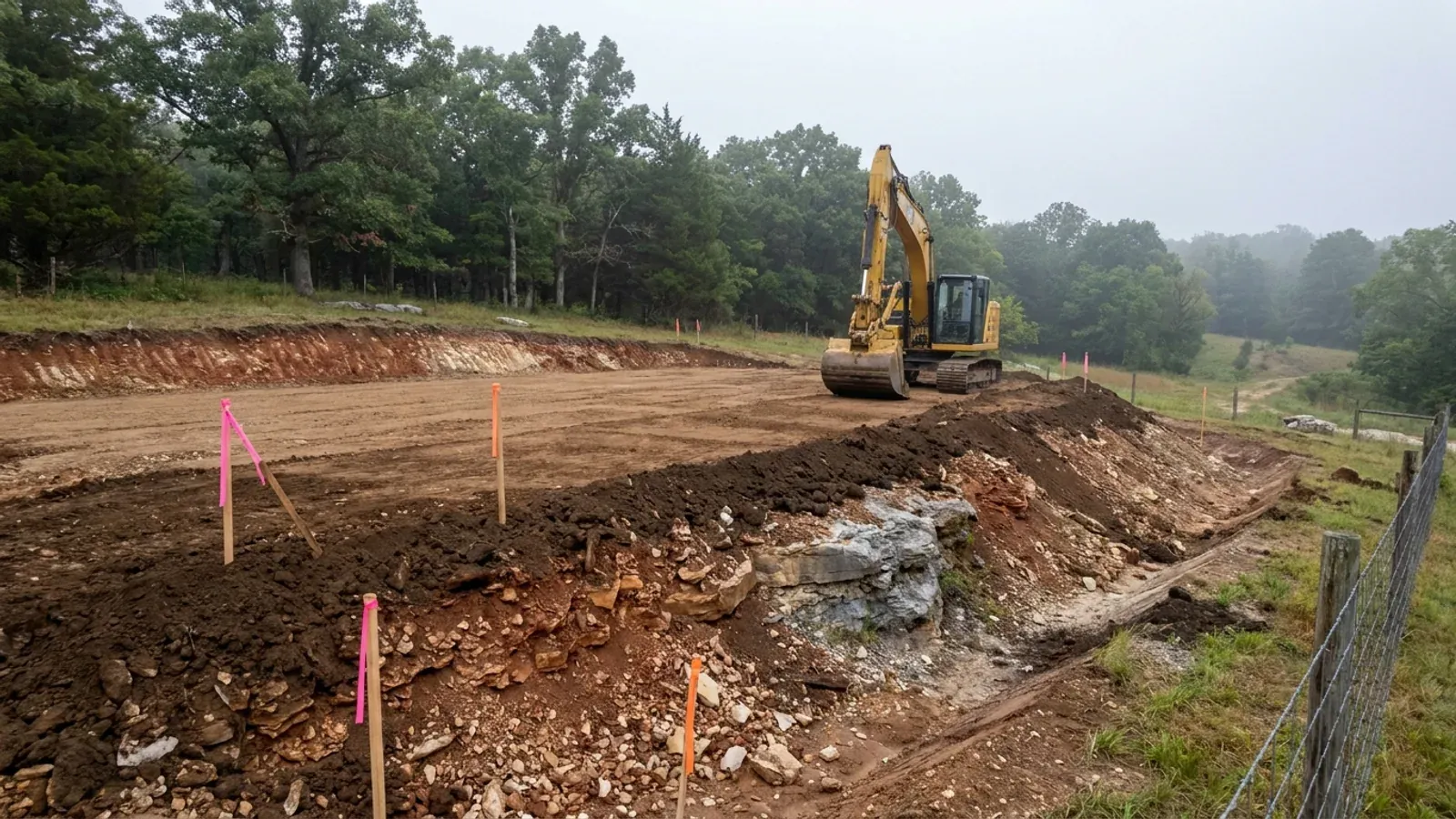
The expensive surprises are in the ground, not the building
What moves a Missouri budget is usually below grade, and which problem you have depends on where in the state you are. Across the Ozarks it is karst: the Department of Natural Resources maps more than sixteen thousand sinkhole points, and what matters there is what is under the slab rather than what the slab sits in. Across the north and centre it is claypan — dense, slow-draining subsoil that perches water above it for months of the year. In the Bootheel it is deep alluvium carrying the highest seismic demand in the state, where the same soils modelled for liquefaction attack post embedment and slab bearing rather than the frame above them. The same ground then decides the septic system, and Missouri does not run that on a percolation test alone: the rule allows a perc test or a soil morphology examination in a profile pit, and the authority reviewing your parcel picks which. Where a drainfield sits near a sinkhole's drainage, perc testing on its own is not permitted at all. Whether that authority is the state or your own county is itself a local question, and it changes what you have to file. So the site work, the foundation and the drainfield get resolved together rather than one at a time. We price the dirt before we price the building.
What we build in Jefferson City
All nine services are available in Jefferson City. What a build costs depends far more on the parcel than on square footage, so we price against your land rather than publishing a rate card.
Custom Plans
Barndominium floor plans drawn to your parcel and your soil, and to whichever Missouri authority — a county, a city, or none at all — will review them.
Barndominium Kits
Barndominium shell packages delivered to your Missouri land, drawn to the criteria your own county or city publishes — because the state publishes none.
Turnkey Builds
Start to finish barndominium construction in Missouri: the permits that genuinely apply, site work, shell and interior finish, under one contract.
What a build looks like
Three stages every Jefferson City project passes through, from a raw parcel to a finished home. Site work first, because that is where the budget is decided.
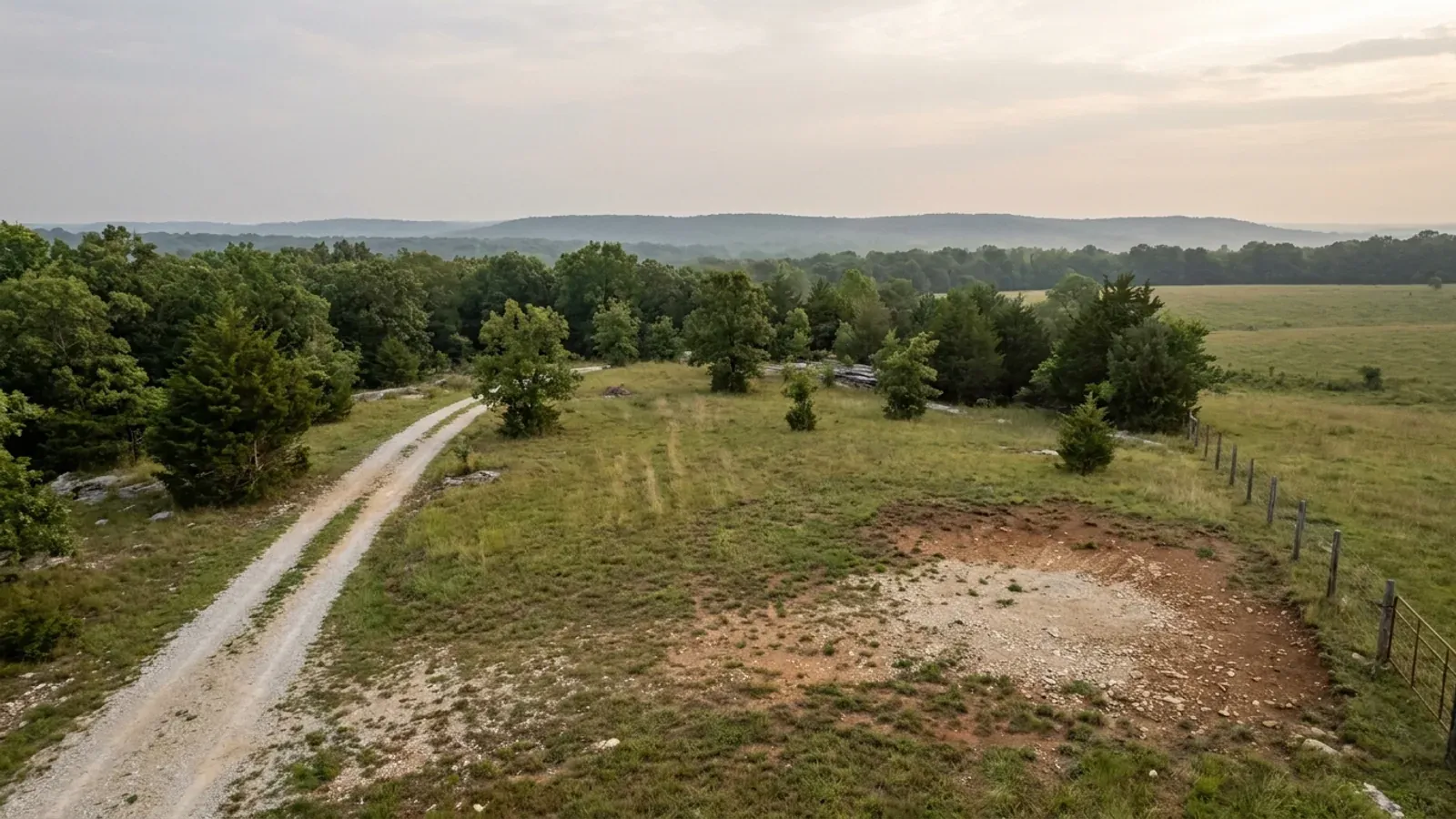
The parcel
Zoning, setbacks, flood zone and utility access get checked before anything is drawn.
Pad and permit
Clearing, grading and a compacted pad, while the submittal works through whichever office issues the permit where you are building.
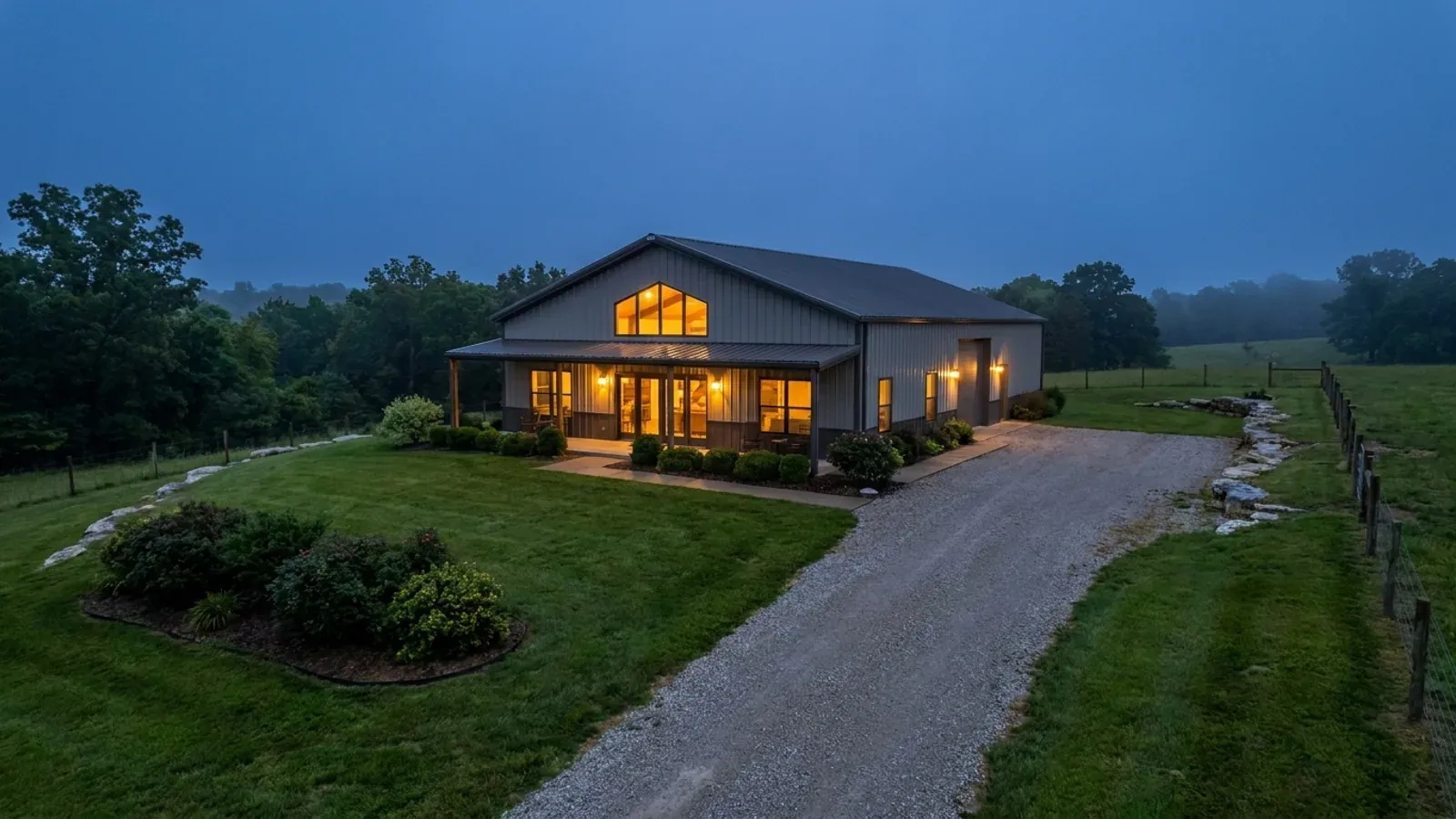
Frame to finish
Shell erected and dried in, then systems, insulation and interior finish through to CO.
Those are the rules where you are building in Jefferson City. Tell us what you want to build and we will draw it to them.
Where we build around Jefferson City
Cole County and the rural land around it. The buildable acreage for a project this size usually sits outside the city limits, which is frequently what changes who issues your permit.
Keep reading
The questions that usually come next once you know what Jefferson City allows.
Barndominium Cost Guide
Sourced per-square-foot ranges by tier and by size, with a calculator built on the same figures.
Read itIs It Legal in Missouri?
Classification, zoning, the HOA gate, and why "nonresidential farm building" does not cover a home.
Read itHow Long Does It Take?
Census build-duration data, and what actually sets the permit clock where you are building.
Read itNearby areas we build in
Others we cover nearby, and they are not interchangeable. One may be a county with an adopted building code, another a county with no legal authority to have one, another a city that permits inside its own limits whichever county the land sits in. So the office that issues the permit, whether anyone inspects the work at all, the fees, the zoning and the design figures can differ from one card to the next — sometimes across a single property line.
Building in Jefferson City: common questions
8 questions we get asked most often about building in Jefferson City. If yours is not on the list, ask it directly.
Which building code will my barndominium be built to near Jefferson City?
Can I build a shop that is bigger than the house?
Is metal siding or a metal roof allowed?
My tract is over three acres — do I still need a septic permit?
Does anyone inspect the building if I go outside the city limits?
How deep do the footings have to go, and what should the slab account for?
Did the 2019 tornado change the building rules in Jefferson City?
Do I need a licensed contractor, and can I do the work myself?
Building in Jefferson City?
Start with the plan. Tell us what you want to build and we will draw it, then confirm which office issues the permit for your parcel, what it will let you put there, and what wind load it has to meet. That conversation costs nothing.