Barndominium Builders in Callaway County, MO
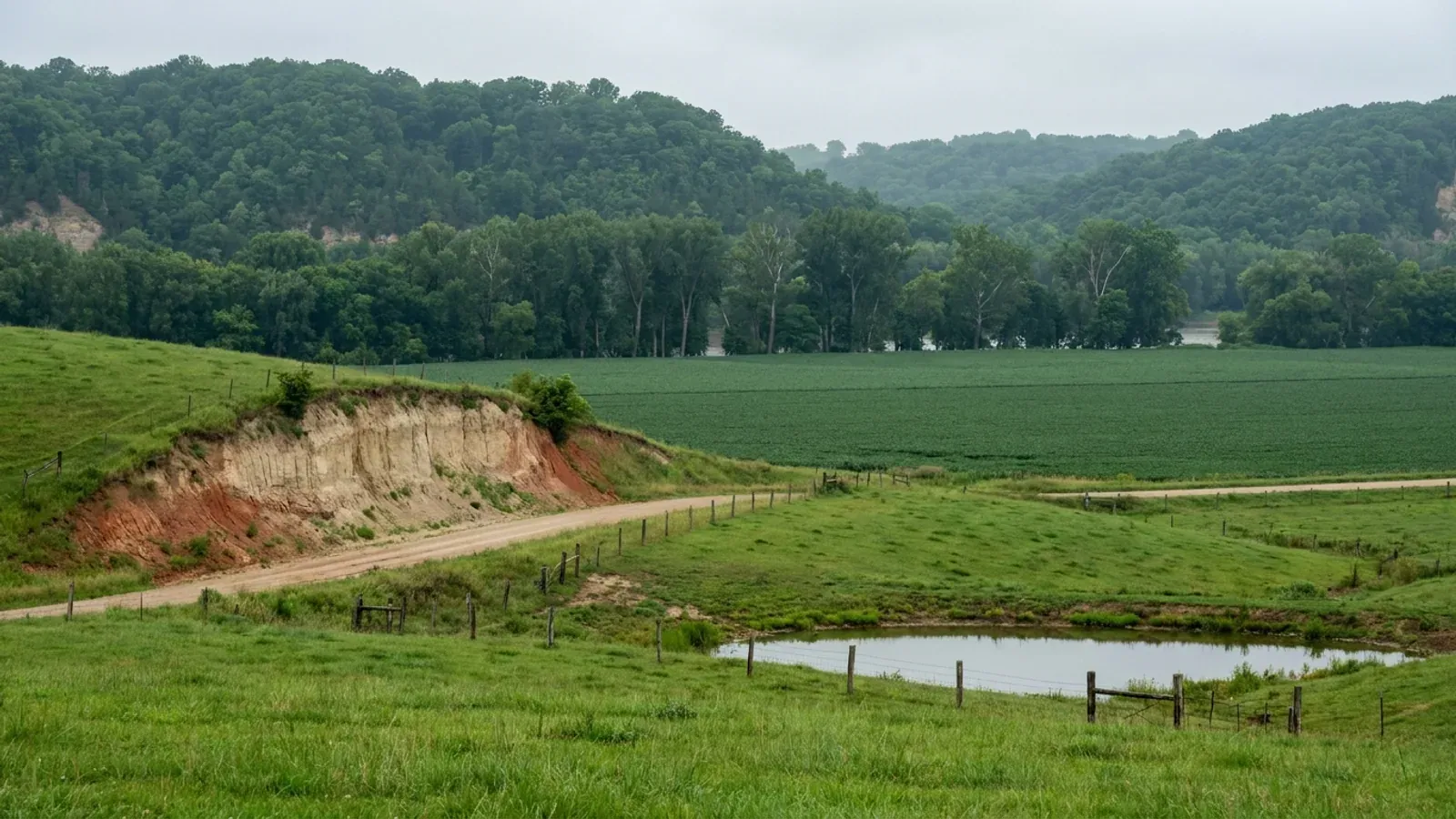
Callaway County is the land bank north of the Missouri River from Jefferson City, and it answers the building-code question in a way almost nobody publishes. It is one of only three second-classification counties in Missouri on the Missouri Association of Counties list published May 2025, which means RSMo 64.170 empowers it to adopt a building code — and it has not. The County Commission publishes a signed letter, reissued every year and current for 2026, that says in eleven words what a land buyer most wants to know: Callaway County has not adopted planning or zoning, and no occupancy permits or building permits are required in unincorporated areas. That is not the same as saying nothing is inspected. The letter names three offices instead of a building department, and between them they are the real gate. The Callaway County Sewer District — organised by countywide vote in August 2018 and now the contact point for on-site septic permitting — administers a county sewage ordinance under which no new construction may be occupied until the sewer system has passed a final inspection, and under which the sewer permit form is the document that produces your 911 address. The county's floodplain administrator answers for anything in a mapped flood hazard area. Road and Bridge issues the right-of-way access permit without which no driveway entrance may be built onto a county road. Inside the cities the answer changes again and it changes twice: Fulton permits and inspects under the 2015 International Residential Code adopted by Ordinance No. 1439-17, and Holts Summit under the 2012 International Residential Code adopted by Ordinance No. 2654 — two editions, twelve miles apart, in one county, and neither of them fills in Table R301.2(1) with a local wind speed, snow load or frost depth. The ground is the other half of the story. The Missouri River is a soil boundary as well as a county line: Callaway carries about 83,074 acres of claypan soils where Cole County, across the water, carries none, and just over half the county's map units are rated somewhat poorly drained or worse. On that ground the foundation conversation starts with water that sits on top of a dense subsoil for months, not with rock.
Callaway County at a glance
- County
- Callaway County
- Population
- 45,126
- ZIP codes
- 65251, 65043, 65231, 65063, 65262, 65059, 65067, 65077, 65080, 63388
- Site visits
- Same-week site visits across Callaway County — Fulton, Holts Summit, New Bloomfield, Auxvasse, Kingdom City, Millersburg, Williamsburg, Mokane, Tebbetts, Steedman and Portland, and the section roads between them. The line that matters here is not a county line but a city limit: 25,736 of the county's 45,126 residents live outside every incorporated place, and that is where the ground rules change completely.
Building conditions in Callaway County
Missouri sets no residential building code and no statewide way of adopting one, so the first question on any parcel is not what the code says — it is whether there is one. Only counties of the first and second classification may adopt a building code at all, and classification is set by assessed valuation rather than population, so a small county can hold the power while a much larger one does not. Zoning is a separate power with its own answer, granted only after a vote of the people and repealable by another. What changes from one jurisdiction to the next is whether the work is inspected, who issues the permit, what that office charges, how the parcel is zoned, and the design figures your drawings have to satisfy.
RSMo 64.170 (effective 28 Aug 2008), RSMo 64.205 (effective 28 Aug 1963) and RSMo 48.020 (effective 28 Aug 2026), rendered from revisor.mo.gov and read 8 Sep 2026; Missouri Association of Counties, 'Missouri Counties by Classification', published May 2025, mocounties.com/s/Missouri-Counties-by-Classification-2025.pdf, downloaded and text-extracted 8 Sep 2026 — CLASS 2 (TOTAL 3): Callaway, Lincoln, Newton
Callaway County, Missouri, 'Callaway County Planning and Zoning Information', callawaycounty.org/commission/callaway-county-planning-and-zoning-information/, read 8 Sep 2026, with the signed 2026 letter posted at /wp-content/uploads/2026/03/Planning-and-Zoning-Information-2026.pdf; corroborated by the county's 'Ordinances, Policies, and Resolutions' index, callawaycounty.org/commission/ordinances-and-policies/, read 8 Sep 2026, which lists 30 instruments and no building code and no zoning ordinance
Missouri Department of Health and Senior Services, OWTS Construction Permit Process county selector, health.mo.gov/business-professionals/onsite-wastewater-treatment/owts-construction-permit-process?county=Callaway, read 8 Sep 2026 — Agency: Callaway County Commission; Authority Type: Ordinance; Callaway County Sewer Ordinance §§ 701.031, 701.043 and 701.046, effective 1 March 2006 and revised 15 November 2011, as posted by the Callaway County Sewer District at callawaysewer.org (both the 'Revised sewer ordinance 2025' and 'Revised Sewer ordinance – Sewer District Authority' copies), read 8 Sep 2026; Callaway County Sewer District, 'On-site Single Home', 'About Us' and 'FAQs' pages, read 8 Sep 2026
USDA-NRCS Soil Data Access (SDMDataAccess.sc.egov.usda.gov/Tabular/post.rest), queried 8 Sep 2026 for survey areas MO027 (Callaway) and MO051 (Cole), joining legend → mapunit → component on majcompflag = 'Yes'; USDA-NRCS Official Series Descriptions for MEXICO and KESWICK, soilseries.sc.egov.usda.gov/OSD_Docs/M/MEXICO.html and /K/KESWICK.html, rendered and read 8 Sep 2026; drainage-class acreages from the muaggatt table for MO027, same query session
Fulton, Missouri, Code of Ordinances ch. 18 arts. II–X, §§ 18-31, 18-45, 18-56, 18-81, 18-106, 18-131, 18-133, 18-156, 18-158, 18-166 and 18-176 (Ord. No. 1439-17, 8-8-17; as amended by Ord. Nos. 1468-18, 1477-18 and 1516-19), Municode Supplement 33, online content updated 27 March 2026, codified through Ordinance No. 1703-25 enacted 18 November 2025, read 8 Sep 2026 and § 18-158 re-read after independent re-navigation the same day; Holts Summit, Missouri, Code of Ordinances § 10-1 (Ord. No. 2654, §§ 2—5, 5-11-2017), Municode Supplement 14, online content updated 28 July 2026, codified through Ordinance No. 2891 enacted 9 December 2025, read 8 Sep 2026
Fulton, Missouri, Code of Ordinances §§ 120-31(f) and 120-111 including Table 4, Graduated Increase in Accessory Structure Size (Ord. No. 1583-22, § 1(Att.), 4-26-22), Municode Supplement 33, codified through Ordinance No. 1703-25 enacted 18 November 2025, read 8 Sep 2026 and re-read after independent re-navigation to § 120-111 the same day
Also worth knowing before you build in Callaway County
- Exterior materials, roof pitch and floor area: what the codes here actually say
- Fulton's zoning chapter contains no restriction on exterior wall or roof materials, no minimum roof pitch for a dwelling, no minimum eave projection, no architectural or design review of a single-family house, and no minimum dwelling floor area — its R-1 district table sets a 7,000-square-foot lot, 65 feet of frontage, 25-10-25 setbacks, a 35-foot height limit and one principal building per lot, and nothing about appearance. The only roof-pitch figure in the chapter is a 3:12 threshold in the solar-array access provisions, and the only mention of architectural character is in the supplemental data required for a planned unit development site plan. Holts Summit is different in kind rather than in degree: § 48-401, 'Exterior appearances', requires that 'the exterior appearance of all buildings shall be in reasonable conformance with the exterior appearance of other structures in the immediate vicinity' — a compatibility test that names no material, no pitch and no eave, but that does reach every building in every district. Auxvasse's zoning does carry a 3:12 minimum pitch and a materials list, but only inside its definition of a 'prefabricated home', and that definition expressly includes steel siding as an acceptable exterior. None of these reaches unincorporated ground.
- Fire districts here are fire districts, not building departments
- RSMo 321.220(12) lets a fire protection district board adopt ordinances whose standards may be 'industrial codes adopted by nationally organized and recognized trade bodies', which in some Missouri counties has made a district the only construction authority on the ground. It has not happened here. Holts Summit Fire Protection District, North Callaway Fire Protection District and South Callaway Fire Protection District each publish a full public site and none of them names an adopted building, residential or fire code, a permit programme or a plan review; two of the three state plainly that they have no burning regulations either. Two things are worth knowing alongside that. RSMo 321.228, effective 28 August 2012, provides that where a city or county adopts, implements and enforces a residential construction regulatory system, fire districts inside it are 'without power, authority, or privilege' to run one — so inside Fulton and Holts Summit, which both do, a district could not take that role even if it wanted to. And RSMo 321.220(12) itself bars a district from imposing regulations or requiring permits 'with respect to the erection, maintenance, repair, alteration, or extension of farm buildings or farm structures', which is a carve-out for farm buildings and not for a dwelling.
- The Callaway Energy Center does not reach your house
- The county's nuclear station sits at the centre of a 10-mile plume exposure pathway emergency planning zone and a 50-mile ingestion exposure pathway zone, as the State Emergency Management Agency defines them. Both are emergency-preparedness constructs: they create planning, notification and public-information duties for government and the operator, and they produce sirens, alert-radio arrangements and the county's Smart911 notification system for residents. They are not a land-use instrument. Nothing in the county's complete published index of ordinances, policies and resolutions, nothing in the Commission's signed planning-and-zoning letter, and nothing in the Fulton or Holts Summit building or zoning chapters attaches any siting rule, setback, design requirement, disclosure duty or permit to a parcel's position inside either zone. Stated plainly because it is the kind of thing a buyer worries about and nobody answers: for the purpose of building a house on land in Callaway County, the plant changes nothing about what you may build or what approvals you need.
- A stormwater permit exists on the Holts Summit side and nowhere else in the county
- Because the unincorporated ground around Holts Summit and Jefferson City is dense enough to fall inside the Census-defined Jefferson City Urban Area, that part of Callaway County is a regulated municipal separate storm sewer system and holds a state operating permit. The county adopted MS4 Stormwater Regulations on 15 October 2024 under RSMo 64.907 — a statute that authorises any county subject to the federal stormwater rules to regulate, with no reference to county classification at all. Inside the mapped area a land disturbance permit is required before disturbing more than one acre, and separately before grading more than 3,000 square feet or using motorised equipment in or near a sinkhole, losing stream, cave, spring, wetland or other sensitive feature, with a stated minimum initial fee of $300. The same regulations set a construction restriction that reads like zoning and is not: no house, building or other structure may be built within 60 feet of the ordinary high-water mark of a watercourse or other drainage facility, or with openings below one foot above the 1% annual chance flood elevation. Projects exclusively agricultural or silvicultural are exempt, and individual lots in a new subdivision are treated as part of the subdivision rather than as separate projects.
- You need a permit for the driveway even though you need none for the house
- Callaway County maintains 820 miles of road, and its Policies and Specifications for Road Construction and Acceptance require a Right of Way Access Permit from the Road and Bridge Department before constructing any driveway entrance, temporary or permanent, onto a county-maintained road. The location must be approved before construction. The department sets the pipe diameter and final location; the minimum culvert is 15 inches in diameter and 24 feet long, a culvert longer than 30 feet steps up one pipe size, nothing longer than 50 feet goes in without prior approval, and all driveway culverts must be annular riveted corrugated metal pipe with at least Aluminized Type 2 coating or HDPE — 'no galvanized pipes will be allowed'. The owner buys the pipe; the county installs it and covers it with one load of rock. Where the entrance is onto a state route instead, the Missouri Department of Transportation requires its own permit to work on its right of way for construction of a driveway or modification of an existing one, and Callaway sits in MoDOT's Central District. A city entrance is a third answer again.
- New Bloomfield is not in the flood insurance programme
- Callaway County itself joined the National Flood Insurance Program's regular phase on 3 January 1985 and remains a participating community, as do Fulton (15 June 1983), Mokane (18 September 1986), Kingdom City (8 March 2006) and Holts Summit (16 January 2007); the effective flood insurance rate map for all of them dates from 5 September 2012. The City of New Bloomfield does not participate in the NFIP — a status FEMA has recorded, with the sanction that accompanies it, since 2 May 1976. That is a live commercial fact rather than a technicality: flood insurance written through the federal programme is not available in a non-participating community, which is a problem for any lender that requires it on a parcel inside a mapped special flood hazard area there. On the county side of the line the floodplain administrator is the county's emergency management director, and the county carries a Floodplain Management Ordinance and flood damage prevention resolutions in its published index.
- Karst is not the story here — bedrock and bottomland are
- The Missouri Department of Natural Resources sinkhole inventory holds 16,001 records statewide. Seven of them fall inside Callaway County. Cole County across the river has nine; Boone County, one county west, has 438. So the sinkhole checks and setbacks that dominate a build in the karst counties are largely beside the point on this ground. Two other measurements matter more. About 92,689 acres of the county — 17.1 percent — sit in map units whose shallowest bedrock is 20 inches or less, concentrated in the dolomite bluff country along the Missouri River and the Auxvasse and Loutre drainages, where Gasconade soils and mapped rock outcrop together account for roughly 37,000 acres. And about 133,955 acres, a quarter of the county, sit in map units with a seasonal high water table within 30 inches of the surface. Those are two different foundation problems on two different parts of the same county, and which one a parcel has is a question the soil survey answers before anyone digs.
- Most people here already live where there is no code
- The Census Bureau's 2024 population estimates put Callaway County at 45,126, of whom 12,573 are in Fulton, 4,714 in Holts Summit, 1,023 in Auxvasse, 744 in New Bloomfield, 187 in Mokane, 135 in Kingdom City and 14 in the sliver of Jefferson City that crosses the river. That leaves 25,736 people — 57 percent of the county — in the balance of the county, outside every city limit. The agricultural census counts 1,271 farms on 289,024 acres, an average of 227 acres, made up of 142,478 acres of cropland, 65,801 of pasture and 62,830 of woodland; 525 of those farms are between 50 and 179 acres and 308 are between 10 and 49. Land in farms fell 12 percent between 2017 and 2022. This is not a county where acreage has to be hunted for at the edges — it is most of what the county is.
- Auxvasse codifies buildings without adopting a building code
- Not every incorporated place in this county runs a building department, and the difference is worth checking before assuming a city limit means inspections. Auxvasse has a full chapter headed Buildings and Building Regulations, and what is in it is a lead-pipe ban, a demolition permit procedure, a dangerous-buildings article with a building inspector and building commissioner, and a building-numbering article — with no adopted building code, no adopted residential code, and no building permit requirement anywhere in the chapter. Its zoning sets a 6,000-square-foot minimum lot in R-1 with 65 feet of width, limits accessory buildings to 30 percent of a rear yard without capping their floor area, and sets no minimum dwelling floor area. Its whole zoning chapter was re-adopted by Ordinance No. 773-2025 on 17 December 2025.
- This county is close to changing classification, and it would not change the answer
- RSMo 48.020 sets the first classification at an assessed valuation of $900 million and over, the second at $600 million and up to that figure, and directs in subsection 2 that the required valuation for each classification be increased annually by the change in the CPI-U, with the State Tax Commission calculating and publishing the indexed amount. The Commission's 2024 annual report gives Callaway County a total assessed valuation of $1,104,624,464 — $1,066,745,651 locally assessed plus $37,878,813 in centrally assessed companies. Under RSMo 48.030.3 a county may move to the first classification once its valuation qualifies and its governing body elects to change. A reader watching that should know what it would and would not do. It would not create or remove building-code authority, because RSMo 64.170 reaches the first and second classifications alike, and it would not lift the referendum requirement in subsection 2. It is a reason to date any statement about this county's class rather than treat it as permanent.
Fulton, Missouri, Code of Ordinances ch. 120 arts. II and V, read in full 8 Sep 2026 (Municode Supplement 33); Holts Summit, Missouri, Code of Ordinances § 48-401 (Prior Code § 42.700; Ord. No. 2671, § 1(42.700), 5-24-2018), Municode Supplement 14, read 8 Sep 2026; Auxvasse, Missouri, Code of Ordinances ch. 37, definition of 'prefabricated home' (Ord. No. 773-2025, § 1(Add. A), 12-17-2025), Municode Supplement 5, online content updated 25 March 2026, read 8 Sep 2026
RSMo 321.220 (effective 28 Aug 2025) and RSMo 321.228 (effective 28 Aug 2012), rendered from revisor.mo.gov and read 8 Sep 2026; Holts Summit Fire Protection District, hsfpd.org (home, 'What We Do' and 'FAQs' pages), North Callaway Fire Protection District, northcallawayfire.org (home and FAQ), and South Callaway Fire Protection District, southcallawayfire.com (home, service area, officers), all read 8 Sep 2026
Missouri State Emergency Management Agency, 'Emergency Information for Missouri Farmers, Food Processors and Distributors in case of a Radiological Accident at a Nuclear Power Plant', revised 31 August 2022, sema.dps.mo.gov/newspubs/publications/nuclear-power-plant-ag-info.pdf, downloaded and text-extracted 8 Sep 2026; Callaway County 'EOC / 911 Dispatch' page, callawaycounty.org/eoc911/, and 'Ordinances, Policies, and Resolutions' index, both read 8 Sep 2026
Callaway County MS4 Stormwater Regulations, adopted 15 October 2024, articles I(C)–(F) and the land disturbance permit and fee provisions, callawaycounty.org/wp-content/uploads/2024/11/Callaway-County-Adopted-MS4-SW-Regs-2024-10-15.pdf, downloaded and text-extracted 8 Sep 2026; Callaway County Road and Bridge page describing the MS4 area and stormwater management plan, read 8 Sep 2026; RSMo 64.907 (effective 28 Aug 2003), rendered from revisor.mo.gov 8 Sep 2026
Callaway County, Missouri, Policies & Specifications for Road Construction & Acceptance, § 2.9 Construction Permits and § 2.8.2, with Appendix B 'Driveway Locations and Culverts' §§ 1.1–1.5, posted at callawaycounty.org/road-and-bridge/ (Section 02 and Section 07 files, February 2026 postings; Appendix C accepted 24 July 2025), downloaded and text-extracted 8 Sep 2026; Missouri Department of Transportation, 'Permits', modot.org/permits, read 8 Sep 2026
FEMA OpenFEMA NFIP Community Status Book API (fema.gov/api/open/v1/NfipCommunityStatusBook), queried 8 Sep 2026 for state MO, county CALLAWAY COUNTY, data last refreshed 25 August 2026 — CID 290049 Callaway County, 290051 Fulton, 290052 Mokane, 290007 Kingdom City, 290015 Holts Summit, and 290548 New Bloomfield with participatingInNFIP false and sanction true from 2 May 1976; Callaway County 'Ordinances, Policies, and Resolutions' index and 'EOC / 911 Dispatch' page, read 8 Sep 2026
Missouri Department of Natural Resources / Missouri Office of Geospatial Information sinkhole layer, gis.dnr.mo.gov/host/rest/services/geology/sinkholes/MapServer layer 1, queried 8 Sep 2026 by county polygon (US Census TIGERweb 2020 county geometry) for FIPS 29027, 29051 and 29019 and for the statewide total; USDA-NRCS Soil Data Access muaggatt and component tables for survey area MO027, queried 8 Sep 2026
U.S. Census Bureau, Vintage 2024 population estimates, co-est2024-alldata.csv and sub-est2024.csv, www2.census.gov/programs-surveys/popest/datasets/2020-2024/, downloaded 8 Sep 2026; USDA NASS 2022 Census of Agriculture county profile for Callaway County, Missouri (cp29027.pdf), downloaded and text-extracted 8 Sep 2026
Auxvasse, Missouri, Code of Ordinances ch. 8 arts. I–IV and ch. 37 (Ord. No. 773-2025, § 1(Add. A), 12-17-2025), Municode Supplement 5, online content updated 25 March 2026, codified through Ordinance No. 773-2025 enacted 17 December 2025, read 8 Sep 2026
RSMo 48.020 (effective 28 Aug 2026) and RSMo 48.030 (effective 25 May 2010), rendered from revisor.mo.gov and read 8 Sep 2026; Missouri State Tax Commission, Seventy-Ninth Annual Report, Chapter 5 Table III, county number 14 (Callaway), stc.mo.gov/wp-content/uploads/sites/5/2025/03/2024-Chapter-5-Table-III.pdf, downloaded and text-extracted 8 Sep 2026
The expensive surprises are in the ground, not the building
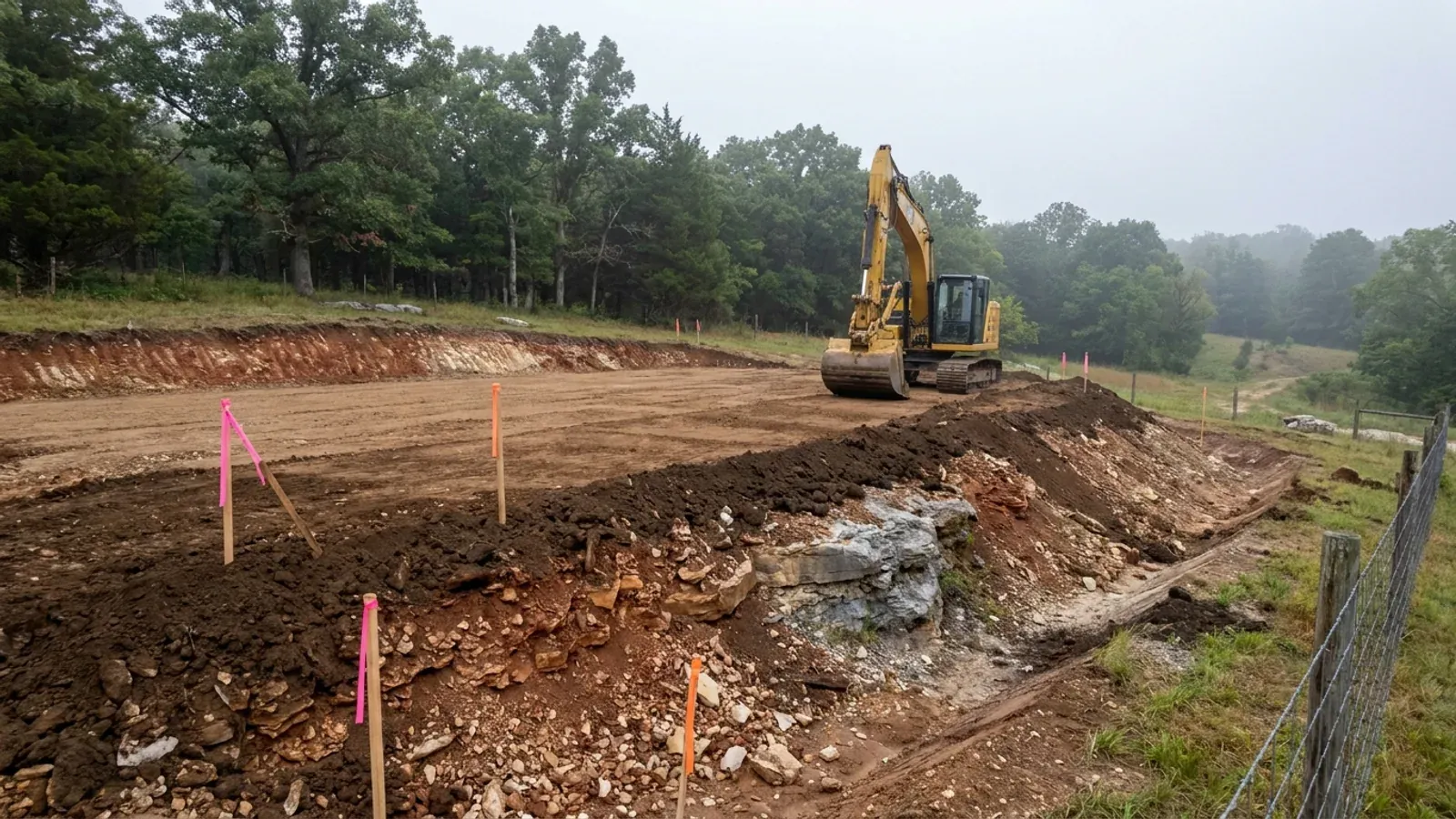
What moves a Missouri budget is usually below grade, and which problem you have depends on where in the state you are. Across the Ozarks it is karst: the Department of Natural Resources maps more than sixteen thousand sinkhole points, and what matters there is what is under the slab rather than what the slab sits in. Across the north and centre it is claypan — dense, slow-draining subsoil that perches water above it for months of the year. In the Bootheel it is deep alluvium carrying the highest seismic demand in the state, where the same soils modelled for liquefaction attack post embedment and slab bearing rather than the frame above them. The same ground then decides the septic system, and Missouri does not run that on a percolation test alone: the rule allows a perc test or a soil morphology examination in a profile pit, and the authority reviewing your parcel picks which. Where a drainfield sits near a sinkhole's drainage, perc testing on its own is not permitted at all. Whether that authority is the state or your own county is itself a local question, and it changes what you have to file. So the site work, the foundation and the drainfield get resolved together rather than one at a time. We price the dirt before we price the building.
What we build in Callaway County
All nine services are available in Callaway County. What a build costs depends far more on the parcel than on square footage, so we price against your land rather than publishing a rate card.
Custom Plans
Barndominium floor plans drawn to your parcel and your soil, and to whichever Missouri authority — a county, a city, or none at all — will review them.
Barndominium Kits
Barndominium shell packages delivered to your Missouri land, drawn to the criteria your own county or city publishes — because the state publishes none.
Turnkey Builds
Start to finish barndominium construction in Missouri: the permits that genuinely apply, site work, shell and interior finish, under one contract.
What a build looks like
Three stages every Callaway County project passes through, from a raw parcel to a finished home. Site work first, because that is where the budget is decided.
The parcel
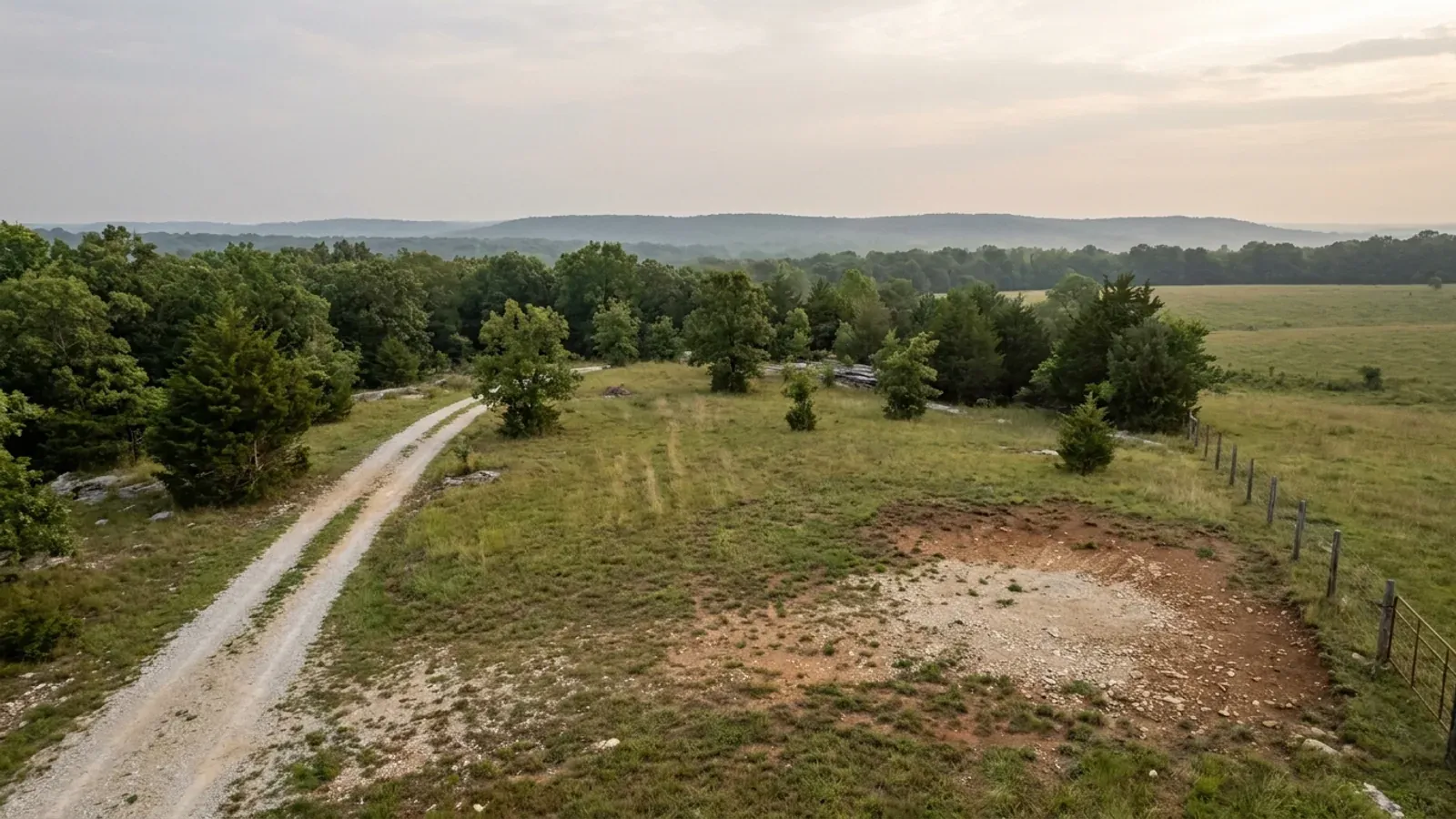
Zoning, setbacks, flood zone and utility access get checked before anything is drawn.
Pad and permit
Clearing, grading and a compacted pad, while the submittal works through whichever office issues the permit where you are building.
Frame to finish
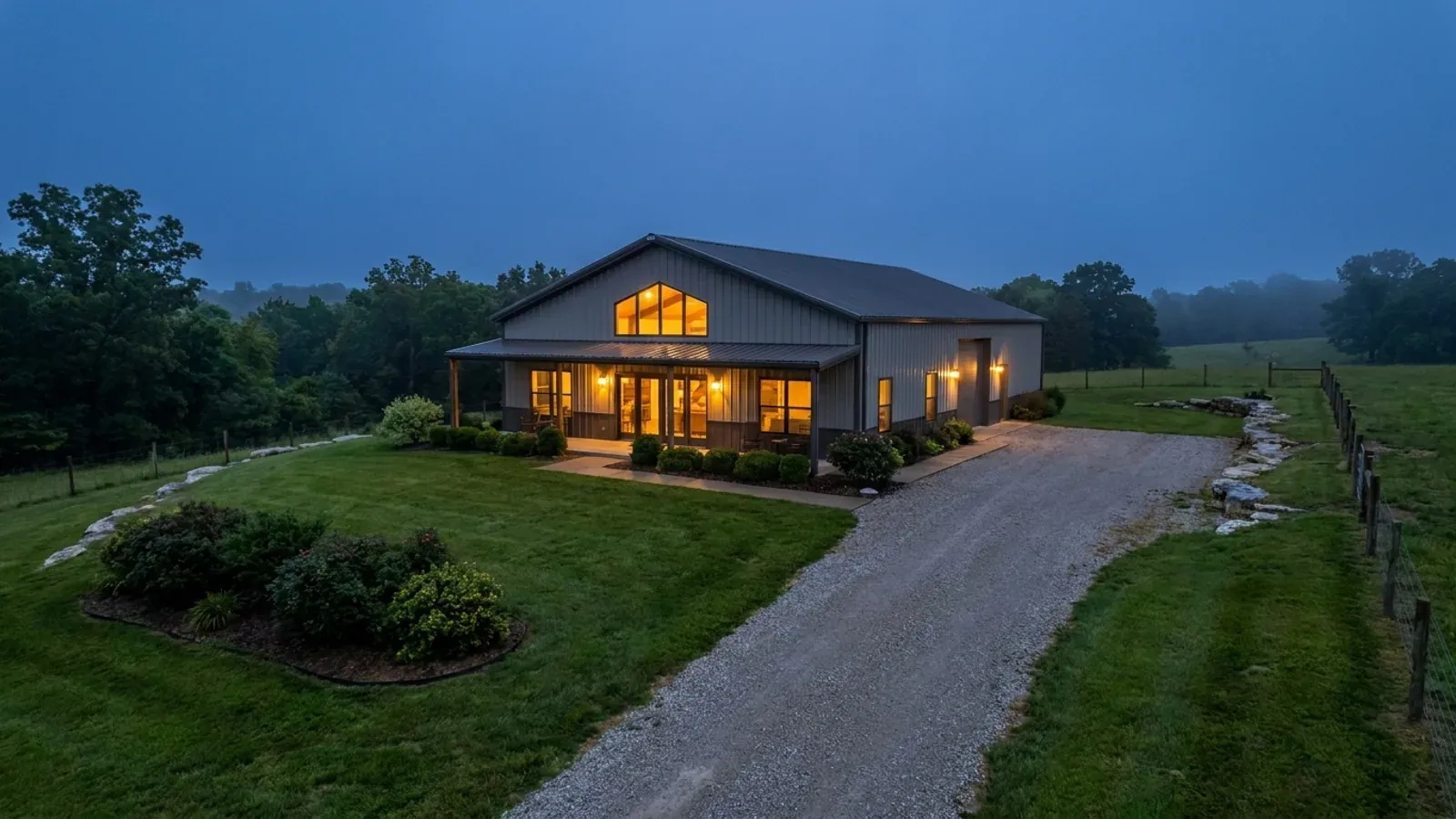
Shell erected and dried in, then systems, insulation and interior finish through to CO.
Those are the rules where you are building in Callaway County. Tell us what you want to build and we will draw it to them.
Where we build around Callaway County
Callaway County and the rural land around it. The buildable acreage for a project this size usually sits outside the city limits, which is frequently what changes who issues your permit.
Keep reading
The questions that usually come next once you know what Callaway County allows.
Barndominium Cost Guide
Sourced per-square-foot ranges by tier and by size, with a calculator built on the same figures.
Read itIs It Legal in Missouri?
Classification, zoning, the HOA gate, and why "nonresidential farm building" does not cover a home.
Read itHow Long Does It Take?
Census build-duration data, and what actually sets the permit clock where you are building.
Read itNearby areas we build in
Others we cover nearby, and they are not interchangeable. One may be a county with an adopted building code, another a county with no legal authority to have one, another a city that permits inside its own limits whichever county the land sits in. So the office that issues the permit, whether anyone inspects the work at all, the fees, the zoning and the design figures can differ from one card to the next — sometimes across a single property line.
Building in Callaway County: common questions
9 questions we get asked most often about building in Callaway County. If yours is not on the list, ask it directly.
Do I need a building permit to build a house in unincorporated Callaway County?
Could Callaway County adopt a building code later, after I have built?
There is no county code. Does that mean nothing about my build is inspected?
The claypan keeps coming up. What does it actually mean for a foundation?
How big a shop can I build next to the house?
Is metal siding or a metal roof restricted anywhere in this county?
What does the nuclear plant mean for building a house here?
Is there a minimum acreage before I can put in a septic system?
Where in the county is land actually available, and how much of it is there?
Building in Callaway County?
Start with the plan. Tell us what you want to build and we will draw it, then confirm which office issues the permit for your parcel, what it will let you put there, and what wind load it has to meet. That conversation costs nothing.