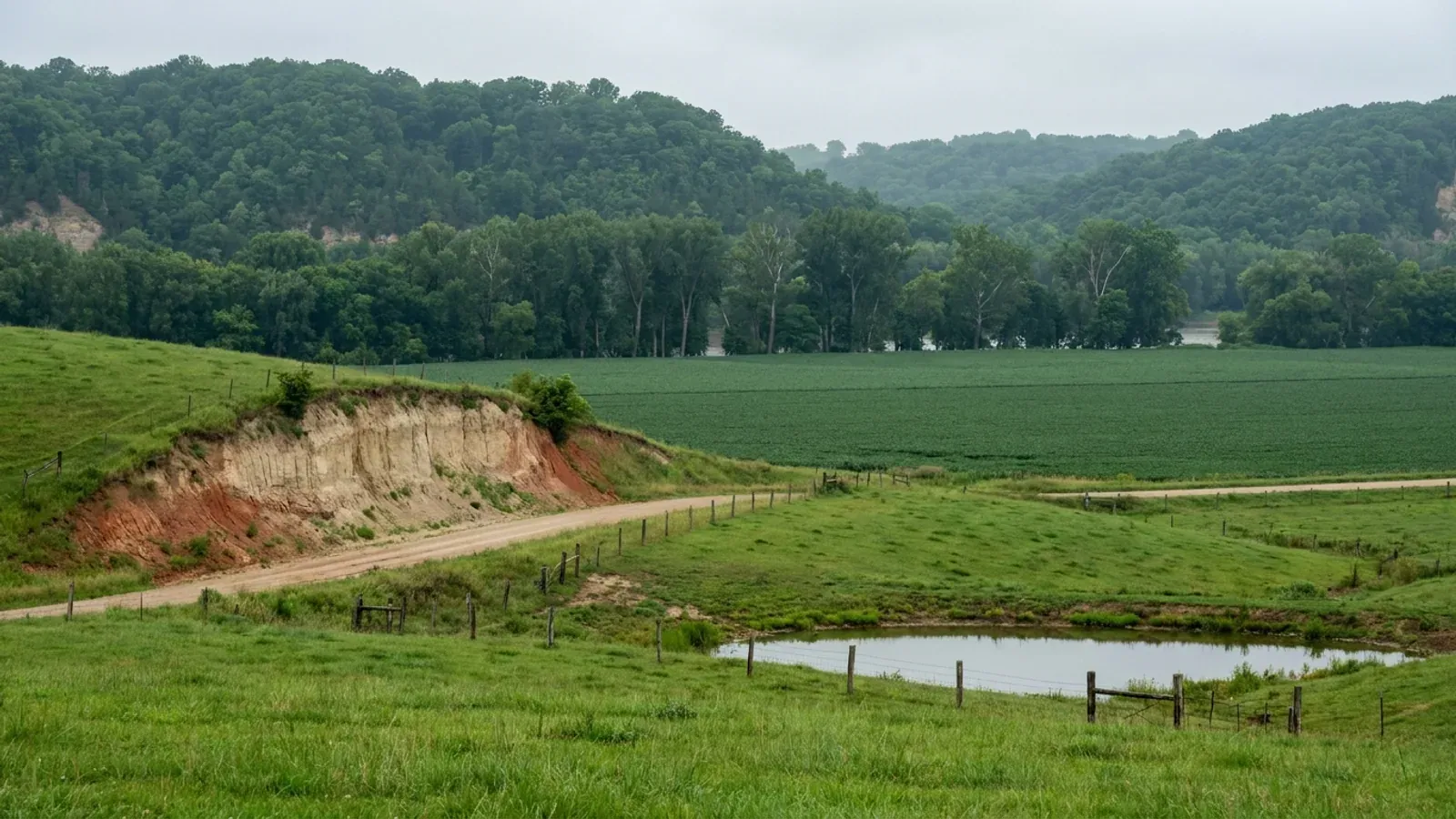
Barndominium Builders in Boone County, MO
Boone County is one of a small group of Missouri counties that both may have a building code and actually has one, and that single fact changes almost everything about building here. Classification is the gate: RSMo 48.020 sets a county's class by assessed valuation rather than population, the Missouri Association of Counties lists Boone in Class 1, and the State Tax Commission's 2024 report puts the county's total assessed valuation at $3,841,367,206. First classification is what RSMo 64.170 requires before a county commission may control construction and issue building permits. Boone County has used that power since 1985, began inspecting in March 1986 under the old BOCA codes, and now runs on the 2015 International Codes and the 2014 National Electrical Code, adopted by Commission Order 149-2017 on 23 March 2017 after three public hearings and effective 1 April 2017. That order repealed every previous version of the Boone County Building Code, which is why the 2012 addendums that are still posted on the county's website are history rather than law. Resource Management inspects everywhere in the county outside the city limits of Columbia, and the county fills in its own IRC Table R301.2(1): 20 lbs/sq. ft. ground snow, 115 mph wind, seismic design category B, severe weathering, a 30-inch frost line, termite moderate to heavy, decay slight to moderate, a winter design temperature of +4 degrees Fahrenheit, no ice barrier underlayment, an air freezing index of 0 to 1,000 and a mean annual temperature of 55 degrees. It also deletes IRC R403.3 outright, so a frost-protected shallow foundation is not an available route to that 30 inches here. The land question has its own answer. The USDA counted 1,120 farms working 196,763 acres in 2022 at a 176-acre average, and 43 percent of those farms are between 10 and 49 acres, which is precisely the tract a shop-and-house buyer is shopping for. That number collides with the zoning: in the A-1 Agriculture district a single-family dwelling needs a lot of at least 10 acres unless the parcel is a lot of record from before 27 December 1973, while A-2 drops to two and a half acres and A-R to half an acre. The ground under all of it is two different worlds. The Menfro series, formed in six to twenty feet of loess, has its national type location in this county about a mile and a half southeast of Wilton, and the level uplands to the north carry the full central-claypan suite instead. West and south of Columbia the county is karst: it publishes over 418 sinkholes, names three sinkhole areas in its zoning regulations by section, township and range, and requires wastewater systems in them to be designed and inspected by a registered professional engineer.
Boone County at a glance
- County
- Boone County
- Population
- 192,154
- ZIP codes
- 65010, 65039, 65201, 65202, 65203, 65240, 65255, 65256, 65279, 65284
- Site visits
- Same-week site visits across the unincorporated county, from Sturgeon and Centralia in the north through Hallsville, Harrisburg and Midway, west to Rocheport and Huntsdale above the river, and south through Pierpont and Hartsburg to Ashland and the Cole County line
Building conditions in Boone County
Missouri sets no residential building code and no statewide way of adopting one, so the first question on any parcel is not what the code says — it is whether there is one. Only counties of the first and second classification may adopt a building code at all, and classification is set by assessed valuation rather than population, so a small county can hold the power while a much larger one does not. Zoning is a separate power with its own answer, granted only after a vote of the people and repealable by another. What changes from one jurisdiction to the next is whether the work is inspected, who issues the permit, what that office charges, how the parcel is zoned, and the design figures your drawings have to satisfy.
Boone County Commission, certified copy of order (Commission Order 149-2017), 23 March 2017, effective 1 April 2017, attested by the Clerk of the County Commission and bound as the front matter of 'Boone County Resource Management 2015 International Code Addendums, Effective Date 4/1/2017'; the same order is filed in the County Clerk's commission-order file for 23 March 2017. Superseded instrument: Commission Order 140-2014, printed on the '2012 International Code Addendums, Effective Date 4/2/2014'. Both addendum PDFs downloaded from boonemo.gov and read as extracted PDF text 8 September 2026, together with the Resource Management Building Inspections page and Regulations index, both read 8 September 2026
Boone County Resource Management, 2015 International Code Addendums, IRC-2015 section, 'Table R301.2(1) - The following values shall be inserted into Table R301.2(1)', plus the R403.3 deletion in the same section and IBC-2015 sections 1604.1, 1801.2 and 1809.5; compared line by line against the 2012 International Code Addendums, IRC-2012 Table R301.2(1). Both PDFs downloaded from boonemo.gov and read as extracted text 8 September 2026
Zoning Regulations, Boone County, Missouri, adopted 27 December 1973 and last revised 31 March 2026, Sections 5.A(1), 5.A(3), 5.A(5), 5.A(7), 7.1.3, 7.1.5, 9.A, 10.A and 11.A, downloaded from boonemo.gov and read as extracted PDF text 8 September 2026; accessory-structure definition from the 2015 International Code Addendums, IRC-2015 R202; farm-size distribution from USDA NASS 2022 Census of Agriculture, Boone County, Missouri county profile (cp29019), downloaded and read 8 September 2026
Boone County Resource Management, 2015 International Code Addendums, sections 0.2.1 (farm structure exemption), 0.2.2, 0.2.3 and R101.2 scope note, downloaded from boonemo.gov and read 8 September 2026; Boone County Planning and Building Inspection handouts 'Agricultural Structures' (Ag-Structures.pdf) and 'Types of construction requiring a building permit' (Buildings_Requiring_Permit.pdf), both linked from the county's Building Inspections page and downloaded 8 September 2026; 'Boone County, Missouri Guide to Construction Permits', Resource Management, downloaded 8 September 2026
Zoning Regulations, Boone County, Missouri, last revised 31 March 2026, read in full for exterior-material, roof-pitch, eave, design-review and floor-area provisions, with Sections 4.A(9), 5, 7, 9, 10, 11 and 23.6 checked specifically; and Boone County Resource Management 2015 International Code Addendums, IRC-2015 and IBC-2015 sections. Both downloaded from boonemo.gov and read as extracted PDF text 8 September 2026
Boone County Fire Protection District, 'Life Safety Division' page at bcfdmo.com, rendered and read 8 September 2026 (host control-tested the same day: a bogus path returns HTTP 404 with the title '404 Error: Page Not Found'); RSMo 321.228, 'Residential construction regulatory system, preemption of law by local governmental body over fire protection district, when, exceptions', effective 28 August 2012 (L. 2012 H.B. 1647 merged with S.B. 769), rendered from revisor.mo.gov 8 September 2026; Boone County Planning and Building Inspection handouts 'Information regarding fire district requirements' (Fire_District_Firehydrants.pdf) and 'Southern Boone County Fire Protection District requires fees' (SBC_Fire_Protection_District_Fees.pdf), both downloaded from boonemo.gov 8 September 2026
Also worth knowing before you build in Boone County
- Septic is a county ordinance here, and the footing inspection waits on it
- The Missouri Department of Health and Senior Services county selector returns Boone County to Boone County Resource Management with Authority Type: Ordinance, at 801 E. Walnut Room 315 in Columbia, with the department's own note that 'This county has their own Onsite Wastewater Ordinance and may have additional requirements beyond the state minimum construction standards.' The county adopted its on-site sewage ordinance in 1993; enforcement sat with City of Columbia and Boone County Public Health and Human Services for years and transferred to Resource Management effective 28 June 2022. In practice the process runs like this: a soil evaluation by a certified soil scientist first, then a permit application carrying the soils morphology report, then a pre-site inspection scheduled for the next business day, then installation by an installer from the county's certified list with no backfilling until the final inspection. Alternative systems must be designed by an engineer. If a new home is being permitted at the same time, the wastewater application is folded into the building permit rather than filed separately. The sequencing rule is the one that catches schedules: the county states that where an on-site system is proposed, the wastewater permit must be approved and the site inspection performed before any other inspection is scheduled, and that this includes footing inspections, which will not be scheduled on the same day as the wastewater pre-site inspection. Note also what an ordinance authority means for the three-acre argument. RSMo 701.031 excludes some single-family lots of three acres or more from the state programme, but RSMo 701.047 lets a county ordinance reach the same parcel, and Boone County's published instructions describe a permit requirement for anyone constructing a new building with an on-site sewage system without stating an acreage exemption. Ask Resource Management about the specific parcel rather than working from the state threshold.
- Over 418 sinkholes, three named sinkhole areas, and a 3,000 square foot land-disturbance trigger
- Boone County is karst country west and south of Columbia. The county publishes the count itself: 'There are over 418 sinkholes in Boone County; most of which are located south of I-70 near Rocheport and Pierpont', over a network of caves and losing streams, with more than 43 losing stream segments along Gans Creek, Fox Hollow Branch, Bonne Femme Creek, Slate Creek, Sinking Creek, Jemerson Creek, Bass Creek and their tributaries. Two consequences are written into county law. Section 12 of the Zoning Regulations names three sinkhole areas by section, township and range — the Pierpont area, the Rocheport and Huntsdale area, and the Midway area — and provides that where public or community sewer is not available in them, sewage disposal systems shall be designed and installed to plans prepared by a registered professional engineer, inspected by or under the supervision of one, and certified by that engineer in a letter to the Director stating the system was properly designed for a sinkhole area. Second, the stormwater ordinance drops the land-disturbance permit threshold from one acre to 3,000 square feet where runoff discharges to a groundwater recharge feature such as a sinkhole or cave, or where the site is within 1,000 feet of or drains to an identified losing stream. On a rural building site those two rules can convert a routine driveway-and-pad job into an engineered wastewater design and a stormwater pollution prevention plan, and both questions are answerable from a parcel map before an offer is made.
- The state soil's type location is in this county, and the claypan is in it too
- Boone County straddles two entirely different foundation problems. Along the Missouri River hills the ground is loess, and the USDA's Official Series Description for the Menfro series — Missouri's state soil — places its national type location in Boone County, about a mile and a half southeast of Wilton on the Hartsburg quadrangle. Menfro formed in loess deposits 'ranging from 6 to 20 feet or more thick' on upland ridgetops, backslopes and benches, with slope gradients from 2 to 60 percent and a solum typically 50 to 70 inches deep. That is deep, well-drained, fine-textured soil with no rock in the way and a lot of slope to think about. On the level uplands north and east it is a different soil entirely: Boone is one of only thirteen Missouri counties carrying the full central-claypan suite as major map-unit components, and the claypan series behave in the opposite way — the Mexico series is classified as a Vertic Epiaqualf, which puts the shrink-swell clay in the taxonomy itself, with the top of the claypan 7 to 18 inches down, very slow permeability and a perched water table between half a foot and a foot and a half from December to May in most years. A slab detail that suits a Menfro ridge above the river is not the detail for a claypan flat twenty miles north, and neither is a guess. The county's own IBC amendment sets a presumptive allowable bearing pressure of 1,500 psf and waives a geotechnical investigation only for one-storey buildings of 2,500 square feet or less in risk categories 1 and 2, which is a reasonable place to start the conversation and not a substitute for a soil boring.
- Land in Boone County: 1,120 farms, and 43 percent of them under 50 acres
- The 2022 Census of Agriculture counted 1,120 farms in Boone County working 196,763 acres at an average of 176 acres, down 5 percent in land and 8 percent in farm count since 2017. The use split is 119,577 acres of cropland, 33,674 acres of woodland, 32,044 acres of pastureland and 11,468 acres of other land, with 4,792 acres irrigated. The size distribution is the number that matters to a barndominium buyer: 67 farms of 1 to 9 acres, 482 of 10 to 49 acres, 351 of 50 to 179 acres, 140 of 180 to 499 acres, 45 of 500 to 999 acres and 35 of 1,000 acres or more. Forty-three percent of the county's farms are in that 10-to-49-acre band, which is exactly the tract this building type is usually bought for, and it is also the band that sits below the A-1 district's 10-acre minimum for a dwelling on one side and above the A-2 district's two and a half acres on the other. The practical reading is that the zoning district on a parcel matters as much as its acreage, and both are worth checking on the county's zoning map before an offer rather than after.
Missouri Department of Health and Senior Services, on-site wastewater treatment construction-permit-process county selector, requested for Boone County and read 8 September 2026, returning Agency: Boone County Resource Management, Authority Type: Ordinance (the same request reproduced the known answer for Camden County, and a bogus path on the host returns an honest HTTP 404); Boone County Resource Management, 'On-Site Wastewater Systems' page, read 8 September 2026; Boone County Resource Management, 'Building Inspections' page, read 8 September 2026; Boone County Code of Health Regulations Chapter 4, published by Boone County Resource Management; RSMo 701.031 and 701.047
Boone County Stormwater, 'Protection of Environmentally Sensitive Areas in Boone County', boonemo.gov, read 8 September 2026, quoting the Boone County Stormwater Ordinance Section 2 and the Soil Survey of Boone County, Missouri; Zoning Regulations, Boone County, Missouri, last revised 31 March 2026, Section 12 'Sewage Disposal in the Sink Hole Areas' and Section 28 land-disturbance provisions, downloaded and read 8 September 2026; 'Boone County, Missouri Guide to Construction Permits', Resource Management, read 8 September 2026
USDA-NRCS Official Series Description, MENFRO series, soilseries.sc.egov.usda.gov, read 8 September 2026 (the host was control-tested the same day and returns an honest HTTP 404 for a bogus series); USDA-NRCS Official Series Description, MEXICO series, same host and date; USDA-NRCS Soil Data Access query of Missouri major map-unit components against the recognised Central Claypan series, run for the statewide research file and recorded in research/statewide/site-conditions.md section 6a; Boone County Resource Management 2015 International Code Addendums, IBC-2015 sections 1801.2 and 1803.2
USDA NASS 2022 Census of Agriculture, Boone County, Missouri county profile (cp29019.pdf), downloaded from nass.usda.gov and read 8 September 2026; a deliberately bogus county code on the same path returns a 196-byte HTTP 404, so the host reports absence honestly. Zoning district minimums from the Zoning Regulations, Boone County, Missouri, last revised 31 March 2026, Sections 5 and 11
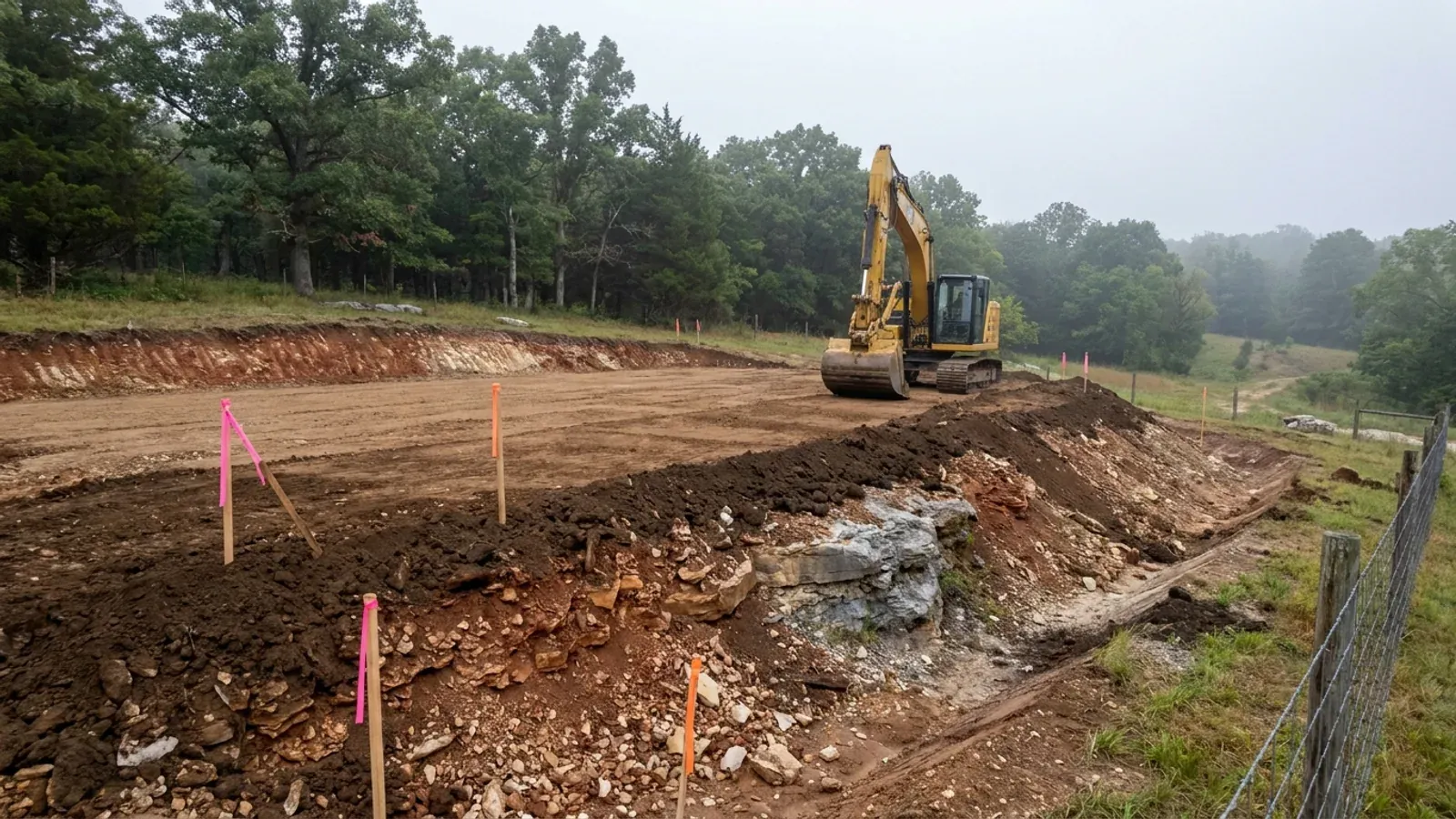
The expensive surprises are in the ground, not the building
What moves a Missouri budget is usually below grade, and which problem you have depends on where in the state you are. Across the Ozarks it is karst: the Department of Natural Resources maps more than sixteen thousand sinkhole points, and what matters there is what is under the slab rather than what the slab sits in. Across the north and centre it is claypan — dense, slow-draining subsoil that perches water above it for months of the year. In the Bootheel it is deep alluvium carrying the highest seismic demand in the state, where the same soils modelled for liquefaction attack post embedment and slab bearing rather than the frame above them. The same ground then decides the septic system, and Missouri does not run that on a percolation test alone: the rule allows a perc test or a soil morphology examination in a profile pit, and the authority reviewing your parcel picks which. Where a drainfield sits near a sinkhole's drainage, perc testing on its own is not permitted at all. Whether that authority is the state or your own county is itself a local question, and it changes what you have to file. So the site work, the foundation and the drainfield get resolved together rather than one at a time. We price the dirt before we price the building.
What we build in Boone County
All nine services are available in Boone County. What a build costs depends far more on the parcel than on square footage, so we price against your land rather than publishing a rate card.
Custom Plans
Barndominium floor plans drawn to your parcel and your soil, and to whichever Missouri authority — a county, a city, or none at all — will review them.
Barndominium Kits
Barndominium shell packages delivered to your Missouri land, drawn to the criteria your own county or city publishes — because the state publishes none.
Turnkey Builds
Start to finish barndominium construction in Missouri: the permits that genuinely apply, site work, shell and interior finish, under one contract.
What a build looks like
Three stages every Boone County project passes through, from a raw parcel to a finished home. Site work first, because that is where the budget is decided.
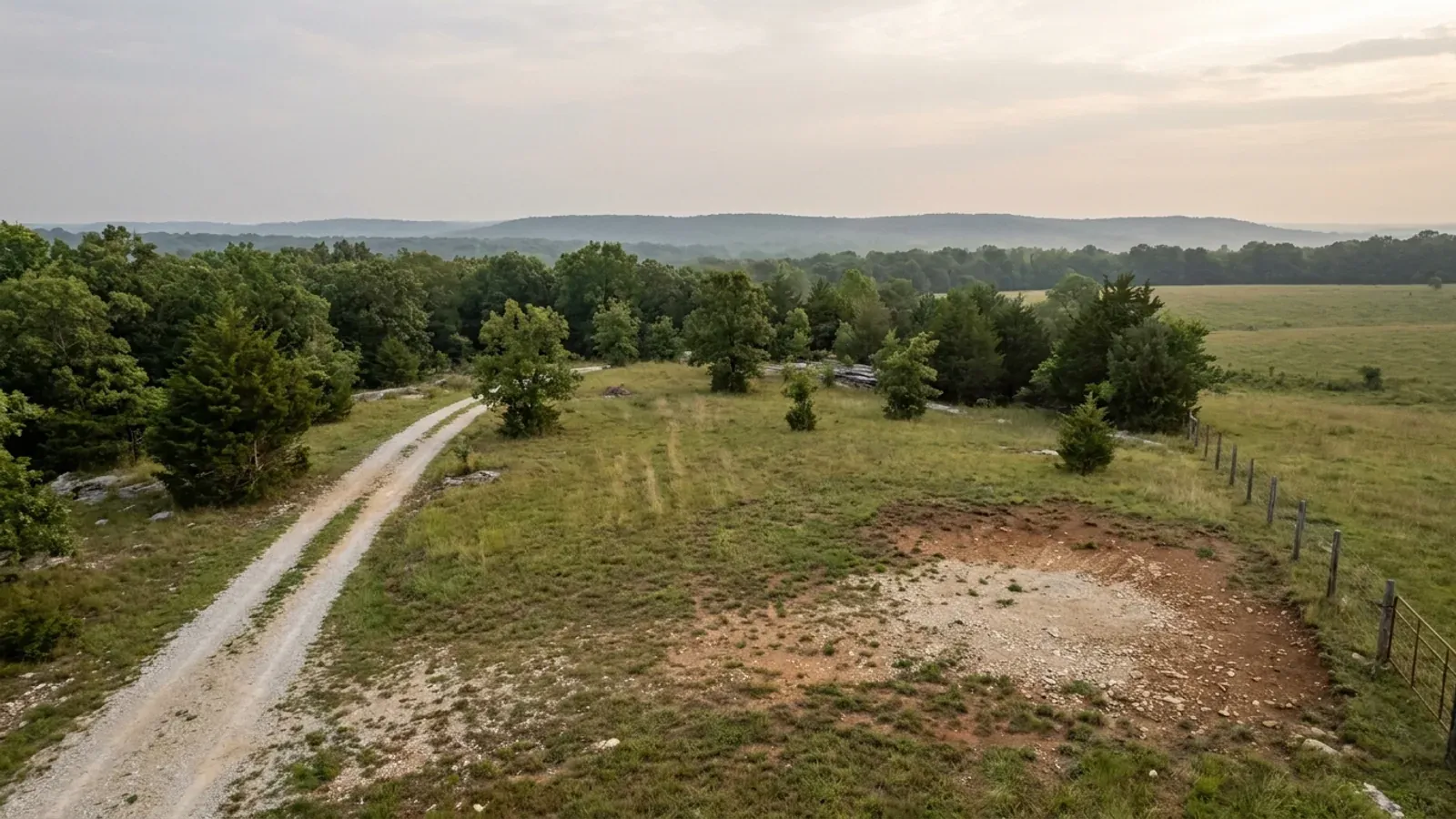
The parcel
Zoning, setbacks, flood zone and utility access get checked before anything is drawn.
Pad and permit
Clearing, grading and a compacted pad, while the submittal works through whichever office issues the permit where you are building.
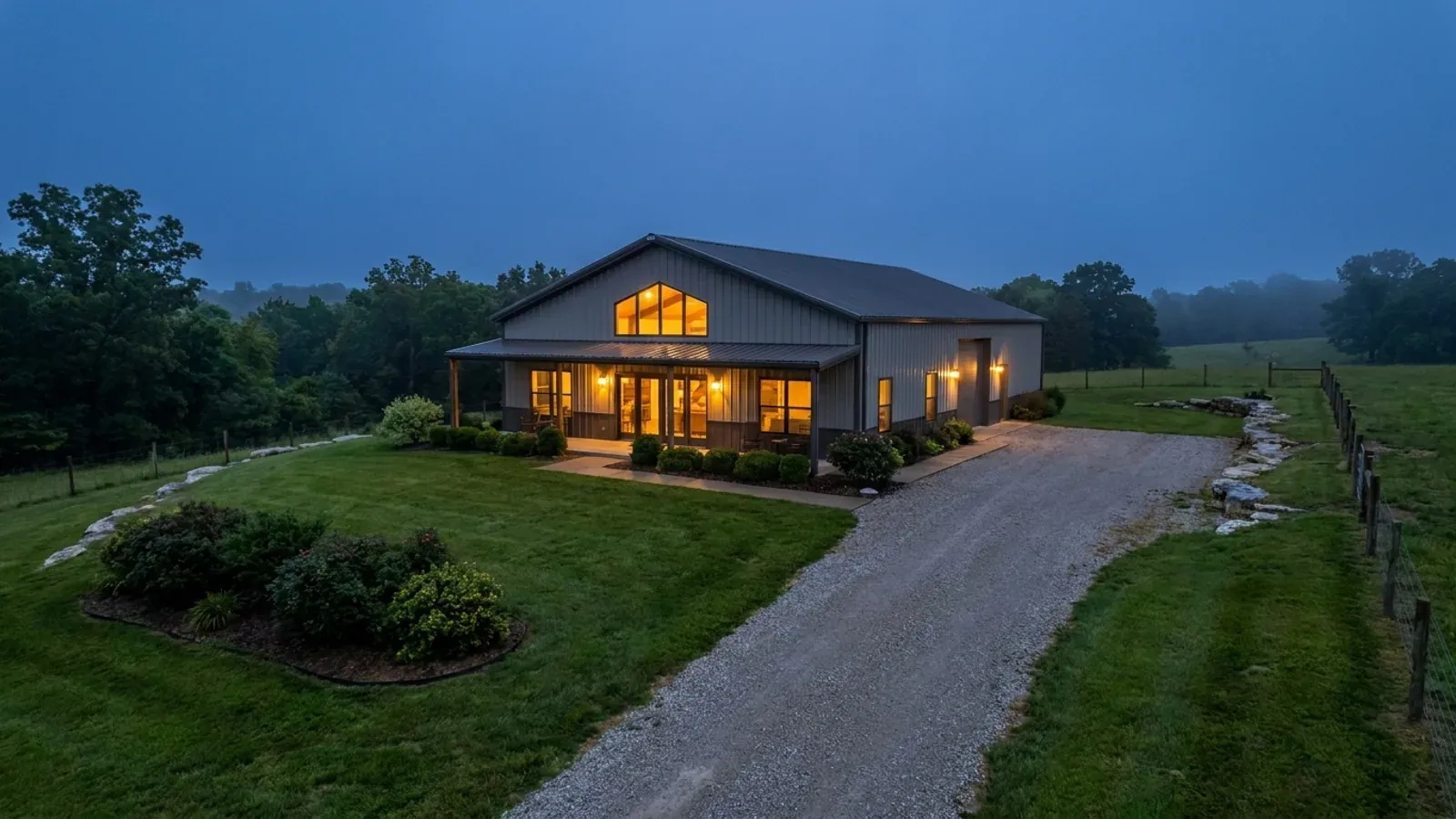
Frame to finish
Shell erected and dried in, then systems, insulation and interior finish through to CO.
Those are the rules where you are building in Boone County. Tell us what you want to build and we will draw it to them.
Where we build around Boone County
Boone County and the rural land around it. The buildable acreage for a project this size usually sits outside the city limits, which is frequently what changes who issues your permit.
Keep reading
The questions that usually come next once you know what Boone County allows.
Barndominium Cost Guide
Sourced per-square-foot ranges by tier and by size, with a calculator built on the same figures.
Read itIs It Legal in Missouri?
Classification, zoning, the HOA gate, and why "nonresidential farm building" does not cover a home.
Read itHow Long Does It Take?
Census build-duration data, and what actually sets the permit clock where you are building.
Read itNearby areas we build in
Others we cover nearby, and they are not interchangeable. One may be a county with an adopted building code, another a county with no legal authority to have one, another a city that permits inside its own limits whichever county the land sits in. So the office that issues the permit, whether anyone inspects the work at all, the fees, the zoning and the design figures can differ from one card to the next — sometimes across a single property line.
Building in Boone County: common questions
7 questions we get asked most often about building in Boone County. If yours is not on the list, ask it directly.
Does Boone County actually inspect a house built out in the country, or is that only inside Columbia?
I have been told Boone County's frost line is 30 inches and its wind speed is 90 mph. Is that right?
Can I put up the shop first and build the house later?
Are there any rules in Boone County against metal siding or a low roof pitch?
My land is in the fire district. Does the fire district have to approve my house too?
How much land do I actually need to build a house in Boone County?
What is the wastewater process, and does the three-acre rule get me out of it?
Building in Boone County?
Start with the plan. Tell us what you want to build and we will draw it, then confirm which office issues the permit for your parcel, what it will let you put there, and what wind load it has to meet. That conversation costs nothing.