Barndominium Builders in Clay County, MO
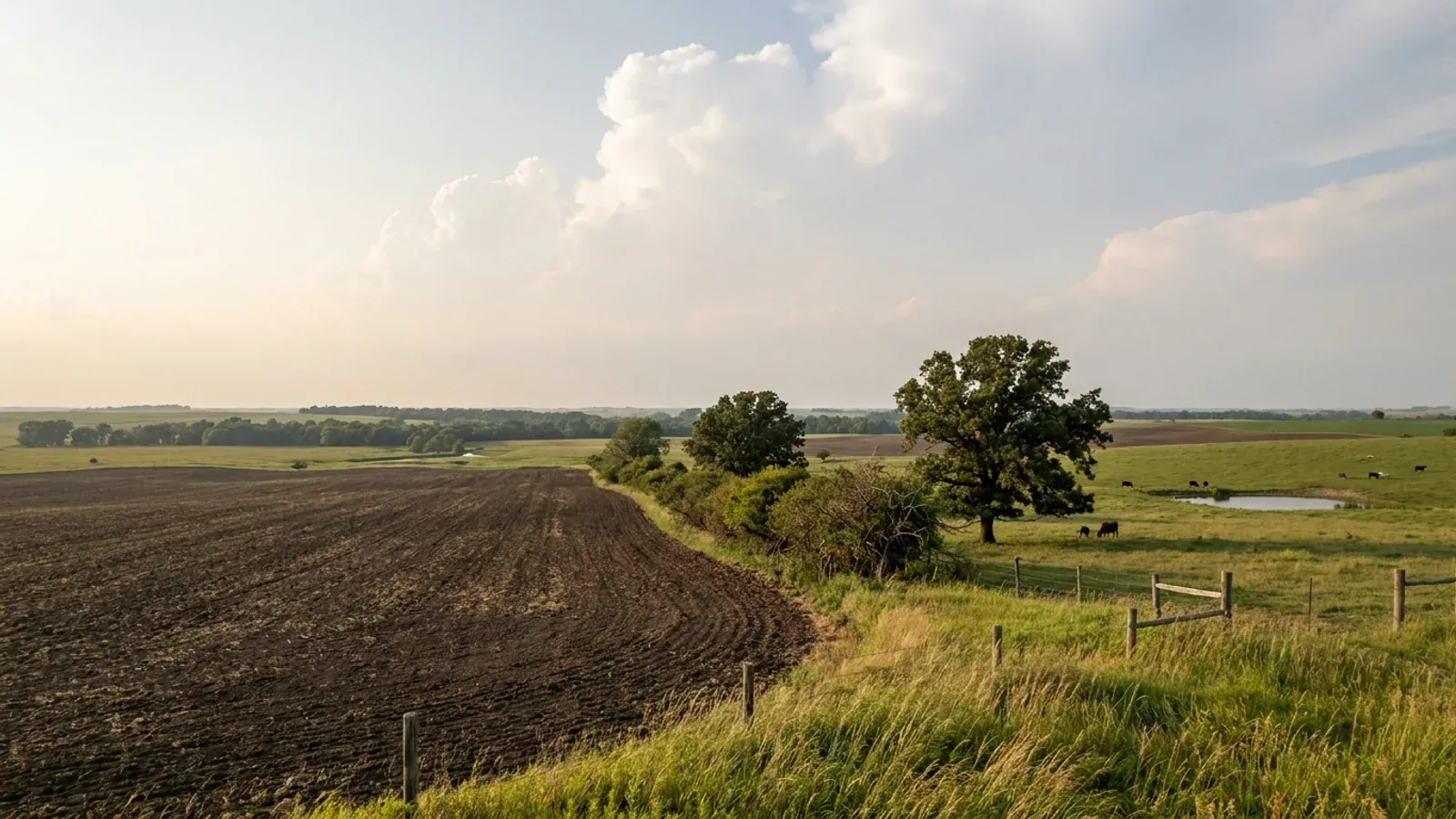
Clay County is a charter county, which puts it outside the four-class system the rest of the state's counties are sorted into. It has a building department, an adopted code and an inspector — and that department reaches a far smaller share of the county than almost anyone expects. Of the county's 263,370 residents, 143,075 live inside Kansas City and 15,906 live in what the Census Bureau calls the balance of the county: the unincorporated ground the Clay County Planning and Zoning Department actually regulates. Liberty, Gladstone, Kearney, Smithville, Excelsior Springs, North Kansas City and a dozen smaller places permit their own builds. So a Clay County mailing address does not tell you who will review your drawings, and the answer changes the code you build to. Unincorporated Clay County runs the 2012 International Codes with the 2011 NEC; Liberty and Smithville run the 2018 International Codes with the 2017 NEC; Kansas City runs the 2018 IRC with a separately adopted 2021 energy code. The land is in the north. USDA's 2022 Census of Agriculture counts 523 farms and 86,064 acres in farms across the county's 397.658 square miles of land, and the genuinely open ground runs north and east of Kearney and Smithville — dissected loess-over-glacial-till prairie and Missouri River hill country, not Ozark karst. What binds a build out there is the county's zoning minimums, its residential design standards for detached houses, and a septic ordinance that requires a soil-morphology evaluation on every single site.
Clay County at a glance
- County
- Clay County
- Population
- 263,370
- ZIP codes
- 64068, 64060, 64089, 64024, 64048, 64062, 64072, 64116, 64117, 64118, 64119, 64155, 64156, 64157, 64158, 64161, 64165, 64166, 64167, 64492
- Site visits
- Same-week site visits across the county, from the Liberty and Gladstone edge north to Kearney, Smithville, Holt and the Clinton County line
Building conditions in Clay County
Missouri sets no residential building code and no statewide way of adopting one, so the first question on any parcel is not what the code says — it is whether there is one. Only counties of the first and second classification may adopt a building code at all, and classification is set by assessed valuation rather than population, so a small county can hold the power while a much larger one does not. Zoning is a separate power with its own answer, granted only after a vote of the people and repealable by another. What changes from one jurisdiction to the next is whether the work is inspected, who issues the permit, what that office charges, how the parcel is zoned, and the design figures your drawings have to satisfy.
U.S. Census Bureau, Vintage 2024 Subcounty Population Estimates, Missouri file sub-est2024_29.csv, SUMLEV 157 (place part within county) for county FIPS 29047, and Vintage 2024 County Population Totals co-est2024-alldata.csv, both fetched from www2.census.gov 6 September 2026; Clay County Planning and Zoning Department, Residential Construction and Floodplain Management pages, claycountymo.gov, read 6 September 2026
Clay County Planning and Zoning Department, Building Codes page (Ordinance Number 2012-ORD-24; codes effective 1 January 2013), claycountymo.gov, and Clay County Code of Ordinances §§ 150.15–150.20 (Ord. No. 2012-ORD-24, 9-10-12), Supp. No. 16, online content updated 8 October 2025; City of Liberty Building Permit Information and Building Inspections pages (2018 International Codes, 2017 NEC, Ordinance 11358), libertymissouri.gov; City of Smithville Building Inspections page, smithvillemo.org; Kansas City Code of Ordinances §§ 18-57 and 18-367 — all read 6 September 2026
Clay County Residential Construction Regulations, revised 10 March 2020, Footings and Foundations item 1 and Accessory Building permit requirements item 1, claycountymo.gov; Clay County Planning and Zoning Building Inspector memorandum 'IRC 2012 Roofing Requirements', section 905.2.7.1, claycountymo.gov; both downloaded 6 September 2026. Kansas City figure from KCMO Code § 18-57 Table R301.2(1); Springfield figure from the City of Springfield 2018 IRC adoptive ordinance, Table R301.2(1)
Clay County Land Development Code § 151-10.6 Residential Design Standards, subsections A, B, C, E and F (LDC as adopted 27 February 2012, amended 28 September 2023; § 151-10.6 amended 14 September 2020 by Ordinance 2020-ORD-12), PDF downloaded from claycountymo.gov 6 September 2026
Clay County Land Development Code § 151-6.3B(1)(d) and § 151-6.3B(2)(a), PDF downloaded from claycountymo.gov 6 September 2026; Clay County Code of Ordinances § 150.04(A) (Ord. No. 2007-ORD-11, § 4, 4-16-07), Supp. No. 16, online content updated 8 October 2025; Clay County Planning and Zoning 2026 Fee Schedule, claycountymo.gov, read 6 September 2026
Individual Sewage Disposal Rules and Regulations for Clay County, Missouri, adopted 1 October 1990, revised 16 November 2017, effective 1 January 2018, under G.O. 89-113 — subsections (1)(B) Applicability, (2)(A)1 and (2)(C), PDF downloaded from clayhealth.com 6 September 2026; Missouri Department of Health and Senior Services, OWTS Construction Permit Process county selector, entry for Clay County (Agency: Clay County Public Health Center; Authority Type: Ordinance; 800 Haines Dr., Liberty), health.mo.gov, read 6 September 2026; RSMo 701.031 (effective 28 August 2005) and RSMo 701.047, revisor.mo.gov
Also worth knowing before you build in Clay County
- Clay County is EPA Radon Zone 1 — and the county inspects for it
- Only 11 of Missouri's 114 counties sit in EPA Radon Zone 1, the band with a predicted average indoor screening level above 4 pCi/L, and Clay is one of them, alongside Jackson, Platte, Cass, Clinton, Andrew, Atchison, Buchanan, Holt, Nodaway and Iron. The Kansas City metro and the northwest corner are the state's radon country; the southeast Bootheel, which carries the state's severe earthquake demand, is its lowest-radon country — the two maps run opposite ways. Clay County does something about it that most Missouri jurisdictions do not: its Residential Construction Regulations list 'Ground Rough Plumbing: Including Radon' as one of the inspections performed during construction, and state under the ground rough plumbing requirements that a 'Pasive Radon system is required (AF 103.6)' — Appendix F of the adopted IRC, Radon Control Methods. On a slab-on-grade barndominium that is a sub-slab decision made before the pour, which is when it costs almost nothing. EPA's own Missouri sheet says the map 'should not be used to determine if individual homes need to be tested' and that 'All homes should be tested, regardless of zone designation.'
- The shop cannot out-footprint the house, and it cannot go up first
- Two provisions in the Land Development Code decide how a shop-and-house build has to be sequenced and sized in unincorporated Clay County. Section 151-6.3B(5)(a): 'No accessory use shall be established and no accessory structures shall be allowed on the subject parcel until after all required permits and approvals for the principal use or activity have been obtained. This provision shall not apply to farm structures with a minimum of 5 acres.' Section 151-6.3B(5)(e): 'Each detached accessory structure may not cover more of the lot than does the principal building as established by its footprint size in square feet... This provision shall not apply to farm buildings/structures with a minimum of 5 acres. Parcels with homes that have a footprint less than 1500 square feet are allowed accessory buildings with a maximum of 1500 square feet.' And living on site while you build is a permitted exception, not a right: § 151-6.3B(5)(f)(i) prohibits using a recreational vehicle, motorized home, mobile home or any accessory building as a principal dwelling 'except during periods of construction of a principal dwelling unit on the same property,' limited to one year, requiring both a residence building permit and a prohibited use permit with the fees paid, plus Clay County Public Health Center approval for wastewater, and extendable only once by six months for good cause. The county's 2026 fee schedule prices that prohibited use permit at $750 for the year and $750 for the six-month extension.
- What the county charges, and how it prices your house
- Clay County prices a residential permit on a valuation it calculates for you. The 2026 fee schedule sets building fees on '$100/sqft. or "actual" under 1,500 sqft, whichever is less', and for Residential New Construction Including Accessory Dwelling Units charges $12 for the first $1,000 of valuation and $9 for each additional $1,000, plus $50 per inspection and the road impact fee. The county's own worked example runs it: 2,000 square feet at $100 gives a $200,000 valuation, so $12 plus 199 times $9 is $1,803, plus five inspections and the impact fee on top. Other published figures: floodplain development permit $90; land disturbance permit $150 for 1–5 acres, $350 for 6–20 acres, $750 for 21 acres and up; rezoning to AG, R-1, R-5 or OP $375; conditional use permit $375; variance before the Board of Zoning Adjustment $275; legal notice publication $190; re-inspections $90 per hour or part hour; and a penalty for not obtaining a required permit of twice the permit fee. The county also runs a voluntary Clay County Green Build Program, approved in 2010 by Ordinance 2010-ORD-33 on the ICC 700 National Green Building Standard, which pays building permit fee rebates.
- The county licenses no contractor — but it will not accept an unlicensed trade
- There is no general-contractor licence in Missouri to hold, and Clay County adds none of its own: no contractor-licensing provision appears anywhere in Chapter 150, the county's building regulations. What the county does require is a licence issued somewhere else. Its Residential Construction Regulations carry the same sentence three times, once each under the plumbing, mechanical and electrical sections: 'All persons doing plumbing work in this jurisdiction for hire must be licensed in a local jurisdiction,' and likewise for mechanical and electrical work. So the trade licence that gets accepted in unincorporated Clay County is one issued by a city or county that does license. Cross into Liberty and the position reverses — the city states that 'All contractors must be licensed with the City of Liberty before a permit will be issued.' Inside Kansas City, KCMO Code § 18-14(j) requires a residential building contractor licence to contract to build a one- or two-family dwelling including detached accessory buildings over 400 square feet.
- The floodplain permit comes before the building permit, and a farm house is not a farm building
- Clay County states that it is 'empowered to adopt, maintain, and enforce the floodplain development code pursuant to the powers granted and limitations imposed by the Missouri Revised Statutes (RSMo) Chapter 49.600' — the statute that lets a Missouri county adopt National Flood Insurance Program regulations, and that requires a vote of the county's own people before such an order takes effect and lets them rescind it by petition. The county's floodplain regulations sit in Chapter 11 of the Land Development Code, apply to numbered and unnumbered A, AE, AO and AH zones, and are keyed to FEMA Flood Insurance Rate Maps that the county says became effective on 3 August 2015. The sequencing point is the one that catches people: 'For those construction activities that require a Building Permit, an FDP must first be approved and issued by the Director of the Planning and Zoning Department before any Building Permit may be obtained.' The permit is $90. And the state's own floodplain guidance is blunt about the barn-shaped house: farm houses are not agricultural structures, so the agricultural framing that survives elsewhere in the code does not survive inside a Special Flood Hazard Area.
- Loess over glacial till, and a winter water table that comes up to your slab
- This is western Missouri prairie and Missouri River hill country, and the soils under it behave nothing like Ozark chert. Querying the USDA-NRCS soil database for Clay County's survey area, the largest-acreage major soil components are Sharpsburg, Lagonda, Armster, Knox, Macksburg and Nodaway. USDA's Official Series Description puts Sharpsburg in the taxonomic class 'Fine, smectitic, mesic Typic Argiudolls' on a parent material of loess and a landscape of 'dissected till plains and river valleys', moderately well drained with a frequently saturated zone between 1.2 and 1.8 metres in the wettest periods. Lagonda is 'Fine, smectitic, mesic Aquertic Argiudolls', formed in 20 to 36 inches of loess over pedisediment washed from glacial till, and USDA records it as 'Somewhat poorly drained. Runoff is medium. Permeability is slow. A perched water table has an upper limit of 1.5 to 2.5 feet during November to April during most years.' Smectitic is shrink-swell clay mineralogy stated in the classification itself. A perched water table a foot and a half down from November to April is a slab, post-hole and drainage problem before it is anything else, and slow permeability is a drainfield problem — which is exactly why the county's septic rules send an evaluator into a profile pit on every site.
- Inside Kansas City, the fee changes at the river
- Kansas City's arterial street impact fee ordinance splits the city in two along the Missouri River, and the Clay County part of the city sits on the north side of that line. KCMO Code § 39-4(b)(1) sets the North Service Area schedule, 'which includes all of the incorporated area of the city located north of the Missouri River that is included in one of the five benefit districts defined in section 39-6', at a net cost of $1,430.00 per single-family detached dwelling with a 50 percent discount factor, giving a discounted fee of $715.00; the South Service Area figure at § 39-4(b)(2) is $706.00. Three of the five northern benefit districts are described entirely by Clay County landmarks — Benefit District B, the N. Oak Corridor, bounded in part by the Gladstone city limits and M-291; Benefit District C, Shoal Creek Valley, bounded on the south by Pleasant Valley Road; and Benefit District D, Birmingham, bounded on the north by Pleasant Valley Road and on the south by the Missouri River. The ordinance even seats 'one member from the appropriate economic development commission, either Platte or Clay' on each northern district's advisory committee. The fee is due only inside a benefit district, so a specific address has to be checked with the city.
U.S. EPA, Map of Radon Zones county-level data (radon_zones-spreadsheet.xls, document number EPA 402/A-16/001; underlying Map of Radon Zones developed 1993) and the EPA Missouri radon zone sheet, epa.gov, the latter downloaded and read 6 September 2026; Clay County Residential Construction Regulations, revised 10 March 2020, Inspections list and Ground Rough Plumbing item 7, claycountymo.gov
Clay County Land Development Code §§ 151-6.3B(5)(a), (e) and (f)(i), PDF downloaded from claycountymo.gov 6 September 2026; Clay County Planning and Zoning 2026 Fee Schedule, claycountymo.gov, read 6 September 2026
Clay County Planning and Zoning 2026 Fee Schedule, claycountymo.gov, read 6 September 2026; Clay County Residential Construction Regulations, revised 10 March 2020, New Residential Construction fee worked example, claycountymo.gov; Clay County Code of Ordinances §§ 150.21 and 150.22 (Clay County Green Building Code and Green Build Program, Ordinance 2010-ORD-33), Supp. No. 16, online content updated 8 October 2025
Clay County Code of Ordinances Chapter 150 in full, Supp. No. 16, online content updated 8 October 2025, codified through Ordinance 2024-ORD-27 enacted 22 August 2024 — no licensing provision present; Clay County Residential Construction Regulations, revised 10 March 2020, Plumbing, Mechanical and Electrical Regulations notes, claycountymo.gov; City of Liberty Building Permit Information page, libertymissouri.gov, read 6 September 2026; Kansas City Code of Ordinances § 18-14(j) (Ord. No. 200418, § 1, 6-18-20)
Clay County Planning and Zoning Department, Floodplain Management page, claycountymo.gov, read 6 September 2026, citing Land Development Code §§ 151-11.6(C), (E) and 151-11.7; Clay County Planning and Zoning 2026 Fee Schedule (Floodplain Development Permit $90); RSMo 49.600, effective 4 March 1991, revisor.mo.gov; SEMA/FEMA, Floodplain Management in Missouri Quick Guide, cover-dated 2020–2021, State Specific Guidance callout
USDA-NRCS Soil Data Access tabular service (SDMDataAccess.sc.egov.usda.gov), major map-unit components for survey area MO047 (Clay County, Missouri), queried 6 September 2026; USDA-NRCS Official Series Descriptions for SHARPSBURG and LAGONDA, soilseries.sc.egov.usda.gov, fetched 6 September 2026
Kansas City, Missouri Code of Ordinances ch. 39, Arterial Street Impact Fees, §§ 39-1, 39-3, 39-4(b)(1)–(2) and 39-6 (Ord. No. 011258, § 1, 9-27-01), read from the codified ordinances 6 September 2026
The expensive surprises are in the ground, not the building
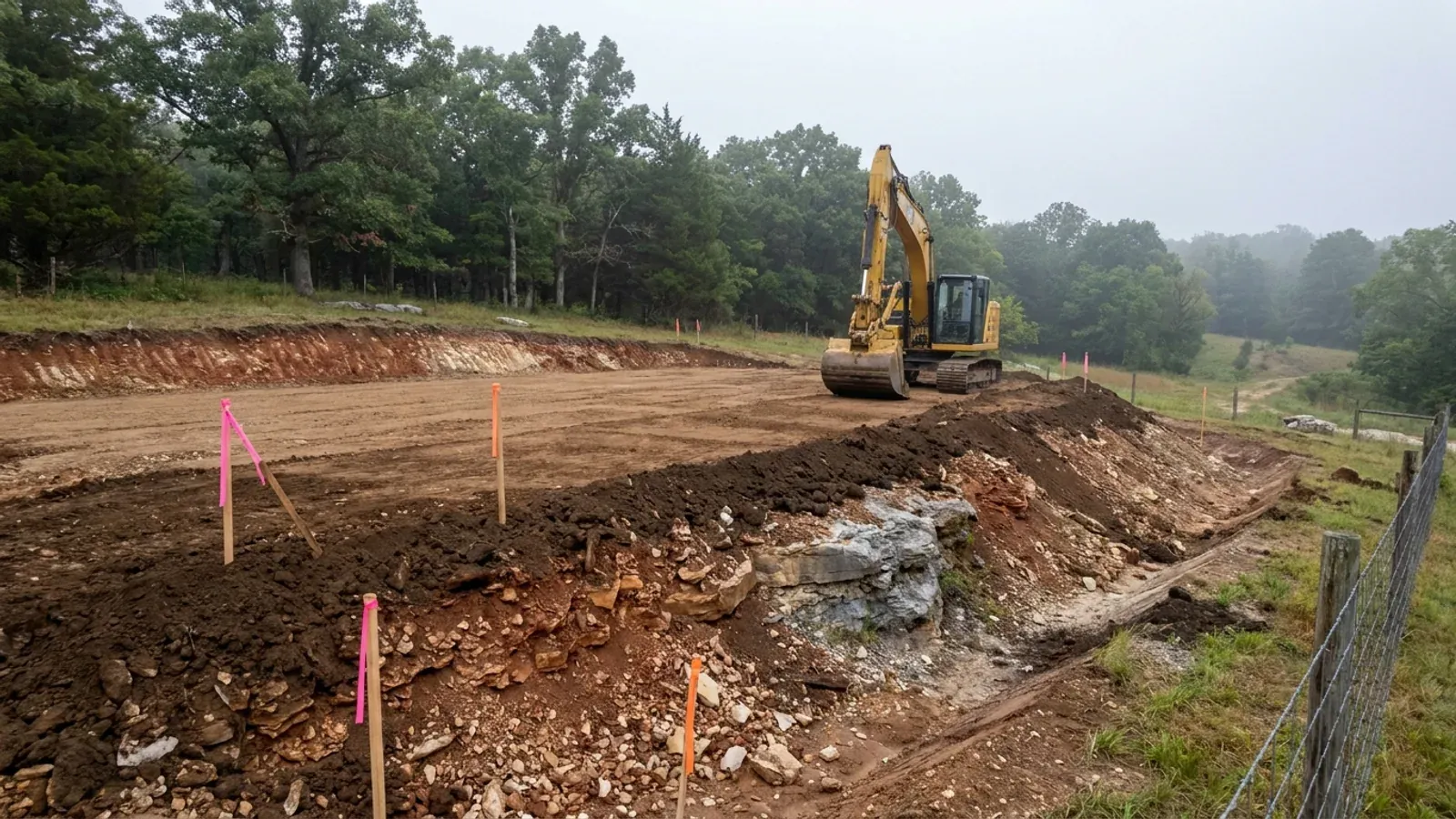
What moves a Missouri budget is usually below grade, and which problem you have depends on where in the state you are. Across the Ozarks it is karst: the Department of Natural Resources maps more than sixteen thousand sinkhole points, and what matters there is what is under the slab rather than what the slab sits in. Across the north and centre it is claypan — dense, slow-draining subsoil that perches water above it for months of the year. In the Bootheel it is deep alluvium carrying the highest seismic demand in the state, where the same soils modelled for liquefaction attack post embedment and slab bearing rather than the frame above them. The same ground then decides the septic system, and Missouri does not run that on a percolation test alone: the rule allows a perc test or a soil morphology examination in a profile pit, and the authority reviewing your parcel picks which. Where a drainfield sits near a sinkhole's drainage, perc testing on its own is not permitted at all. Whether that authority is the state or your own county is itself a local question, and it changes what you have to file. So the site work, the foundation and the drainfield get resolved together rather than one at a time. We price the dirt before we price the building.
What we build in Clay County
All nine services are available in Clay County. What a build costs depends far more on the parcel than on square footage, so we price against your land rather than publishing a rate card.
Custom Plans
Barndominium floor plans drawn to your parcel and your soil, and to whichever Missouri authority — a county, a city, or none at all — will review them.
Barndominium Kits
Barndominium shell packages delivered to your Missouri land, drawn to the criteria your own county or city publishes — because the state publishes none.
Turnkey Builds
Start to finish barndominium construction in Missouri: the permits that genuinely apply, site work, shell and interior finish, under one contract.
What a build looks like
Three stages every Clay County project passes through, from a raw parcel to a finished home. Site work first, because that is where the budget is decided.
The parcel
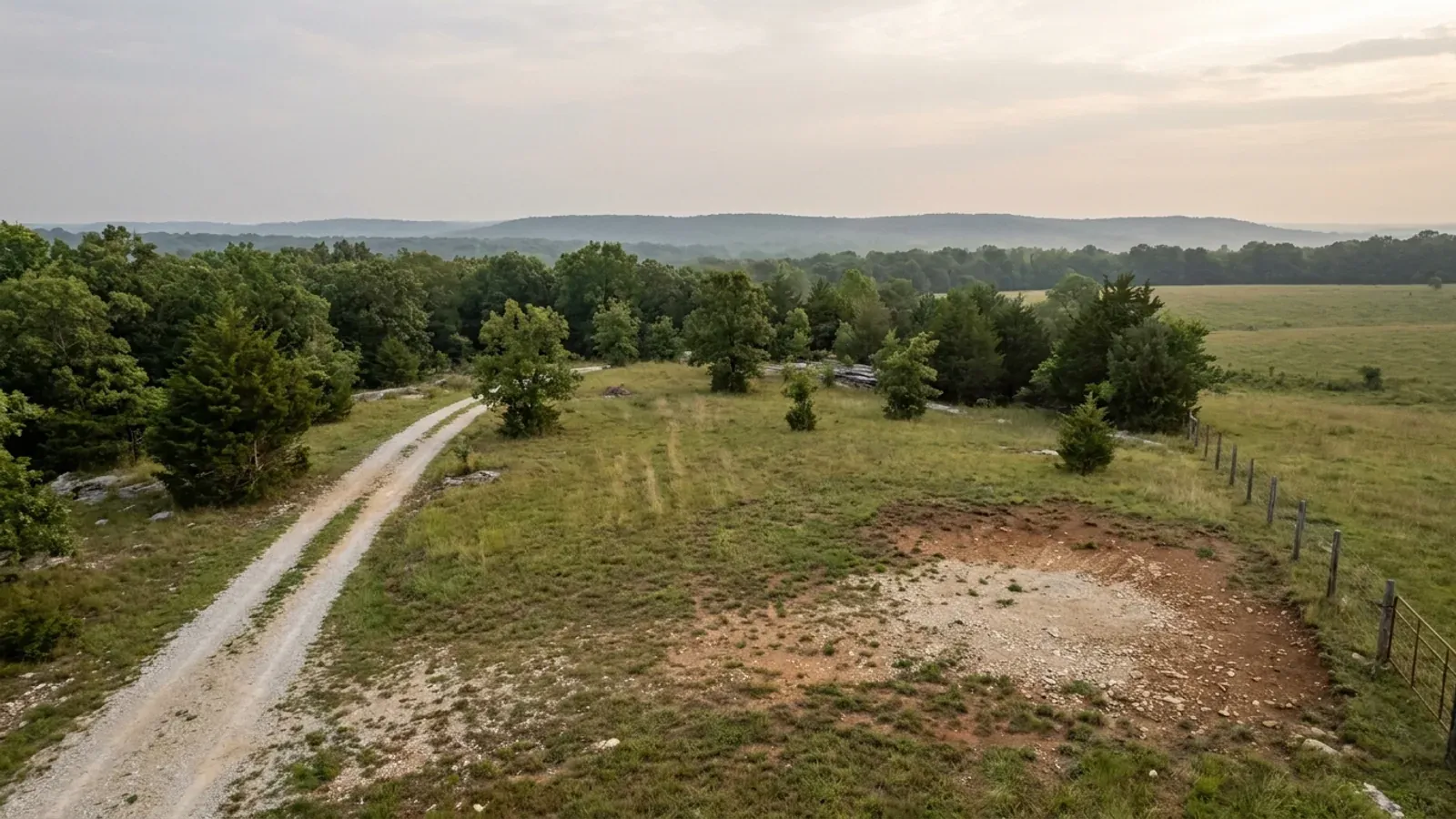
Zoning, setbacks, flood zone and utility access get checked before anything is drawn.
Pad and permit
Clearing, grading and a compacted pad, while the submittal works through whichever office issues the permit where you are building.
Frame to finish
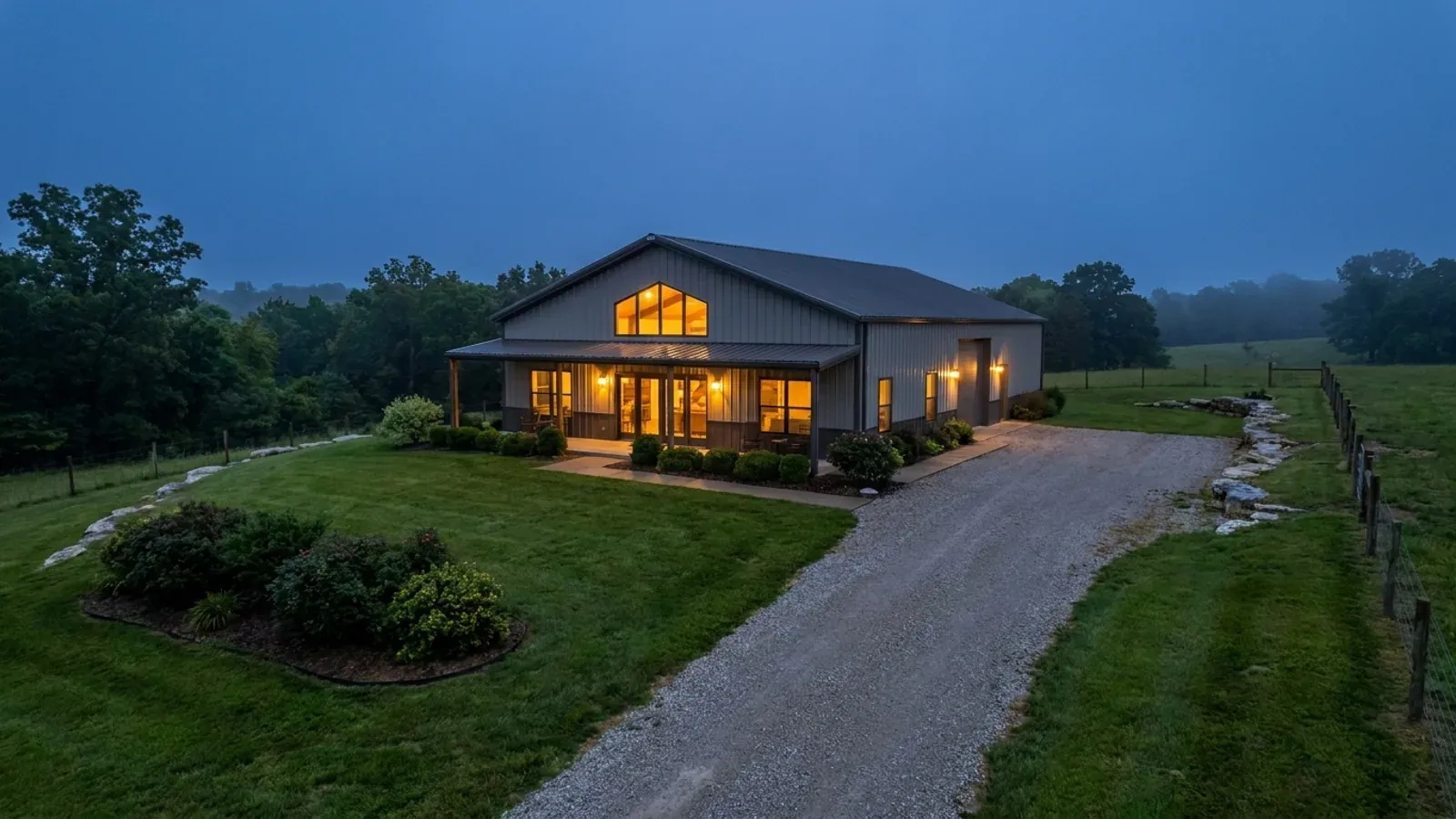
Shell erected and dried in, then systems, insulation and interior finish through to CO.
Those are the rules where you are building in Clay County. Tell us what you want to build and we will draw it to them.
Where we build around Clay County
Clay County and the rural land around it. The buildable acreage for a project this size usually sits outside the city limits, which is frequently what changes who issues your permit.
Keep reading
The questions that usually come next once you know what Clay County allows.
Barndominium Cost Guide
Sourced per-square-foot ranges by tier and by size, with a calculator built on the same figures.
Read itIs It Legal in Missouri?
Classification, zoning, the HOA gate, and why "nonresidential farm building" does not cover a home.
Read itHow Long Does It Take?
Census build-duration data, and what actually sets the permit clock where you are building.
Read itNearby areas we build in
Others we cover nearby, and they are not interchangeable. One may be a county with an adopted building code, another a county with no legal authority to have one, another a city that permits inside its own limits whichever county the land sits in. So the office that issues the permit, whether anyone inspects the work at all, the fees, the zoning and the design figures can differ from one card to the next — sometimes across a single property line.
Building in Clay County: common questions
8 questions we get asked most often about building in Clay County. If yours is not on the list, ask it directly.
My land is in Clay County. Who actually issues my building permit?
Can I put up a steel building with metal siding as my house?
I have five acres. Can I build the shop first and live in it while I build the house?
What design numbers will Clay County hold my drawings to?
Everyone says three acres means no septic permit. Is that true in Clay County?
What do I have to have in hand before the county will issue a building permit?
Clay County is on the 2012 code. Does an older code mean a cheaper build?
Where in Clay County can I still buy real acreage?
Building in Clay County?
Start with the plan. Tell us what you want to build and we will draw it, then confirm which office issues the permit for your parcel, what it will let you put there, and what wind load it has to meet. That conversation costs nothing.