Barndominium Builders in Sikeston, MO
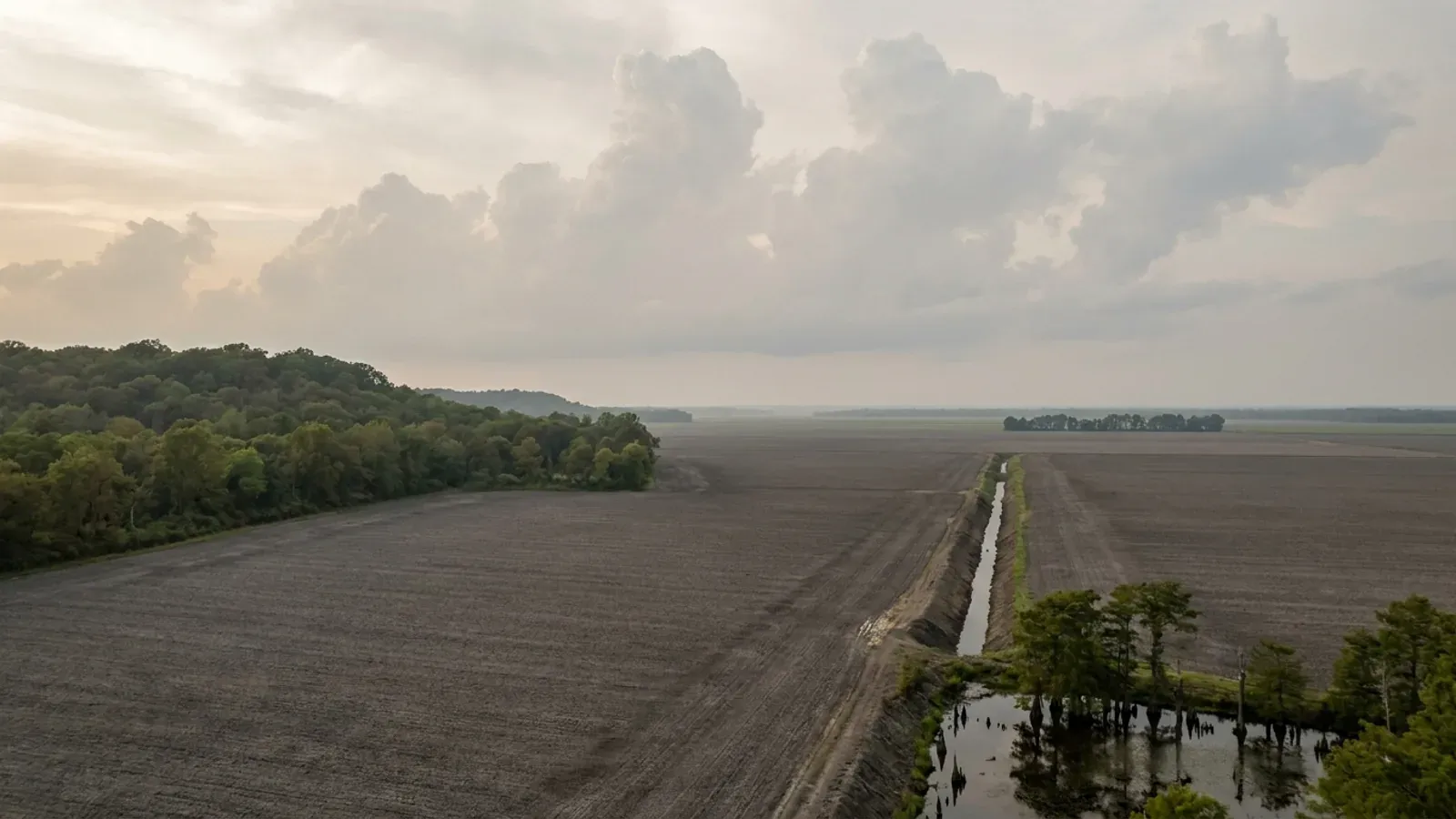
Sikeston is one city in two counties, and the split is written into its own rulebook: the zoning ordinance sets a minimum lot size and in the same sentence sends you to the Recorder of Deeds of Scott or New Madrid County. That line carries more weight here than it would anywhere else in Missouri, because the state's own hazard authority draws a boundary through the middle of the city. A 1991 State Emergency Management Agency and FEMA study of a magnitude 7.6 New Madrid earthquake put Scott County at 5 percent of structures collapsed and New Madrid County at 10 percent, and Sikeston is in both bands at once. Sikeston is also where the Missouri building-code story runs out. Both counties are third classification, so neither may adopt a county building code at all, and neither publishes a building department: inside the city limits the code is the City of Sikeston's, and outside them there is none. What the city adopted repays a second reading. It took the 2018 International Residential Code and amended it to delete all seismic sections, references, tables and charts, in the same section that fills in Table R301.2(1) with seismic design category E. Around all of that lies the best land in the state for this building type, flat drained Mississippi embayment alluvium, with New Madrid County averaging 1,419 acres a farm and Scott County 549, against a 308-acre Missouri average.
Sikeston at a glance
- County
- Scott County
- Population
- 16,062
- ZIP codes
- 63801
- Site visits
- Within the week from the St. Louis area
Building conditions in Sikeston
Missouri sets no residential building code and no statewide way of adopting one, so the first question on any parcel is not what the code says — it is whether there is one. Only counties of the first and second classification may adopt a building code at all, and classification is set by assessed valuation rather than population, so a small county can hold the power while a much larger one does not. Zoning is a separate power with its own answer, granted only after a vote of the people and repealable by another. What changes from one jurisdiction to the next is whether the work is inspected, who issues the permit, what that office charges, how the parcel is zoned, and the design figures your drawings have to satisfy.
City of Sikeston Municipal Code, Title V Building and Construction, Chapter 500 Building Regulations, Article II Residential Code For One and Two-Family Dwellings, Sections 500.080 and 500.090 (Ord. No. 5936, 4 November 2013; Ord. No. 6250, 6 December 2021), and Article I Building Code, Sections 500.010 and 500.020, on eCode360, read 6 September 2026
Revised Statutes of Missouri, Sections 319.200 (effective 28 August 1996), 319.203 (effective 28 August 1991) and 319.207 (effective 28 August 1990), rendered from revisor.mo.gov 6 September 2026
USGS Seismic Design Web Service, earthquake.usgs.gov, reference documents ASCE7-16 and ASCE7-22, Risk Category II, queried 6 September 2026; statewide comparison values from the same service, ASCE 7-16, as recorded in this project's statewide site-conditions research of 5 September 2026
Missouri Department of Natural Resources, Facts about the New Madrid Seismic Zone, dnr.mo.gov, fetched 6 September 2026; population split from U.S. Census Bureau Vintage 2024 Subcounty Population Estimates, file sub-est2024_29.csv, SUMLEV 157 place-part records for place 67790 in counties 29201 and 29143
City of Sikeston Municipal Code Section 500.090.A.8, Table R301.2(1) Climatic and Geographic Design Criteria (Ord. No. 6250, 6 December 2021), read on eCode360 6 September 2026; comparison figures from each named jurisdiction's own adopted table as recorded in this project's statewide site-conditions research, 5 September 2026
USDA National Agricultural Statistics Service, 2022 Census of Agriculture County Profiles, Missouri: New Madrid County (cp29143.pdf) and Scott County (cp29201.pdf), nass.usda.gov, downloaded 6 September 2026; state totals from NASS 2022 Census of Agriculture, Missouri, Volume 1 Chapter 2 Table 8, as recorded in this project's statewide geography research, 5 September 2026
Also worth knowing before you build in Sikeston
- Neither county may adopt a building code, and neither publishes a building department
- RSMo 64.170.1 empowers the county commission in all counties of the first and second classification to adopt regulations controlling construction and to issue building permits, and RSMo 64.205 states the scope negatively in one sentence: sections 64.170 to 64.200 shall apply to all counties of the first and second class. The Missouri Association of Counties list published in May 2025 puts Scott County and New Madrid County both in Class 3, among 89 of Missouri's 114 counties. Neither may adopt a county building code at all, and the situation only changes if assessed valuation changes the classification. The counties' own websites bear this out. Scott County's published department list runs from Ambulance District to Treasurer with no building, planning, zoning or code-enforcement office in it; its Office of County Development describes itself as responsible for infrastructure, business attraction and retention, marketing and the management of state and federal grants. New Madrid County's department list likewise carries no building or zoning office, but does carry a Floodplain Administration department that Scott County's does not. That difference is worth knowing before buying, because in a Missouri county without planning and zoning, RSMo 49.600 requires a vote of the people before the commission may adopt National Flood Insurance Program regulations at all, and lets voters rescind them by petition afterwards.
- The septic permit changes hands at the county line, inside the city
- Missouri's Department of Health and Senior Services runs on-site wastewater permitting through three authority types, and Sikeston's two counties fall into two different ones. Scott County's authority is the Scott County Health Department under a Contract authority type, at 102 Grove Estates Court, PO Box 129, Sikeston, MO 63801, on (800) 471-4044. New Madrid County's authority is DHSS itself, authority type DHSS, at 930 Wildwood Dr., Jefferson City, on (573) 751-6095 extension 5, with an application number requested through a state web form. DHSS also warns on the same page that some incorporated cities do not fall under the local permitting authority even where an ordinance is in place, in which case the local authority defers the permit back to DHSS, so an in-city parcel needs the question asked directly. Two further Missouri rules matter more here than the perc test everyone expects. Under 19 CSR 20-3.060 the state recognises two acceptable site evaluations, percolation tests or a soil morphology examination in a profile pit, and the administrative authority chooses which is used, so the right phrase for Missouri is soil morphology evaluation, or a percolation test if the local authority allows one. And RSMo 701.031 excludes the owner of a single-family residence lot of three acres or more from the state on-site sewage programme entirely, subject to setback and nuisance conditions, though DHSS is explicit that a local ordinance may still be more restrictive than the state standard.
- The ground under Sikeston: a soil named after the city, and the aquifer at the surface
- There is a USDA soil series called Sikeston, and its type location is in New Madrid County about three miles southeast of the city. Its official series description reads: The Sikeston series consists of very deep, poorly drained, moderately slowly permeable soils formed in loamy alluvium in depressional areas, channels, and sunken lowlands of flood plains. Slope gradients are 0 to 2 percent. On drainage it says: Poorly drained. Runoff is negligible or very low. Permeability is moderately slow. There is a permanent water table between 4 and 10 feet and a high water table that extends to the surface in undrained areas. That is the foundation problem here stated by the federal agency that maps it, and it is a foundation problem rather than a frame problem: high water and loose saturated alluvium are what liquefaction acts on. The regional picture matches. Missouri DNR's Southeastern Lowlands Groundwater Province fact sheet, dated 10 August 2021, describes the Bootheel province as all or parts of 11 counties over about 3,900 square miles, names Sikeston among the cities drawing public water from it, and records that the Southeast Lowlands Alluvial Aquifer is found at the surface, holds up to 21 trillion gallons, and supplies irrigation wells capable of pumping up to 3,000 gallons per minute. Water is not the constraint here that it is in northern Missouri; keeping it out from under a slab is.
- Radon runs backwards here: the worst-earthquake counties are the best-radon counties
- Parsed directly from the EPA's county-level Map of Radon Zones dataset on 6 September 2026, Missouri returns 115 rows, the 114 counties plus St. Louis city. Zone 1, the highest predicted indoor screening level at above 4 pCi/L, covers 11 counties: Andrew, Atchison, Buchanan, Cass, Clay, Clinton, Holt, Iron, Jackson, Nodaway and Platte, which is the Kansas City metro and the northwest corner with one Ozark outlier. Zone 3, the lowest at a predicted average below 2 pCi/L, covers exactly seven: Butler, Dunklin, Mississippi, New Madrid, Pemiscot, Scott and Stoddard. Both of Sikeston's counties are in that seven. The map with the highest seismic demand in Missouri and the map with the lowest radon potential in Missouri cover the same ground, so a page that says Missouri is a high-radon state is wrong in eleven counties' favour and seven counties' disfavour, and this city is in the seven. EPA's own caveats travel with the map and should be repeated: the Map of Radon Zones was developed in 1993, it should not be used to determine whether an individual home needs testing, and all homes should be tested regardless of zone designation. On a slab-on-grade building the passive sub-slab work costs almost nothing before the pour and is expensive to retrofit, so it is a design-time decision in any zone.
- The city amends the residential code line by line and never once touches the siding
- Sikeston has an adopted residential code and a department that inspects against it, so this is where a restriction on exterior materials would appear if the city had one. It does not. Chapter 500 adopts the 2018 International Residential Code by Ordinance No. 6250 and then rewrites it hard: it adds requirements about who prepares construction documents, forces plumbing walls to two-by-six framing, deletes the footings-for-wood-foundations section, deletes the pier and curtain wall foundation section, deletes the columns chapter, and strips every seismic reference out of the masonry foundation wall provisions. Not one of those amendments reaches exterior wall covering, and the chapter leaves the model code's exterior-covering provisions standing unaltered. Chapter 405, the zoning regulations, divides the city into fifteen districts and carries no prohibited-materials list, no minimum masonry percentage, no minimum roof pitch on a dwelling, no minimum eave projection, no minimum dwelling floor area and no design review or certificate-of-appropriateness process. The word corrugated appears once in the whole of Title IV, in the industrial use table, where it describes the manufacture of shipping containers. Two narrow appearance clauses do exist: underpinning around a manufactured home "shall be similar in appearance to materials used for the siding of the manufactured home to which it is attached" within ninety days of setup, and a group home's exterior appearance and other standards must equal those applying to single-family residences. The city also adopted the 2018 International Zoning Code as a companion at Section 500.1170, then deleted its agricultural, residential, commercial and industrial zone chapters outright and pointed the classifications back at Chapter 405, so nothing new about materials arrived with it. Chapters 420 and 425 are declarations of protective covenants adopted by the city, and both attach to a business and technology park and an industrial park rather than to housing. Outside the city limits neither county publishes a building or zoning office for a rule of this kind to sit in.
Revised Statutes of Missouri Sections 64.170 and 64.205, and Section 49.600, revisor.mo.gov; Missouri Association of Counties, Missouri Counties by Classification, published May 2025; Scott County Missouri county departments page and Office of County Development page, scottcountymo.com; New Madrid County departments menu, newmadridcountymo.gov. All fetched 6 September 2026
Missouri Department of Health and Senior Services, OWTS Construction Permit Process county selector, health.mo.gov, queried for Scott and New Madrid counties 6 September 2026; 19 CSR 20-3.060 and RSMo 701.031 as recorded in this project's statewide site-conditions research, 5 September 2026
USDA Natural Resources Conservation Service, Official Series Description, SIKESTON series, established series revised June 2007, soilseries.sc.egov.usda.gov, fetched 6 September 2026; Missouri Department of Natural Resources, Groundwater Provinces of Missouri: Southeastern Lowlands Groundwater Province, PUB3001, dated 10 August 2021, dnr.mo.gov, fetched 6 September 2026
United States Environmental Protection Agency, EPA Map of Radon Zones county-level dataset radon_zones-spreadsheet.xls, document number EPA 402/A-16/001, underlying map developed 1993, downloaded from epa.gov and parsed 6 September 2026; EPA Missouri Map of Radon Zones sheet, epa.gov, downloaded 6 September 2026
City of Sikeston Municipal Code Chapter 500 Building Regulations — Sections 500.010, 500.080, 500.090, 500.1170 and 500.1190 (Ord. No. 6218 of 26 April 2021, Ord. No. 6250 of 6 December 2021 and Ord. No. 6314 of 5 June 2023) — and Chapter 405 Zoning Regulations, Chapter 415 Subdivisions and Chapters 420 and 425 Declarations of Protective Covenants, all rendered in full from eCode360, custId SI3431, on 9 September 2026, the code's own currency line reading "Includes legislation through 04-06-2026"; the jurisdiction was taken from the page title returned in the same response as the text, and Title IV was fetched again as a separate document to re-read the load-bearing passages, which matched; a bogus id on the same host returns an honest 404 titled "eCode360 Error"
The expensive surprises are in the ground, not the building
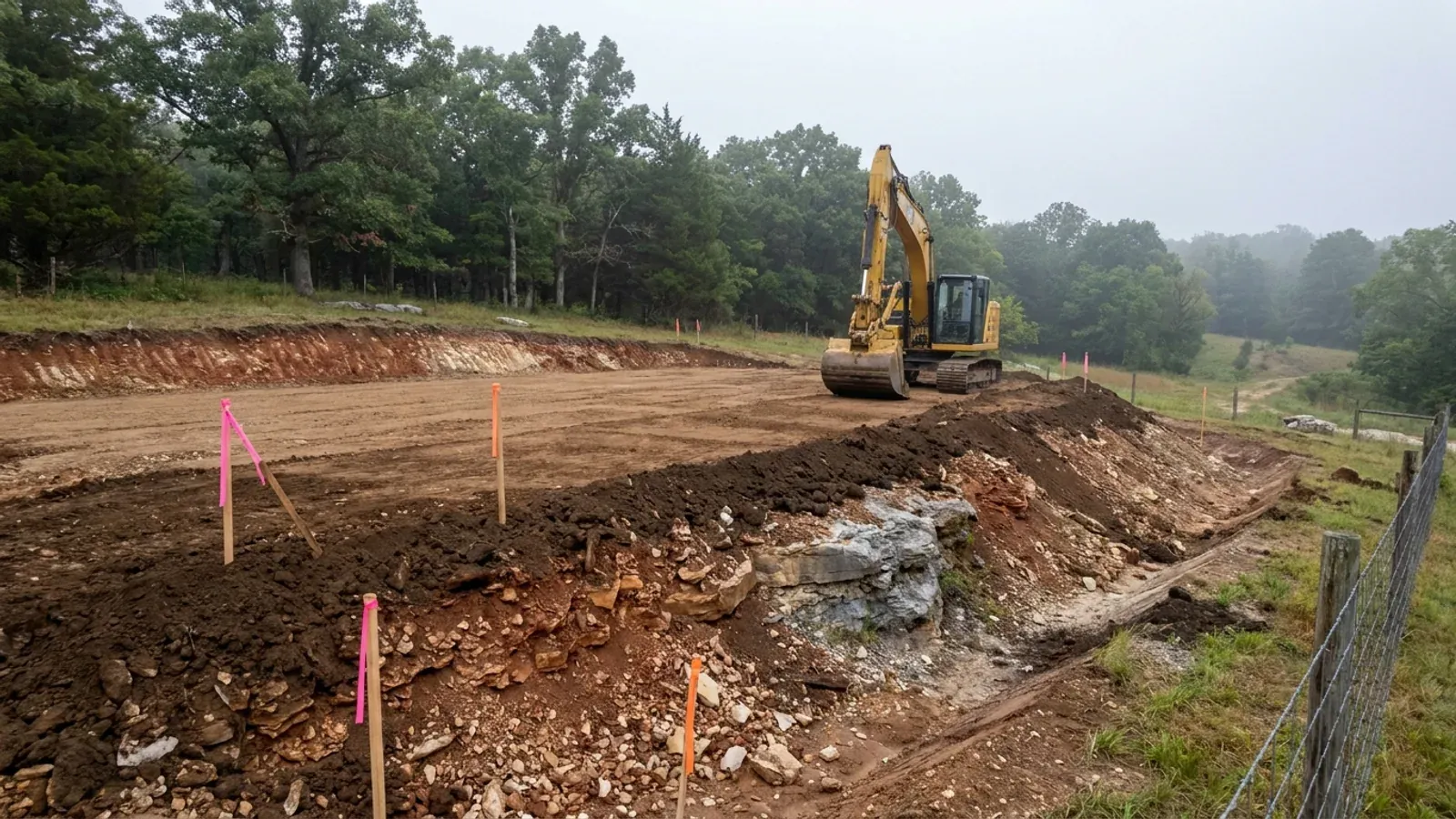
What moves a Missouri budget is usually below grade, and which problem you have depends on where in the state you are. Across the Ozarks it is karst: the Department of Natural Resources maps more than sixteen thousand sinkhole points, and what matters there is what is under the slab rather than what the slab sits in. Across the north and centre it is claypan — dense, slow-draining subsoil that perches water above it for months of the year. In the Bootheel it is deep alluvium carrying the highest seismic demand in the state, where the same soils modelled for liquefaction attack post embedment and slab bearing rather than the frame above them. The same ground then decides the septic system, and Missouri does not run that on a percolation test alone: the rule allows a perc test or a soil morphology examination in a profile pit, and the authority reviewing your parcel picks which. Where a drainfield sits near a sinkhole's drainage, perc testing on its own is not permitted at all. Whether that authority is the state or your own county is itself a local question, and it changes what you have to file. So the site work, the foundation and the drainfield get resolved together rather than one at a time. We price the dirt before we price the building.
What we build in Sikeston
All nine services are available in Sikeston. What a build costs depends far more on the parcel than on square footage, so we price against your land rather than publishing a rate card.
Custom Plans
Barndominium floor plans drawn to your parcel and your soil, and to whichever Missouri authority — a county, a city, or none at all — will review them.
Barndominium Kits
Barndominium shell packages delivered to your Missouri land, drawn to the criteria your own county or city publishes — because the state publishes none.
Turnkey Builds
Start to finish barndominium construction in Missouri: the permits that genuinely apply, site work, shell and interior finish, under one contract.
What a build looks like
Three stages every Sikeston project passes through, from a raw parcel to a finished home. Site work first, because that is where the budget is decided.
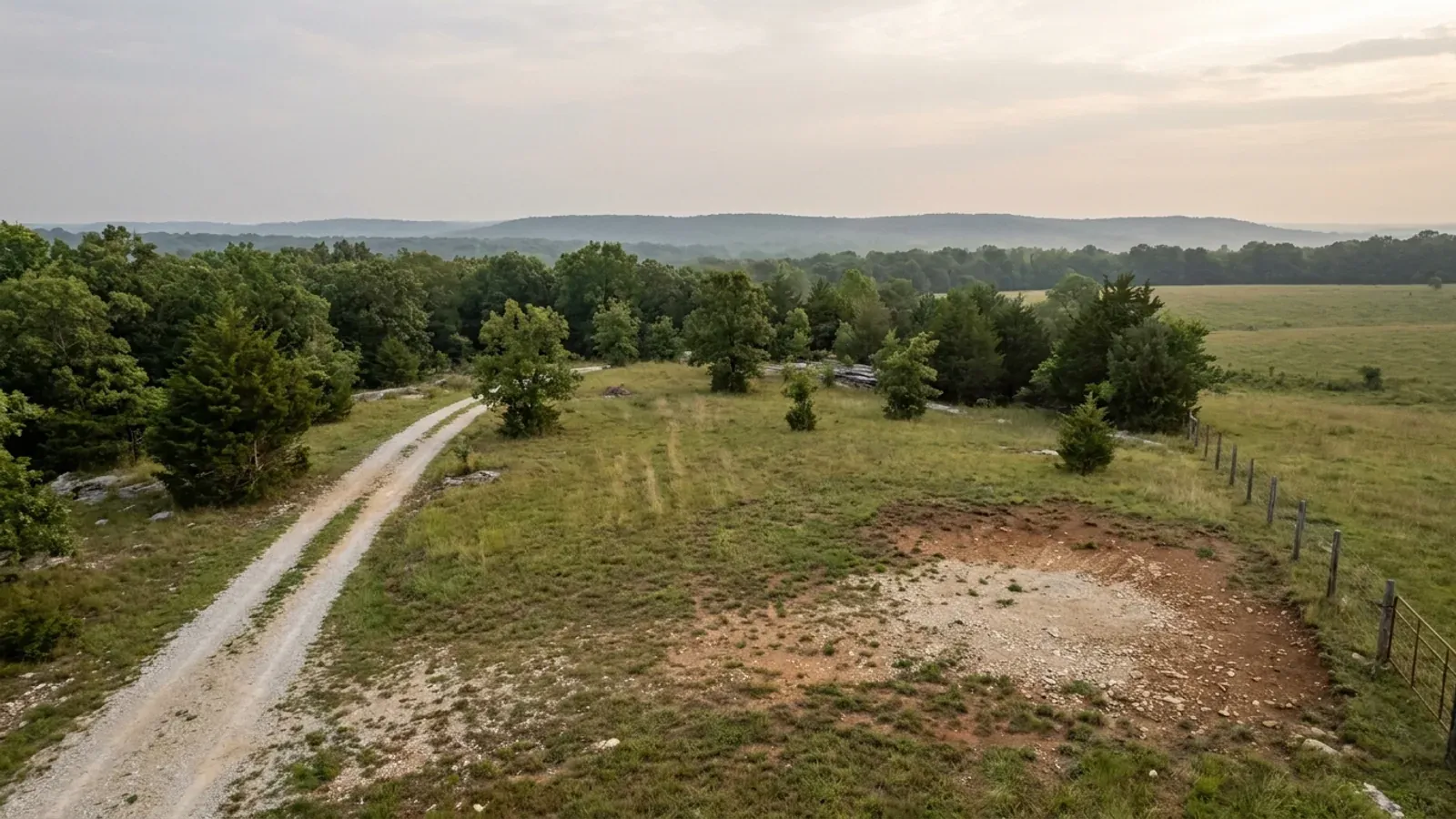
The parcel
Zoning, setbacks, flood zone and utility access get checked before anything is drawn.
Pad and permit
Clearing, grading and a compacted pad, while the submittal works through whichever office issues the permit where you are building.
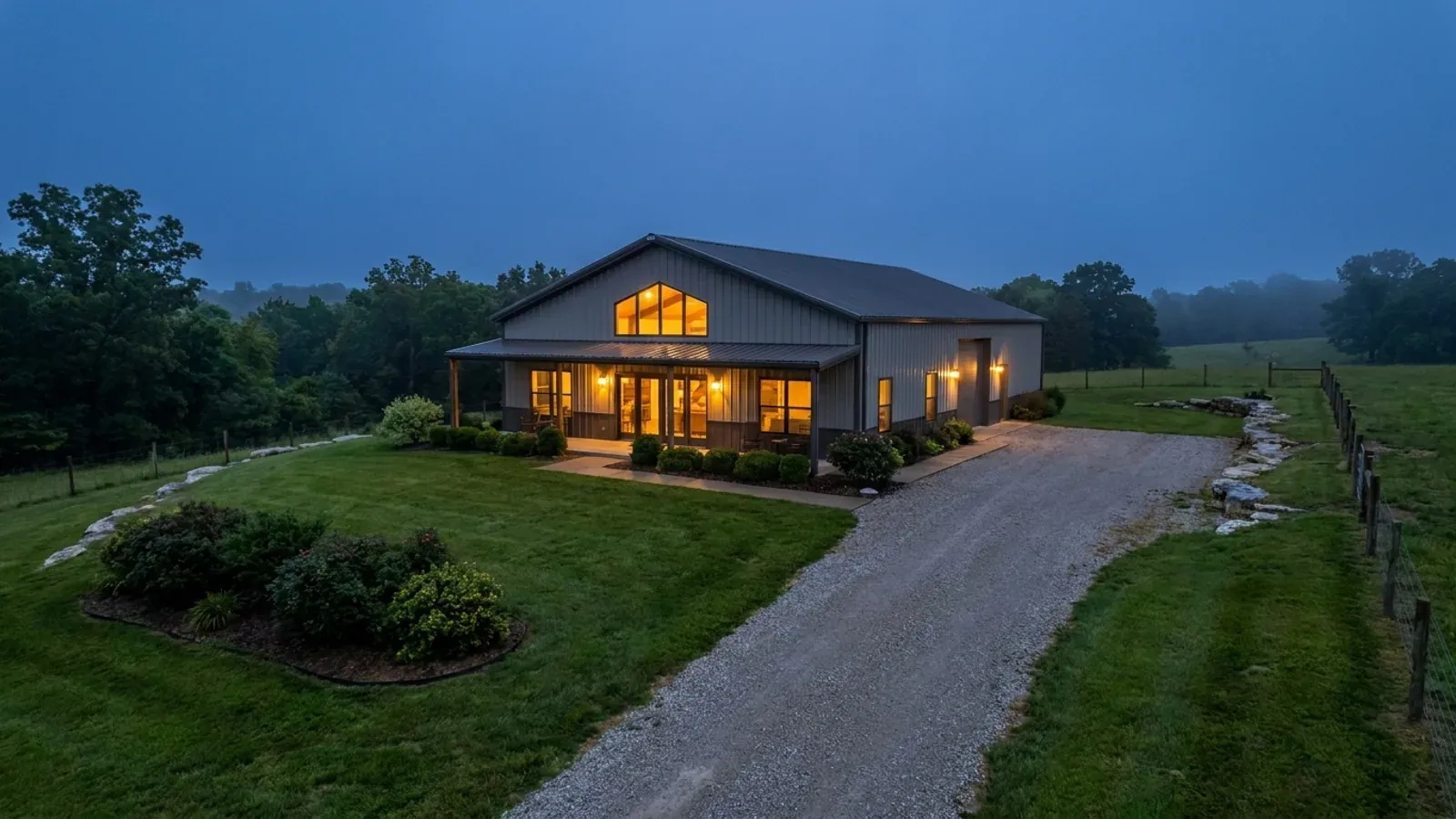
Frame to finish
Shell erected and dried in, then systems, insulation and interior finish through to CO.
Those are the rules where you are building in Sikeston. Tell us what you want to build and we will draw it to them.
Where we build around Sikeston
Scott County and the rural land around it. The buildable acreage for a project this size usually sits outside the city limits, which is frequently what changes who issues your permit.
Keep reading
The questions that usually come next once you know what Sikeston allows.
Barndominium Cost Guide
Sourced per-square-foot ranges by tier and by size, with a calculator built on the same figures.
Read itIs It Legal in Missouri?
Classification, zoning, the HOA gate, and why "nonresidential farm building" does not cover a home.
Read itHow Long Does It Take?
Census build-duration data, and what actually sets the permit clock where you are building.
Read itNearby areas we build in
Others we cover nearby, and they are not interchangeable. One may be a county with an adopted building code, another a county with no legal authority to have one, another a city that permits inside its own limits whichever county the land sits in. So the office that issues the permit, whether anyone inspects the work at all, the fees, the zoning and the design figures can differ from one card to the next — sometimes across a single property line.
Building in Sikeston: common questions
8 questions we get asked most often about building in Sikeston. If yours is not on the list, ask it directly.
Does Missouri's earthquake law force me to build my barndominium to a seismic standard?
Sikeston is in two counties. Which one am I in, and does it change anything?
Will anyone inspect my build if I buy land outside the Sikeston city limits?
What seismic design category applies to a house in Sikeston?
What does the New Madrid Seismic Zone actually change about a post-frame or steel-frame building?
Can I build a barndominium on acreage inside the Sikeston city limits?
What will the city charge me for the permit?
Is radon a problem in Sikeston?
Building in Sikeston?
Start with the plan. Tell us what you want to build and we will draw it, then confirm which office issues the permit for your parcel, what it will let you put there, and what wind load it has to meet. That conversation costs nothing.