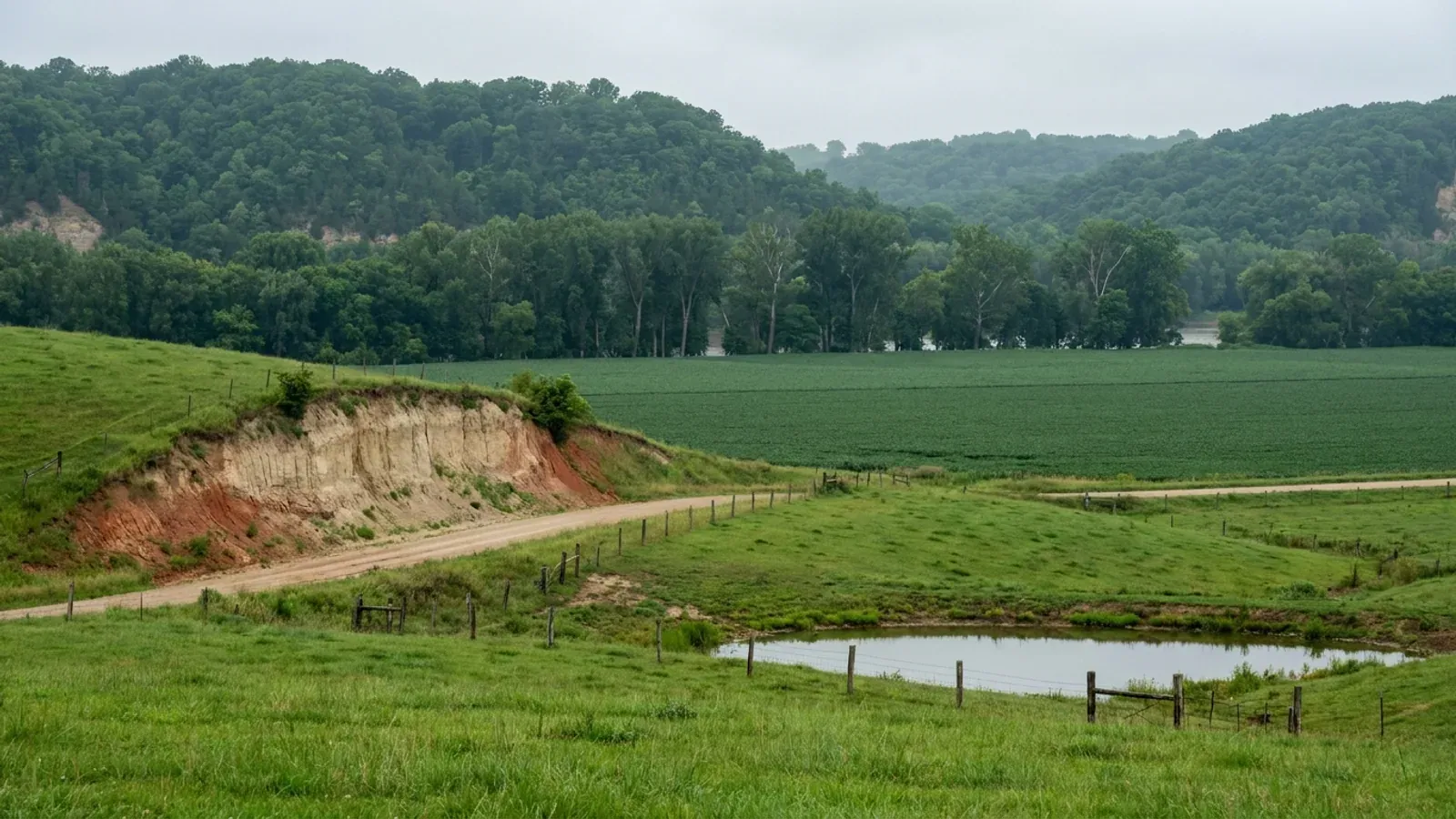
Barndominium Builders in Sedalia, MO
Sedalia is the clearest place in west-central Missouri to see how much the city limit decides. Inside it the City of Sedalia runs a Building and Code Department and enforces the 2021 International Building Code and the 2021 International Residential Code, adopted by Ordinance No. 12057 on 3 June 2024, with a filled-in Table R301.2 that a permit is actually issued against: 115 mph wind, 20 psf ground snow, seismic design category B, severe weathering, a 32-inch frost line, termite hazard moderate to heavy, an air freezing index of 1054 and a mean annual temperature of 55.3 degrees. Outside the limits there is no building permit of any kind, and the reason is not that Pettis County has never got round to it. Pettis County is a county of the fourth classification. That is the fact most often got wrong here, and it cuts the opposite way from the way it sounds. Fourth classification is not a lower rung below third — it is a grandfather status created by RSMo 48.020, whose Classification 4 paragraph provides that such a county 'shall remain a county in the second classification and shall operate under the laws of this state applying to the second classification.' RSMo 64.170 empowers 'the county commission in all counties of the first and second classification' to adopt construction regulations and issue building permits, and RSMo 64.205 says the same thing from the other side: sections 64.170 to 64.200 apply to all counties of the first and second class. So Pettis County may lawfully have a building code. It has simply chosen not to have one, and that is a different answer for a buyer than a county that is barred from having one — a choice can change at an election, and 64.170(2) sets out the ballot question for a county that had none before 28 August 2001. What the county has instead is a short list of real gates that catch people who assume no permit means no paperwork. The Pettis County Health Center holds onsite wastewater authority by its own ordinance rather than under the state programme, and its published summary of Pettis County Court Order 7-2007 #1233 says in terms that there are no exemptions for single-family residences — so the three-acre argument that works in some Missouri counties does not start here. A soil morphology examination, not a percolation test, is what supports a lagoon or an absorption field. Pettis County is also a participating National Flood Insurance Program community with an effective map dated 30 November 2023, so floodplain development is regulated on unincorporated ground even though nothing else about the building is. And 43 percent of the county's residents — 18,912 of 43,791 — live on exactly that ground, outside Sedalia, La Monte, Smithton, Green Ridge, Houstonia, Hughesville and the Windsor sliver. This is farming country and the land supports it: the 2022 Census of Agriculture counts 1,066 farms on 360,253 acres in Pettis County at a 338-acre average, 215,937 acres of it cropland, with livestock, poultry and products at 73 percent of $362.6 million in sales. A great many of those holdings already carry a working building, and the question a buyer asks next is whether a barndominium counts as one. In Missouri that question is answered by statute rather than by a county clerk's discretion. RSMo 64.620.2 excludes the erection, maintenance, repair, alteration or extension of farm buildings and farm structures from county zoning in second- and third-class counties — but only in an area not within the area shown on the flood hazard area map, and only where the county has zoning at all, which Pettis does not, because RSMo 64.510 would require a vote of the people first. Inside Sedalia the exemption question is answered differently again: the city defines 'Farming' as a tract of not less than five acres and treats livestock as agriculture only on ten acres or more, and its District A permits a farm dwelling only for the owner and tenants in conjunction with farm use. A house that is not part of a farm operation is not a District A use, whatever the building looks like. The ground here is prairie clay, not Ozark rock, and the foundation problem is the reverse of the one people expect. Across the 439,360-acre Pettis County soil survey, bedrock lies within 40 inches on 1,890 component-weighted acres — four-tenths of one percent. What governs instead is water and shrink-swell: 263,832 acres are somewhat poorly drained and another 28,929 poorly drained, 269,816 acres carry a horizon in the top five feet with linear extensibility of six percent or more, and the two dominant soils are Arisburg, a smectitic Aquertic Argiudoll with a perched saturated zone within 1.5 feet from January to April, and Hartwell, an Argialboll with a perched water table between half a foot and two feet from November to April. That water sits above the 32-inch frost line Sedalia publishes. On a slab-on-grade shop-and-house the drainage plan and the footing detail are the job, and neither the city nor the county fixes a presumptive soil bearing value by ordinance — the adopted model tables and whatever a site investigation supports are what a Missouri-licensed professional engineer designs to.
Sedalia at a glance
- County
- Pettis County
- Cities & counties covered
- Sedalia 22,310 · Pettis County 43,791 · Balance of Pettis County (unincorporated) 18,912
- Site visits
- Same-week site visits across Pettis County — Sedalia and the US 50/US 65 crossing, Smithton and Otterville east toward the Cooper County line, La Monte and Knob Noster west toward Johnson County, Hughesville, Longwood, Beaman and Houstonia north through the Blackwater country, and Green Ridge, Ionia and the Windsor edge south toward Truman Lake
Building conditions in Sedalia
Missouri sets no residential building code and no statewide way of adopting one, so the first question on any parcel is not what the code says — it is whether there is one. Only counties of the first and second classification may adopt a building code at all, and classification is set by assessed valuation rather than population, so a small county can hold the power while a much larger one does not. Zoning is a separate power with its own answer, granted only after a vote of the people and repealable by another. What changes from one jurisdiction to the next is whether the work is inspected, who issues the permit, what that office charges, how the parcel is zoned, and the design figures your drawings have to satisfy.
Missouri Association of Counties, 'Missouri Counties by Classification', published May 2025, PDF downloaded from mocounties.com and read 8 September 2026 — Pettis appears in the CLASS 4 block of four counties within a stated total of 114, under the document's own note 'CLASS 4 COUNTIES OPERATE UNDER THE LAWS OF CLASS 2 COUNTIES'; RSMo 48.020 (effective 28 Aug 2026, A.L. 2026 H.B. 1825), RSMo 64.170 (effective 28 Aug 2008) and RSMo 64.205 (effective 28 Aug 1963), each rendered from revisor.mo.gov and read 8 September 2026.
Sedalia, Missouri Code of Ordinances § 10-115(8), as enacted by Ord. No. 12057, § 2, adopted 3 June 2024; read on the Municode Library at Supplement No. 35, online content updated 18 May 2026, codified through Ordinance No. 12379 enacted 1 December 2025. Read 8 September 2026, and re-read after an independent re-navigation with the page title verified as 'ARTICLE IV. - BUILDING CODE | Code of Ordinances | Sedalia, MO'.
Pettis County official website (pettiscomo.gov), County Offices and Directory pages, read 8 September 2026 — a bogus path on the same host returns an honest HTTP 404; Pettis County Fire District (pettiscofire.org) Stations page and full page inventory enumerated through the site's own WordPress index, read 8 September 2026, with a bogus path returning an honest 404; RSMo 321.228 (effective 28 Aug 2012) and RSMo 321.220, rendered from revisor.mo.gov and read 8 September 2026.
Missouri DHSS, OWTS Construction Permit Process county selector, requested with ?county=Pettis and read 8 September 2026 — validated the same session against the known-good control ?county=Camden, which returned Camden County Wastewater Dept., authority type Ordinance, while a bogus value returned the page's own error 'The submitted value ... in the county element is not allowed'; ordinance detail from the Pettis County Health Center's published 'Summary of Pettis County On-site Wastewater Ordinance' (Pettis County Court Order 7-2007 #1233), from a dated Internet Archive capture of 17 April 2021, the health centre's live site being off air on 8 September 2026; RSMo 701.031 and RSMo 701.047.
Sedalia, Missouri Code of Ordinances §§ 64-1, 64-36, 64-37(b)(11)b, 64-37(c)(7), 64-62(a), 64-63, 64-151 and 64-154(d)(6), and ch. 10 art. IV §§ 10-114 and 10-115; read on the Municode Library at Supplement No. 35, online content updated 18 May 2026, page titles verified as 'ARTICLE I. - IN GENERAL', 'ARTICLE II. - DISTRICTS' and 'ARTICLE VI. - ADDITIONAL REGULATIONS | Code of Ordinances | Sedalia, MO'. Read 8 September 2026.
USDA-NRCS Soil Data Access tabular service, queried 8 September 2026 for legend areasymbol MO159 (Pettis County, Missouri; 439,360 acres, 93 map units) — restriction, drainage class, linear-extensibility and slope figures are component-percentage-weighted acres; a bogus areasymbol returned an empty result on the same endpoint in the same session. Series characteristics from the Official Series Descriptions for ARISBURG and HARTWELL at soilseries.sc.egov.usda.gov, read 8 September 2026, where a bogus series name returns an honest HTTP 404.
Also worth knowing before you build in Sedalia
- The farm-building exemption here is a statute, not a county policy — and it stops at the floodplain
- Missouri counties differ enormously in how they treat agricultural buildings, which is why the question is worth asking before buying rather than after. In Pettis County the answer has two layers. There is no county zoning and no county building code, so at present nothing regulates a farm building on unincorporated ground, and there is no exemption to apply for because there is nothing to be exempt from. If the county ever did zone, it would first need a vote of the people under RSMo 64.510, and the exemption would then come from the statute rather than from a local decision: RSMo 64.620.2 provides that county zoning in second- and third-class counties 'shall not apply ... to the raising of crops, livestock, orchards, or forestry' and 'shall not apply to the erection, maintenance, repair, alteration or extension of farm buildings or farm structures used for such purposes in an area not within the area shown on the flood hazard area map.' That last clause is the sharp edge — the statutory farm-building exemption does not reach into the mapped floodplain, and Pettis County is a participating National Flood Insurance Program community with an effective map dated 30 November 2023. Inside Sedalia the definitions do the work instead, and they use two different acreages. Section 64-1 defines 'Farming' as the use of a tract of land, not less than five acres, for cultivating and harvesting crops or raising and managing livestock or poultry, and says it may include the residence of those engaged in agricultural production; it separately treats the raising and feeding of livestock and poultry as an agricultural venture only where the area is ten acres or more and the livestock is incidental or supplemental to the raising of crops. District A then permits farming, accessory farm buildings including barns, sheds, silos, windmills, stables, pens and kennels, and 'Farm dwellings provided for the owner and tenants in conjunction with farm use' — a dwelling untethered from a farm operation is not a permitted District A use however the building is clad. And none of that is a permit exemption: the city adopted no agricultural appendix, and the only detached accessory structure exempt from a building permit is 200 square feet or less.
- Sedalia deleted the energy chapter outright, from both the residential and the building code
- For a metal-skinned or post-frame building the envelope is most of the cost and most of the comfort, so what a jurisdiction has removed from its energy provisions matters as much as what it kept. Sedalia has removed all of them. Section 10-115(15) deletes IRC Chapter 11, Energy Efficiency, in its entirety. Section 10-114(17) deletes IBC Chapter 13, Energy Efficiency, in its entirety. Section 10-114(9) deletes IBC 110.3.9, energy efficiency inspections. And the adopted-codes list in Chapter 10 contains no International Energy Conservation Code of any year. So inside the city there is no enforced insulation table, no air-leakage target, no duct-sealing requirement and no mandatory blower-door or duct-leakage test; outside the city there is nothing at all, because the county adopts nothing. That is not an argument for building a cold shell — a 55.3-degree mean annual temperature and an air freezing index of 1054, both from the city's own table, describe a climate that punishes a thin envelope. It is an argument for writing the insulation, the vapour control and the air-sealing detail into the build contract as specified numbers, because no inspector in this market is going to check them for you.
- Missouri has no state general-contractor licence, and Sedalia does not create one
- There is no statewide general contractor licence in Missouri to hold, and Sedalia has not filled the gap with a local one. Its published fee schedule licenses trades and businesses, not builders: master and journeyman plumber certificates at $25 a year each under section 10-330, and a general business licence category for 'Contractors' that names paper hanger, painting, plastering, sewer, brick, cement, sidewalk and bridge contractors, taxed on annual gross earnings from $15 up to $110. There is no general building contractor licence in the schedule and none in the Community Development permits and licensing list, which runs building, electrical, plumbing, mechanical, special use and sign permits, rezoning, occupational business licence and zoning maps. Unincorporated Pettis County licenses nothing of the kind either. What that means for a buyer is that the checks a licence would otherwise carry have to be made by hand: ask for the permit history in the city where the builder has worked, ask who seals the foundation and framing drawings, and get the insurance certificates directly from the carrier rather than from the contractor.
- Starting without a permit inside the city doubles the fee, and the certificate of occupancy is applied for first
- Two procedural traps catch people who treat a Sedalia permit as paperwork to be caught up on later. Section 10-90 provides that anyone who commences work requiring a permit without first obtaining one shall, if later permitted to obtain a permit, 'pay double the fee fixed for such work', and Appendix A states the same as 200 percent of the applicable permit fee; the only relief is genuine emergency work that could not practically have waited. And the certificate of occupancy runs the other way round from most people's expectation. Section 64-158(c) provides that no permit for excavation for any building shall issue before application has been made for the certificate of occupancy, and 64-158(d) requires the application in writing coincident with the building permit application. So on a barndominium the occupancy application is part of the opening paperwork, not the closing paperwork. Permits also expire: section 10-87(d) voids one where work is not commenced within 180 days, or is suspended or abandoned for 180 days, and reactivation costs half the original fee. Base permit cost is $50 up to $1,000 of construction value plus $6 for each additional $1,000, with electrical, plumbing and commercial mechanical permits on the same $50-plus-$6 basis.
- The adopted seismic category and the current USGS value disagree, and the site class decides which is right
- Sedalia's own Table R301.2 prints seismic design category B, and that is the figure the permit is issued against. The USGS Seismic Design Web Service, queried at the city's Census internal point on 8 September 2026, returns ASCE 7-16 spectral accelerations of Ss 0.137 g and S1 0.084 g. At Site Class D those give SDS 0.146, SD1 0.134 and category C; at Site Class C they give SDS 0.118, SD1 0.084 and category B. Under ASCE 7-22 the same point returns Ss 0.23 g and S1 0.10 g, SDS 0.20 and SD1 0.14, and category C at Site Class D. Both figures belong on the page and neither cancels the other: the adopted category governs the permit, and the site class — which is established by investigation at the parcel, not read off a map — is what moves the answer between B and C. On the soils described above, softer and wetter than average, the site class is a question worth answering rather than assuming. For most houses Sedalia removes the issue anyway: section 10-115(32) provides that pursuant to RSMo 319.203 no provision of the IRC requiring seismic design and construction provisions shall apply to any single-family or duplex residence.
- Forty-three percent of Pettis County lives on ground with no building code, on farms averaging 338 acres
- The unincorporated share here is not a rounding error. Of 43,791 residents in Pettis County, 18,912 live in the balance of the county outside every incorporated place — 43 percent — while Sedalia holds 22,310 and the remaining towns are small: La Monte 1,009, Green Ridge 599, Smithton 504, Houstonia 195, Hughesville 152 and a 110-person slice of Windsor. The land those people live on is working farmland at scale. The 2022 Census of Agriculture counts 1,066 farms in Pettis County on 360,253 acres at a 338-acre average, made up of 215,937 acres of cropland, 63,854 of pastureland, 53,324 of woodland and 27,138 other. Market value of products sold was $362,647,000, up 52 percent since 2017, with livestock, poultry and products at 73 percent of it. By size, 355 farms fall between 50 and 179 acres and 207 between 180 and 499 — the bracket most barndominium buyers are actually shopping in. This is also the reason so many enquiries here start from a building that already exists: a county this heavily farmed is a county where the buyer already owns a pole barn and is asking what it would take to live in one.
- Sedalia's own agricultural district is five acres, five percent coverage and no height limit
- It surprises people that the city has an agricultural zone at all, and its numbers are unlike anything in the residential districts. Section 64-36 states District A's purpose as preserving prime agricultural land, protecting existing farm operations from nonfarm objections and restricting low-density rural development until utilities are feasible. Its dimensional rules are: a minimum of five acres for all lots or parcels; a maximum area density of five percent of the land area covered by buildings or structures; no height restriction except as prescribed by federal aviation requirements; a front yard of at least 80 feet measured from the centreline of the travelled road, on both roads for a corner lot; and side and rear yards of at least 50 feet. On a five-acre parcel that five-percent figure works out to a little under 11,000 square feet of total building footprint, which is generous for a house-plus-shop and is a coverage cap rather than a per-building cap. The permitted-use list is agricultural first and residential only derivatively: farming; farm dwellings for the owner and tenants in conjunction with farm use; accessory farm buildings and structures including barns, sheds, silos, windmills, stables, pens and kennels; grain elevators, orchards, nurseries and greenhouses; roadside stands for produce grown on the premises; and several institutional and open-land uses. The height point is the practical one for this building type — a District A parcel is the one place inside the city where a 20-foot eave on a working shop is not fighting a 35-foot, two-and-a-half-storey ceiling.
- No instrument here fixes a presumptive soil bearing value
- Some Missouri jurisdictions write a presumptive load-bearing value into their ordinances, so a designer can size a footing without a site investigation. Sedalia does not. The city's codified amendment lists to the 2021 IBC and the 2021 IRC were read in full and neither touches IBC Section 1806 or Table 1806.2, nor IRC Section R401 or Table R401.4.1 — the model provisions run unamended, which means the presumptive values are the code's own and the building official retains the code's power to require a soil investigation. Unincorporated Pettis County fixes nothing because it adopts nothing. One older document is worth knowing about so it is not relied on: a Community Development 'Building Guidelines' sheet still published on the city's website recites the 2015 code editions and an amendment to IBC Section 1809.5 requiring footings and foundations to extend not less than 32 inches below finished grade, along with prescriptive footing and rebar details. Those amendments do not appear in the current codified text under Ordinance No. 12057. The 32-inch depth is still the operative number for a residential footing, but it comes from the frost line depth in the city's own Table R301.2 read with IRC R403.1.4, not from a surviving IBC 1809.5 amendment. On soils with linear extensibility of six percent or more across three-fifths of the county, a bearing value taken from a table rather than from a boring is a thin basis for a slab in any case.
RSMo 64.510 (effective 28 Aug 1963) and RSMo 64.620 (effective 4 Mar 1991), rendered from revisor.mo.gov and read 8 September 2026; Sedalia, Missouri Code of Ordinances §§ 64-1, 64-36(b) and 10-114(6), Municode Supplement No. 35 (18 May 2026), read 8 September 2026; NFIP status from the OpenFEMA NfipCommunityStatusBook API, all 888 Missouri rows pulled and filtered locally on 8 September 2026 — Pettis County, CID 290823, participating, regular programme from 1 May 1994, currently effective map 30 November 2023.
Sedalia, Missouri Code of Ordinances §§ 10-113, 10-114(9), 10-114(17) and 10-115(15), as enacted by Ord. No. 12057, § 2, adopted 3 June 2024; Municode Library, Supplement No. 35, online content updated 18 May 2026. Read 8 September 2026.
Sedalia, Missouri Code of Ordinances Appendix A, City Fee Schedule, chapters 10 and 12, read on the Municode Library at Supplement No. 35 (content updated 18 May 2026) where the appendix is flagged as modified in that version; City of Sedalia Community Development permits and licensing index at sedalia.com, read 8 September 2026, where a bogus path on the same host returns an honest HTTP 404.
Sedalia, Missouri Code of Ordinances §§ 10-87(d), 10-88, 10-90, 10-92 and 64-158, and Appendix A City Fee Schedule ch. 10; Municode Library, Supplement No. 35, online content updated 18 May 2026, codified through Ordinance No. 12379 enacted 1 December 2025. Read 8 September 2026.
Sedalia, Missouri Code of Ordinances § 10-115(8) and § 10-115(32), Municode Supplement No. 35 (18 May 2026); USGS Seismic Design Web Service, /ws/building-codes/asce7-16/calculate and /asce7-22/calculate at 38.705239, -93.235819, Risk Category II, Site Classes C and D, queried 8 September 2026 and judged by the payload's own request.status field — a bogus coordinate on the same endpoint returns status 'error' and a bogus reference document returns the service's HTML shell rather than data.
Census Bureau Vintage 2024 population estimates, sub-county file sub-est2024.csv and county file co-est2024-alldata.csv from www2.census.gov, downloaded 8 September 2026 (Sedalia city 22,310; Pettis County 43,791; Balance of Pettis County 18,912); USDA NASS 2022 Census of Agriculture county profile for Pettis County, Missouri (cp29159.pdf), downloaded and read 8 September 2026, where a bogus FIPS returns a 196-byte HTTP 404 on the same host.
Sedalia, Missouri Code of Ordinances § 64-36 (Code 1982, § 31-16.1; Ord. No. 7763, § 5, 9-8-1981; Ord. No. 10285, § 2, 3-16-2015, which the codifier's editor's note records as having amended and renumbered former § 64-46 as new § 64-36), read on the Municode Library at Supplement No. 35, online content updated 18 May 2026, page title verified as 'ARTICLE II. - DISTRICTS | Code of Ordinances | Sedalia, MO'. Read 8 September 2026.
Sedalia, Missouri Code of Ordinances §§ 10-114 and 10-115 read in full on the Municode Library at Supplement No. 35 (18 May 2026) on 8 September 2026, containing no amendment to IBC 1806, IBC 1809 or IRC R401/R403; City of Sedalia Department of Community Development 'Building Guidelines' PDF at sedalia.com, downloaded and read 8 September 2026, which states on its first page that its requirements come from the 2015 editions of the International Building Code and International Residential Code.
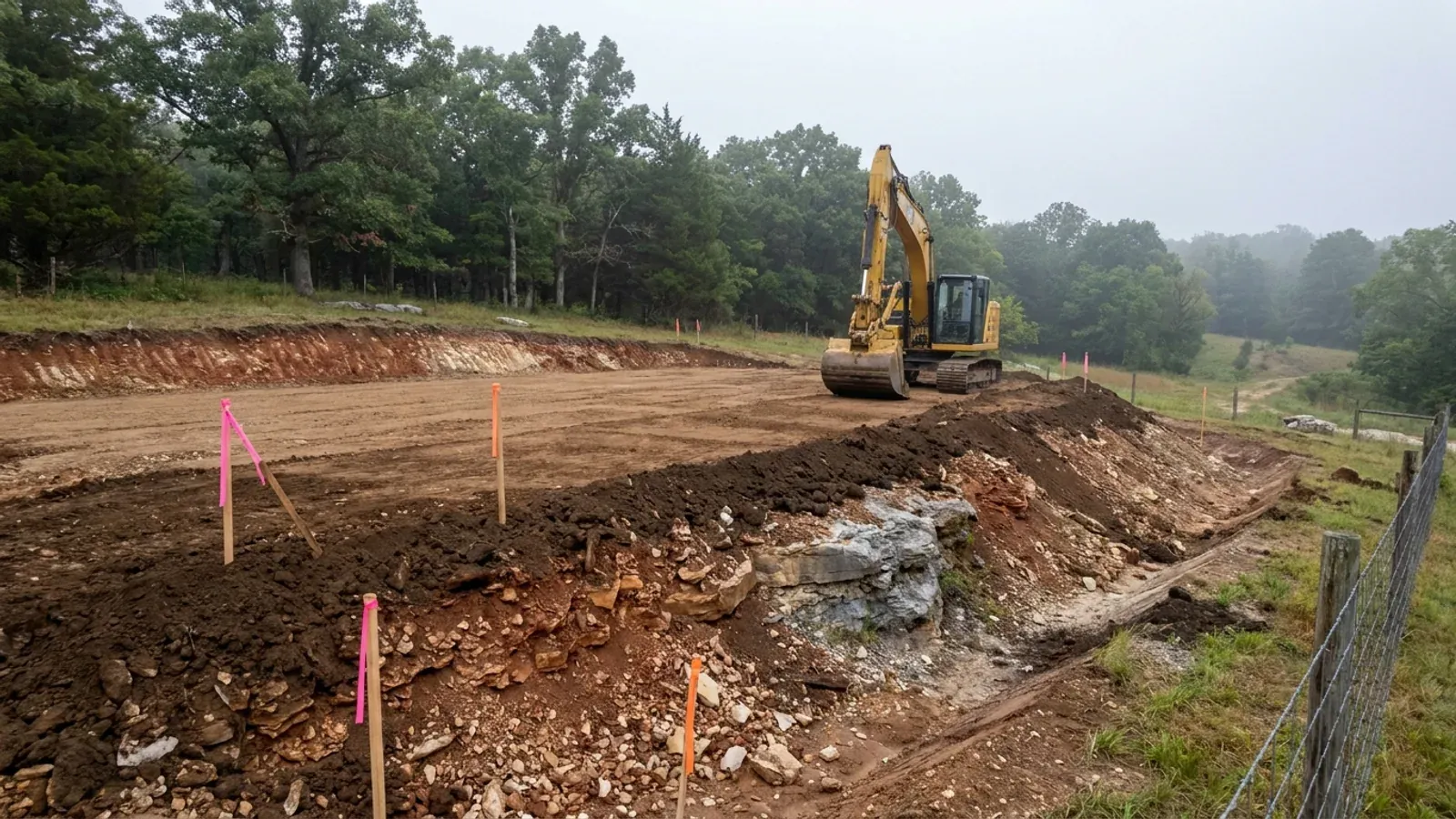
The expensive surprises are in the ground, not the building
What moves a Missouri budget is usually below grade, and which problem you have depends on where in the state you are. Across the Ozarks it is karst: the Department of Natural Resources maps more than sixteen thousand sinkhole points, and what matters there is what is under the slab rather than what the slab sits in. Across the north and centre it is claypan — dense, slow-draining subsoil that perches water above it for months of the year. In the Bootheel it is deep alluvium carrying the highest seismic demand in the state, where the same soils modelled for liquefaction attack post embedment and slab bearing rather than the frame above them. The same ground then decides the septic system, and Missouri does not run that on a percolation test alone: the rule allows a perc test or a soil morphology examination in a profile pit, and the authority reviewing your parcel picks which. Where a drainfield sits near a sinkhole's drainage, perc testing on its own is not permitted at all. Whether that authority is the state or your own county is itself a local question, and it changes what you have to file. So the site work, the foundation and the drainfield get resolved together rather than one at a time. We price the dirt before we price the building.
What we build in Sedalia
All nine services are available in Sedalia. What a build costs depends far more on the parcel than on square footage, so we price against your land rather than publishing a rate card.
Custom Plans
Barndominium floor plans drawn to your parcel and your soil, and to whichever Missouri authority — a county, a city, or none at all — will review them.
Barndominium Kits
Barndominium shell packages delivered to your Missouri land, drawn to the criteria your own county or city publishes — because the state publishes none.
Turnkey Builds
Start to finish barndominium construction in Missouri: the permits that genuinely apply, site work, shell and interior finish, under one contract.
What a build looks like
Three stages every Sedalia project passes through, from a raw parcel to a finished home. Site work first, because that is where the budget is decided.
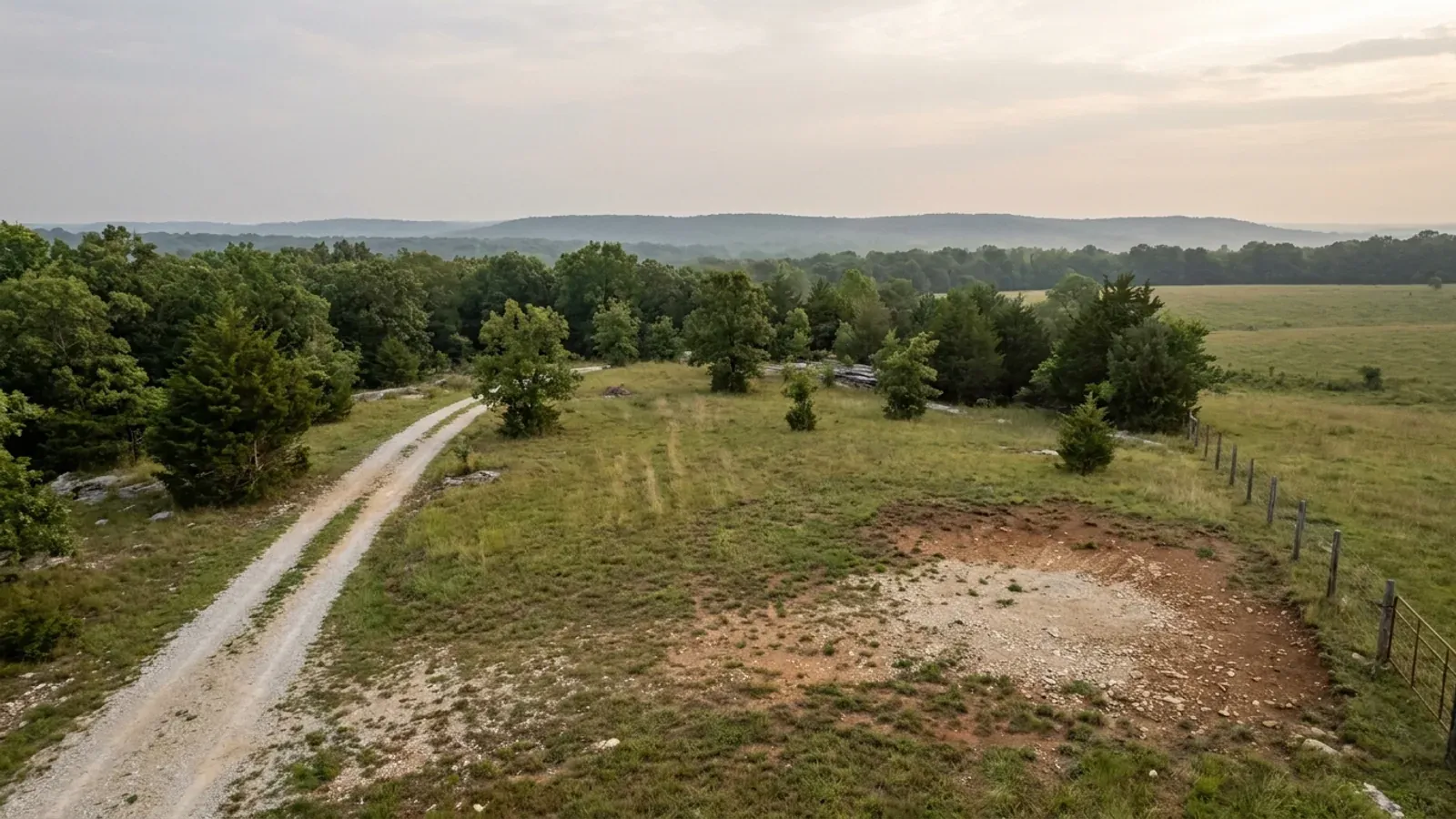
The parcel
Zoning, setbacks, flood zone and utility access get checked before anything is drawn.
Pad and permit
Clearing, grading and a compacted pad, while the submittal works through whichever office issues the permit where you are building.
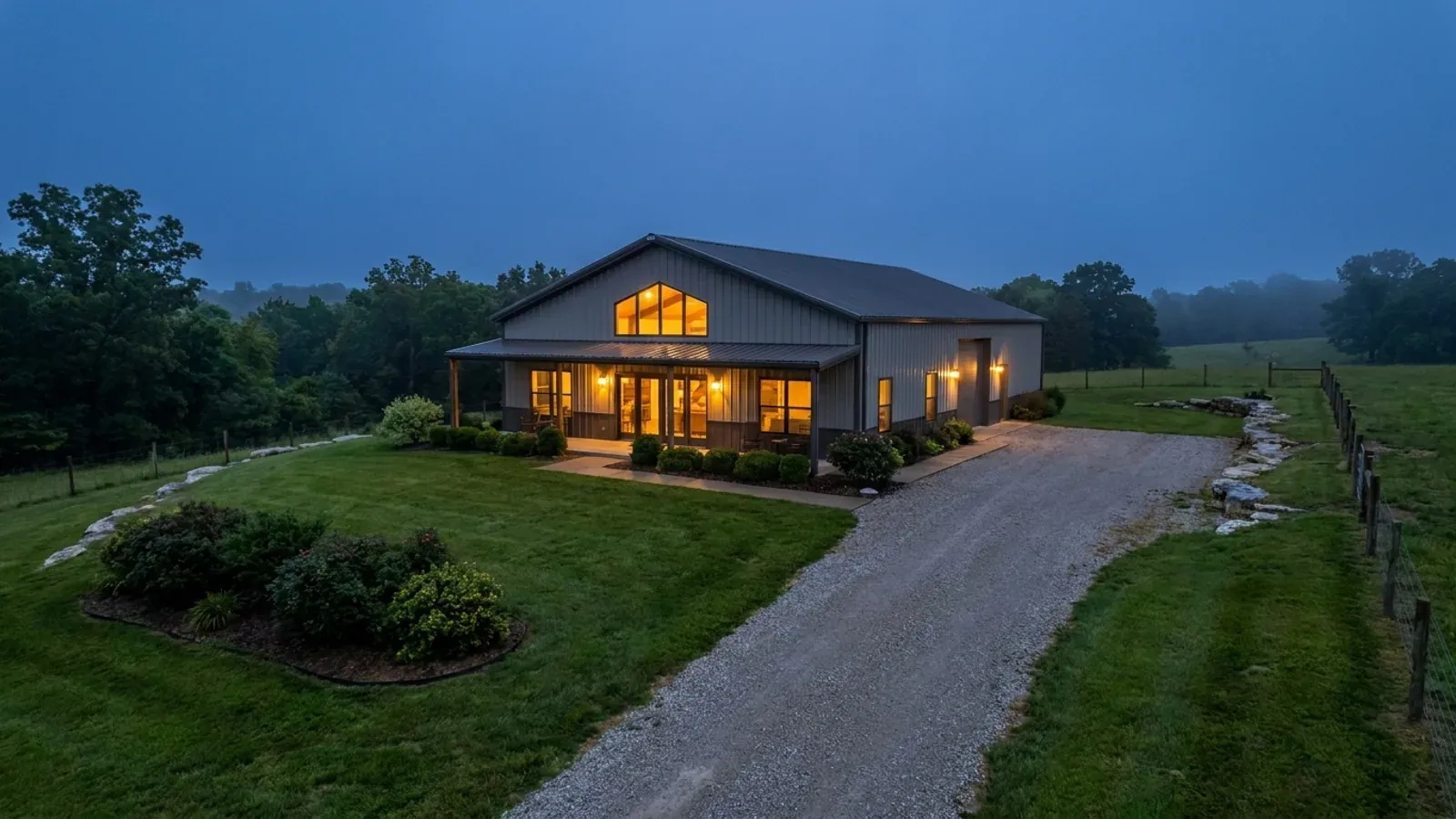
Frame to finish
Shell erected and dried in, then systems, insulation and interior finish through to CO.
Those are the rules where you are building in Sedalia. Tell us what you want to build and we will draw it to them.
Where we build around Sedalia
Pettis County and the rural land around it. The buildable acreage for a project this size usually sits outside the city limits, which is frequently what changes who issues your permit.
Keep reading
The questions that usually come next once you know what Sedalia allows.
Barndominium Cost Guide
Sourced per-square-foot ranges by tier and by size, with a calculator built on the same figures.
Read itIs It Legal in Missouri?
Classification, zoning, the HOA gate, and why "nonresidential farm building" does not cover a home.
Read itHow Long Does It Take?
Census build-duration data, and what actually sets the permit clock where you are building.
Read itNearby areas we build in
Others we cover nearby, and they are not interchangeable. One may be a county with an adopted building code, another a county with no legal authority to have one, another a city that permits inside its own limits whichever county the land sits in. So the office that issues the permit, whether anyone inspects the work at all, the fees, the zoning and the design figures can differ from one card to the next — sometimes across a single property line.
Building in Sedalia: common questions
9 questions we get asked most often about building in Sedalia. If yours is not on the list, ask it directly.
Do I need a building permit for a barndominium in Pettis County, outside Sedalia?
Could Pettis County adopt a building code later?
How deep do the footings have to go here?
Are metal siding or a low roof pitch a problem in Sedalia?
How big a shop can I put up alongside the house?
Does the three-acre septic exemption apply in Pettis County?
Does calling it an agricultural building get me out of anything?
Is there a licence I should be checking a builder for in Missouri?
What is the difference between building inside Sedalia and just outside it?
Building in Sedalia?
Start with the plan. Tell us what you want to build and we will draw it, then confirm which office issues the permit for your parcel, what it will let you put there, and what wind load it has to meet. That conversation costs nothing.