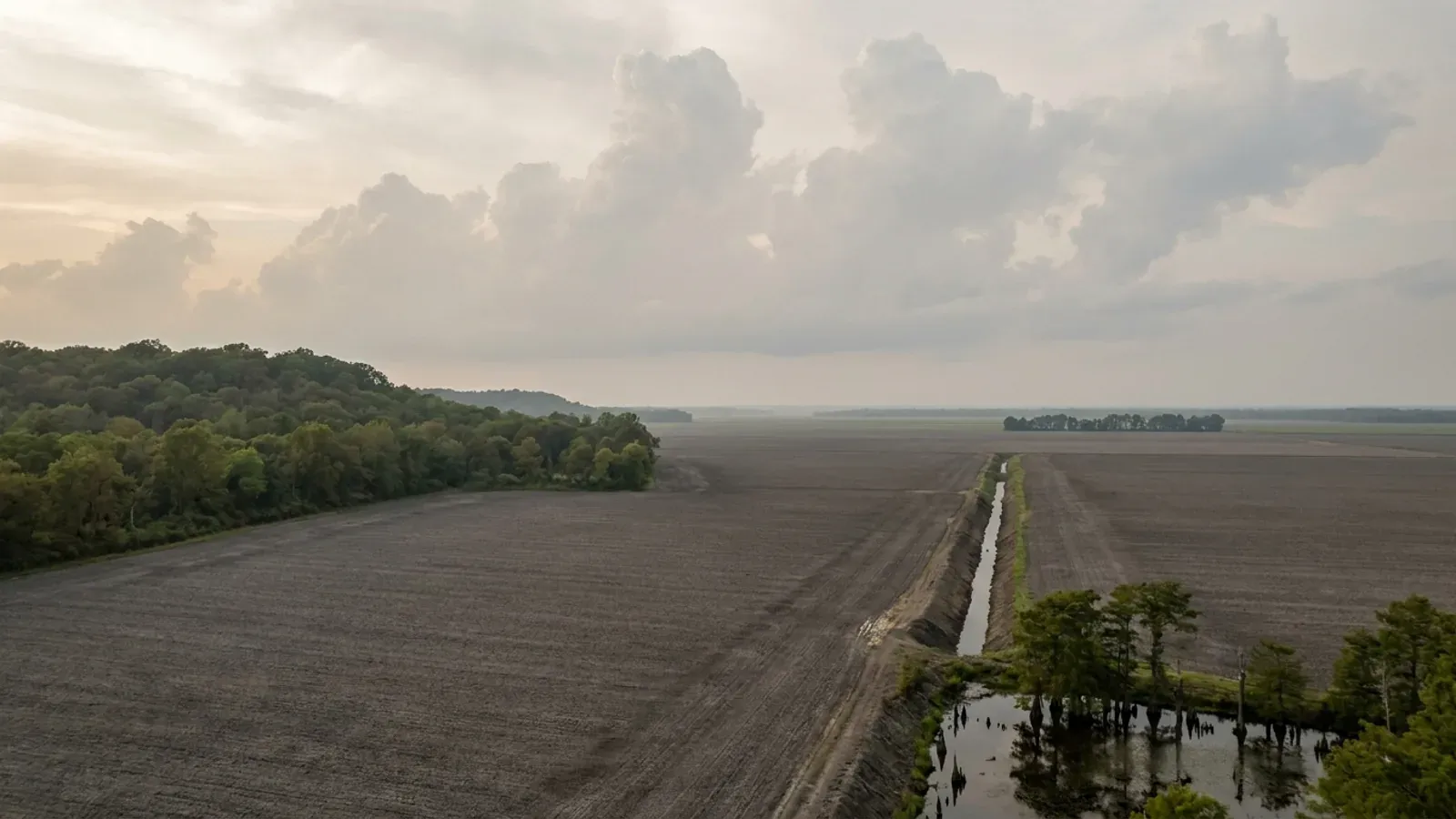
The Ozark escarpment dropping to flat Bootheel farmland with dark alluvial soil, a straight drainage ditch and a cypress slough.
Butler County City-adopted code, city inspection

Barndominium Builders in Poplar Bluff, MO

Poplar Bluff is where the Ozark foothills run out onto the Bootheel lowlands, and the two halves of that sentence are two different foundations. It is also the sharpest published disagreement about earthquakes anywhere on this site. The city adopted the 2018 International Residential Code by Ordinance 19-72 on 18 November 2019 and, in the same ordinance, filled in Table R301.2(1) with Seismic Design Category A. Queried on 8 September 2026 at the city's own Census internal point, the USGS Seismic Design Web Service returns Category D under ASCE 7-16 and D again under ASCE 7-22, and at Site Class D under 7-16 it declines to return a category at all and answers See Section 11.4.8, the standard's demand for a site-specific ground motion hazard analysis. The adopted figure is the one the permit runs on. Both belong in front of anyone pricing drawings here. The same table is worth reading line by line, because Sikeston, forty-six miles east on the identical 2018 edition, disagrees with every figure in it: Poplar Bluff publishes 90 mph, 20 psf ground snow, category A and a 36-inch frost line, and Sikeston publishes 115 mph, 15 psf, category E and 15 inches. Same model code, same year, four differences. Outside the city limits the picture changes completely. Butler County is third classification on the Missouri Association of Counties list published in May 2025, and RSMo 64.170 empowers only first- and second-classification counties to adopt a building code, so the county has no building-code authority to exercise. Its own published directory runs twelve offices and none of them is a building, planning, zoning or code-enforcement office. What still gates a build there is real, though: a floodplain development permit in the mapped hazard areas, a state on-site wastewater permit, addressing, and utilities. Around all of it is farmland with the scale this building type wants. The 2022 Census of Agriculture counts 451 farms on 250,359 acres in Butler County, an average of 555 acres against a 308-acre state average, with 125,808 acres irrigated, half of everything in farms.

Poplar Bluff at a glance

County
Butler County
Population
16,177
ZIP codes
63901, 63932, 63940, 63945, 63954, 63961
Site visits
Within the week from the St. Louis area

Building conditions in Poplar Bluff

Missouri sets no residential building code and no statewide way of adopting one, so the first question on any parcel is not what the code says — it is whether there is one. Only counties of the first and second classification may adopt a building code at all, and classification is set by assessed valuation rather than population, so a small county can hold the power while a much larger one does not. Zoning is a separate power with its own answer, granted only after a vote of the people and repealable by another. What changes from one jurisdiction to the next is whether the work is inspected, who issues the permit, what that office charges, how the parcel is zoned, and the design figures your drawings have to satisfy.

Build conditions for Poplar Bluff , Butler County, Missouri : design wind speed 90 mph, City of Poplar Bluff. BUILD CONDITIONS POPLAR BLUFF, MOButler CountyCITY-ADOPTED CODEDESIGN WIND SPEED90 mph, City of Pop…Read off the City of Poplar Bluff's own filled-in Table R301.2(1), printed at Municipal CodeSection 500.401.A.4 as part of Ordinance 19-72, adopted 18 November 2019, which adopts the 2018…ZONING · RS-1 RURAL RESIDENTIAL, WHERE SINGLE…15,000 sq ft lot area and 125 ft wid…Poplar Bluff's zoning ordinance divides the city into R, C, M and Odistricts, and RS-1 Rural Residential is the one that matters to an…CITY OF POPLAR BLUFF BUILDING PERMIT FEEPermit fee modifier of .0037 applied…From Municipal Code Section 500.030.B, as amended by Ordinance 19-01of 7 January 2019. The city's published method takes the total cost…WHO ISSUES THE PERMITCity of Poplar Bluff Planning and In…The Planning Department administers zoning, subdivision, buildingpermits and inspections, and the stormwater management programme,…
Build conditions for Poplar Bluff, drawn from the sourced facts on this page. Every figure above is cited in the quick-facts panel below, with its source and vintage.
The city's own table prints seismic design category A, inside the New Madrid seismic zone
Poplar Bluff Municipal Code Section 500.401.A.4, enacted by Ordinance 19-72 of 18 November 2019, fills in Table R301.2(1) of the 2018 International Residential Code with these values: ground snow load 20, wind speed 90, topographic effects NO, special wind region NO, wind-borne debris zone NO, Seismic Design Category A, weathering SEVERE, frost line depth 36 inches, termite moderate-heavy, winter design temperature 6 degrees, ice barrier underlayment required YES, air freezing index 1017, mean annual temperature 58.1 degrees, elevation 361 feet, latitude 36.7 North. The flood hazard cell records the date the jurisdiction entered the National Flood Insurance Program as 03/08/1974 and the date of the flood insurance study as 11/26/2010. Category A is the lowest seismic design category the code defines, and Missouri's Department of Natural Resources names Butler County among the counties it lists for the New Madrid Seismic Zone. That is not a contradiction anyone should resolve by guessing; it is the number the permit runs on, and it should be put to the building official in writing alongside the federal values before a structural package is priced.

City of Poplar Bluff Municipal Code, Title V Building and Construction, Chapter 500, Article X Residential Code, Sections 500.400 and 500.401 (Ord. No. 19-72, 18 November 2019), on eCode360, codified text marked Includes legislation through 06-15-2026, version 27; read and independently re-read 8 September 2026. New Madrid county list from Missouri DNR, Facts about the New Madrid Seismic Zone

The USGS returns category D at the city's own coordinate, under both current standards
Queried on 8 September 2026 at the City of Poplar Bluff's Census internal point, 36.763259 by -90.413953, Risk Category II, the USGS Seismic Design Web Service returns for ASCE 7-16 at Site Class C: Ss 1.014 g, S1 0.336 g, SDS 0.811 g, SD1 0.336 g, Seismic Design Category D. Under ASCE 7-22 at the same point it returns Ss 1.31 g, S1 0.35 g, SDS 0.84 g, SD1 0.30 g and Category D at Site Class C, and SDS 0.77 g, SD1 0.47 g and Category D at Site Class D. The one answer it refuses is ASCE 7-16 at Site Class D, where it returns no Fv, no SD1 and no category and prints the note See Section 11.4.8 instead, which is that standard's requirement for a site-specific ground motion hazard analysis. Site Class D is soft soil, and about forty-four percent of the mapped acres in this county have a seasonal high water table within twelve inches of the surface, so it is not an academic branch of the table. Four federal answers, all of them D or a demand for site-specific work; one adopted answer, A. Carry both.

USGS Seismic Design Web Service, earthquake.usgs.gov/ws/building-codes/asce7-16/calculate and /asce7-22/calculate, Risk Category II, Site Classes C and D, queried 8 September 2026; coordinate from the 2024 U.S. Census Bureau Gazetteer place file for Missouri

Butler County is third classification, so RSMo 64.170 gives it no building-code authority at all
RSMo 64.170(1) empowers the county commission to control construction, issue building permits and set inspection fees in all counties of the first and second classification. RSMo 64.205 states the boundary from the other side: sections 64.170 to 64.200 shall apply to all counties of the first and second class. Butler County is listed in the Class 3 block of the Missouri Association of Counties classification list published in May 2025, so it sits outside that grant. This is worth stating precisely, because it is not the same as a county that could adopt a code and has declined. A first- or second-class county can put the question to its unincorporated voters under RSMo 64.170(2) and adopt one. Butler County cannot, until its assessed valuation moves it into a class that may. Class 3 counties are not powerless generally: RSMo 64.510 lets a second- or third-class county adopt county planning and zoning after a vote of the people, and RSMo 64.695 lets voters terminate it again on a petition of five percent of the county's last gubernatorial vote, which makes any resolution adopted under the programme void. Butler County publishes no zoning ordinance, and its own county directory lists twelve offices, none of them a building, planning, zoning or code-enforcement office.

RSMo 64.170 (effective 28 August 2008), 64.205 (effective 28 August 1963), 64.510 and 64.695, rendered from revisor.mo.gov 8 September 2026; Missouri Counties by Classification, Missouri Association of Counties, published May 2025; Butler County, MO official website, County Directory and Elected Officials pages, read 8 September 2026

Butler County septic runs on the state programme itself, so the three-acre exclusion actually operates here
The Department of Health and Senior Services on-site wastewater county selector returns, for Butler County, Agency DHSS, Authority Type DHSS, at 930 Wildwood Drive, Jefferson City. That answer decides a question a lot of land buyers get wrong. Missouri counties fall into three authority types: the DHSS onsite programme, a local authority under contract, and a local authority under its own ordinance. Where a county runs its own ordinance under RSMo 701.047 it can and often does reach parcels the state programme would not. Butler County does not. The state programme applies, and with it RSMo 701.031's exclusion in the statute's own words: the owner of a single-family residence lot consisting of three acres or more, except lots adjacent to lakes operated by the Corps of Engineers or by a public utility, is excluded from sections 701.025 to 701.059, when all points of the system are located in excess of ten feet from any adjoining property line and no effluent enters an adjoining property, contaminates surface waters or groundwater or creates a nuisance. Read the conditions, not just the acreage. The ten-foot setback from every property line is a real constraint on a narrow tract, the lakeshore exception is absolute, and the exclusion is from the permit, never from the consequences of a bad system. There is a live pricing note as well: the department states that effective 28 August 2026, following changes to RSMo 701.046 which removed the ninety-dollar permit fee and authorised the department to set reasonable fees, application fees for construction, modification and repair of on-site sewage disposal systems are temporarily suspended until the new standards take effect.

Missouri Department of Health and Senior Services, On-site Wastewater Treatment, OWTS Construction Permit Process, county selector result for Butler, read 8 September 2026 (validated against a Camden County control returning Camden County Wastewater Dept., Ordinance, and a nonsense county value returning no authority block); RSMo 701.031 (effective 28 August 2005), rendered from revisor.mo.gov 8 September 2026

There is essentially no shallow bedrock in Butler County, and that is the opposite of the Ozark reputation
Measured from USDA-NRCS Soil Data Access on 8 September 2026 for survey area MO023, Butler County, Missouri, which covers 447,251 acres in 109 map units. Lithic bedrock appears as a restrictive feature on 2.48 acres of the entire survey area, with the shallowest occurrence at 178 inches, roughly fifteen feet down. Nothing in the county carries a bedrock restriction within forty inches. What does restrict foundations here is water and dense subsoil, not rock. A fragipan is mapped on 80,887 acres, about eighteen percent of the survey area, shallowest at 41 inches. Natric, sodium-affected horizons cover 11,374 acres, shallowest at 10 inches. By drainage class, 195,407 acres are poorly drained and another 10,939 are somewhat poorly or very poorly drained, so about forty-six percent of the county is poorly drained or worse. Components with a recorded seasonal high water table cover 311,774 acres, and of those, 197,773 acres see water within twelve inches of the surface, 255,206 within twenty-four inches and 307,643 within thirty-six inches. Set that last figure against the 36-inch frost line the city publishes: on roughly sixty-nine percent of the county's mapped acres the seasonal water table comes up into the depth the footing has to reach. The dominant components tell the same two-country story, with Clarksville on 52,655 acres of Ozark upland and Calhoun, Tuckerman, Amagon, Kobel and Foley across the lowlands.

USDA-NRCS Soil Data Access tabular service, sdmdataaccess.sc.egov.usda.gov, queries against legend, mapunit, component, corestrictions, comonth and cosoilmoist for areasymbol MO023 (Butler County, Missouri, per sacatalog), run 8 September 2026

The accessory-building cap is a ladder that stops at 1,000 square feet, and a hard limit of two buildings per lot
Poplar Bluff Municipal Code Section 405.060.B, enacted by Ordinance 19-39 of 3 June 2019, sets the shop question directly. In the RS, RD and RA-1 districts a private residential garage is limited to 550 square feet of floor area, with an additional 200 square feet permitted for each 3,000 square feet of lot area by which the lot exceeds 6,000 square feet, provided that no garage shall exceed 1,000 square feet nor house more than five automobiles. So the allowance grows with the lot and then stops, and a bigger tract does not buy a bigger building. Section 405.060.B.4 adds a separate count limit: only two accessory buildings per lot are permitted in all R districts, counting storage buildings and recreational buildings alike. The same subsection states that accessory buildings may not be used for dwelling purposes, that no accessory building may be built before construction of the main building has actually commenced, and that an accessory building may not occupy more than thirty percent of a rear yard. A second and quite separate cap applies inside the mapped floodplain: Section 415.140.G allows an accessory structure used solely for parking and limited storage, unattached, of limited investment value and not larger than 400 square feet, to be built at grade and wet-floodproofed, but only with no human habitation or occupancy, single-wall design, a granted variance and a floodplain development permit. A shop bigger than the house is a conversation to have with the Planning Department before a lot is bought, not after.

City of Poplar Bluff Municipal Code, Chapter 405 Zoning Regulations, Article III Supplementary District Regulations, Section 405.060.B (Ord. No. 19-39, 3 June 2019), and Chapter 415 Flood Damage Prevention, Section 415.140.G (Ord. No. 7215, 1 November 2010), on eCode360, codified text through 15 June 2026, read 8 September 2026

Also worth knowing before you build in Poplar Bluff

Nothing in the city's rules bans a metal building, and the design review that exists is scoped to historic districts
This was checked section by section and the answer is a reassuring one. Chapter 405, the zoning ordinance, contains no minimum roof pitch, no minimum eave projection and no exterior material restriction reaching a single-family dwelling anywhere in the R districts. The words pitch and eave do not appear in Articles II or III at all. The one materials rule in the chapter is Section 405.050, the O-1 Professional Office district's architectural design regulations, which require exterior wall surfaces to be faced with brick, stone, architecturally treated or rock-face concrete block, stucco, textured or patterned concrete, glass or an equivalent or better, and allow up to twenty-five percent of any wall surface to be artificial stucco, wood or metal used as architectural trim as approved by the Planning and Zoning Commission, with architectural and landscape plans submitted to the Commission before a building permit issues. That is an office district, and it does not touch a house in RS-1. The city's other appearance control is Chapter 420: under Section 420.210 a certificate of appropriateness from the Historical Preservation Commission is required only for a designated landmark or for a building, structure or feature located within a designated historic district, including new construction of a principal or accessory building there. There is also no minimum dwelling floor area in any R district. Outside the city limits, unincorporated Butler County publishes no zoning ordinance and no appearance standards at all.

City of Poplar Bluff Municipal Code, Chapter 405 Zoning Regulations, Articles II and III (Sections 405.030 to 405.110) and Chapter 420 Historical Preservation Commission, Article IV, Section 420.210 (Ord. No. 6043, 17 February 1998), on eCode360, codified text through 15 June 2026, read 8 September 2026

Every community in Butler County is in the flood programme, and the city adds a foot of freeboard
The OpenFEMA National Flood Insurance Program Community Status Book, queried 8 September 2026 for Butler County, Missouri, returns exactly five communities, all participating and none sanctioned: unincorporated Butler County (CID 290044, regular programme 3 April 1985), Fisk (290045, 16 September 1981), Neelyville (290046, 5 May 1981), Poplar Bluff (290047, 4 February 1981) and Qulin (290048, 15 October 1981). All five carry the same currently effective map date, 26 November 2010, which is also the flood insurance study date the city wrote into its own Table R301.2(1). Poplar Bluff's ordinance is stricter than the federal minimum: Section 415.150.A.1 requires new construction or substantial improvement of any residential structure to have its lowest floor, including basement, elevated to one foot above base flood elevation, and in an AO shallow-flooding zone Section 415.170 requires elevation to the depth number on the map or at least two feet above highest adjacent grade where no depth number is given. There is a farm carve-out with sharp edges: Section 415.140.E permits a structure used solely for agricultural purposes to be built at grade and wet-floodproofed only if there is no human habitation or occupancy of the structure, it is of single-wall design, a variance has been granted and a floodplain development permit has been issued. A barndominium is a dwelling, so that door is closed to it. The city's Flood Plain Administrator is the City Planner under Section 415.050; for unincorporated Butler County the State Emergency Management Agency lists Bill Robinson of Smith Co. Engineers, 901 Vine Street, Poplar Bluff.

OpenFEMA NfipCommunityStatusBook API, fema.gov/api/open/v1, filtered to state MO and county BUTLER COUNTY, data last refreshed 25 August 2026, queried 8 September 2026 (control: a Taney County query correctly returns Forsyth as non-participating and sanctioned since 2 July 1976); City of Poplar Bluff Municipal Code Chapter 415 Flood Damage Prevention, Sections 415.040, 415.050, 415.140, 415.150 and 415.170 (Ord. No. 7215, 1 November 2010); Missouri State Emergency Management Agency county contact listing for Butler County, read 8 September 2026

Three fire organisations cover Butler County, and only one of them could lawfully run a residential code here
The Missouri Division of Fire Safety's registered fire department listing, registration year 2026, records exactly three organisations in Butler County: the Poplar Bluff Fire Department, type municipality; the Butler County Fire Protection District, type district, based at 3240 South Westwood Boulevard in Poplar Bluff; and the Qulin Fire Protection District, type district. The distinction matters because of RSMo 321.228, effective 28 August 2012. Where a city, town, village or county adopts, implements and enforces a residential construction regulatory system, any fire protection district wholly or partly inside it is, in the statute's words, without power, authority, or privilege to enforce or implement one there, and any such system a district adopts is treated as advisory only. Poplar Bluff plainly runs such a system, so inside the city limits that preemption bites on the two districts. Outside the city limits Butler County regulates nothing, which leaves the RSMo 321.220(12) route legally open to a district: a Chapter 321 board may adopt fire ordinances whose standards may be industrial codes adopted by nationally organized and recognized trade bodies, and classification under Chapter 64 is irrelevant to that power. Neither Butler County district publishes an adopted building or residential code, and neither maintains a website carrying its ordinances. Whichever district covers a given address, RSMo 321.228.3 preserves its final say on fire hydrant location and specification, hydrant flow rates and fire lanes, and its right to inspect alteration, enlargement, replacement or repair of a one- or two-family dwelling, without charging for either. Ask the district covering the address by name before assuming there is nothing to satisfy.

Missouri Department of Public Safety, Division of Fire Safety registered fire department dataset on data.mo.gov (resource gbr4-c765), filtered to Butler County, registration year 2026, queried 8 September 2026; RSMo 321.228 (effective 28 August 2012) and 321.220, rendered from revisor.mo.gov 8 September 2026

Sealed drawings are a commercial requirement in Poplar Bluff, not a residential one
This is the question that moves a budget, and the city answers it in one place. Municipal Code Section 500.030.B.1.b provides that commercial applications must be accompanied by three complete sets of blueprints and one set of building specifications, all of which have been signed, sealed and dated by a professional architect or engineer registered in the State of Missouri, and gives the Building Inspector fifteen days from a complete preapplication to calculate the building, plumbing, mechanical and electrical inspection fees. The residential paragraph immediately above it, Section 500.030.B.1.a, requires only that an application be submitted to the Planning Department before residential erection, construction, remodel or reconstruction, or any structural alteration of an existing residence or structure. Nowhere does the code single out steel-framed or post-frame buildings, and no metal-structure sealing rule appears in the chapter. That does not mean a package never needs a Missouri-licensed professional engineer's seal: the 2018 International Residential Code the city adopted governs what may be built prescriptively and what may not, so a frame outside its prescriptive provisions still has to be designed, and the Building Inspector reviews the submission either way. It does mean the trigger here is what the code covers, not a local metal-building ordinance, which is not true of every jurisdiction in the state. One practical warning about the city's own paperwork: the building permit application form on the city website still asks applicants to classify construction type and use and occupancy as specified by the IBC 2000 code, three editions behind the 2018 International Building Code the council actually adopted in 2019.

City of Poplar Bluff Municipal Code, Chapter 500, Article I, Section 500.030.B (Ord. No. 19-01, 7 January 2019), on eCode360, codified text through 15 June 2026; City of Poplar Bluff Application for Plan Examination and Building Permit, poplarbluff-mo.gov Document Center item 130, downloaded and read 8 September 2026

The city licenses the trades and does not license general contractors
Poplar Bluff maintains its own trade licensing. Chapter 520 of the municipal code carries an Electrician's License article, Sections 520.110 to 520.290, alongside an Electrical Inspector article and a permits and inspections article, and the Planning and Inspections Department publishes current public lists of Master Electricians, Master Plumbers and HVACR installers, together with the exam applications for each. What it does not publish anywhere is a general contractor licence or a builder registration, and none appears in the code. The only thing standing between a general contractor and a permit is Section 500.020, which provides that no building permit or other permit shall be issued to any contractor or subcontractor unless that contractor or subcontractor first pays the occupational licence tax. That is a city business tax, not a competency licence, and Missouri has no statewide general contractor licence to hold either. So the question to ask a builder in this market is which named individuals hold the city's electrical, plumbing and mechanical licences, because those are the credentials the city actually issues and checks.

City of Poplar Bluff Municipal Code, Chapter 520 Electricity, Articles II, III and IV, and Chapter 500 Section 500.020 (Ord. No. 3208, 15 June 1964), on eCode360, codified text through 15 June 2026; City of Poplar Bluff Planning and Inspections department page and Planning Department Applications page, listing MASTER ELECTRICIANS 2025, MASTER PLUMBERS 2026 and HVACR INSTALLERS 2026, read 8 September 2026

Butler County farms average 555 acres and half of everything in farms is irrigated
The 2022 Census of Agriculture county profile for Butler County, Missouri counts 451 farms on 250,359 acres of land in farms, an average of 555 acres, against a Missouri average of 308. Land in farms breaks down as 203,718 acres of cropland, 27,229 of woodland, 13,739 of pastureland and 5,673 other. Crops are 99 percent of the value of products sold. The figure that says most about the ground is irrigation: 125,808 acres are irrigated, which the profile puts at 50 percent of land in farms. Half the farmland in this county is under irrigation, which is a lowland row-crop economy, not an Ozark one, and it is the same water story the soil survey tells from the other direction. Seventy-eight farms in the county are 1,000 acres or larger. For a buyer, the practical consequence is that tracts here come at a size that will carry a house, a shop and a setback without an argument, and that the parcel most likely to be offered cheaply is the one the drainage map explains.

USDA National Agricultural Statistics Service, 2022 Census of Agriculture, County Profile for Butler County, Missouri, downloaded from nass.usda.gov and read 8 September 2026 (control: a nonexistent county profile at the same path returns a 196-byte HTTP 404)
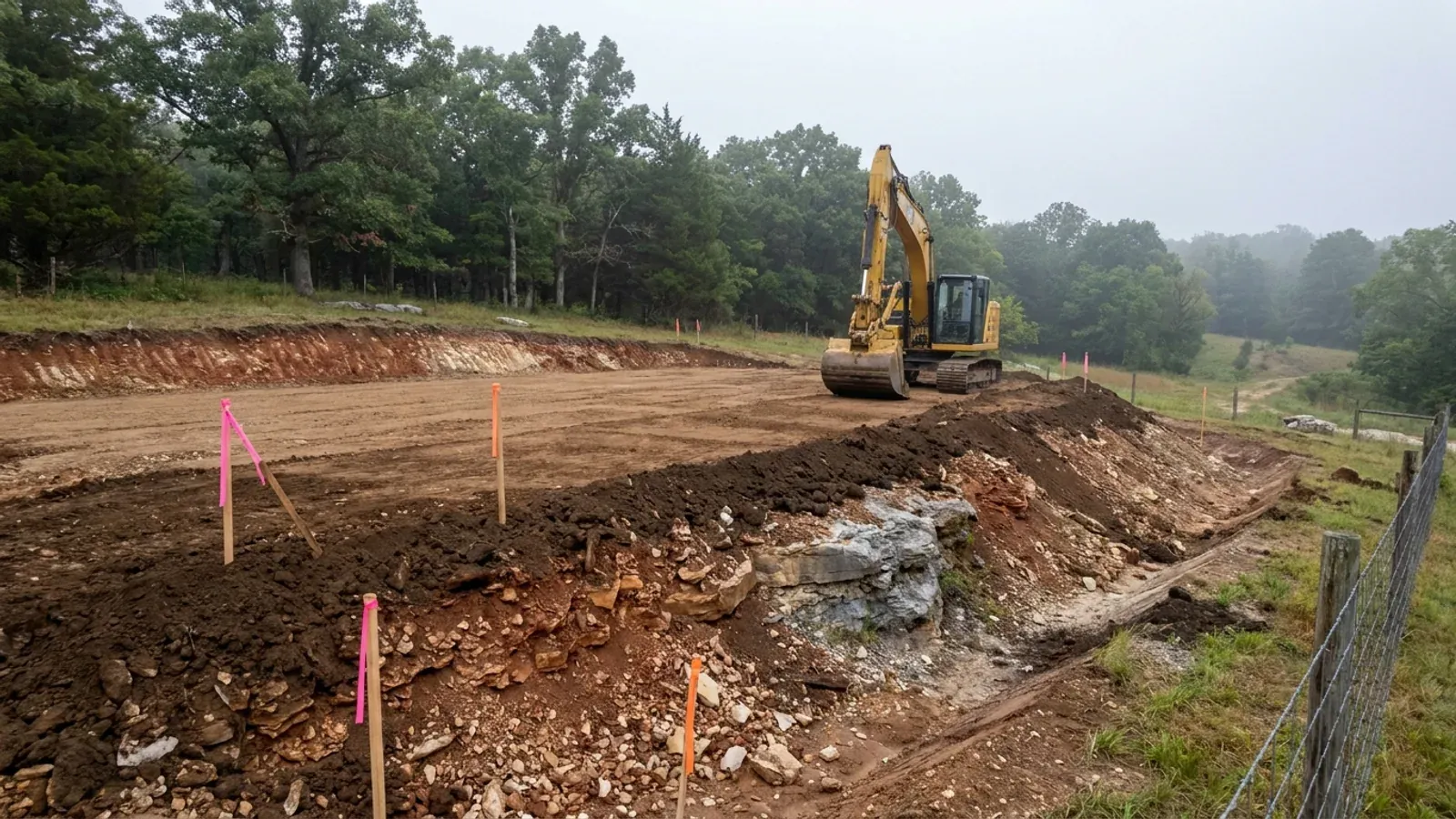
An excavator grading a compacted building pad on a cleared lot, with survey stakes and a drainage swale visible.
Below the slab

The expensive surprises are in the ground, not the building

What moves a Missouri budget is usually below grade, and which problem you have depends on where in the state you are. Across the Ozarks it is karst: the Department of Natural Resources maps more than sixteen thousand sinkhole points, and what matters there is what is under the slab rather than what the slab sits in. Across the north and centre it is claypan — dense, slow-draining subsoil that perches water above it for months of the year. In the Bootheel it is deep alluvium carrying the highest seismic demand in the state, where the same soils modelled for liquefaction attack post embedment and slab bearing rather than the frame above them. The same ground then decides the septic system, and Missouri does not run that on a percolation test alone: the rule allows a perc test or a soil morphology examination in a profile pit, and the authority reviewing your parcel picks which. Where a drainfield sits near a sinkhole's drainage, perc testing on its own is not permitted at all. Whether that authority is the state or your own county is itself a local question, and it changes what you have to file. So the site work, the foundation and the drainfield get resolved together rather than one at a time. We price the dirt before we price the building.

What a build looks like

Three stages every Poplar Bluff project passes through, from a raw parcel to a finished home. Site work first, because that is where the budget is decided.
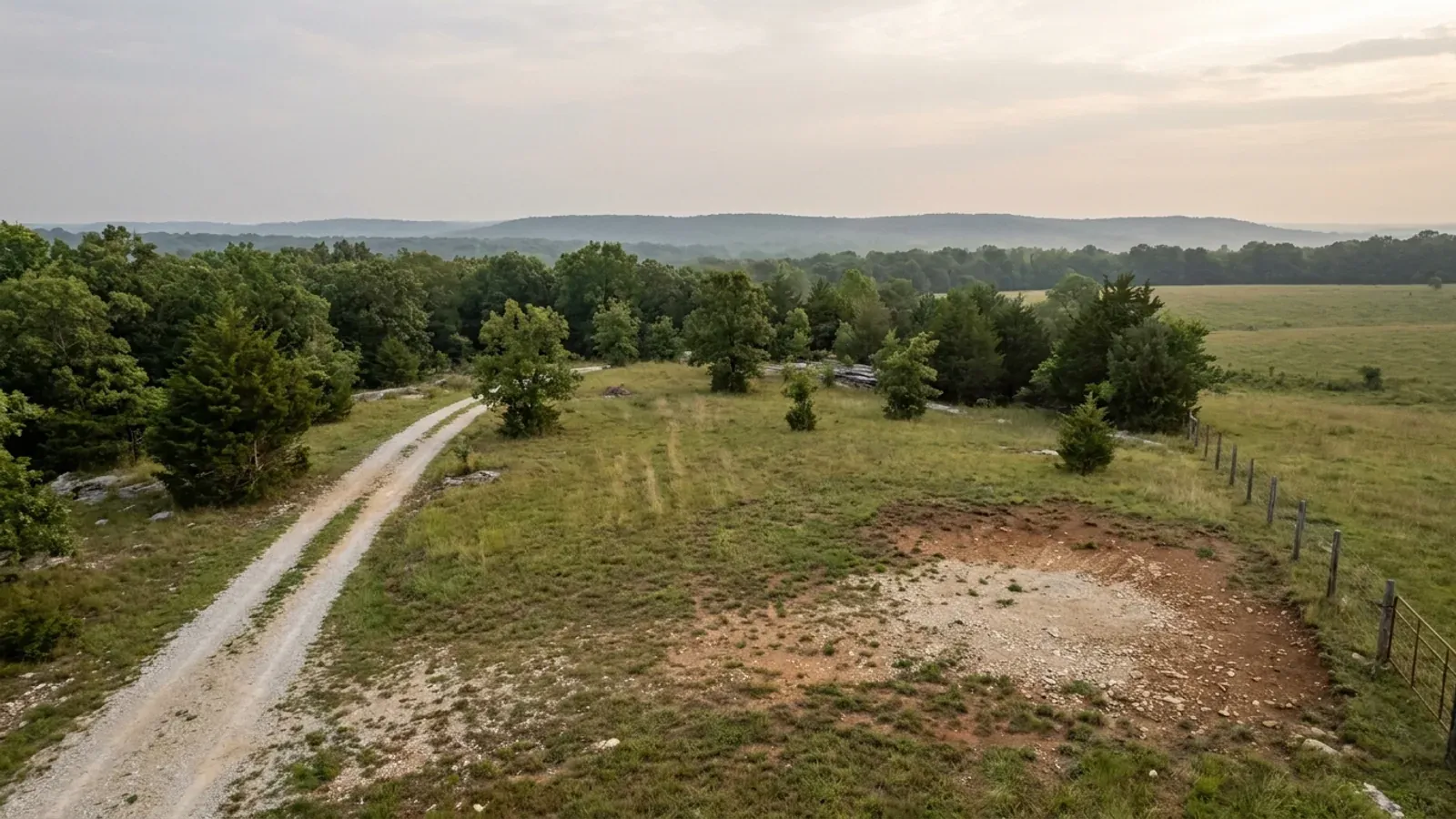
Aerial view of an undeveloped rural lot with cleared grass, a oak and hickory treeline with a few loblolly pines, and a pale gravel access track.
Stage one

The parcel

Zoning, setbacks, flood zone and utility access get checked before anything is drawn.

An excavator grading a compacted building pad on a cleared lot, with survey stakes and a drainage swale visible.
Stage two

Pad and permit

Clearing, grading and a compacted pad, while the submittal works through whichever office issues the permit where you are building.
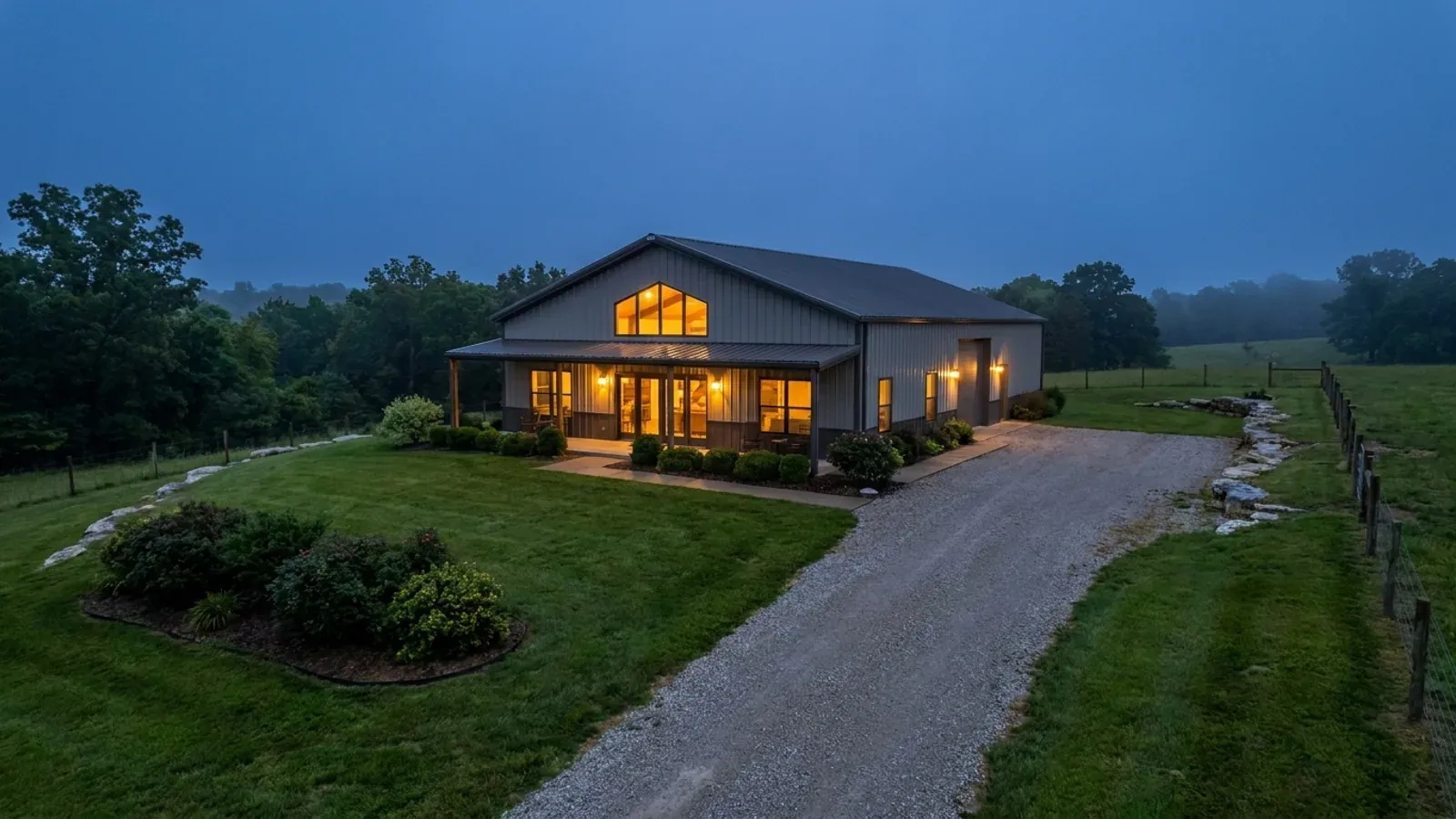
A finished barndominium at dusk with warm interior lighting glowing through its large windows.
Stage three

Frame to finish

Shell erected and dried in, then systems, insulation and interior finish through to CO.

Those are the rules where you are building in Poplar Bluff. Tell us what you want to build and we will draw it to them.

Where we build around Poplar Bluff

Butler County and the rural land around it. The buildable acreage for a project this size usually sits outside the city limits, which is frequently what changes who issues your permit.

The Poplar Bluff service area, including the rural acreage outside the built-up edge, which is where the parcels big enough for a build like this usually sit. The map marks the territory we build in. It is not a branch location, and there is no office at this pin.

Nearby areas we build in

Others we cover nearby, and they are not interchangeable. One may be a county with an adopted building code, another a county with no legal authority to have one, another a city that permits inside its own limits whichever county the land sits in. So the office that issues the permit, whether anyone inspects the work at all, the fees, the zoning and the design figures can differ from one card to the next — sometimes across a single property line.

Building in Poplar Bluff: common questions

8 questions we get asked most often about building in Poplar Bluff. If yours is not on the list, ask it directly.

Do I need a building permit for a barndominium in unincorporated Butler County?
There is no county building permit to get, because there is no county building code and no county building department. Butler County is a third-classification county on the Missouri Association of Counties list published in May 2025, and RSMo 64.170(1) empowers only counties of the first and second classification to control construction and issue building permits, with RSMo 64.205 confirming that sections 64.170 to 64.200 apply to counties of the first and second class. The county's own published directory runs twelve offices and none of them is a building, planning, zoning or code-enforcement office. That is a narrower statement than it sounds, though, and the difference matters. The county does not inspect. Other things still do apply. A floodplain development permit is required for development in the mapped special flood hazard areas of the unincorporated county, which has been in the National Flood Insurance Program's regular programme since 3 April 1985 and lists a floodplain administrator through Smith Co. Engineers in Poplar Bluff. An on-site wastewater construction permit is required under the state programme, administered here by the Department of Health and Senior Services directly. Addressing, the electric and water utility, and any private covenant on the deed all operate independently of any of that. Inside the Poplar Bluff city limits the answer flips completely: the city permits and inspects under the 2018 International Residential Code.
Poplar Bluff is in the New Madrid seismic zone, so why does its code say seismic design category A?
Because the city filled the table in that way, and the number in the table is the number the permit runs on. Municipal Code Section 500.401.A.4, enacted by Ordinance 19-72 on 18 November 2019, fills Table R301.2(1) of the 2018 International Residential Code with Seismic Design Category A, the lowest the code defines. The USGS Seismic Design Web Service, queried at the city's own Census internal point on 8 September 2026, returns Category D under ASCE 7-16 at Site Class C and Category D under ASCE 7-22 at both Site Class C and Site Class D, and at Site Class D under ASCE 7-16 it will not return a category at all, answering with the note See Section 11.4.8, that standard's trigger for a site-specific ground motion hazard analysis. Both sets of numbers are real and both are published. The state statute does not settle it either: Section 500.090 of the city code says all construction shall comply with RSMo 319.200 through 319.207, but RSMo 319.203.2 exempts any private structure under ten thousand square feet and any single-family or duplex residence, and 319.203.3 says nothing in those sections requires a jurisdiction to run an inspection programme. The practical answer is to put the adopted A and the federal D in front of the Building Inspector in writing at the start, decide with a Missouri-licensed professional engineer what the structural package will actually be designed to, and price that. Discovering the gap at inspection is the expensive way to find it.
Can I build a shop bigger than the house on a lot inside Poplar Bluff?
Not as an accessory garage, and the ceiling is lower than most people expect. Municipal Code Section 405.060.B, enacted by Ordinance 19-39 of 3 June 2019, limits a private residential garage in the RS, RD and RA-1 districts to 550 square feet of floor area, with an additional 200 square feet for each 3,000 square feet by which the lot exceeds 6,000 square feet, and then caps the whole thing: no garage shall exceed 1,000 square feet nor house more than five automobiles. The allowance ladders up with lot size and then stops, so buying more land does not buy more building. There is a second, separate limit on top of it: only two accessory buildings per lot are permitted in all R districts, counting storage buildings and playhouses over twenty-five square feet alike. Accessory buildings may not be used for dwelling purposes and may not occupy more than thirty percent of a rear yard. In the mapped floodplain a third rule applies: Section 415.140.G allows an unattached accessory structure of not more than 400 square feet, used solely for parking and limited storage, to sit at grade and be wet-floodproofed, but only with no human habitation, single-wall design, a granted variance and a floodplain development permit. The way people actually build a big shop here is to make the workshop part of the principal building rather than an accessory one, which is what a shop-house is, or to build outside the city limits where none of these caps exist. Take the plan to the Planning Department at 501 Vine Street before the lot is bought.
Is there any rule against metal siding or a low-pitch roof on a house here?
Not on a house in the city's residential districts. Chapter 405 of the Poplar Bluff municipal code sets no minimum roof pitch, no minimum eave projection and no exterior material restriction for a dwelling in an R district, and it sets no minimum dwelling floor area either. The words pitch and eave do not appear in the district regulations at all. There are two appearance controls in the code and both are narrowly scoped. Section 405.050's architectural design regulations, requiring brick, stone, treated concrete block, stucco, glass or equivalent and allowing metal only as up to twenty-five percent architectural trim with Planning and Zoning Commission approval, apply to the O-1 Professional Office district and nowhere else. Chapter 420's certificate of appropriateness applies only to a designated landmark or a building within a designated historic district, under Section 420.210. If your lot is neither in the O-1 district nor in a historic district, neither reaches you. Outside the city limits, unincorporated Butler County publishes no zoning ordinance and no appearance standards whatsoever. This is worth checking rather than assuming, because it is not the answer everywhere in the state: some Missouri jurisdictions do prohibit corrugated sheet metal on exterior walls or roofs, and some require a stamped structural design for any metal structure. Poplar Bluff and Butler County do not.
My land is over three acres. Do I still need a septic permit in Butler County?
Probably not, and Butler County is one of the counties where that widely repeated rule actually holds, but the conditions attached to it are the part people skip. The Department of Health and Senior Services county selector returns Butler County as authority type DHSS, meaning the state runs the on-site wastewater programme here directly rather than a county administering its own ordinance. That matters, because RSMo 701.047 lets a county ordinance reach parcels the state programme would not, and several Missouri counties use it aggressively. Butler County does not have one. So RSMo 701.031 applies as written: the owner of a single-family residence lot of three acres or more is excluded from sections 701.025 to 701.059, except lots adjacent to lakes operated by the Corps of Engineers or by a public utility, and only when all points of the system are located more than ten feet from any adjoining property line and no effluent enters an adjoining property, contaminates surface waters or groundwater or creates a nuisance. Read all four conditions. The ten-foot setback is a genuine constraint on a long narrow tract. The lakeshore exception is absolute and defeats the acreage argument entirely. And an exclusion from the permit is not an exclusion from the consequences of a failed system on ground where the seasonal high water table reaches within twenty-four inches of the surface across more than half the county's mapped acres. A soil evaluation before the house is sited is cheap compared with a drainfield that will not accept water in March.
How deep do footings have to go in Poplar Bluff, and what is the ground actually like?
The city publishes a 36-inch frost line depth in its own Table R301.2(1), with weathering listed as severe and an air freezing index of 1017, all adopted by Ordinance 19-72 on 18 November 2019. That is a deep figure, and it is worth knowing that the city forty-six miles east of here publishes 15 inches on the identical 2018 edition of the same model code, which is exactly why a design figure has to come from the jurisdiction you are building in rather than from the region. The ground the footing goes into is the more interesting half of the answer. Measured from USDA-NRCS Soil Data Access for survey area MO023 on 8 September 2026, Butler County has essentially no shallow rock: lithic bedrock appears as a restrictive feature on 2.48 acres of a 447,251-acre survey area, at 178 inches down, and nothing at all is restricted by bedrock within forty inches. What does govern foundations here is water and dense subsoil. About forty-six percent of the county is poorly drained or worse. A fragipan sits under 80,887 acres, shallowest at 41 inches. And across components covering 311,774 acres, the seasonal high water table rises to within twelve inches of the surface on 197,773 acres and within thirty-six inches on 307,643. In other words, on a large share of this county the footing trench and the spring water table occupy the same depth. That is a drainage and dewatering conversation before the pour, and it is the single biggest difference between a lot on the Ozark side of the county and one on the lowland side.
Will a fire district inspect my build if the county does not?
It depends where you are and which district you are in, and the honest answer is to ask the district by name. The Missouri Division of Fire Safety's 2026 registration list records three organisations covering Butler County: the Poplar Bluff Fire Department, a municipal department; the Butler County Fire Protection District; and the Qulin Fire Protection District. Inside the Poplar Bluff city limits, RSMo 321.228 settles it: where a city adopts, implements and enforces a residential construction regulatory system, which Poplar Bluff plainly does, any fire protection district wholly or partly inside it is without power, authority, or privilege to enforce or implement one there. Outside the city limits the county regulates nothing, so the other route in the statute books is legally open: RSMo 321.220(12) lets a Chapter 321 district board adopt fire ordinances whose standards may be industrial codes adopted by nationally organized and recognized trade bodies, and county classification has no bearing on that power at all. Neither Butler County district publishes an adopted building or residential code, and neither maintains a public site carrying its ordinances, so there is nothing to point you at either way. What every district keeps regardless, under RSMo 321.228.3, is final regulatory authority over fire hydrant location and specification, hydrant flow rates and fire lanes, and the right to inspect alteration, enlargement, replacement or repair of a one- or two-family dwelling, and it may not charge a fee for either. On a rural tract the hydrant and access question is the one that most often changes a site plan, so make the call early.
What does a building permit cost inside the city, and what do I have to submit?
The city publishes its method rather than a flat fee. Under Municipal Code Section 500.030.B, as amended by Ordinance 19-01 of 7 January 2019, the permit fee is calculated by taking the total cost of the project and applying a permit fee modifier of .0037. Where an accepted contract bid exists that is the total cost; otherwise the applicant's figure is compared against the code's own valuation formula, gross area times gross area multiplier times type of construction factor times permit fee modifier, with the gross area multiplier set at 0.50 for new residential facilities and 0.72 for new commercial. Alterations are charged at four dollars per thousand dollars of estimated cost. Mechanical, electrical and plumbing each carry their own permit and inspection fee under Chapters 530, 520 and 525. An excavation permit costs seventy-five dollars for a residential project of five acres or twenty lots or more. As for submissions, Section 500.030.B.1.a asks only that a residential application be filed with the Planning Department before construction begins; the requirement for three complete sets of blueprints and specifications signed, sealed and dated by an architect or engineer registered in the State of Missouri is written into Section 500.030.B.1.b for commercial applications. One prerequisite catches people out: under Section 500.020 no permit issues to any contractor or subcontractor who has not first paid the city's occupational licence tax. And note that the city's own application form still asks for construction type and occupancy classification as specified by the IBC 2000 code, while the adopted building code has been the 2018 International Building Code since Ordinance 19-71 in November 2019, so fill that section out with the Building Inspector rather than guessing.

Building in Poplar Bluff?

Start with the plan. Tell us what you want to build and we will draw it, then confirm which office issues the permit for your parcel, what it will let you put there, and what wind load it has to meet. That conversation costs nothing.