Barndominium Builders in Polk County, MO
Cross the Greene County line going north and the rules do not loosen so much as change shape, and almost nobody writes down how. Polk County is third classification on the Missouri Association of Counties list published in May 2025. RSMo 64.170.1 empowers only the county commission in counties of the first and second classification to adopt regulations controlling construction and to issue building permits, and RSMo 64.205 states the same scope from the other direction, that sections 64.170 to 64.200 apply to all counties of the first and second class. So there is no county building code here, and there cannot be one until the county's assessed valuation moves its classification under RSMo 48.020. The county's own index of offices runs the Commission, Assessor, County Clerk, Circuit Clerk, Collector, Coroner, Emergency Management, Juvenile Office, Prosecuting Attorney, Public Administrator, Recorder of Deeds, Surveyor and Treasurer, and contains no building, planning, zoning or code enforcement office at all; its own Permits and Licenses page lists four things, a merchant licence, a liquor licence, a marriage licence and an auctioneer licence. Thirty minutes south, first-classification Greene County publishes a sixteen-page Appendix T handout on pole barns, accessory buildings and living areas inside them, and requires a Missouri licensed design professional to produce a complete set of plans and shop drawings for all metal or steel structures. Polk County publishes nothing of the kind because it has nothing to publish it under. What it does have is a septic ordinance with real teeth, and that ordinance is the thing that actually reaches a house. The Polk County On-Site Sewage Disposal Ordinance was adopted by the County Commission on 29 December 1995 and revised on 1 July 1998, 1 August 2001, 1 March 2004 and 24 February 2006. Its fourth exception requires design approval and a permit for every non-municipal individual on-site sewage disposal system in the county, in its own words regardless of lot size or acreage, so the three-acre single-family exclusion in RSMo 701.031 does not operate here at all. Its sixth says in a single line that use of percolation soil tests shall not be approved in Polk County, which leaves a soil scientist's morphology report in a test pit as the only route. Its eleventh requires home plans, site layout, soil tests, septic system designs and a geological hydrological study where applicable to be submitted for approval before construction begins on any site needing on-site wastewater disposal. That is the closest thing to plan review anyone in this county will ask you for, and it comes from the Polk County Health Center rather than from a building department. The Health Center will not issue that permit without a 911 address, and the address is assigned not by the county commission but by Polk County Central Dispatch, whose board has been elected since voters approved a three-eighths-cent sales tax in 2011 under RSMo 190.335. Flood cover is the other thing worth knowing before you buy: unincorporated Polk County is not a participating community in the National Flood Insurance Program, and neither is Humansville or the village of Halfway, while Bolivar and Pleasant Hope both participate on a map effective 17 September 2010. Inside a city the answer changes twice more. Bolivar adopts the 2021 International Building Code and the 2021 International Residential Code by Ordinance 3717 of 22 February 2022, issues a residential permit in 24 to 48 business hours without asking for construction drawings, and then inspects footings, foundation and basement walls, framing, rough-in, services and final. Pleasant Hope runs a full zoning ordinance with a city building inspector, a building permit and a certificate of occupancy. Humansville publishes four forms in total, one of which is a tiny home permit under Ordinance 2026-01 carrying a three-hundred-square-foot minimum floor area. Around all three is the most thoroughly farmed ground in southwest Missouri: 1,380 farms working 340,780 acres at an average of 247 acres, 151,007 of those acres in pasture, and 89 percent of the county's farm sales in livestock, poultry and their products.
Polk County at a glance
- County
- Polk County
- Population
- 33,070
- ZIP codes
- 65613, 65674, 65725, 65649, 65663, 65710, 65617, 65640, 65650, 65601, 65724
- Site visits
- Same-week site visits across the county — Bolivar and the university side of town, north on Highway 13 to Humansville and Flemington, south to Brighton and Pleasant Hope, west to Fair Play, Dunnegan and the Stockton Lake side, east to Halfway and the Pomme de Terre country
Building conditions in Polk County
Missouri sets no residential building code and no statewide way of adopting one, so the first question on any parcel is not what the code says — it is whether there is one. Only counties of the first and second classification may adopt a building code at all, and classification is set by assessed valuation rather than population, so a small county can hold the power while a much larger one does not. Zoning is a separate power with its own answer, granted only after a vote of the people and repealable by another. What changes from one jurisdiction to the next is whether the work is inspected, who issues the permit, what that office charges, how the parcel is zoned, and the design figures your drawings have to satisfy.
Missouri Association of Counties, Missouri Counties by Classification, published May 2025, PDF downloaded from mocounties.com/s/Missouri-Counties-by-Classification-2025.pdf and read as text 8 September 2026 (control: a bogus filename on the same path returns HTTP 404); RSMo 64.170 (Effective 28 Aug 2008), RSMo 64.205 (Effective 28 Aug 1963) and RSMo 48.020 (Effective 28 Aug 2026), rendered from revisor.mo.gov 8 September 2026; Polk County County Offices index and Permits and Licenses page, polkcountymo.gov, read 8 September 2026 (control: a bogus path on that host returns HTTP 404 titled 404 Not Found).
Polk County On-Site Sewage Disposal Ordinance (As Amended February 24, 2006), two-page signed instrument bearing the signatures of the Presiding, Northern and Southern Commissioners and three Health Board of Trustees officers, published by the Polk County Health Center at polkcountyhealthcenter.org and read 8 September 2026. The PDF is an image-only scan with no font objects; page 1 was read from a rendered PNG obtained separately from the document host and page 2 from an independent browser rendering, the two readings agreeing on items 4 to 9. RSMo 701.031 (Effective 28 Aug 2005) and RSMo 701.047 (Effective 28 Aug 1994), rendered from revisor.mo.gov 8 September 2026.
Polk County On-Site Sewage Disposal Ordinance (As Amended February 24, 2006), items 6, 7 and 10; Polk County Health Center, Septic Permits and Inspections page and On-Site Sewage Disposal System Construction Permit Application Packet dated December 2024 (SEPTIC-Application-Packet-2026-No-installer-list.pdf), polkcountyhealthcenter.org, downloaded and read as text 8 September 2026 (control: a bogus path on that host returns HTTP 404 titled Page not found).
OpenFEMA NfipCommunityStatusBook API v1, queried for state MO and county POLK COUNTY on 8 September 2026, returning five communities; fields participatingInNFIP, sanction, sanctionDate, currentlyEffectiveMapDate and regularEmergencyProgramDate. Control: the same query with a nonexistent county name returns an empty array. Note that the API's participating and sanction fields describe one status under two names, not two separate findings.
Missouri Division of Fire Safety, Registered Fire Departments — Fire Departments by County, PDF generated 8 September 2026 from apps1.mo.gov/fsreg/dl.ashx?f=report&k=fdco&o=pdf (334,671 bytes; control: a bogus report key on the same endpoint returns a zero-byte body), Polk County block read as text; Central Polk County Fire Protection District, cpcfpd.org home, Forms and Applications and Proposition Fire FAQ pages read 8 September 2026 (control: a bogus path returns HTTP 404 titled 404 Error - Page Not Found); Morrisville Fire Protection District, morrisvillefire.org and morrisvillefiredist.org, read 8 September 2026; RSMo 321.220 (Effective 28 Aug 2025) and RSMo 321.228 (Effective 28 Aug 2012), rendered from revisor.mo.gov 8 September 2026.
City of Bolivar, MO Code Sections 500.010, 500.020, 500.060 and 500.070 and Chapter 410 Articles III and IV, ecode360.com customer BO3244, codified text stated as including legislation through 23 June 2026, read 8 September 2026 and each load-bearing passage re-read after an independent re-navigation with document.title captured in the same evaluation as the content and confirming City of Bolivar, MO. Control: a nonexistent node id on the same host returns HTTP 404 titled eCode360 Error, and a nonsense search term returns zero results against 1 for corrugated and 1 for eave.
Also worth knowing before you build in Polk County
- Nobody in this county publishes a wind speed, a snow load, a frost depth or a seismic category
- Bolivar adopts the 2021 IRC but never fills in Table R301.2(1). A full-text search of its codified ordinances returns no occurrence of R301.2 and no occurrence of the word frost anywhere in the code, and its Buildings and Inspections page publishes no design criteria either. Pleasant Hope's zoning ordinance sets yards, heights and coverage but no climatic or geographic design criteria, and Humansville's tiny home permit points at the currently adopted International Residential Code without naming an edition. Outside those three there is no adopted code at all. So there is no published design figure anywhere in Polk County — not a wind speed, not a ground snow load, not a frost line depth, not a seismic design category, not a climate zone. That is the honest answer and it is worth stating plainly, because the figures a buyer will be quoted for this county have to come from somewhere, and where they come from is a national map or a neighbouring jurisdiction's table rather than from anything adopted here. Twelve miles is enough to change them: Nixa and the city of Ozark publish an 18-inch frost line where Springfield publishes 24.
- The ground here is not the ground in Greene County, and the sinkhole count proves it
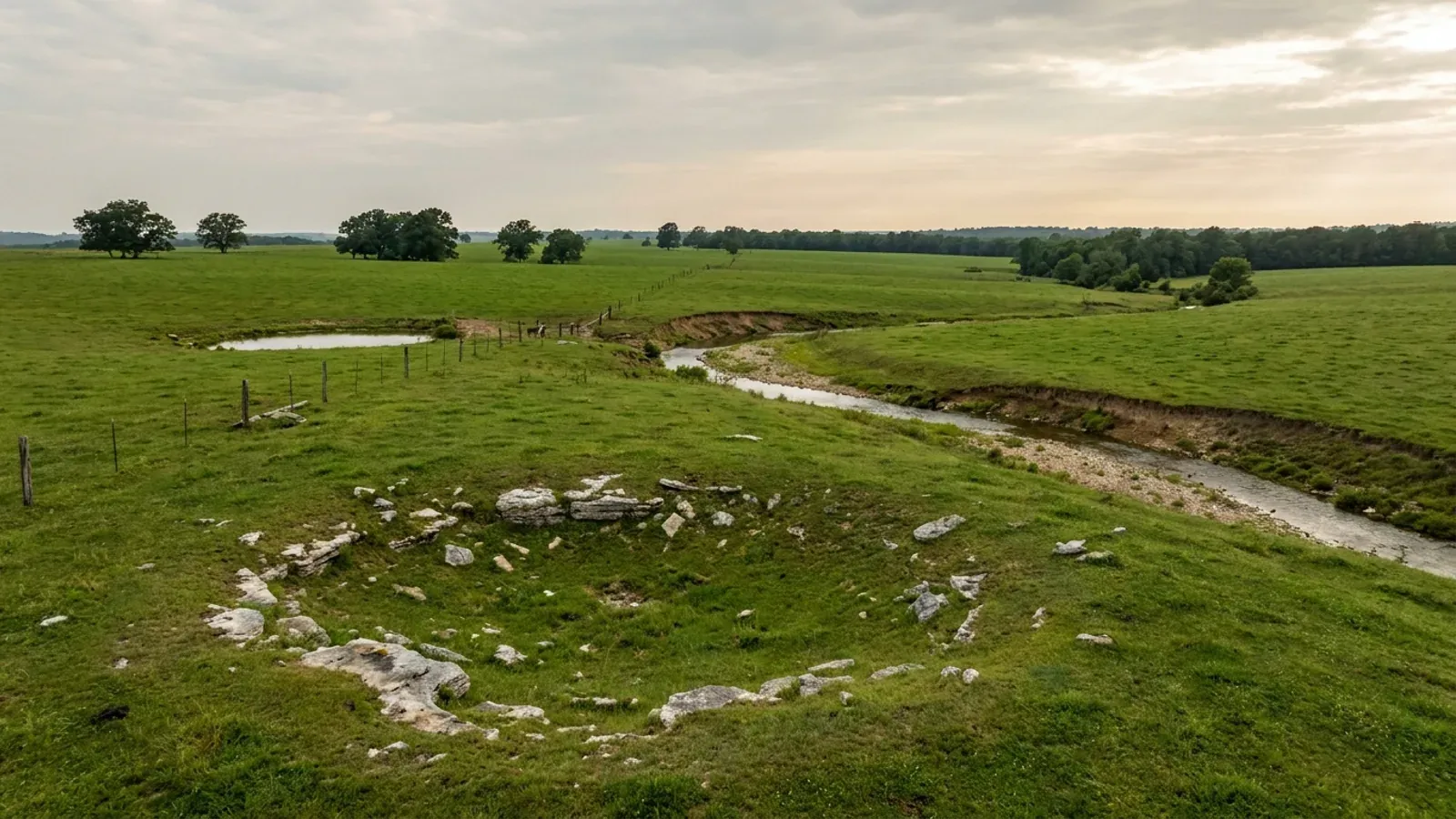
- Both counties sit on the Springfield Plateau, and the reflex is to treat them as one ground condition. The Missouri Department of Natural Resources sinkhole inventory records 91 documented sinkholes inside Polk County against 1,471 inside Greene and 662 inside Christian, out of 16,001 statewide — and Polk is the larger county of the three at 635.5 square miles of land. Depth to rock is moderate rather than shallow: in the Polk County soil survey area, lithic and paralithic bedrock is mapped within 51 centimetres, about twenty inches, on 23,641 component-weighted acres, 5.7 percent of the 411,296-acre survey, rising to 54,628 acres or 13.3 percent within 102 centimetres, about forty inches. The constraint that actually shows up in a footing trench here is different: a fragipan is mapped on 85,021 component-weighted acres, 20.7 percent of the survey, its shallowest occurrence at 46 centimetres, about eighteen inches. The two largest soil components in the county are Viraton at 46,016 acres, which is the fragipan soil, and Goss at 45,654 acres, which is the cherty one. Slopes are gentle by Ozark standards: only 30,718 acres, 7.5 percent, fall in components whose slope class begins at 15 percent.
- The septic permit needs a 911 address, and an elected board issues it
- The Polk County Health Center's covering letter to installers and homeowners states that permits will not be issued without a 911 address, and asks for detailed directions from the office including gates, codes and landmarks. In a county with no building permit, that makes the address the first real gate on a new build. It is not issued by the county commission. Polk County Central Dispatch, founded in 2003 as a joint operation of the City of Bolivar, Citizens Memorial Hospital, the Sheriff's Office, the County Commission and the county Fire and Rescue Training Association, took over addressing and runs an online 911 addressing application; since voters approved a three-eighths-cent sales tax in 2011 under RSMo 190.335 its board has been elected on staggered four-year terms, and it moved into a new centre at 370 N Davis Drive in Bolivar in 2025. Sequence a build here accordingly: address first, then the soil morphology report, then the septic application with the house plans attached, then construction.
- Setbacks the septic permit will hold you to, including the ones for sinkholes
- The county's application packet prints the on-site setback table in full, and these are the distances that decide where a house can actually sit on a Polk County parcel. From a sewage tank: 50 feet to a private water supply well, 300 to a public one, 25 to a cistern, 50 to a spring, 50 to a classified stream or lake, 25 to an open ditch, 10 to a property line, 5 to a building foundation, 15 to a basement and 50 to the edge of a surficial sinkhole. From the disposal area: 100 feet to a private well, 300 to a public one, 100 to a spring, 50 to a classified stream, 10 to a property line with 25 recommended downslope, 15 to a foundation, 25 to a basement, 20 to the top of slope of an embankment or cut of two feet or more, and 100 to the edge of a surficial sinkhole. A lagoon carries 300 feet to a private well and 100 to a property line. The packet adds a plain instruction that sewage tanks and soil absorption systems should never be located in the drainage area of a sinkhole, and its site layout sheet asks you to draw in sinkholes, rock outcrops, springs and test pits. An unplugged abandoned well with less than eighty feet of casing pushes every one of those distances out to 150 feet.
- Three cities, three different answers, and the smallest one has the smallest house
- Bolivar, at 11,549 people in 2024 and growing from 10,804 in 2020, adopts the 2021 IBC, the 2021 IEBC and the 2021 IRC, requires no construction drawings for a residential permit and issues one in 24 to 48 business hours, and requires commercial applicants to submit one wet-sealed and one digital set of construction documents prepared by a State of Missouri registered architect or engineer. Pleasant Hope, at 692, runs a zoning ordinance adopted under RSMo Chapter 89 with a city building inspector who must certify plans before a permit issues and inspect again before a certificate of occupancy; its A-1 district allows a single-family dwelling on three acres and caps building coverage including accessory structures at forty percent. Humansville, at 939, publishes four forms in total — a business licence application, an employment application, a water and sewer application, and a tiny home permit under Ordinance 2026-01 requiring a minimum floor area of 300 square feet, a minimum lot of 50 by 50 feet, a 911 address, and written notice to every adjacent owner within 200 feet before the City Council takes it up. Read the scope on that last one carefully: Pleasant Hope's zoning ordinance mentions 900 square feet of living area, but only inside its definition of a manufactured home, and it is not a minimum dwelling size for a site-built house.
- What the farm data says about the parcels that are actually for sale
- The 2022 Census of Agriculture counts 1,380 farms in Polk County working 340,780 acres at an average of 247 acres. The land splits 151,007 acres of pastureland, 112,379 of cropland, 60,190 of woodland and 17,204 of other uses, and 89 percent of the county's 108.9 million dollars in farm sales is livestock, poultry and their products — 53.8 million from cattle and calves and 33.8 million from poultry and eggs. The size distribution is the part that matters to somebody buying a building site: 353 farms of 10 to 49 acres and 474 of 50 to 179 acres, together 60 percent of the county's farms, against 52 farms of a thousand acres or more. This is not big-spread country; it is small-holding country, which is exactly the five-to-forty-acre tract a house-plus-shop buyer is looking for, and it is why the septic ordinance's refusal of any acreage exclusion bites here rather than being a technicality.
eCode360 full-text search of City of Bolivar, MO (customer BO3244) for R301.2, frost, ground snow and wind speed, run 8 September 2026 with a nonsense-term control returning zero results; City of Bolivar Buildings and Inspections page, bolivar.mo.us, read 8 September 2026 with the full ordinary desktop header set (the host returns a Cloudflare interstitial to a bare user-agent on both real and bogus paths, so it is header-sensitive rather than closed); City of Pleasant Hope Article VIII Planning and Zoning, 78-page PDF from cityofpleasanthope.com, read as text 8 September 2026.
Missouri DNR sinkhole inventory, ArcGIS feature service gis.dnr.mo.gov/host/rest/services/geology/sinkholes/MapServer/1, counted 8 September 2026 by spatial intersection against the Census TIGERweb county polygon for GEOID 29167; the identical method returned 1,471 for Greene (29077) and 662 for Christian (29043), matching the figures already on record, and 16,001 statewide. USDA-NRCS Soil Data Access, survey area MO167 Polk County, Missouri, queried 8 September 2026: acres are component-weighted as map-unit acres times comppct_r divided by 100, de-duplicated by cokey, with corestrictions.resdept_r read in CENTIMETRES and converted as stated (51 cm = 20.1 in, 102 cm = 40.2 in); reskind filtered to Lithic bedrock and Paralithic bedrock together, which at the 51 cm threshold returns exactly the same acreage as Lithic bedrock alone. Total survey area 411,296 acres, matching the sum of component-weighted acres. Control: a bogus areasymbol returns an empty result object.
Polk County Health Center, On-Site Sewage Disposal System Construction Permit Application Packet, installer and homeowner letter dated December 2024, downloaded from polkcountyhealthcenter.org and read as text 8 September 2026; Polk County Missouri 911 About Us and Online 911 Addressing Application pages, polkco911.com, read 8 September 2026 (control: a bogus path on that host returns HTTP 404 titled 404 - Page Not Found).
Polk County Health Center, On-Site Sewage Disposal System Construction Permit Application Packet, On-Site Set Back Distances table and Site Layout sheet, downloaded from polkcountyhealthcenter.org and read as text 8 September 2026; the packet cites 19 CSR 20-3.060(1)(c) minimum construction standards and the Polk County On-Site Sewage Disposal Ordinance alongside the table.
City of Bolivar, MO Code Sections 500.010 and 500.060 and Buildings and Inspections page at bolivar.mo.us, read 8 September 2026; City of Pleasant Hope Article VIII Planning and Zoning, Sections 405.220 and 405.260 and the definition of MANUFACTURED HOME, 78-page PDF from cityofpleasanthope.com read as text 8 September 2026; City of Humansville Printable Applications and Forms page and Application for Placement of a Tiny Home (Tiny Home Ordinance No. 2026-01), humansvillemo.us, read 8 September 2026 (control: a bogus path returns HTTP 404 titled Page not found); populations from the Census Bureau Vintage 2024 subcounty population estimates file sub-est2024.csv.
USDA NASS 2022 Census of Agriculture, Polk County, Missouri county profile (cp29167.pdf), downloaded 8 September 2026 (control: a nonexistent county code on the same path returns a 196-byte HTTP 404); land area and 2024 population from the Census Bureau 2024 national county gazetteer file and the Vintage 2024 county population estimates file co-est2024-alldata.csv.
The expensive surprises are in the ground, not the building
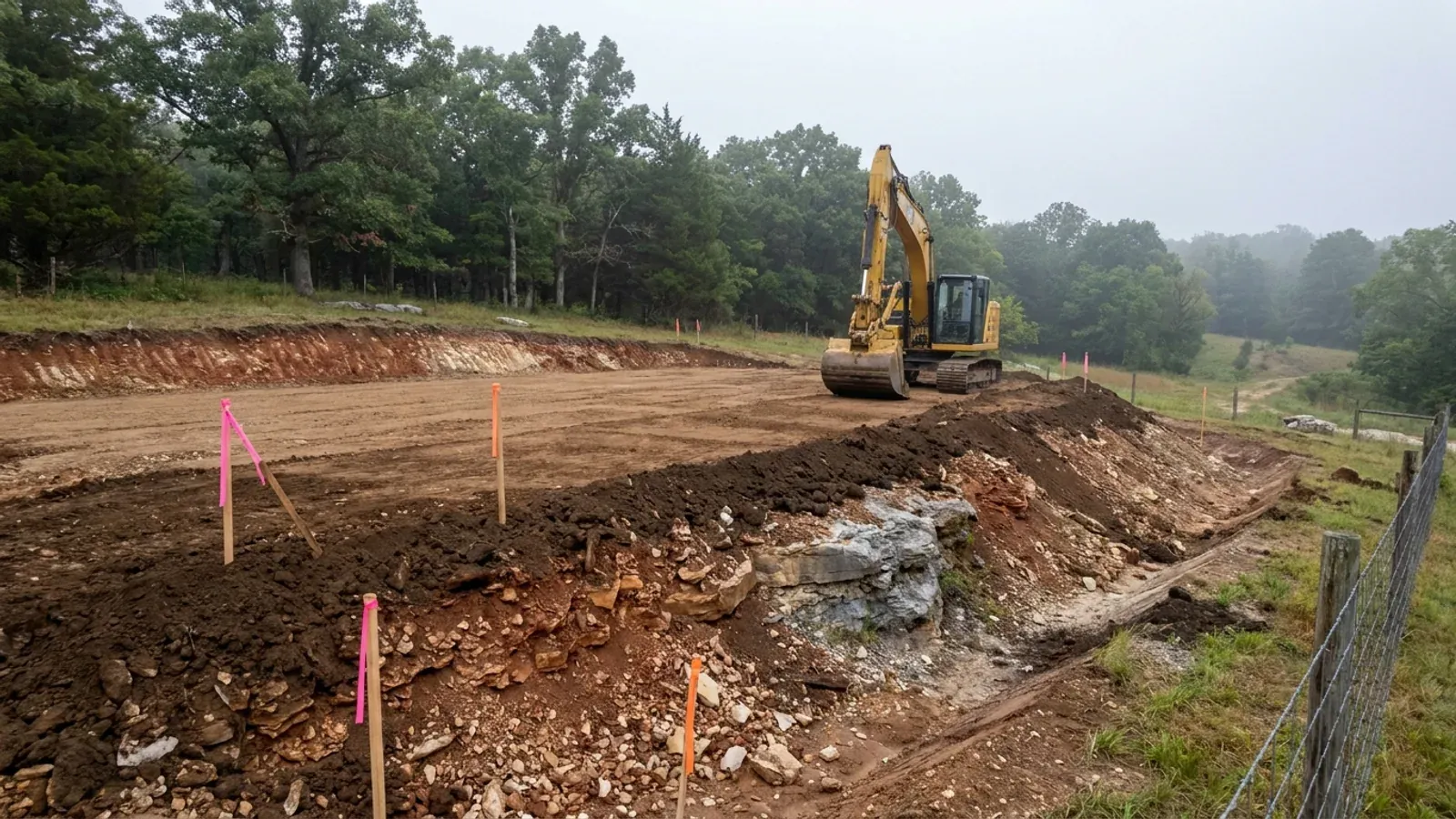
What moves a Missouri budget is usually below grade, and which problem you have depends on where in the state you are. Across the Ozarks it is karst: the Department of Natural Resources maps more than sixteen thousand sinkhole points, and what matters there is what is under the slab rather than what the slab sits in. Across the north and centre it is claypan — dense, slow-draining subsoil that perches water above it for months of the year. In the Bootheel it is deep alluvium carrying the highest seismic demand in the state, where the same soils modelled for liquefaction attack post embedment and slab bearing rather than the frame above them. The same ground then decides the septic system, and Missouri does not run that on a percolation test alone: the rule allows a perc test or a soil morphology examination in a profile pit, and the authority reviewing your parcel picks which. Where a drainfield sits near a sinkhole's drainage, perc testing on its own is not permitted at all. Whether that authority is the state or your own county is itself a local question, and it changes what you have to file. So the site work, the foundation and the drainfield get resolved together rather than one at a time. We price the dirt before we price the building.
What we build in Polk County
All nine services are available in Polk County. What a build costs depends far more on the parcel than on square footage, so we price against your land rather than publishing a rate card.
Custom Plans
Barndominium floor plans drawn to your parcel and your soil, and to whichever Missouri authority — a county, a city, or none at all — will review them.
Barndominium Kits
Barndominium shell packages delivered to your Missouri land, drawn to the criteria your own county or city publishes — because the state publishes none.
Turnkey Builds
Start to finish barndominium construction in Missouri: the permits that genuinely apply, site work, shell and interior finish, under one contract.
What a build looks like
Three stages every Polk County project passes through, from a raw parcel to a finished home. Site work first, because that is where the budget is decided.
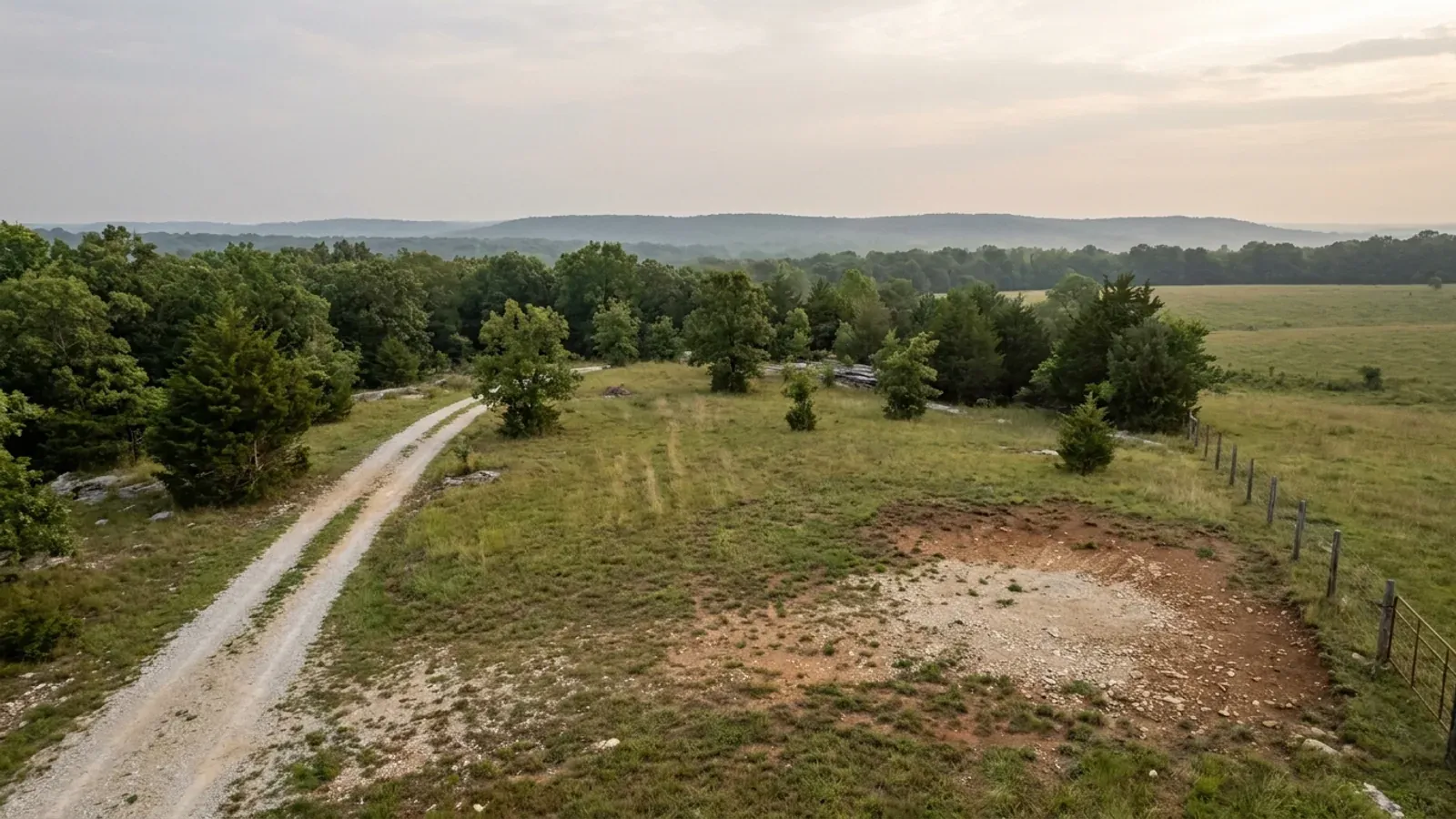
The parcel
Zoning, setbacks, flood zone and utility access get checked before anything is drawn.
Pad and permit
Clearing, grading and a compacted pad, while the submittal works through whichever office issues the permit where you are building.
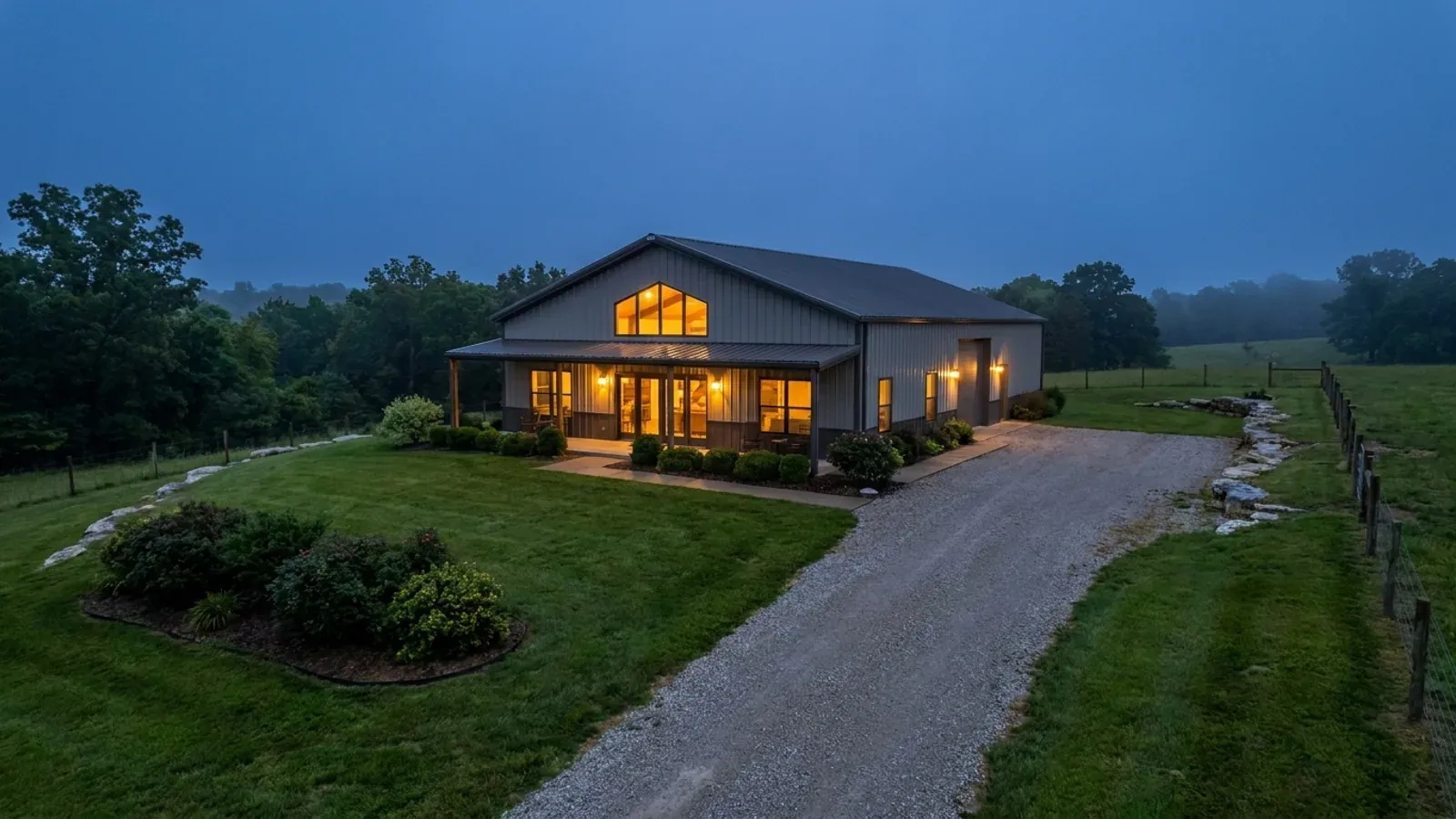
Frame to finish
Shell erected and dried in, then systems, insulation and interior finish through to CO.
Those are the rules where you are building in Polk County. Tell us what you want to build and we will draw it to them.
Where we build around Polk County
Polk County and the rural land around it. The buildable acreage for a project this size usually sits outside the city limits, which is frequently what changes who issues your permit.
Keep reading
The questions that usually come next once you know what Polk County allows.
Barndominium Cost Guide
Sourced per-square-foot ranges by tier and by size, with a calculator built on the same figures.
Read itIs It Legal in Missouri?
Classification, zoning, the HOA gate, and why "nonresidential farm building" does not cover a home.
Read itHow Long Does It Take?
Census build-duration data, and what actually sets the permit clock where you are building.
Read itNearby areas we build in
Others we cover nearby, and they are not interchangeable. One may be a county with an adopted building code, another a county with no legal authority to have one, another a city that permits inside its own limits whichever county the land sits in. So the office that issues the permit, whether anyone inspects the work at all, the fees, the zoning and the design figures can differ from one card to the next — sometimes across a single property line.
Building in Polk County: common questions
8 questions we get asked most often about building in Polk County. If yours is not on the list, ask it directly.
Do I need a building permit to build a barndominium in Polk County?
My tract is over three acres. Doesn't that exempt me from the septic permit?
Can I get a percolation test done for my septic system?
Is there anything in Polk County that stops me putting metal siding or a metal roof on a house?
How big a shop can I build next to the house?
Which fire district covers my land, and can it require a permit?
Can I buy flood insurance on land in unincorporated Polk County?
How is building here different from building in Greene County?
Building in Polk County?
Start with the plan. Tell us what you want to build and we will draw it, then confirm which office issues the permit for your parcel, what it will let you put there, and what wind load it has to meet. That conversation costs nothing.